
To Issue 186
Citation: Speers I, Halvorsen R, Stinebaugh R, “Beyond the Barrel: Prefilled Syringes that Fold in Half”, ONdrugDelivery, Issue 186 (May 2026), pp 70–75.
Ian Speers, Robert Halvorsen and Ryan Stinebaugh of Pacto Medical discuss the unmet needs in prefilled deployability that led to the development of Slimshot™, a detached plunger rod that nests alongside the syringe, and Slimshot™ Doser, a companion concept designed to reduce the mental load of variable dosing in high-pressure delivery situations, and how these concepts can contribute to improved workflows and logistics throughout the healthcare sector.
Prefilled syringes (PFSs) have earned their place in the healthcare sector by decreasing preparation steps, improving the speed and sterility of drug delivery, reducing overfill requirements and supporting more consistent delivery of injectable medicines.1–4 However, as injectable products move into a wider range of care environments, it is no longer enough just to ask whether a product can be delivered safely and accurately – it must also be asked whether a product can be stored, transported, staged and used efficiently and effectively wherever it is needed.
This question becomes especially important in channels where space, cold-chain storage capacity, time and training are constrained. In those settings, packaging volume, kit density, secondary packaging burden and workflow complexity are not ancillary considerations – they directly affect whether enough doses can be stocked, carried and used at the point of need. This is the context in which Slimshot™ and Slimshot™ Doser were developed, not as novelty devices, but as attempts to address real operational constraints that conventional PFS formats often leave unresolved.
DEPLOYABILITY IS BECOMING A DESIGN INPUT
Across healthcare, the “performance” of an injectable product is increasingly shaped by more than just the drug and primary container alone. A therapy can be clinically effective and still be difficult to deploy if it is bulky to store, inefficient to transport, awkward to stage or overly dependent on ideal user conditions and training.
This can be seen most clearly in emergency response, prehospital care, tactical medicine, disaster preparedness and resource-constrained delivery settings, but the same logic applies in well-resourced hospitals and healthcare systems as well. Pharmacy shelves, automated dispensing cabinets, code carts, bedside storage and distribution networks all operate within the constraints of finite space and finite labour. Even in such settings, bulk creates cost, clutter and inefficiency over time.
This is why deployability should be treated as a key design requirement. In practical terms, that means designing a product’s presentation not only for manufacturability and regulatory viability but also for packaging density, cold-chain storage efficiency, last-mile transport, kit organisation and fast, reliable use by real clinicians in real environments.
THE PROBLEM BECAME CLEAR IN THE FIELD
Slimshot™ grew out of first-hand experience managing medical logistics and delivering clinical care in low-resource environments around the world. In managing humanitarian and medical supply chains in disaster, emergency, austere and resource-constrained settings, one problem became impossible to ignore: life-saving medicines are only useful if they are affordable and can actually be moved, stored and distributed to where they are needed.
In many of those constrained settings, the issue was not a lack of clinical demand for PFSs. The issue was that traditional PFS formats were often too bulky relative to the number of doses that teams needed to carry and deliver. When every pouch, drawer, kit and cooler matters, even modest reductions in form factor can change what gets stocked and how much of it can travel to the last mile.
Those same constraints show up in other locations and workflows too. Nurses care about having what they need readily accessible in carts, automated dispensing cabinets and bedside storage. Helicopter and ground emergency teams care about kit density. Pharmacy and warehouse staff care about the cumulative burden of secondary packaging, restocking frequency and shelf space. In each case, the format of the PFS becomes part of the proposed value.
WHEN USERS CREATE WORKAROUNDS, THE DESIGN REQUIREMENT REVEALS ITSELF
One of the clearest signals that a product format is mismatched to its environment is when users start creating workarounds. In emergency and field settings, clinicians have historically detached plunger rods to save space, pre-drawn medications into syringes before each deployment or relied on alternative drug delivery presentations simply because existing options do not meet their needs (Figure 1).
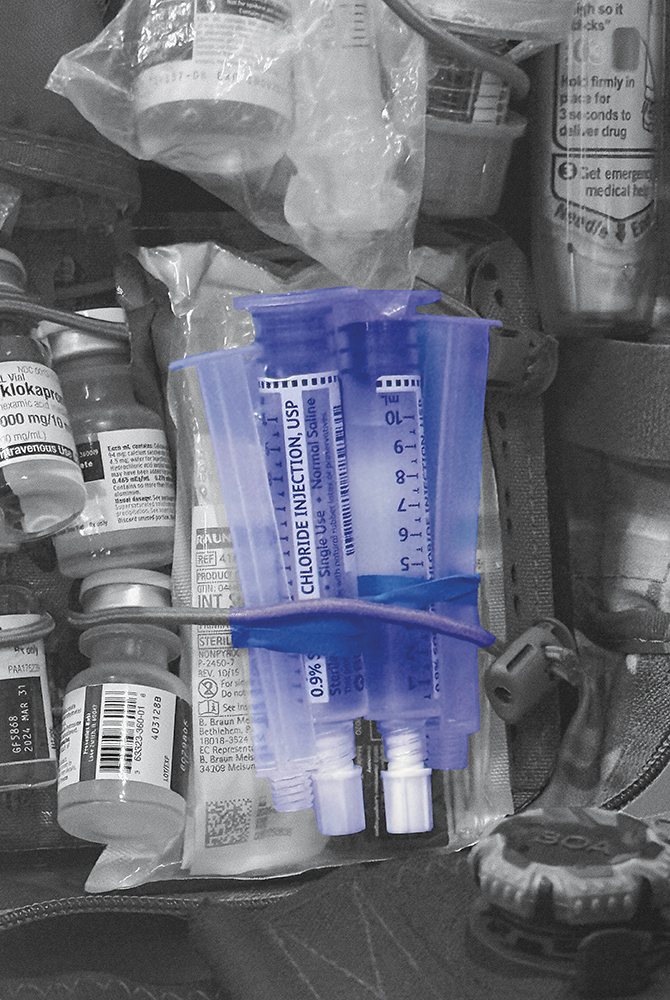
Figure 1: Space constraints lead to dangerous do-it-yourself solutions – many medics remove and/or repackage plunger rods.
Such workarounds solve one problem while creating others. They can add handling steps, increase training burden, introduce more variability and create additional opportunities for error. They also reveal something important: compactness is not cosmetic. It is a functional requirement that users have already been trying to solve for themselves. Therefore, there is an opportunity for product developers to solve that problem deliberately, without giving up the core advantages that made PFSs attractive in the first place.
SLIMSHOT™ – A PLUNGER ROD NESTED NEXT TO THE BARREL
Slimshot™ is designed to reduce syringe bulk without requiring a wholesale change to familiar PFS workflows. The core concept is a compact plunger rod that nests alongside the syringe barrel during storage and transport and is then attached at the point of use (Figure 2). It is designed to work with standard off-the-shelf barrel, plunger and tip components, in sizes ranging from 0.5 to 60 mL, using all types of barrel materials and in alignment with familiar manufacturing and handling patterns, all while materially reducing stored volume.
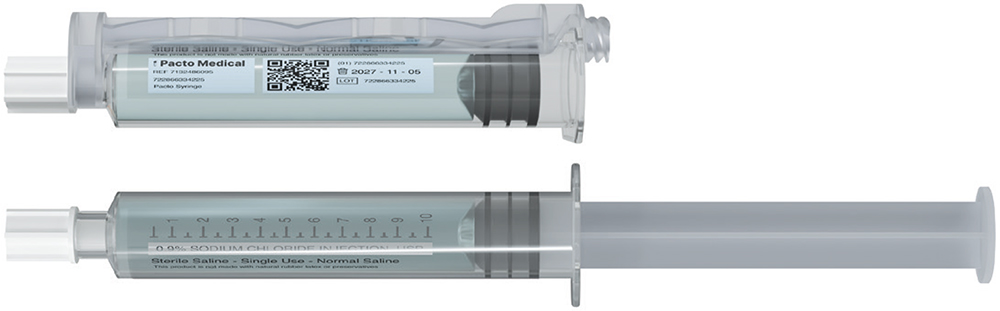
Figure 2: Slimshot™ (top) versus current PFSs (bottom).
The goal of Slimshot™ is not simply to make a syringe look different – it is to improve the economics and practicality of PFSs across the whole value chain, from manufacturing and packaging to transport, storage and use. Slimshot’s design can reduce the packaging footprint by up to roughly 40% compared with a standard PFS. In operational terms, that means:
- Approximately 7,000 more 10 mL PFSs per 48” x 40” x 48” pallet
-
Approximately 35% reduction in supply chain costs
– Includes reduced costs associated with terminal sterilisation, packaging, storage, transport and restocking - Lower storage burden for warehouses and care environments
- More efficient use of cold chain storage
- Denser packing in kits, bags and emergency caches
-
Less packaging material associated with each delivered dose
– For a 10 mL PFS, plastic flow wrap per syringe could be reduced by 0.1 g and cardboard used per syringe could be reduced by 0.5 g - Reduced carbon footprint and emissions per syringe delivered, due to more efficient sterilisation, packaging, transport and storage.
Those are the kinds of gains that matter to pharmaceutical partners, CDMOs and end users alike; gains that compound across the system rather than staying confined to the device itself.
CLINICAL RECEPTION MATTERS AS MUCH AS COMPACTNESS
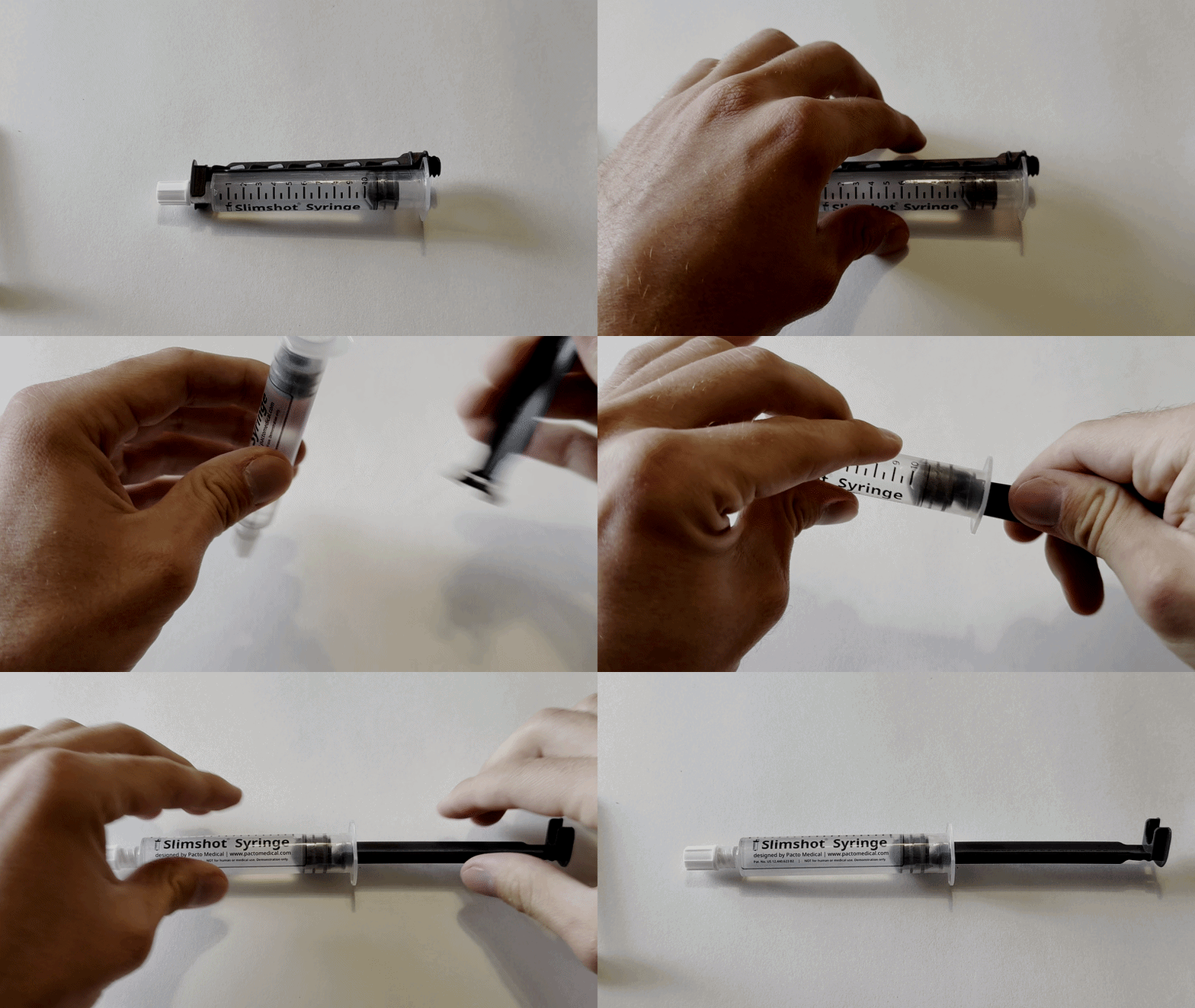
Figure 3: Assembly of Slimshot™ PFS.
Compactness only has value if users can assemble and use the product confidently (Figure 3). Therefore, close attention was paid to early clinician feedback during Slimshot’s development. When tested with 50 nurses from around the world, 100% were able to successfully assemble Slimshot™ in an average of 4 seconds.
When surveyed about how easy it was to assemble Slimshot™, 80% of those nurses answered “Very easy”, 18% answered “Easy” and the remaining 2% answered “Neutral”. When surveyed about how confident they were that they could use Slimshot™ correctly in their day-to-day job, 92% answered “Very confident”, 6% answered “Somewhat confident” and the remaining 2% answered “Neutral”. When tested with a total of 111 nursing professionals, 92% did not need any type of instructions on how to assemble Slimshot™.
PRECISION DOSING IS A DEPLOYABILITY PROBLEM TOO
Compactness is only one part of the real-world challenge. In many care environments, especially paediatric emergency care, the harder problem is not simply getting a medicine to the bedside or point of injury but getting the right amount into the patient quickly and confidently. Weight-based variable dosing is one of the clearest examples. In high-stress and high-consequence scenarios, clinicians often rely on rapid reference tools such as the Broselow tape to convert patient size into a target dose, to then translate that target into a delivered volume under time pressure.
That process can be cognitively demanding even for experienced clinicians, and the consequences of error are amplified in paediatrics, where small volume differences matter more. This can be viewed as another deployability challenge – a product is not fully ready for demanding environments if it still relies on mental maths, fine visual estimation or perfect technique at the moment of dosing.
For example, in one study, during 118 simulated emergency paediatric resuscitations using conventional syringes, 26% (31 doses) of simulated medication administrations were dosed incorrectly. 65% of those incorrect doses were defined as critical dosing errors (doses administered at less than 90% of the minimum correct dose or greater than 110% of the maximum correct dose).5 In another study, 14 (70%) out of 20 drug doses prepared with conventional methods during a simulated paediatric cardiopulmonary resuscitation were incorrect.6
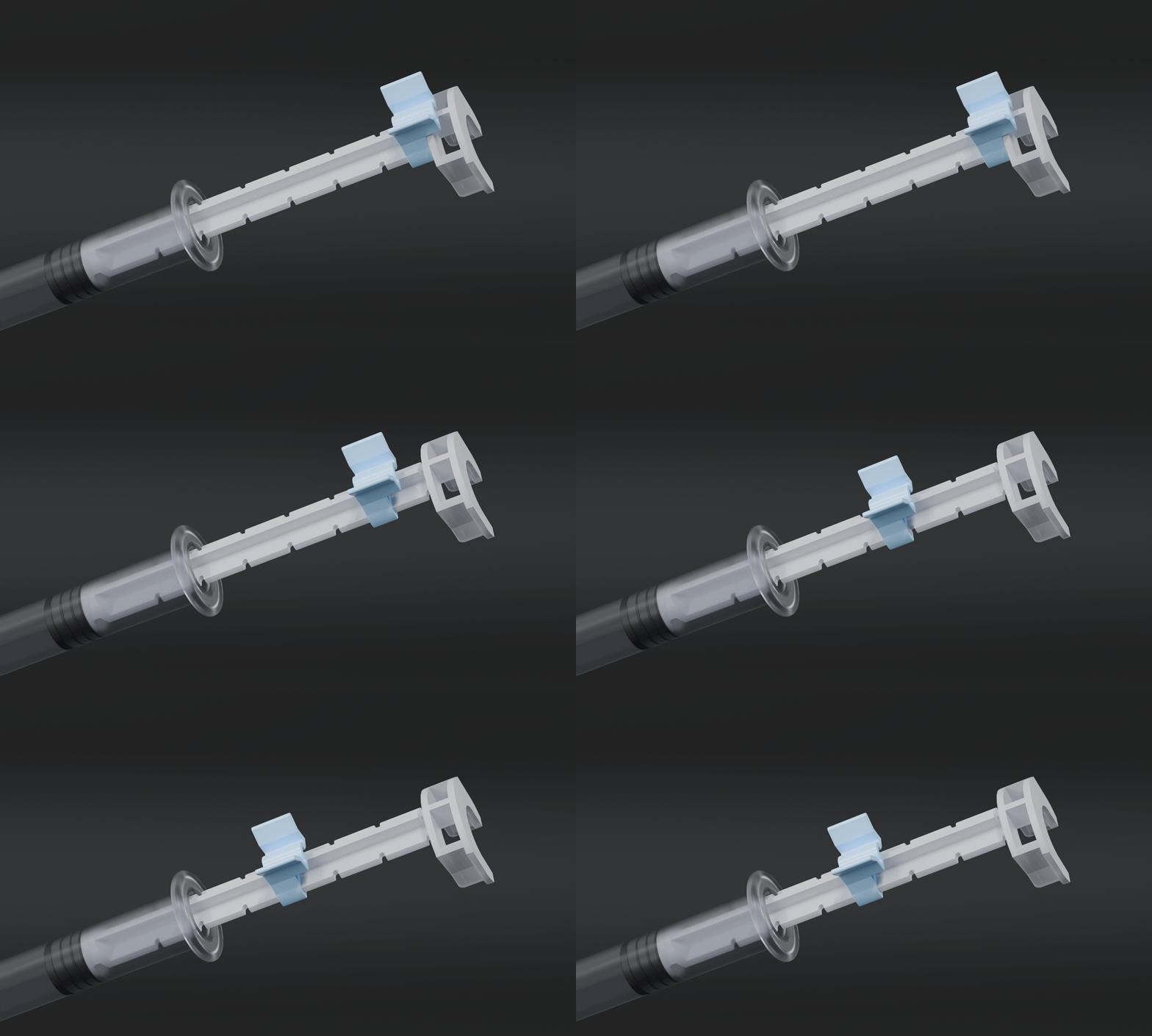
Figure 4: Slimshot™ Doser.
Slimshot™ Doser is a direct response to these problems. The concept uses a plunger rod with defined notches and an adjustable clip that can be set by the user to a specific position prior to administration (Figure 4). Each notch corresponds to a predetermined dose volume or patient-specific dosing variable, allowing the user to align the clip to the intended target and then dispense that amount of medication with a physical stop built into the device via the secured clip. In effect, the plunger rod becomes both the actuation mechanism and the dosing guide. This can be achieved on either a traditional or compact Slimshot™ plunger rod. The aim is to reduce cognitive load, reduce dependence on barrel-mark readings alone and support more repeatable variable or partial-dose delivery in urgent settings where precise dosing matters most.
MANUFACTURING READINESS HAS TO BE BUILT IN EARLY
For any new syringe architecture to matter commercially, it needs a credible path to scale. This fact has shaped the development of Slimshot™ from the outset. Slimshot™ has been designed as a single-piece plunger rod intended to fit within high-volume injection moulding and practical automated assembly pathways. Partner discussions have focused on Design for Manufacture and Assembly work, scalable materials such as polypropylene and assembly concepts that occur after fill-finish to preserve sterility and minimise disruption to existing processes.
This approach matters because the industry does not need elegant prototypes that break at the factory gate. It needs formats that can be tooled, inspected, assembled and packaged in a commercially viable way. Compact syringe innovation only becomes meaningful when it works simultaneously for the end user, the manufacturing line and the supply chain.
“THE INITIAL FOCUS IS ON MEDICATIONS USED IN PREHOSPITAL CARE, FOLLOWED BY COLD CHAIN PRODUCTS, SUCH AS VACCINES, BIOLOGICS AND OTHER INJECTABLE CATEGORIES WHERE LOGISTICAL EFFICIENCY CREATES CLEAR VALUE.”
GO-TO-MARKET: START WHERE BULK HURTS MOST
Pacto Medical’s go-to-market strategy for Slimshot™ is to begin where the burden of bulk is already visible and commercially meaningful. As such, the initial focus is on medications used in prehospital care, followed by cold chain products, such as vaccines, biologics and other injectable categories where logistical efficiency creates clear value.
Prehospital and emergency care drugs are of strong interest because readiness, portability and speed of use are central to the value proposition. Once a compact presentation proves itself in those channels, the broader platform opportunity becomes easier to evaluate. From there, the larger prospect is not confined to one product line – it extends to any injectable presentation where the delivered cost, stocking footprint or deployment model makes conventional bulk an avoidable inefficiency.
PARTNERING OPPORTUNITIES
Pacto Medical believes that compact PFSs will advance fastest with collaboration across the value chain. For pharmaceutical companies, that may start with identifying products whose commercial performance is constrained by packaging density, cold chain storage space or bedside usability. For CDMOs, the focus may be automated assembly, packaging configuration, inspection strategy or manufacturability at scale. For syringe and component partners, it may be compatibility across barrel families, plungers and material systems. In practical terms, the most useful collaborations are likely to include:
- Candidate-product fit assessments
- Design for Manufacture and Assembly development
- Packaging and pallet-density studies
- Channel-specific usability testing.
“FOR MANY PRODUCTS, ESPECIALLY THOSE USED IN EMERGENCY, STOCKPILED OR LOGISTICS-SENSITIVE CHANNELS, THE KEY QUESTION IS NO LONGER ONLY WHETHER A PFS WORKS, BUT WHETHER IT WORKS EFFICIENTLY ENOUGH ACROSS THE FULL JOURNEY FROM FACTORY TO POINT OF CARE.”
CONCLUSION
The next important advances in injectable drug delivery will come about by treating deployability as a core part of product design. For many products, especially those used in emergency, stockpiled or logistics-sensitive channels, the key question is no longer only whether a PFS works, but whether it works efficiently enough across the full journey from factory to point of care.
Slimshot™ and Slimshot™ Doser are Pacto Medical’s efforts to answer that challenge in two connected ways – by reducing the physical burden of PFS delivery and by supporting more reliable administration workflows where precision matters. The company’s broader view is simple: if the industry wants injectable products to reach more settings, serve more users and move more efficiently through the system, then the architecture of the syringe itself has to become part of the conversation.
The technologies discussed in this article are under development and have not been reviewed or approved by the FDA or other regulatory authorities. The inventions disclosed are covered under a variety of patents, including US 12,440,623 B2 and other pending patents in various jurisdictions.
REFERENCES
- Makwana S et al, “Prefilled syringes: An innovation in parenteral packaging”. Int J Pharm Investig, 2011, Vol 1(4), pp 200–206.
- Morsch M, “The Case for Prefilled Syringes”. Outpatient Surgery Magazine, Aug 2025.
- “Helping to reduce risk (and save time) with ready-to-administer syringes”. Healthcare IT News, Mar 2023.
- Ali S, Huang J, “FORMULATION FORUM – Prefilled Syringes: Overcoming the Challenges for Safe & Accurate Delivery of Drugs”. Drug Development & Delivery, May 2024.
- Moreira ME et al, “Color-Coded Prefilled Medication Syringes Decrease Time to Delivery and Dosing Error in Simulated Emergency Department Pediatric Resuscitations”. Ann Emerg Med, 2015, Vol 66(2), pp 97–106.
- Siebert JN et al, “A Mobile Device App to Reduce Time to Drug Delivery and Medication Errors During Simulated Pediatric Cardiopulmonary Resuscitation: A Randomized Controlled Trial”. J Med Internet Res, 2017, Vol 19(2), art e31.