

To Issue 187
Citation: Beauchamp D, Kusnierz J, “Micronisation Success Starts with Solid-State Understanding”, ONdrugDelivery, Issue 187 (Jun 2026), pp 14–18.
Dr Derek Beauchamp and John Kusnierz explain how solid-state characterisation underpins the behaviour of a drug substance under processing conditions, and consider the importance of micronisation in improving bioavailability and drug product performance.
As molecules become more complex and solubility challenges more common, particle engineering, particularly micronisation, has become a core strategy to enhance bioavailability and optimise drug product performance. For BCS Class II compounds, reducing mean particle diameter to the low-micron range increases specific surface area and accelerates dissolution kinetics, consistent with the Noyes–Whitney relationship.1,2 In highly potent API programmes, micronisation also enables precise dosing and content uniformity when API loading is minimal.
“THE MECHANICAL ENERGY INTRODUCED DURING SIZE REDUCTION CAN ALTER THE SOLID-STATE FORM OF THE API BY WAY OF POLYMORPHIC TRANSITIONS, PARTIAL AMORPHISATION AND SURFACE DISORDER.”
However, micronisation is not a neutral unit operation. The mechanical energy introduced during size reduction can alter the solid-state form of the API by way of polymorphic transitions, partial amorphisation and surface disorder.3,4 These changes may not be immediately visible, but they can directly impact stability, dissolution behaviour and downstream manufacturability.
Solid-state characterisation is therefore not a downstream confirmation step. It is the foundation for understanding how a drug substance behaves under processing conditions. When integrated early and applied consistently, it can reduce development risk, support scale-up and aid micronisation in delivering the intended performance without unintended consequences.
WHY MICRONISATION INTRODUCES RISK WITHOUT SOLID-STATE CONTROL
Micronisation is often approached as a mechanical step. In practice, it is a material-sensitive process where particle collisions, shear forces and localised temperature increases can disrupt and change crystal structure. These process-induced effects may include:
- Partial amorphisation not fully captured by bulk measurements
- Polymorphic conversion triggered by stress or humidity exposure
- Surface disorder that alters dissolution kinetics
- Recrystallisation during storage or downstream processing.
Figure 1 shows a goniometer being used for powder X-ray diffraction (PXRD), a high-precision mechanical technique that is used to accurately position and rotate the sample, X-ray source and detector to measure diffraction angles and provide an output used to confirm crystalline form.

Figure 1: Goniometer used in PXRD data collection.
“MECHANICAL ACTIVATION DURING MILLING HAS BEEN SHOWN TO HAVE THE POTENTIAL TO GENERATE DISORDERED REGIONS THAT CAN LATER RECRYSTALLISE, LEADING TO VARIABILITY IN PRODUCT PERFORMANCE.”
Mechanical activation during milling has been shown to have the potential to generate disordered regions that can later recrystallise, leading to variability in product performance.3,4 Without a defined solid-state strategy, these risks often emerge later, during scale-up or stability studies, when mitigation is more complex and costly.
DESIGNING A MICRONISATION STRATEGY
A successful micronisation strategy begins with the material, not the equipment. The key considerations include:
- Crystallinity, polymorphic form and thermal behaviour
- Sensitivity to moisture and mechanical stress
- Likelihood of phase transitions under process conditions
- Impact of downstream unit operations such as blending and tableting.
Materials that appear stable under ambient conditions may respond differently under high-energy milling environments. Solid-state transformations under stress are well established and can directly affect dissolution, stability and manufacturability.4
A risk-based approach requires linking material attributes to process parameters early in development. This includes defining critical quality attributes (CQAs), understanding process sensitivities and building data that translate at scale.
This approach aligns with quality-by-design principles, where material understanding drives process design rather than trial-and-error optimisation.5
MAINTAINING CONTROL OF SOLID-STATE PROPERTIES ACROSS THE PRODUCT LIFECYCLE
Solid-state risk does not disappear after micronisation. It evolves across the entire development lifecycle:
Early Development
Early development defines the foundation for success. The key questions include:
- Which polymorph, hydrate or solvate is most stable under process-relevant conditions?
- How does the material respond to thermal, mechanical and humidity stress?
- What particle size is required to achieve the target dissolution profile?
The selected solid-state form directly influences dissolution rate, stability and manufacturability.6 Decisions made at this stage determine the robustness of the micronisation strategy.
“AS DEVELOPMENT PROGRESSES, CONSISTENCY BECOMES CRITICAL. VARIABILITY IN PARTICLE SIZE OR SOLID-STATE FORM CAN LEAD TO MEASURABLE DIFFERENCES IN DISSOLUTION AND BIOAVAILABILITY.”
Clinical Development
As development progresses, consistency becomes critical. Variability in particle size or solid-state form can lead to measurable differences in dissolution and bioavailability. Solid-state characterisation during clinical development can assist:
- Stability of the selected polymorph during micronisation
- Control of process-induced amorphous content
- Consistent particle size distribution (PSD) across batches and scales
- Reproducible material performance.
These controls are essential to maintain alignment between clinical and commercial material.6
Process Validation
During validation, the focus shifts from understanding to control. Solid-state characterisation can support this by:
- Confirming equivalence between input and micronised material
- Establishing acceptable process ranges
- Linking material attributes to product performance
- Supporting regulatory submissions.
Polymorphic form and solid-state properties are recognised as CQAs due to their direct impact on drug product performance.6
Commercial Supply
Even after process validation, solid-state risks remain. Changes in raw materials, environment or equipment can introduce variability that affects product quality. Ongoing monitoring can ensure:
- Long-term polymorphic stability
- Control of amorphous content
- Consistency in PSD and morphology
- Early detection of process drift.
Maintaining this control is essential for attaining consistent product performance and patient safety.
BUILDING A MULTI-TECHNIQUE ANALYTICAL STRATEGY
No single analytical method can fully characterise solid-state behaviour. A combination of orthogonal techniques is required to build confidence in form and stability. Table 1 provides an overview of key solid-state analytical techniques used to characterise APIs before and after micronisation.
| Analytical Technique | What It Measures | Why It Matters |
| X-ray Diffraction | Crystal structure, polymorph identity, amorphous content |
Verifies solid-state form and crystalline structure of product |
| Differential Scanning Calorimetry | Thermal transitions (melting point, glass transition, recrystallisation) | Detects polymorphic changes and amorphisation introduced during processing |
| Thermogravimetric Analysis | Weight changes from moisture loss, decomposition or solvent evaporation | Assesses thermal stability and drying behaviour |
| Dynamic Vapour Sorption | Moisture or solvent uptake profiles under controlled humidity | Evaluates hygroscopicity and supports formulation and storage strategy |
| Specific Surface Area | Surface area per unit mass | Links surface properties to dissolution, flow and particle interactions |
| Particle Size Distribution | Distribution of particle sizes (e.g. via laser diffraction, dynamic light scattering) | Defines a critical quality attribute impacting dissolution and content uniformity |
| Scanning Electron Microscopy | Particle morphology, surface texture, agglomeration | Correlates physical structure with processing behaviour and performance |
Table 1: Overview of key solid-state analytical techniques used to characterise APIs before and after micronisation.
An example of the dynamic vapour sorption (DVS) sample vessel used to determine mass changes in real time under varying humidity is shown in Figure 2.
Each technique contributes a different perspective. Together, they provide a complete understanding of how the material responds to micronisation and subsequent processing.
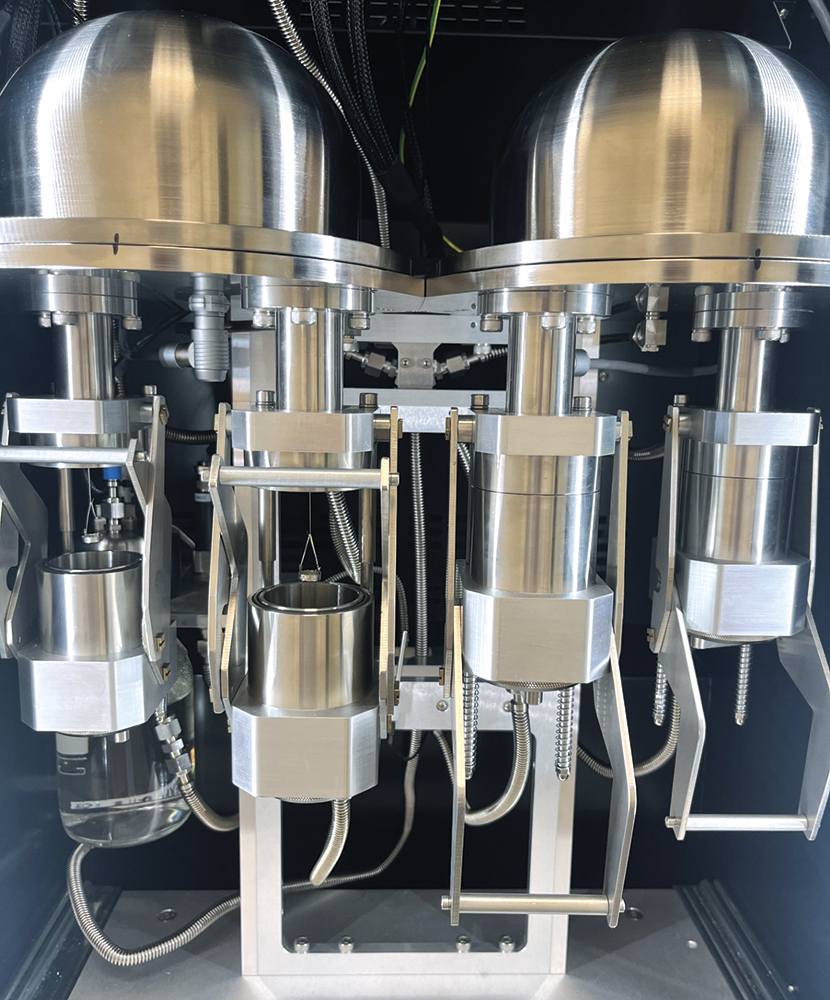
Figure 2: A DVS sample vessel used to determine mass changes in real time under varying humidity levels.
“SOLID-STATE CONSIDERATIONS EXTEND BEYOND THE API TO INTERMEDIATES AND FINISHED DOSAGE FORMS.”
Applying Solid-State Thinking Beyond the API
Solid-state considerations extend beyond the API to intermediates and finished dosage forms.
API Evaluation
- Confirm polymorphic form and crystallinity
- Assess stability and moisture sensitivity
- Define PSD and morphology.
Intermediate Evaluation
- Monitor transformations during processing
- Evaluate API–excipient compatibility
- Detect amorphous content.
Final Product Evaluation
- Confirm API form within the formulation
- Verify stability over shelf life
- Link solid-state properties to dissolution and bioavailability.
This integrated approach ensures continuity in characterisation from raw materials to final product and reduces the risk of late-stage surprises.6
CONCLUSION
Micronisation and particle engineering are powerful tools, but their success depends on more than achieving a target particle size. The underlying solid-state properties of the material ultimately determine stability, performance and manufacturability.
A development strategy that integrates solid-state characterisation before and after micronisation, supported by process understanding and lifecycle control, reduces risk and enables predictable scale-up.
For sponsors, the ability to combine particle engineering expertise with deep solid-state knowledge is critical. It enables informed decision-making, reduces development uncertainty and supports consistent product quality from early development through to commercialisation.
REFERENCES
- Amidon GL et al, “A theoretical basis for a biopharmaceutic drug classification: The correlation of in vitro drug product dissolution and in vivo bioavailability”. Pharm Res, 1995, Vol 12(3), pp 413–420.
- Csicsák D et al, “The Effect of the Particle Size Reduction on the Biorelevant Solubility and Dissolution of Poorly Soluble Drugs with Different Acid-Base Character”. Pharmaceutics, 2023, Vol 15(1), art 278.
- Descamps M, Willart JF, “Perspectives on the amorphisation/milling relationship in pharmaceutical materials”. Adv Drug Deliv Rev, 2016, Vol 100, pp 51–66.
- Willart JF, Descamps M, “Solid state amorphization of pharmaceuticals”. Mol Pharm, 2008, Vol 5(6), pp 905–920.
- Yu LX, “Pharmaceutical quality by design: Product and process development, understanding, and control”. Pharm Res, 2008, Vol 25(4), pp 781–791.
- Giron D, Mutz M, Garnier S, “Solid-state of pharmaceutical compounds”. J Therm Anal Calorim, 2004, Vol 77, pp 709–747.