

To Issue 183
Citation: Cornell L, Potnis M, Krishnendu K, “Empowering Vision for the Future: Advanced Containment Solutions for Ophthalmic Applications”, ONdrugDelivery, Issue 183 (Mar 2026), pp 30–36.
Dr Linara Cornell, Dr Manali Potnis and Dr Krishnendu Khan review the current landscape and challenges associated with delivery systems for ophthalmic applications, and how West Pharmaceutical Services plays a critical role in this specialised industry by providing high-quality prefilled syringe components and systems that meet the stringent requirements for these sight-saving therapies.
Ophthalmic drug delivery has evolved rapidly over the past two decades, driven largely by the success of injectable biologics targeting retinal diseases such as age-related macular degeneration, diabetic retinopathy and diabetic macular oedema. The widespread adoption of intravitreal injections (IVIs) has transformed patient care by stabilising or even improving vision in previously untreatable conditions. Each injection requires precision, sterility and consistency to maintain safety and visual outcomes.
This heightened focus has accelerated the transition from traditional vial-and-syringe preparations to ready-to-administer delivery formats, such as prefilled syringe (PFS) systems, which reduce contamination risks, improve workflow efficiency and ensure consistent dosing accuracy. Consequently, the design of the PFS plays a pivotal role in reducing procedural complexity and clinician workload. Importantly, the use of PFSs has been associated with a lower risk of post-injection endophthalmitis1-3 (a severe infection and inflammation of the inner eye).
Within this context, PFSs have become critical primary container systems for ophthalmic applications, streamlining clinical workflows while enabling reliable, sterile and patient-focused injection experiences.
CURRENT LANDSCAPE FOR OPHTHALMIC SYRINGES
Syringe Formats, Materials and Emerging Trends
“MODERN OPHTHALMIC PFS SYSTEMS HAVE EVOLVED SIGNIFICANTLY TO MEET THE STRINGENT DEMANDS OF INTRAVITREAL AND PERIOCULAR DRUG ADMINISTRATION, PARTICULARLY FOR THERAPIES DELIVERED IN MICROVOLUMES.”
Modern ophthalmic PFS systems have evolved significantly to meet the stringent demands of intravitreal and periocular drug administration, particularly for therapies delivered in microvolumes. A typical PFS assembly comprises several key components, including the barrel, plunger or piston, plunger rod, needle, and tip cap or needle shield. Of these, the barrel and plunger are of paramount importance, as they directly contact the drug product and largely determine the system’s compatibility, stability and performance.
Ophthalmic PFSs are available in both glass and polymer formats, each offering distinct advantages depending on the drug formulation and intended storage conditions. Glass syringes remain the most established material due to their long regulatory history, excellent barrier properties and compatibility with a wide range of biologics. However, glass syringes can also present certain challenges, including potential interactions with silicone oil lubricants,4 residual tungsten generated during the needle manufacturing process and susceptibility to breakage,5 all of which are critical considerations for sensitive ophthalmic therapies administered in microvolumes.6,7 Another significant concern is glass delamination, where thin lamellae or flakes detach from the inner wall following chemical interactions with high pH or ionic formulations.8 Moreover, certain molecules, particularly proteins, can adsorb to the charged surface of glass, which may reduce the drug’s potency.9
In contrast, polymer syringes made up of cyclo-olefin polymer (COP) or cyclo-olefin copolymer materials have gained traction as a modern alternative, offering low extractables and leachables (E&L) profiles, high break resistance and flexible design. Polymer syringes are also free of tungsten and metal ions, reducing compatibility concerns for fragile formulations, particularly protein-based therapeutics. Moreover, polymer syringe systems enable features such as silicone-free or silicone-based lubrication technologies that can further minimise particle generation and protein aggregation.
Beyond material selection, ophthalmic PFS systems can be configured with either Luer lock or staked-needle options, each providing distinct advantages depending on clinical and formulation needs. Staked-needle syringes offer a fully integrated design that simplifies assembly, maintains sterility and ensures accurate, ready-to-use administration – attributes especially valuable for single-use IVIs. Luer lock configurations, however, offer flexibility during development, allowing attachment of different needle types or connectors, which is beneficial for early formulation screening or specialised delivery procedures.
This focus on minimising interactions extends to the plunger system, which plays a critical role in both drug compatibility and device performance. Modern bromobutyl and chlorobutyl plungers are designed to provide enhanced chemical and physical resistance, along with high manufacturing consistency. Each elastomer type exhibits a distinct E&L profile, which might be further influenced by the barrier layer that is sometimes applied to the drug-contact surface. Depending on the design, these barriers may coat only the drug-contact area or cover the entire plunger. Common barrier technologies include film-based laminations and thin, functional coatings applied through spraying, lamination or other deposition methods.
Some specialised barrier layers include silicone, B2, Teflon®, FluroTec™ or OmniFlex®. These surface treatments help to maintain formulation stability, reduce E&Ls and improve the functional reliability of the plunger system. These surface treatments serve several purposes: they reduce E&L levels, maintain formulation stability, improve glide and break-loose forces, and can also enhance container closure integrity (CCI). Achieving optimal performance requires precise matching of material, geometry and surface characteristics. This is especially critical in ophthalmic applications, where microdose accuracy and sensitivity of biologic formulations demand exceptional control over all syringe components.
The plunger rod is considered a secondary packaging component, as it does not directly contact the drug formulation. It is commonly manufactured from polypropylene due to the polymer’s strength, chemical resistance and ease of processing.10
“STABILITY STUDIES ARE CONDUCTED TO CONFIRM THE PURITY AND POTENCY OF THE DRUG UNDER DEFINED STORAGE CONDITIONS, WHILE BIOCOMPATIBILITY TESTING ENSURES THAT MATERIALS IN CONTACT WITH THE DRUG OR PATIENT TISSUES ARE SAFE
AND NON-REACTIVE.”
Regulatory Considerations
The US FDA and the EMA tightly regulate ophthalmic products, including small-molecule drugs, biologics and medical devices used in or around the eye. When an ophthalmic product is packaged in a PFS, additional considerations arise, as this format introduces several potential challenges. These include compatibility between the formulation and syringe components, as well as mechanical performance factors, such as CCI, dose accuracy and ease of use. Stability studies are conducted to confirm the purity and potency of the drug under defined storage conditions, while biocompatibility testing ensures that materials in contact with the drug or patient tissues are safe and non-reactive. Regulations also mandate clear labelling and instructions for handling, preparation and administration to ensure consistent and safe use by healthcare professionals and patients alike. Even after regulatory approval, the FDA requires post-market surveillance, which includes the collection of adverse event data, periodic inspections and continued verification that the product remains compliant with all applicable safety and quality standards.
One potential concern for PFSs in ophthalmic applications is the risk of particulate contamination originating from syringe materials. The regulatory framework for particulates in ophthalmic injectables is defined by the US Pharmacopeia (USP) Chapter <789>, which outlines official methodologies for testing and acceptance criteria for visible and subvisible particulates in injectable ophthalmic products. Testing includes light obscuration particle count and microscopic particle count. This chapter mandates that all ophthalmic products must undergo visual inspection and that injectable solutions must be free of foreign matter.
The European Pharmacopoeia (EP) further distinguishes between extrinsic and intrinsic particles. Extrinsic particles typically originate from the environment, equipment or packaging, while intrinsic particles arise from the formulation or product itself. Although both types must generally be avoided, some particles – such as those intentionally included in cell therapies – may be acceptable if measures are taken to ensure no unintended particles are present. The EP also notes that certain products can be difficult to inspect visually due to properties such as opalescence, colouration, opacity or lyophilisation. In such cases, additional testing is required, including extended inspection times against black and white backgrounds or the use of higher light intensities.
Generally, both the FDA and EMA recommend risk-based control strategies, building quality into processes to prevent particulates from sources such as manufacturing, packaging and the drug itself, especially because ophthalmic particles can cause “floaters” or irritation.
CURRENT TECHNICAL CHALLENGES FOR OPHTHALMIC SYRINGES
Particulates
Particulates are tiny, unwanted, undissolved solid particles found in injectable medicines that can negatively impact patients by causing inflammation, blockages or immune reactions. In ophthalmology, particulates can contaminate eye medications, not only posing a high risk of reduced drug efficacy but also of serious adverse effects, including ocular tissue damage, vision impairment and endophthalmitis. Large particulates may also affect injection smoothness and precision by increasing the required injection force.
The issue of particulates is regulated by USP <789>, which specifies strict limits on the number of particles of different sizes. In ophthalmic formulations, most particulate contamination originates from silicone oils released from syringe barrels. These can promote protein aggregation and the formation of protein-based particles. Additionally, manufacturing debris, such as residual tungsten or glass lamellae, can contribute to particulate contamination.
To reduce the formation of silicone oil-based particles, novel siliconisation techniques have been developed, including baked-on or cross-linked silicone coatings. Glass syringes with baked-on silicone are made by heating the siliconised glass barrel, vapourising the low-molecular weight silicone molecules and further immobilising the coating. Crosslinking allows for a stronger chemical bond between the silicone layer and the barrel, which reduces silicone migration into the solution.11 However, these methods do not completely eliminate the problem. Therefore, silicone-free syringes remain the most effective solution for preventing silicone-related particulates, although they require careful design to ensure consistent injection smoothness.
“ONE OF THE MOST CRITICAL CONSIDERATIONS IN PFS DESIGN IS ENSURING THAT THESE COMPONENTS DO NOT INTRODUCE E&LS DURING CONTACT WITH THE PRODUCT.”
Extractables & Leachables
One of the most critical considerations in PFS design is ensuring that these components do not introduce E&Ls during contact with the product. The presence of foreign chemical contaminants can compromise drug quality and efficacy and, more importantly, pose significant safety risks to patients. Ophthalmic drug products are especially sensitive to even trace levels of leachables. One of the issues is that the drug product comes into direct contact with ocular tissues, without the benefit of the body’s digestive or metabolic defence mechanisms that help process other types of medications. Additionally, ophthalmic drugs are typically administered as low-volume formulations, which can result in higher concentrations of contaminants if leachables are present.
Type I borosilicate glass, the most commonly used material for glass PFS barrels, contains a range of inorganic oxides, such as boron, silicon, calcium, sodium, potassium, iron and aluminium.12 Migration of these elements into the formulation can lead to precipitation with buffering salts, shifts in pH and potential toxic effects due to metal accumulation – especially in patients with impaired renal function. Furthermore, glass PFS systems that incorporate staked needles often require the use of tungsten pins during needle fabrication. Residual tungsten can leach into the product, leading to unwanted protein aggregation, unfolding or denaturation – all of which may reduce the drug’s therapeutic efficacy and trigger undesirable immune responses.13
In contrast, polymer-based PFS systems – such as those constructed using COP – pose a much lower risk of E&L generation, making them particularly well-suited for sensitive biologics and advanced therapies. In a 36-month leachables study involving water for injection stored in COP-based PFS barrels, no observable difference was found in the levels of organic extractables compared with glass barrels. However, the elemental extractable values were significantly lower for COP barrels than for glass, indicating a cleaner material profile and reduced risk of inorganic contamination.14
Silicone and Lubrication Control
Most conventional syringes use silicone oil lubrication to facilitate smooth plunger movement; however, studies have shown that silicone droplets can migrate into the drug formulation. In ophthalmic applications, this phenomenon poses unique risks, as the introduction of silicone oil into the vitreous humour has been associated with adverse effects such as myodesopsia, commonly known as “floaters”. These floating particles, varying in shape and size, can impair visual comfort and, in severe cases, necessitate surgical intervention.15 In addition to ocular concerns, the release of silicone oil during storage and transportation can also promote protein aggregation, potentially increasing the immunogenicity of biologic formulations.16 To mitigate these risks, several silicone oil-free, polymer-based PFS systems have been developed in recent years. These designs employ alternative coatings or advanced surface treatments that deliver consistent, smooth injection performance while eliminating the adverse effects associated with silicone-based lubricants.
Performance Attributes
Additional factors influencing the selection of the most suitable PFS for ophthalmic applications include design and performance characteristics that affect usability – specifically, a clean, simple and secure needle attachment mechanism, as well as low and consistent glide forces to ensure smooth plunger movement. Equally important is the injection activation force (also known as break-loose force), which should be carefully optimised to allow the dose to be administered with minimal effort while preventing premature plunger activation during handling or transport. If the required forces are too high or inconsistent, jerky plunger motion may occur, potentially causing trauma to delicate ocular tissues.
Another critical parameter is the tissue penetration force. For instance, the sclera requires greater force for penetration than the cornea. Needle design and lubrication play significant roles in influencing both the tissue penetration force and the subsequent glide force during injection.17 Injection rate and volume are also key considerations, as both can affect intraocular pressure. Properly managing injection forces helps to control flow rate and dose volume, reducing the risk of a sudden increase in intraocular pressure that could result in transient vision loss.18
Finally, the ergonomic design of the syringe should promote a comfortable, secure grip, enabling the user to easily control injection speed and positioning. The needle should remain safely shielded prior to activation to prevent accidental needlestick injuries, yet remain visible during use to allow healthcare professionals to confirm correct alignment and injection site placement.
Viscosity and Drug Formulation Considerations
Viscosity plays a pivotal role in determining injection forces, flow behaviour and overall delivery consistency in ophthalmic PFS systems. High-viscosity formulations can significantly increase the required injection force, potentially compromising injection smoothness and dosing precision. For intravitreal administration typically involving injection volumes of only 50–100 µL, small variations in force or flow rate can have clinically meaningful implications, such as transient intraocular pressure elevation or patient discomfort. Maintaining predictable flow characteristics is therefore critical for both safety and user experience. Syringe geometry, needle dimensions and plunger design must be optimised to achieve low and consistent glide forces even at elevated viscosities. Similarly, plunger coatings or surface treatments can reduce frictional resistance and maintain smooth movement throughout the injection stroke.
Material choice further influences performance. COP syringes, with their ultra-smooth internal surfaces and dimensional precision, have shown advantages in handling viscous ophthalmic formulations.19,20 Their consistent friction profile supports controlled plunger movement and reproducible dose delivery, which are essential for IVIs given the small therapeutic window.
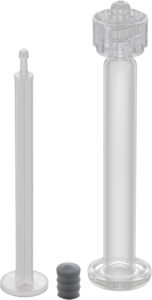
Figure 1: West NovaPure®
0.5 mL plungers.
WEST PHARMACEUTICAL SERVICES’ PRODUCT OFFERINGS
NovaPure® 0.5 mL Plungers
NovaPure® 0.5 mL plungers, developed by West, represent a next-generation elastomeric closure technology designed to ensure exceptional quality, consistency and compatibility for PFS applications, particularly those used for IVI therapies, where precision, purity and consistency are paramount. Manufactured using West’s advanced bromobutyl rubber formulation 4023/50, NovaPure 0.5 mL plungers provide high chemical resistance, low E&L and dimensional uniformity. These properties help to mitigate the risk of interaction between the plunger and highly sensitive biologic formulations, supporting long-term drug stability (Figure 1).
Key Product Attributes
- Optimised Plunger Design: Developed using quality-by-design principles to ensure consistent break-loose and glide force performance in ISO standard barrels for PFS applications.
- FluroTec™ Barrier Film: Minimises interactions between the drug formulation and the elastomeric closure, helping to maintain chemical stability and product integrity throughout shelf life.
- Low Endotoxin: Tightened endotoxin specification to 0.1 endotoxin units/device in alignment with FDA guidance on endotoxin testing recommendations for single-use intraocular ophthalmic devices and EP 5.1.10, ensuring enhanced patient safety of ophthalmic applications.
- Low Particles: Lowest particulate specification, for both visible and subvisible particulate, to enable alignment to USP <789> Particulate Matter in Ophthalmic Solutions.
- MDR Package: Comprehensive documentation, including relevant West technical summaries, quality statements, regulatory bulletins and exclusive supporting materials to facilitate compliance with Annex I of the European Medical Device Regulation (2017/745) filing requirements.
When paired with polymer or glass syringe barrels, NovaPure 0.5 mL plungers form an optimised containment and delivery system that minimises particulate generation and ensures reliable drug delivery performance over the product shelf life for ocular therapies. This, coupled with West’s global supply and regulatory support network, enables pharmaceutical manufacturers to streamline development, reduce regulatory risk and ensure patient safety across the entire drug lifecycle.
Daikyo Crystal Zenith® Polymer Syringe
The Daikyo Crystal Zenith® (CZ) RU Luer lock 0.5 mL syringe is a sterile, ready-to-use PFS solution developed to meet the stringent requirements of modern biopharmaceutical and ophthalmic drug applications. This system offers break-resistant, superior particulate performance compared with conventional glass syringes, significantly improving patient safety (Figure 2).

Figure 2: Daikyo Crystal Zenith® 0.5 mL PFS.
Key Product Attributes
- Advanced Construction: Glass-like transparency with superior break resistance and dimensional accuracy, offering robust strength and safety for delicate ophthalmic procedures.
- Silicone-Free Design: Eliminates the risk of silicone-related particulates and protein aggregation, supporting stability of biologic formulations and improving injection consistency.
- FluroTec Barrier Films: Applied to both plunger and tip cap to reduce E&L, prevent drug-elastomer interaction and maintain long-term formulation integrity.
- Low Particulates And Endotoxins: Complies with USP <789> requirements for ophthalmic solutions, ensuring high optical clarity and patient protection.
- Ready-To-Use Packaging: Supplied sterile and compatible with nested tub configurations, allowing seamless integration into aseptic fill-finish operations.
The Daikyo CZ RU Luer lock syringe design with FluroTec film laminated D21-7HW chlorobutyl plungers provide smooth, controlled and consistent extrusion forces, ensuring predictable injection performance and a positive user experience across a range of delivery conditions. Additionally, the syringe exhibits exceptionally low particulate and endotoxin levels and meets USP <789> compliance for ophthalmic solutions, ensuring clarity, sterility and patient safety.
Overall, the Daikyo CZ RU Luer lock 0.5mL syringe represents a technologically advanced containment and delivery system that combines material innovation, precision engineering and proven performance to meet the evolving needs of complex biologics and ophthalmic formulations.
“STRINGENT GLOBAL REGULATORY FRAMEWORKS AND ENHANCED INSPECTION TECHNOLOGIES ARE DRIVING HIGHER EXPECTATIONS FOR CLEANLINESS, STERILITY AND TRACEABILITY.”
CONCLUSION
Ultra clean, low particulate PFS systems represent a critical convergence of advanced material science, heightened regulatory vigilance and tightly integrated supply chains. Innovations such as polymer-based barrels, low extractable elastomers and silicone-free or controlled lubrication designs can significantly reduce particulate risk and improve compatibility with sensitive biologics. At the same time, stringent global regulatory frameworks and enhanced inspection technologies are driving higher expectations for cleanliness, sterility and traceability. An integrated, end-to-end supply chain linking component manufacturing and distribution has become essential to consistently meet these quality demands while ensuring reliability, scalability and patient safety in modern injectable drug delivery.
West is in a unique position not only to provide PFS components, such as high-quality elastomeric plungers for PFS solutions, but also to offer a full polymeric PFS solution, such as the Daikyo CZ RU Luer lock 0.5 mL syringe. Furthermore, West’s expertise extends beyond component supply to include analytical testing and technical support to help customers optimise system performance, mitigate risk and accelerate time to market. Through its global manufacturing footprint and robust quality systems, West ensures consistent product integrity and regulatory compliance, empowering pharmaceutical partners to confidently deliver safe and effective ocular and other treatments to patients worldwide.
West, NovaPure and FluroTec are trademarks or registered trademarks of West Pharmaceutical Services, Inc. in the US and other jurisdictions.
Crystal Zenith is a registered trademark of Daikyo Seiko, Ltd.
All other trademarks are the property of their respective owners.
Crystal Zenith, FluroTec and B2 coating technologies are licensed from Daikyo Seiko.
REFERENCES
- Zhang C et al, “Rates of Endophthalmitis in Prefilled versus Nonprefilled Syringes for Intravitreal Injections: A Systematic Review and Meta-Analysis”. Ophthalmol Retina, 2026, Vol 10(2), pp 165–175.
- Uzzan J et al, “Clinical Outcomes and Experiences with Prefilled Syringes Versus Vials for Intravitreal Administration of Anti-VEGF Treatments: A Systematic Review”. Ophthalmol Ther, 2024, Vol 13(9), pp 2445–2465.
- Louis AM et al, “Impact of Prefilled Syringes and Masking on Postintravitreal Injection Endophthalmitis”. J Vitreoretin Dis, 2023, Vol 7(5), pp 382–388.
- Dessouki A et al, “Presumed Silicone Oil Droplets After Intravitreal Pegcetacoplan Injections”. JAMA Ophthalmol, 2023, Vol 141(11), pp 1062–1065.
- Du CY et al, “Tungsten residues in prefilled syringes promote monoclonal antibody aggregation and charge heterogeneity”. Eur J Pharm Biopharm, 2025, Vol 217, art 114900.
- Zhao Y et al, “Efficacy and safety of berberine for dyslipidemia: study protocol for a randomized double-blind placebo-controlled trial”. Trials, 2021, art 85.
- Sassalos TM et al, “Prefilled syringes for intravitreal drug delivery”. Clin Ophthalmol, 2019, Vol 13, pp 701–706.
- Zhao J et al, “Glass delamination: a comparison of the inner surface performance of vials and pre-filled syringes”. AAPS PharmSciTech, 2014, Vol 15(6), pp 1398–1409.
- Vilivalam L, Vilivalam V, “A comparison of protein stability in prefillable syringes made of glass and plastic”. PDA J Pharm Sci Technol, 2017, Vol 71(6), pp 462–477.
- Sacha G, Rogers A, Miller R, “Pre-filled syringes: a review of the history, manufacturing and challenges”. Pharm Dev Technol, 2015, Vol 20(1), pp 1–11.
- Jayanth P et al, “Syringe Coating Technologies: Old, New, and Developing”. Retina Today, Mar 2022.
- Samuel Y et al, “Extractable and Leachable Implications on Biological Products in Prefilled Syringes”. Am Pharm Rev, Jan 2011.
- Li J et al, “Mechanistic understanding of protein-silicone oil interactions”. Pharm Res, 2012, Vol 29(6), pp 1689–1697.
- Kiminami H et al, “Low Leachable Container System Consisting of a Polymer-Based Syringe with Chlorinated Isoprene Isobutene Rubber Plunger Stopper”. PDA J Pharm Sci Technol, 2015, Vol 69(6), pp 713–724.
- Melo G, “Potential Implications of Silicone Oil From Syringes”. Retinal Physician, 2022, Vol 19, pp 40–42.
- Krayukhina E et al, “An Assessment of the Ability of Submicron- and Micron-Size Silicone Oil Droplets in Dropped Prefillable Syringes to Invoke Early- and Late-Stage Immune Responses”. J Pharm Sci, 2019, Vol 108(7), pp 2278–2287.
- Matthews A et al, “Indentation and needle insertion properties of the human eye”. Eye (Lond), 2014, Vol 28(7), pp 880–887.
- Lee DJ et al, “Transient Vision Loss Associated with Prefilled Aflibercept Syringes”. Ophthalmol Sci, 2022, Vol 2(2), art 100115.
- Maruno T et al, “Sweeping of Adsorbed Therapeutic Protein on Prefillable Syringes Promotes Micron Aggregate Generation”. J Pharm Sci, 2018, Vol 107(6), pp 1521–1529.
- Fang L, Rase M, “Excipient and Packaging Material Impact on Glass and Polymer-Based Prefilled Syringe Functionality”. PDA J Pharm Sci Technol, 2024, Vol 78(1), pp 70–89.