
To Issue 192
Citation: Bromley-Davenport D, “Manufacturers’ Role in Delivering Essential Respiratory Healthcare During the Transition to Low-GWP pMDIs”, ONdrugDelivery, Issue 192 (Oct/Nov 2026), pp 30–32.
Darren Bromley-Davenport of Orbia Fluor & Energy Materials discusses the transition from current hydrofluoroalkane propellants to lower global warming potential alternatives for use in metered dose inhalers, highlighting the services that the company can offer the industry via its GMP facilities and wealth of experience to ensure that the transition is as smooth as possible.
As environmental fluorinated gas (F-gas) regulations increasingly target the climate impact of medical propellants, manufacturers of pressurised metered dose inhalers (pMDIs) must transition towards lower-global-warming-potential (GWP) alternatives. However, replacing the propellant is only one part of the challenge; manufacturers must now simultaneously manage reformulation, device compatibility, regulatory compliance and manufacturing readiness while ensuring that patients continue to have reliable access to essential respiratory medicines.
“AS THE INDUSTRY TRANSITIONS TO LOWER-GWP TECHNOLOGIES, MAINTAINING CLINICAL PERFORMANCE, PRODUCT AVAILABILITY AND SUPPLY CONTINUITY IS ESSENTIAL.”
THE INDUSTRY’S CURRENT POSITION
With an estimated 43 billion pMDI doses delivered annually worldwide, and demand continuing to increase, the dosage form remains a critical treatment option for many patients.1 The propellant-driven delivery mechanism enables consistent drug delivery independent of inspiratory effort, making pMDIs an important option across respiratory care. Therefore, as the industry transitions to lower-GWP technologies, maintaining clinical performance, product availability and supply continuity is essential.
One of the leading low-GWP propellant candidates is HFA-152a (Zephex® 152a), developed by Orbia Fluor & Energy Materials, which offers an approximately 90% reduction in carbon footprint compared with current propellants. Industry leaders, such as Chiesi (Parma, Italy), have already secured MHRA approval for an HFA-152a-containing pMDI, while other manufacturers await regulatory decisions following their own submissions.2 These developments reinforce that the transition has already begun.
LESSONS LEARNED FROM THE PREVIOUS PROPELLANT TRANSITION
The previous transition from chlorofluorocarbon propellants to hydrofluoroalkanes (HFAs) in the 1990s demonstrated the complexity of changing propellant systems. What was initially expected to be a relatively straightforward substitution ultimately required substantial redevelopment work because of differences in the physical and chemical properties of the new propellants. In some cases, these challenges contributed to development delays and supply pressures.
Manufacturers face similar considerations today. Transitioning to HFA-152a requires a detailed understanding of interactions between the propellant, API, excipients, device componentry and materials, including valves, elastomers and canisters. Reformulated products must continue to deliver consistent performance throughout their entire lifecycle while meeting regulatory expectations for quality, safety and efficacy. Achieving this requires comprehensive development programmes capable of validating inhaler performance under real-world conditions.
THE IMPORTANCE OF EARLY DEVELOPMENT WORK
Technical readiness will be critical to the smooth introduction of low-GWP pMDIs. Compatibility assessments, formulation optimisation, performance testing and long-term stability studies can help identify potential challenges early in development. Evaluating parameters such as delivered dose uniformity, aerodynamic particle size distribution, shot weight and leak rate can provide confidence that reformulated products will continue to perform as intended (Figure 1).
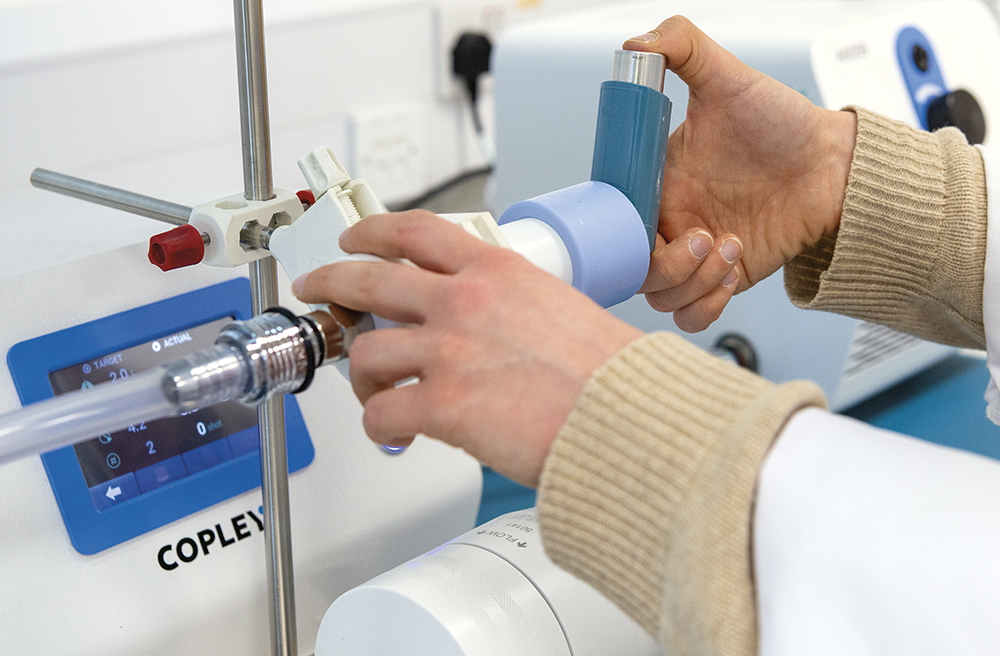
Figure 1: A dose-uniformity sampling apparatus for collecting delivered doses for delivered dose-uniformity testing.
“ACCESS TO DEVELOPMENT EXPERTISE, ANALYTICAL CAPABILITY AND SPECIALIST TESTING INFRASTRUCTURE WILL BECOME INCREASINGLY IMPORTANT.”
For manufacturers, identifying potential issues early is significantly less disruptive than addressing them during scale-up, clinical development or regulatory review. As increasing numbers of manufacturers pursue low-GWP reformulation programmes, access to development expertise, analytical capability and specialist testing infrastructure will become increasingly important.
To support developers through this process, Orbia Fluor & Energy Materials has invested in capabilities spanning compatibility testing, formulation development, performance evaluation and GMP clinical manufacturing. These capabilities exist to help organisations navigate the transition to low-GWP propellants, from early research through to clinical supply and commercial readiness, calling upon over three decades of expertise.
MANUFACTURING AND REGULATORY READINESS
Alongside formulation development, manufacturers must prepare for evolving manufacturing and regulatory requirements. Specialist infrastructure is often required to support the development and handling of low-GWP propellants, including ATEX-rated facilities designed for flammable formulations, analytical capabilities for pMDI characterisation, and expertise in analytical chemistry and materials science.
Access to GMP manufacturing capacity is equally important for generating the data required to support development programmes and regulatory submissions. Since obtaining its Investigational Medicinal Products licence in 2023, Orbia Fluor & Energy Materials has produced GMP batches from its production facility, providing pharmaceutical companies with access to MHRA-approved clinical manufacturing capabilities that would otherwise require significant investment.
At the same time, regulatory compliance is becoming increasingly complex. Since January 2025, the EU hydrofluorocarbon (HFC) quota system has applied to HFC compounds manufactured or imported for use in pMDIs, as well as imported finished products. Manufacturers therefore need to navigate not only technical development challenges but also F-gas quota administration, compliance requirements and associated authorisation processes. Cross-industry collaboration with experienced partners that offer support in these areas is now a critical element of any successful propellant transition strategy, particularly for organisations operating globally.
LOOKING AHEAD
With the 2030 F-gas milestone approaching, there is increased pressure on manufacturers to reformulate, validate and commercialise lower-GWP inhalers while maintaining uninterrupted access to essential respiratory therapies worldwide. Organisations that establish robust development strategies early, supported by the necessary technical, manufacturing and regulatory expertise, are likely to be better positioned to manage risk and maintain development timelines.
To support this transition, Orbia Fluor & Energy Materials delivers a holistic approach to propellant compatibility testing for production-area modifications within a single development pathway, incorporating APIs, componentry and compliance.
“ULTIMATELY, THE INDUSTRY’S CHALLENGE IS ENSURING THAT REFORMULATED PRODUCTS CAN BE DEVELOPED, VALIDATED AND COMMERCIALISED AT SUFFICIENT PACE TO MAINTAIN PATIENT ACCESS TO ESSENTIAL RESPIRATORY THERAPIES.”
Ultimately, the industry’s challenge is ensuring that reformulated products can be developed, validated and commercialised at sufficient pace to maintain patient access to essential respiratory therapies. The manufacturers that successfully combine technical readiness, regulatory planning and manufacturing capability will be best positioned to deliver a smooth transition while supporting the long-term sustainability of respiratory care.
REFERENCES
- “Montreal Protocol on Substances that Deplete the Ozone Layer: Report of the Technology and Economic Assessment Panel”. Report, UN Environment Programme, May 2026.
- “Chiesi Marks Significant Step in its Net Zero Journey with MHRA Approval of its First Pressurised Metered-Dose Inhalers Containing a Next-Generation, Low GWP Propellant”. Press Release, Chiesi, Jul 2026.