
To Issue 193
Citation: Mulpas J, Ganley W, “Achieving Clinical Readiness for Inhaled Drug Products”, ONdrugDelivery, Issue 193 (Nov 2026), pp 20–27.
Jonathan Mulpas and Dr William Ganley present an integrated framework for preparing inhaled drug products for clinical evaluation. They focus on the decisions that should be addressed prior to clinical studies, the avoidable detours that can delay development and the role of formulation science, device optimisation and predictive testing in building confidence in inhaled products before they enter the clinic.
Developing an inhaled drug product for clinical evaluation requires more than a promising formulation, a capable device or a promising set of performance data. While the objective may appear straightforward, advancing a therapy from concept to clinical studies is a path shaped by multiple interdependent decisions. Clinical readiness emerges when formulation, device, patient-use, analytical and regulatory considerations are aligned around a clear product objective – it is rarely a linear process.
This complexity is increasing as inhaled therapies move beyond established respiratory small-molecule treatments towards more sophisticated formulations, biologics, advanced drug classes and increasingly demanding product profiles. Simultaneously, developers are expected to make early decisions with limited material, evolving clinical assumptions and compressed development timelines.
Promising laboratory results can create a false sense of security during inhalation development. A formulation may be stable, a device may deliver the required dose and early aerosol data may appear encouraging, yet significant development risks can remain.
In many cases, the challenge is not whether the individual components work, but whether they work together under conditions that reflect the intended patient population, clinical use scenario and regulatory pathway. Clinical readiness begins to emerge only when formulation, device and evidence-generation strategies are aligned around a common product objective (Box 1).
BOX 1: Common Development Detours That Delay Clinical Entry
Detour One: Optimising the formulation before defining the TPP. A formulation can appear technically promising but still fails to support the intended patient, dose or deposition objective.
Detour Two: Selecting the device too late. Late device selection can reveal compatibility, performance or usability issues that require reformulation, device modification or additional testing.
Detour Three: Treating patient use as a late-stage question. Inspiratory capability, inhalation profile, co-ordination, training needs and use environment can all influence whether the product performs as intended.
Detour Four: Generating data without a clear decision objective. More data does not necessarily reduce risk. Evidence is most valuable when it informs a defined development decision.
Detour Five: Treating development functions independently. Formulation, device, patient-use, testing and regulatory activities need early alignment to avoid late-stage gaps or conflicting assumptions.
Key Message: The greatest development risks often emerge at the interfaces between disciplines.
DEFINING SUCCESS BEFORE DEVELOPMENT BEGINS
Before developers decide how a product should be formulated or delivered, they need to define what success actually looks like. Who will use the product? What dose must reach the target site? Under what conditions will administration take place? What level of variability can the programme realistically accommodate? The target product profile (TPP) brings these questions together, translating a clinical ambition into practical development requirements and providing a common point of reference for formulation, device and evidence-generation activities.
For inhaled therapies, the TPP should clarify the intended patient population, route of administration, dosing objectives, target deposition region, administration context and usability expectations. It should also identify the product performance attributes that matter most for the intended clinical outcome, such as aerosol characteristics, inhalation-flow dependency, device handling and the evidence needed to support progression.
Many development programmes begin with technical feasibility questions. Can the molecule be formulated? Can the formulation be aerosolised? Can the device deliver the intended dose? Can the product meet early analytical expectations? While these questions are necessary, they should be guided by a broader understanding of what the final product must achieve.
Without that framework, teams may optimise attributes that are scientifically interesting but not decisive for clinical success. A formulation can perform well under controlled conditions during bench tests yet fail to support the intended use case if it is incompatible with the device, patient population or deposition objective. Likewise, a technically capable device may be unsuitable if it imposes handling or inhalation requirements that do not match the treatment setting or needs of an intended patient group.
A well-defined TPP can help teams to avoid these disconnects and prioritise development activities. Not every parameter can be optimised at once and not every uncertainty carries the same level of risk. The TPP helps to determine which questions need to be answered first. It should also evolve as formulation, device, analytical and predictive insights become available, rather than being fixed in isolation and handed off to technical teams.
Often, clinical readiness is improved not by making better decisions later, but by asking better questions earlier. A strong TPP focuses development on the attributes that are most likely to have an impact on clinical performance, patient use and regulatory expectations. As illustrated in Figure 1, formulation development, device optimisation and evidence generation need to align around a shared TPP and the needs of the intended patient population.
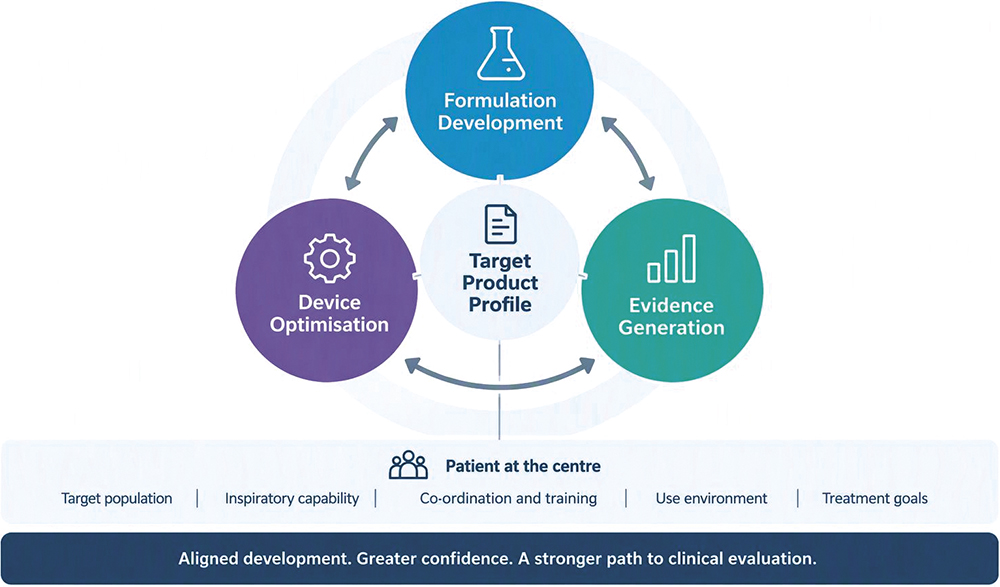
Figure 1: Clinical readiness emerges from the alignment of formulation development, device optimisation and evidence generation around a clearly defined TPP and the needs of the intended patient population.
FORMULATION DEVELOPMENT AS THE FOUNDATION OF CLINICAL READINESS
A formulation can meet every laboratory target and still be wrong for the product. Stability, manufacturability and aerosol performance are all essential, but they do not guarantee successful delivery in the intended clinical setting. For inhaled products, relatively small changes in concentration, particle properties, viscosity or excipients can alter aerosol generation, emitted dose and deposition behaviour. Formulation development therefore needs to optimise more than the formulation itself. It must optimise how the formulation performs within the complete delivery system.
Formulation-related considerations may include solubility, excipient compatibility, rheological properties, concentration, powder characteristics, stability, material compatibility, aerodynamic particle size, delivered dose uniformity and interactions with the respiratory or nasal environment. These parameters cannot be considered separately from the wider product strategy.
In early development, formulation work often focuses on establishing feasibility. However, feasibility alone is not the endpoint; a formulation that performs well in isolation may not be optimal as part of the final drug-device combination.
For example, a formulation intended for nebulisation may need to balance drug concentration, viscosity, aerosol output, administration time and patient acceptability. A dry powder formulation may require careful attention to particle engineering, flow properties, moisture sensitivity and device resistance. A nasal or pulmonary liquid may need to account for spray pattern, droplet size and interactions with mucosal surfaces.
The risk in many programmes is that formulation and device work proceed as separate streams – the formulation team may focus on stability and laboratory performance while device selection is deferred. Difficulties can then emerge if the formulation proves incompatible with the delivery mechanics, dose requirements or patient-use assumptions of the chosen device.
A more effective approach is to view the formulation as part of an integrated product system from the beginning. This does not mean that every variable must be fixed early, rather, it means that formulation decisions should be made with an understanding of how they may influence device selection, analytical testing, manufacturability and clinical performance expectations.
A technically successful formulation is not automatically a clinically successful formulation. To achieve clinical readiness, it must support the intended clinical objective, perform within the delivery system and remain compatible with future development and manufacturing requirements.
“FOR INHALED DRUG PRODUCTS, THE DELIVERY DEVICE IS NOT A PASSIVE CONTAINER – IT IS AN ACTIVE CONTRIBUTOR TO PRODUCT PERFORMANCE AND PATIENT EXPERIENCE.”
DEVICE SELECTION SHOULD NOT BE AN AFTERTHOUGHT
For inhaled drug products, the delivery device is not a passive container – it is an active contributor to product performance and patient experience. Device characteristics can influence delivered dose, aerosol generation, inhalation-flow requirements, administration time, dose reproducibility, patient feedback and usability.
Despite this, device selection is sometimes treated as a downstream activity that follows formulation development. If the device does not align with the formulation, target dose, patient population or deposition objective, the development programme may require late reformulation, device modification or additional testing cycles.
Device strategy should therefore begin early, even if the final configuration is not yet fixed. Early consideration of the device helps to define the feasible design space for the formulation and exposes performance trade-offs that may shape the product concept. These can include dose delivery versus administration time, aerosol output versus deposition control and device functionality versus ease of use.
The device is also the interface between the product and the patient. Technical performance alone is not sufficient. Patient inspiratory capacity, co-ordination, disease severity, training requirements, treatment settings and the circumstances in which the product will be used can all influence which delivery approach is most appropriate. Studies evaluating realistic inhalation profiles have shown that inhalation behaviour can vary considerably across users and can be influenced by factors such as device resistance and training, highlighting the importance of considering patient-use conditions during development and performance testing.1
Increasingly, developers are moving beyond standardised breathing patterns and incorporating patient-relevant inhalation profiles into both experimental and modelling activities. Realistic breathing profiles can be generated from measured user data and may differ substantially from simplified sinusoidal or fixed flow rate testing conditions. Parameters such as peak inspiratory flow, time to peak, inhaled volume, inhalation duration and the effects of user training can all influence aerosol delivery and regional deposition. In practice, these profiles allow developers to characterise how patients actually inhale, rather than how they are expected to inhale, improving the relevance of both in vitro and in silico assessments while also helping to identify potential performance risks earlier.1,2
Human factors considerations can also be incorporated much earlier in development than has traditionally been the case.3 Rather than evaluating patient behaviour only during later-stage usability studies, developers can investigate variables such as inspiratory-flow capability, inhalation duration, co-ordination requirements and the impact of training or feedback mechanisms on administration technique. Where guidance or feedback technologies are incorporated, breathing-profile data can help to determine whether users are able to achieve and maintain the intended inhalation pattern and whether variability is reduced relative to unguided use. These assessments provide an additional layer of evidence linking product design, patient behaviour and expected delivery performance. Their greatest value emerges when they are considered alongside formulation, device and predictive development activities rather than as separate workstreams.2
“AS INHALED PRODUCTS BECOME MORE SOPHISTICATED, DEVELOPMENT DECISIONS INCREASINGLY BENEFIT FROM THE INTEGRATION OF DEVICE EXPERTISE, FORMULATION SCIENCE AND PREDICTIVE ASSESSMENT.”
As inhaled products become more sophisticated, development decisions increasingly benefit from the integration of device expertise, formulation science and predictive assessments. Through the combination of Aptar Pharma’s drug delivery device experience and Nanopharm’s modelling and development capabilities, developers can investigate how formulation, device and patient-related factors interact before clinical studies are initiated. Bringing these capabilities together allows performance risks to be investigated earlier, while formulation and device choices can still be adapted, and can help to establish a more coherent evidence base before progression into clinical evaluation.
The critical question is not whether the formulation works or whether the device works; it is whether the formulation and device function effectively together in the context of the intended patient, dose, deposition objective and clinical use. Figure 2 summarises these interdependencies, showing how patient context, regulatory expectations, formulation, device, aerosol performance and supporting evidence contribute to the product objective.
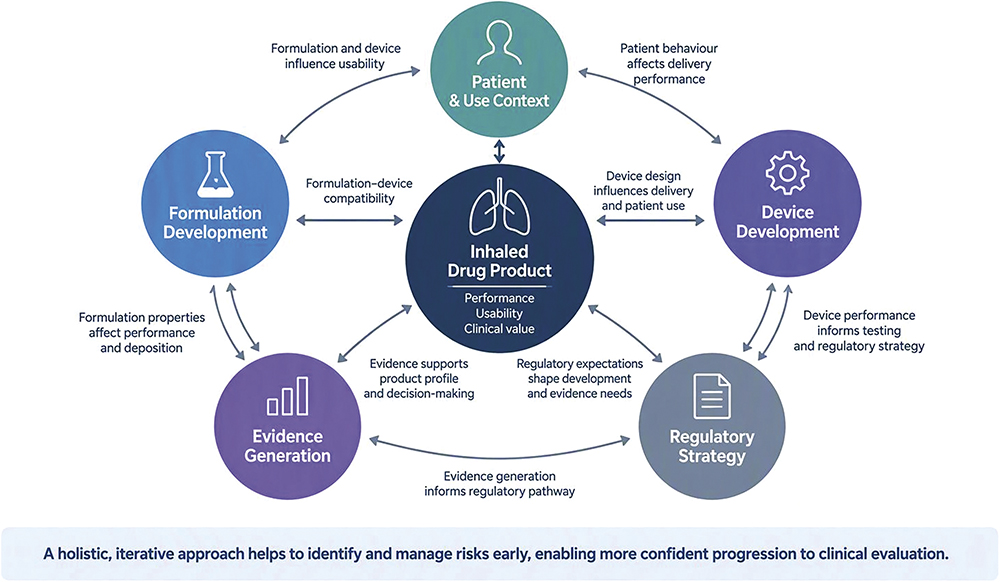
Figure 2: Interdependencies in inhalation product development. The product objective is shaped by patient context, regulatory expectations, formulation, device, aerosol performance and in vitro and in silico evidence.
USING IN VITRO AND IN SILICO TOOLS TO SUPPORT BETTER DECISIONS
Integration of in silico tools is increasingly important in inhaled drug product development because performance is influenced by interconnected factors, including formulation properties, device behaviour, aerosol characteristics, patient inhalation profiles and airway physiology. In vitro methods can characterise delivered dose, delivery rate, droplet or particle size distribution, spray characteristics and device reproducibility under standardised and realistic test conditions. In silico tools can then help to interpret these findings in relation to deposition, physiology or exposure.
Inhaled product performance cannot be understood by measuring a single parameter. Delivered dose, particle or droplet size and aerosol output are essential data points, but they do not describe the complete product system. Developers also must understand how performance may change under patient-relevant conditions and how measured attributes may translate into regional deposition or exposure expectations.
Predictive approaches can help to bridge the gap between experimental observations and expected product behaviour by integrating formulation, device, physiological and deposition-related inputs. Physiologically based pharmacokinetic (PBPK) modelling, regional deposition modelling, patient-relevant breathing profiles and realistic in vitro testing can all contribute to a richer understanding of product performance.
Recent advances in data-driven regional deposition methodologies have also enabled more rapid assessment of aerosol behaviour while retaining patient-specific physiological considerations, helping developers to explore how changes in formulation, device performance and inhalation conditions may influence deposition patterns throughout the respiratory tract for healthy volunteers and multiple patient groups.4
PBPK modelling, regional-deposition modelling, patient-relevant breathing profiles and realistic in vitro testing can all contribute to a richer understanding of product performance. By combining these complementary approaches, developers can move beyond isolated performance measurements and begin to explore how formulation and device characteristics may ultimately influence regional deposition, local exposure and systemic PK behaviour.5
Such integrated methodologies can help to compare development options, investigate variability and identify critical product attributes before clinical evaluation. Through Nanopharm’s combination of advanced in vitro characterisation, deposition modelling and PBPK capabilities, developers can evaluate product performance from multiple perspectives simultaneously rather than relying on individual datasets in isolation. This integrated approach can support earlier risk identification, more informed development decisions and greater confidence when progressing towards clinical evaluation. Importantly, its role is not to replace clinical evidence but to strengthen the rationale for the decisions that precede it.
LINKING PRODUCT PERFORMANCE TO PHARMACOKINETIC OUTCOMES
One of the persistent challenges in inhalation development is understanding how measured product performance translates into PK exposure. Aerosol characterisation metrics, such as aerodynamic particle size distribution, spray characteristics and delivered dose, inform regional deposition estimates and provide essential information about the product, but they do not always offer a complete mechanistic explanation for the systemic PK observed in a clinical study.
PBPK modelling provides a framework to connect these different layers of evidence. By integrating regional lung deposition data with human physiology and drug-specific parameters, a PBPK model can be used to investigate how formulation, device and patient-related factors may influence systemic plasma concentrations. This can be particularly useful when comparing development options, examining potential sources of variability or interpreting PK findings that cannot be fully explained from in vitro aerosol measurements alone.
At Nanopharm, Simhalation™ provides an inhalation- and nasal-specific PBPK framework that can interface with in vitro and in silico inputs. The platform is designed to accommodate physiological, product and molecule-specific information, allowing the model to be tailored to the question being investigated. In this context, the technical reason for naming Simhalation is clear: it provides the mechanistic bridge between product performance, regional deposition and expected PK behaviour, rather than functioning as a stand-alone simulation tool.
Example Application: Connecting Deposition to Exposure
One practical application of integrated modelling is understanding whether observed differences in aerosol performance are likely to translate into meaningful differences in PK exposure. In many development programmes, aerosol characterisation data and regional deposition estimates may already be available, yet the relationship between these measurements and the expected systemic PK profile remains unclear.
By combining regional deposition modelling with PBPK simulations, developers can investigate how formulation characteristics, device performance and patient-related variables influence local and systemic exposure. Rather than evaluating aerosol performance and PK independently, both datasets can be interpreted within a common mechanistic framework. The impact of in vitro product performance characteristics can then be interpreted in a physiologically meaningful way. This approach also allows for inverse design of inhaled products where, starting from the ideal experience for the patient, designers work backwards to the ideal in vitro characteristics and form a TPP or a product development safe space.
Simhalation allows developers to explore how changes in deposition patterns, formulation attributes or inhalation conditions may influence expected PK behaviour, while identifying the assumptions that contribute most strongly to variability in modelled outputs. In practice, this type of analysis can help to support prioritisation of development options, guide the design of subsequent experimental studies or determine whether observed differences in aerosol performance are likely to have a meaningful impact on systemic exposure.
The value of this type of modelling is not that it predicts clinical outcomes with certainty or replaces experimental and clinical evidence. Instead, it provides a structured way to test assumptions, explore scenarios and identify the parameters that are most likely to affect the observed PK profile. The reliability and regulatory relevance of the analysis depend on its intended context of use, the quality of the supporting data, the transparency of the model assumptions and appropriate evaluation of predictive performance.6,7 Used appropriately, the analysis can show where uncertainty remains, what it could mean for product performance and which questions should be investigated prior to clinical evaluation (Box 2).
BOX 2: What In Vitro and In Silico Tools Can, and Cannot, Tell Us
- They Can: Characterise aerosol and device performance under relevant test conditions, compare formulation-device options, examine the influence of realistic breathing profiles, estimate regional deposition, explore how deposition may influence local or systemic exposure, investigate variability and identify questions that require further experimental study.
- They Cannot: Entirely replace clinical evidence, eliminate uncertainty, guarantee clinical success, predict every individual patient outcome, compensate for a poorly defined product strategy or make a model credible without appropriate data, assumptions and evaluation.
- Key Message: The purpose of predictive tools is not certainty. Their value lies in making uncertainty more visible, interpretable and useful for development decisions.
BUILDING AN INTEGRATED PATH TO CLINICAL READINESS
Many delays in inhaled product development do not arise from a single scientific failure – they result from disconnected decisions, late integration or data generation that is not tied to a clear development question.
Treating formulation, device and testing as independent workstreams may appear efficient because each team can progress in parallel. However, the most important product risks often emerge at the interfaces between disciplines. A formulation may be stable but difficult to deliver. A device may be technically capable but inappropriate for the intended patient population. A robust test may still be of limited value if it does not inform the next decision.
More information does not necessarily reduce risk. Relevant information reduces risk. A focused experiment that answers a critical development question may be more useful than a broad set of studies that do not change the decision pathway.
The same principle applies to patient-use considerations. Inhalation flow, co-ordination, training, handling, adherence and treatment context can all influence product performance. If these factors are introduced only after the product concept has matured, a technically promising programme may require avoidable rework.
Clinical readiness is the cumulative result of decisions made across the development pathway. An integrated approach begins with the TPP and connects formulation development, device strategy, in vitro characterisation, predictive assessment, patient-use understanding and regulatory planning in an iterative workflow.
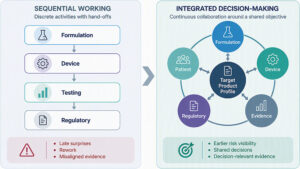
Figure 3: Moving from sequential working to integrated decision-making enables formulation, device, patient, evidence and regulatory considerations to be evaluated continuously around a shared TPP.
Early predictive insights may inform the target deposition strategy. That strategy may shape formulation requirements. Formulation behaviour may influence device selection or tuning. In vitro testing may reveal variability that prompts further formulation optimisation, device adjustment or patient-use evaluation. Regulatory considerations may define the evidence needed to justify progression. As shown in Figure 3, this changes development from a sequence of functional hand-offs into continuous decision-making around a shared product objective.
Rather than completing one activity and handing the output to the next team, formulation scientists, device specialists, analytical experts, modellers, human factors teams and regulatory advisers work from a shared understanding of the product objective and the uncertainties that matter most. New evidence can then refine the programme while design choices remain adaptable.
The goal is not to remove every source of uncertainty before clinical evaluation. That is rarely achievable. The goal is to identify the uncertainties that matter, understand their potential impact and generate enough decision-relevant evidence to proceed responsibly.
INTEGRATING REGULATORY THINKING THROUGHOUT DEVELOPMENT
Regulatory planning should not be treated as a final checkpoint after technical development is complete. It should be integrated from the beginning, especially for inhaled drug-device combination products where formulation, device, usability, quality and performance evidence may all influence the development path.
Early regulatory thinking helps teams to understand what evidence will be needed, how test methods should be justified and how product performance should be characterised. It can also help to avoid generating evidence that is scientifically interesting but misaligned with development or submission needs.
For inhaled products, regulatory readiness may involve analytical method development, dose delivery assessment, aerosol performance characterisation, design verification, extractables and leachables, biological evaluation, risk assessment, human factors and documentation strategy. Integrated in vitro and in silico evidence prove that useful product development data can justify decisions post-submission and avoid costly additional testing. These activities are not simply administrative tasks at the end of development – they shape the evidence package required to justify progression and support interactions with regulators.
An integrated regulatory strategy also clarifies the role of each development activity. A method, model, usability study or design-verification activity should support a defined question, decision or evidence requirement. This is particularly important when several partners or specialist teams are involved, as misalignment may lead to duplicated work, inconsistent assumptions or late-stage gaps.
The strongest regulatory strategies are built progressively. They do not wait until the end of development to ask whether the evidence package is adequate. From the beginning, they ask “What decision, claim or development step must this evidence support next?”
CONCLUSION
Preparing an inhaled drug product for clinical evaluation requires more than a promising formulation, a capable delivery device or a set of performance data. It requires the alignment of multiple development dimensions into a coherent strategy.
The most successful programmes are not those that optimise each component independently – they are designed to recognise early that formulation, device, patient use, testing and regulatory requirements are interconnected. A decision made in one area can create constraints or opportunities in another, and clinical readiness depends on understanding those interactions before they become late-stage barriers.
By starting with a clear TPP, integrating formulation and device considerations early, using in vitro and in silico tools to support decision-making and embedding regulatory thinking throughout development, teams can build a stronger foundation for clinical evaluation.
No development strategy can remove every uncertainty before an inhaled product enters the clinic, nor should that be the objective. The more important task is determining which uncertainties can be accepted and which could compromise dose delivery, patient use, clinical interpretation or regulatory progression (Box 3).
BOX 3: What Does Clinical Readiness Really Mean?
- Clinical Readiness Is Not: Complete certainty, finished development, perfect product understanding, absence of all risk or a single final checkpoint.
- Clinical Readiness Is: Understanding the risks that matter most, knowing which uncertainties remain, having evidence to support the next decision, aligning formulation, device, patient-use, testing and regulatory strategy, and entering clinical evaluation with a clear rationale.
- Key Message: Clinical readiness is built through connected decisions and a coherent understanding of the product, its remaining risks and the rationale for moving forwards.
This is why clinical readiness cannot be created through a final round of testing. It is built through the decisions made throughout development: how the product objective is defined, when the device is introduced, which performance questions are explored and how evidence is used to refine the pathway forwards. When these decisions are connected, teams start clinical evaluation with more than a collection of completed activities – they enter with a coherent understanding of the product, its remaining risks and the rationale for moving forwards.
REFERENCES
- Delvadia RR et al, “In Vitro Tests for Aerosol Deposition. IV: Simulating Variations in Human Breath Profiles for Realistic DPI Testing”. J Aerosol Med Pulm Drug Deliv, 2016, Vol 29(2), pp 196–206.
- Dantas C et al, “Assessing the Impact of Realistic Breathing Profiles in Aerosol Deposition Using In-Silico Methods”. DDL Conf Proc, 2024, Vol 35, pp 395–398.
- “Draft Guidance for Industry and FDA Staff: Applying Human Factors and Usability Engineering to Medical Devices”. US FDA, Feb 2016.
- Sadafi H et al, “Rapid deposition analysis of inhaled aerosols in human airways”. Sci Rep, 2024, Vol 14, art 24965.
- Han L, “Orally Inhaled Drug Product PSGs: General Considerations Using the Alternative Bioequivalence Approach in Lieu of Comparative Clinical Endpoint Bioequivalence Study for Suspension-Based Metered Dose Inhalers”. US FDA, 2024.
- “Guideline on the Reporting of Physiologically Based Pharmacokinetic Modelling and Simulation”. EMA, Jul 2019.
- Shebley M et al, “Physiologically Based Pharmacokinetic Model Qualification and Reporting Procedures for Regulatory Submissions: A Consortium Perspective”. Clin Pharmacol Ther, 2018, Vol 104(1), pp 88–110.