
To Issue 187
Citation: Jannin V, “Advancing Oral Biologic Delivery: Overcoming Barriers to Enable Innovation and Access”, ONdrugDelivery, Issue 187 (Jun 2026), pp 20–23.
Dr Vincent Jannin considers the advantages of delivering biologic medications, including glucagon-like peptide-1s, via oral delivery and discusses the technological strides being made towards enabling biologics to shift away from parenteral delivery.
Biological therapies, more commonly referred to as biologics, have redefined the treatment landscape across multiple disease areas, from metabolic disorders to oncology. However, despite their clinical impact, the vast majority of biologics remain constrained to parenteral administration.1 This reliance on injection not only contributes to patient burden but also creates inefficiencies across healthcare delivery.
Recent advances in formulation and delivery technologies are fundamentally challenging this paradigm. Oral delivery of biologics is now emerging as a viable and increasingly scalable approach to unlock new opportunities to expand access to these critical medications and improve patient adherence. However, significant scientific and manufacturing challenges must still be addressed to further advance oral biologics in clinical pipelines.
PATIENT PREFERENCE AND SYSTEM-LEVEL PRESSURES
The momentum behind development of oral biologics is driven by both patient demand and structural pressures within healthcare systems. Injectable therapies, particularly in chronic disease, are associated with a range of barriers, including administration complexity, reliance on healthcare professionals and reduced patient adherence.
“RECENT SURVEYS DEMONSTRATED A STRONG INCLINATION TOWARD ORAL DELIVERY, WITH THE MAJORITY OF PATIENTS – APPROXIMATELY 91% IN ONE SURVEY – FAVOURING ORAL DELIVERY OVER INJECTABLE ALTERNATIVES.”
Patient preference data are unequivocal. Recent surveys demonstrated a strong inclination toward oral delivery, with the majority of patients – approximately 91% in one survey – favouring oral delivery over injectable alternatives. One survey reported that 55% of patients with twice-yearly injections would prefer daily oral administration if given the choice.2 This preference reflects both the reduced convenience of regular injections and well-documented aversion to needles, which remain a significant barrier to treatment initiation and persistence.
From the perspective of healthcare systems, these challenges are amplified by capacity constraints, workforce shortages and the rising prevalence of chronic diseases. The need to transition appropriate therapies towards self-administration is therefore not only patient-driven but also operationally imperative. Thus, oral biologics offer a dual advantage: improving patient adherence and alleviating the burden on healthcare systems. Nowhere is this shift more evident than in the rapid emergence of oral glucagon-like peptide-1 receptor agonists (GLP-1 RAs).
“TRADITIONALLY, PEPTIDES AND PROTEINS WERE CONSIDERED UNSUITABLE FOR ORAL ADMINISTRATION DUE TO INSTABILITY AND POOR ABSORPTION IN THE GASTROINTESTINAL TRACT. HOWEVER, ORAL SEMAGLUTIDE HAS FUNDAMENTALLY CHALLENGED THIS ASSUMPTION.”
THE RISE OF ORAL GLP-1 RECEPTOR AGONISTS
The clinical and commercial success of oral GLP-1 RAs represents a pivotal demonstration of feasibility in oral biologic delivery. Traditionally, peptides and proteins were considered unsuitable for oral administration due to instability and poor absorption in the gastrointestinal tract. However, oral semaglutide has fundamentally challenged this assumption.
The clinical and commercial performance of oral semaglutide has illustrated that biologic efficacy can be preserved in an oral format when supported by appropriate formulation strategies. The use of absorption enhancers, such as salcaprozate sodium, can enable protection from gastric degradation and facilitate transcellular uptake across the gastric epithelium.
Importantly, this success is not merely product-specific; it has catalysed broader interest in oral delivery platforms. GLP-1 RAs have provided a validated proof-of-concept that is now informing development pipelines across peptides, proteins and emerging biologic classes.
BARRIERS TO ORAL DELIVERY
Historically, three interconnected challenges have limited the development of oral biologics:
- Protecting molecules from degradation
- Enabling absorption across the intestinal barrier
- Achieving sufficient bioavailability for therapeutic effect.
First, biologics, particularly proteins and peptides, are highly sensitive to degradation. The acidic environment of the stomach and the presence of proteolytic enzymes can rapidly break these molecules down, rendering them inactive before absorption occurs. Biologics also suffer from poor permeability across the intestinal lining. Even when intact, the mucus layer acts as a protective barrier, preventing large molecules from reaching epithelial cells, while tight junctions between cells restrict passive diffusion.
Furthermore, bioavailability remains a major constraint. It has been estimated that the vast majority of orally administered proteins are digested before systemic uptake, posing a significant challenge to achieving therapeutic efficacy. In addition to those hurdles, manufacturing considerations also play a role. Biologics can be sensitive to heat, solvents and processing conditions, making scale-up and commercialisation of oral formulations particularly demanding. Collectively, these challenges have driven innovation across the industry, spurring the development of new solutions in formulation and delivery strategies to overcome these barriers.
ADVANCING FORMULATION STRATEGIES
New formulation approaches have emerged that can enable oral biologic delivery by addressing both stability and absorption challenges. However, each strategy ultimately depends on the properties of the biological agent in question.
“NEXT-GENERATION CAPSULE TECHNOLOGIES, SUCH AS READY-TO-USE ENTERIC CAPSULES, HAVE FURTHER STREAMLINED THIS APPROACH. BY ELIMINATING THE NEED FOR POST-FILLING COATING STEPS, THESE SYSTEMS REDUCE THE EXPOSURE TO HEAT AND SOLVENTS, WHICH CAN DAMAGE SENSITIVE APIs.”
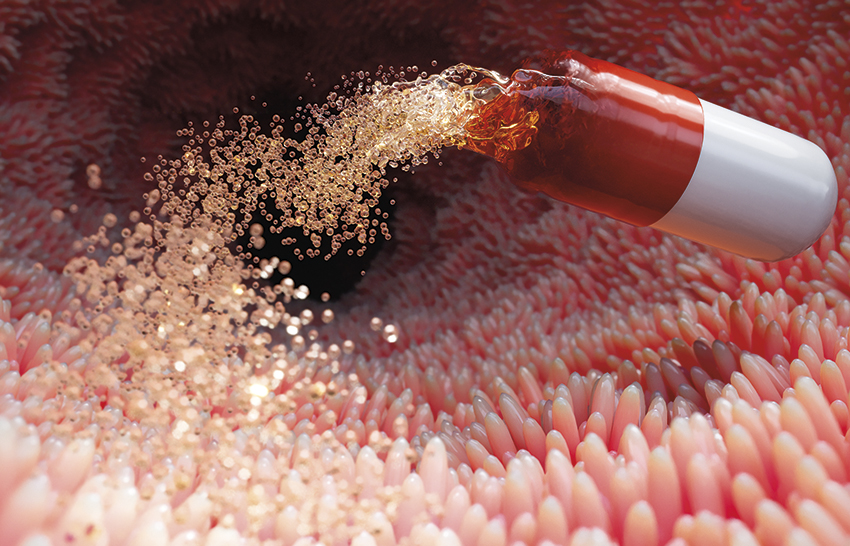
One of the most important innovations in this regard is enteric protection. Enteric coatings or capsules are designed to remain intact in the acidic stomach environment and dissolve in the more neutral pH of the intestine, protecting sensitive biologics from degradation. Next-generation capsule technologies, such as ready-to-use enteric capsules, have further streamlined this approach. By eliminating the need for post-filling coating steps, these systems reduce the exposure to heat and solvents, which can damage sensitive APIs. This also improves manufacturing efficiency and scalability. Critically, these innovations open the door to more patient-centric therapies by enabling reliable oral delivery without adding complexity to production processes.3–5
Beyond protecting biologic APIs, improving bioavailability is key. Several strategies have emerged to address these challenges, including:
- Permeation enhancers, which work by destabilising the integrity of lipid membranes and opening tight junctions to enhance transcellular and paracellular permeability6,7
- Lipid-based formulations (LBFs) can support the absorption of drugs by keeping drugs solubilised in lipid systems or colloids to protect against enzymatic degradation, while enabling hydrophilic compound solubility via hydrophobic ion pairing (HIP) with surfactants8,9
- Nanoparticles are used as a versatile tool to address multiple barriers to biologic absorption and have the potential to increase biologic uptake either through activation of non-specific uptake channels or by targeting specific receptors.6
In some cases, a single strategy can be sufficient for several biological agents, while in others, combining multiple approaches has proven particularly effective. For example, alternative models of GLP-1 administration have used a combination of enteric protection, LBFs, HIP and permeation enhancers. Also, preclinical models of monoclonal antibodies and RNA-based therapies have also shown promising results with combination strategies.6,9–11 These integrated delivery platforms represent a scalable model for improving oral bioavailability and expanding the range of biologics that can be delivered orally.
IMPLICATIONS FOR PATIENT ACCESS
The successful translation of oral biologics has implications that extend beyond formulation science – by enabling self-administration, oral therapies can reduce dependence on healthcare infrastructure and remove key barriers associated with injectable delivery. This is particularly relevant for chronic disease management, where long-term adherence is critical for maintaining therapeutic efficacy. Oral delivery also has the potential to support earlier healthcare interventions, improve patient persistence and broaden access to treatment across diverse populations. From a health-economic perspective, the shift towards oral administration may also reduce the costs associated with clinical administration, hospital visits and resource use.
“THE SUCCESS OF GLP-1 RAS HAS DEMONSTRATED THAT ORAL DELIVERY OF BIOLOGICS IS NOT ONLY ACHIEVABLE BUT SCALABLE WHEN SUPPORTED BY APPROPRIATE TECHNOLOGIES.”
DEFINING INNOVATION FOR FUTURE SUCCESS
The emergence of oral biologics reflects the convergence of formulation innovation, patient-centric design and market demand. While significant challenges remain, the field has moved beyond proof-of-concept towards early-stage commercialisation and platform development. The success of GLP-1 RAs has demonstrated that oral delivery of biologics is not only achievable, but scalable when supported by appropriate technologies. Meanwhile, advances in enteric protection, bioavailability and manufacturing processes are expanding the range of biologics that can be delivered orally.
Looking ahead, this progress is expected to continue. As technologies mature and more products reach the market, oral biologics have the potential to move from the exception to the expectation, reshaping treatment paradigms across multiple disease areas. This reflects a fundamental shift towards therapies that are designed around patient needs, improving adherence, enabling earlier interventions and expanding access to life-changing treatments.
REFERENCES
- Palacios JI et al, “High-velocity delivery of biologics via the gastrointestinal tract by self-pressurized oral capsules”. J Control Release, 2025, Vol 385, art 113963.
- Myers JT et al, “Preference for a Novel Oral Alternative to Parenterally Administered Medications”. Patient Prefer Adherence, 2024, Vol 18, pp 1547–1562.
- Jannin V et al, “In vitro evaluation of the gastrointestinal delivery of acid-sensitive pancrelipase in a next generation enteric capsule using an exocrine pancreatic insufficiency disease model”. Int J Pharm, Vol 630, art 122441.
- Hansen MM et al, “Encapsulated donor faeces for faecal microbiota transplantation: the Glyprotect protocol”. Ther Adv Gastroenterol, 2024, Vol 17, art 17562848241289065.
- Jannin V et al, “Enteric properties of Capsugel® Enprotect® capsules filled with Fecal Microbiota Transplant are confirmed after 12-month storage at -80°C”. Poster Presentation, European Conference on Pharmaceutics, Mar 2025.
- Masloh S et al, “Challenges and Opportunities in the Oral Delivery of Recombinant Biologics”. Pharmaceutics, 2023, Vol 15(5), art 1415.
- Mantaj J, Vllasaliu D, “Recent advances in the oral delivery of biologics”. The Pharmaceutical Journal, Jan 2020.
- Hashmi AR et al, “Advanced Drug Delivery Strategies to Overcome Solubility and Permeability Challenges: Driving Biopharmaceutical Advancements Toward Commercial Success”. ACS Omega, 2025, Vol 10(36), pp 40769–40792.
- Dumont C et al, “A two-tier protection strategy for oral delivery of GLP-1 peptides: lipid-based formulation combined with enteric capsules”. Front Drug Deliv, 2026, Vol 6, art 1770094.
- “Revolutionising The Way Biologics Are Delivered: Converting Injectable Antibodies into Safe and Simple Oral Pills?”. Presentation, Intract Pharma, APS PharmSci, Sep 2019.
- “Oral delivery of encapsulated RNA nanotherapeutics for targeted treatment of ileal Crohn’s disease”. Web Page, CORDIS, accessed Jun 2026.