To Issue 193
Citation: Gardy J, “Beyond Particle Counts: Characterising Foreign Particulates in Inhaled and Nasal Products”, ONdrugDelivery, Issue 193 (Nov 2026), pp 32–36.
Dr Jabbar Gardy discusses how to go beyond simple counting when investigating foreign particles in orally inhaled and nasal drug products using different analytical techniques and describes the advantages that performing a deeper characterisation of such particulates can confer.
FOREIGN PARTICLES: MORE THAN A COUNTING PROBLEM
Foreign particulate matter is not a new concern for developers of orally inhaled and nasal drug products (OINDPs) – it has been discussed within the pharmaceutical aerosol community for more than two decades, including work from the International Pharmaceutical Aerosol Consortium on Regulation and Science (IPAC-RS) on testing, control and the clinical relevance of foreign particles in these products.1,2 What has changed considerably is how much analytical science can now tell us about an individual particle.
In practice, finding a particle is often the straightforward part. The more difficult questions come afterwards. What is it? Where might it have come from? Is it associated with the formulation, manufacturing process, container closure system or delivery device? Is it part of the normal particulate background for that product, or is it telling us that something has changed? A particle count alone cannot answer those questions.
“FOREIGN PARTICULATE CHARACTERISATION IS INCREASINGLY AN IDENTIFICATION AND INVESTIGATION PROBLEM, RATHER THAN SIMPLY A COUNTING EXERCISE.”
Foreign material can potentially originate from raw materials, device and packaging components or the manufacturing equipment and environment. A useful investigation therefore needs to move beyond showing that particles are present and towards understanding what those particles represent. Foreign particulate characterisation is increasingly an identification and investigation problem, rather than simply a counting exercise.
COUNTING IS IMPORTANT, BUT IT IS ONLY THE BEGINNING
Particle counting remains fundamental. Light obscuration, microscopy and automated imaging can provide valuable information about particle number, size and morphology, depending on the product and the purpose of the investigation. Light obscuration, for example, has previously been investigated for quantitative determination of foreign particulate matter in pressurised metered dose inhalers (pMDIs).3 This approach has its limitations, namely that particle number and size do not necessarily tell investigators what the particles are made from.
Two particles may have similar dimensions while being chemically quite different. One may be polymeric, another metallic and another formulation-derived. If an investigation stops at count and size, those differences can remain hidden. Earlier IPAC-RS work has recognised the need for developmental characterisation and appropriate quality-control strategies for foreign particles in OINDPs.1,2 The principles remain relevant, but the analytical capability available to investigate individual particles has moved on considerably. Figure 1 summarises orthogonal progression from enumeration and morphology to molecular and elemental characterisation, with the analytical result interpreted alongside product and process knowledge.
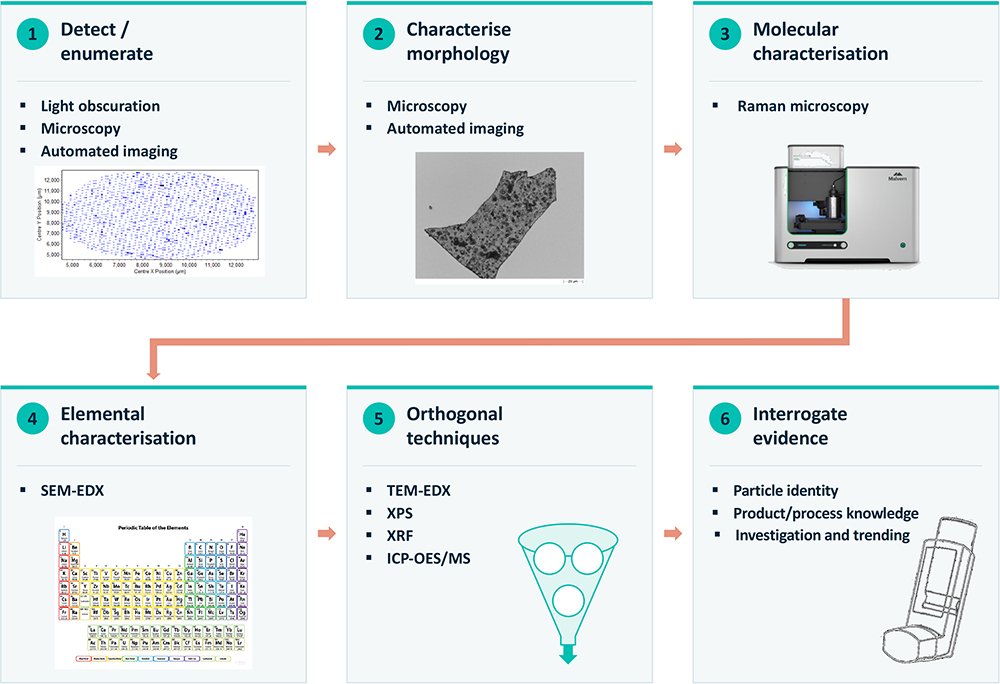
Figure 1: Orthogonal analytical approach to foreign particulate characterisation.
A RISK-BASED REGULATORY PERSPECTIVE
The regulatory discussion around container closure systems provides useful context. In August 2026, the US FDA issued draft guidance on Container Closure Systems for Human Drugs and Biological Products.4 It currently remains draft guidance, distributed for comment, and is not yet for implementation.
Nevertheless, the scientific thinking is relevant to OINDPs. The draft guidance describes a risk-based approach to establishing the suitability of container closure systems, including systems that are also device-constituent parts of combination products. In a pMDI, for example, the canister, metering valve and actuator form part of the system responsible for storing and delivering the medicine. When an unexpected particle is found, knowledge of those materials can therefore become highly relevant.
Identification of a polymer becomes more informative when it can be compared with known materials. Likewise, identification of metallic or other inorganic material may direct an investigation towards a different group of possible sources. Neither result proves the source, but both allow the investigation to become more focused.
“EXPECTING A SINGLE ANALYTICAL TECHNIQUE TO ANSWER EVERY QUESTION IS RARELY REALISTIC.”
WHY ORTHOGONAL CHARACTERISATION MATTERS
Expecting a single analytical technique to answer every question is rarely realistic. Different techniques elucidate different things. For example, morphologically directed Raman spectroscopy (MDRS) brings together automated particle imaging and Raman spectroscopy. Imaging provides information such as particle size and morphology, while Raman analysis provides molecular information for particles that produce a suitable spectrum.
Farias et al demonstrated its application in the characterisation of API particle-size distributions in mometasone furoate nasal suspension formulations,5 and Kim et al have shown how morphological information and Raman identification can be combined for subvisible particle characterisation in therapeutic protein products.6
Raman spectroscopy, however, does not answer every question. Particle size, fluorescence, optical properties and the intrinsic Raman response of the material can all affect spectral quality. Some inorganic particles may provide little useful Raman information. A failed Raman identification should not therefore be treated as a failed particulate investigation – it may simply mean that another analytical question needs to be asked.
Energy-dispersive X-ray spectroscopy (EDX) provides a complementary view. Scanning electron microscopy (SEM) gives high-resolution morphological information, while EDX provides elemental composition. Its usefulness in foreign-matter investigations is well established, and combining microscopy, vibrational spectroscopy and elemental analysis can be particularly powerful when the identity of an unknown particle is not obvious.7
THE ORTHOGONAL TOOLBOX IS VARIED
SEM-EDX is not the only technique that can sensibly follow MDRS. In SEM-EDX, an electron beam generates characteristic X-rays from the interaction volume, so morphology and elemental composition can be linked to the same particle. For much smaller particles, transmission electron microscopy (TEM) combined with EDX can push imaging and elemental mapping to finer spatial scales, although the compromise is more demanding specimen preparation and a much smaller amount of material under examination.8
X-ray photoelectron spectroscopy asks a different question again. Given the photoelectrons it measures escape only from the near-surface region, it is particularly useful when surface composition or chemical state is important to characterise.9 X-ray fluorescence (XRF) provides non-destructive elemental screening where there is sufficient mass, while atomic absorption technology, inductively coupled plasma optical emission spectroscopy (ICP-OES) and inductively coupled plasma mass spectrometry (ICP-MS) can provide sensitive elemental measurements after suitable sample preparation.10,11
Sample mass, composition, surface sensitivity, detection limits and the need to preserve the particle all influence the decision. The point is not to assemble the most expansive analytical toolbox – it is to understand the measurements well enough to choose the experiment that removes the next uncertainty.
WHAT DID THE PARTICLES ACTUALLY TELL US?
In a practical example to be presented at the Drug Delivery to the Lungs conference in Dec 2026, MDRS detected 4,900 foreign particles in Batch A and 2,287 in Batch B. Automated imaging showed predominantly irregular particles across a broad particle-size distribution. Those numbers demonstrated a difference between the samples, but the counts alone did not explain it. The MDRS scattergrams and representative automated particle images are shown in Figure 2, illustrating the difference in detected particle populations between the two batches whilst retaining the morphological information associated with individual particles.
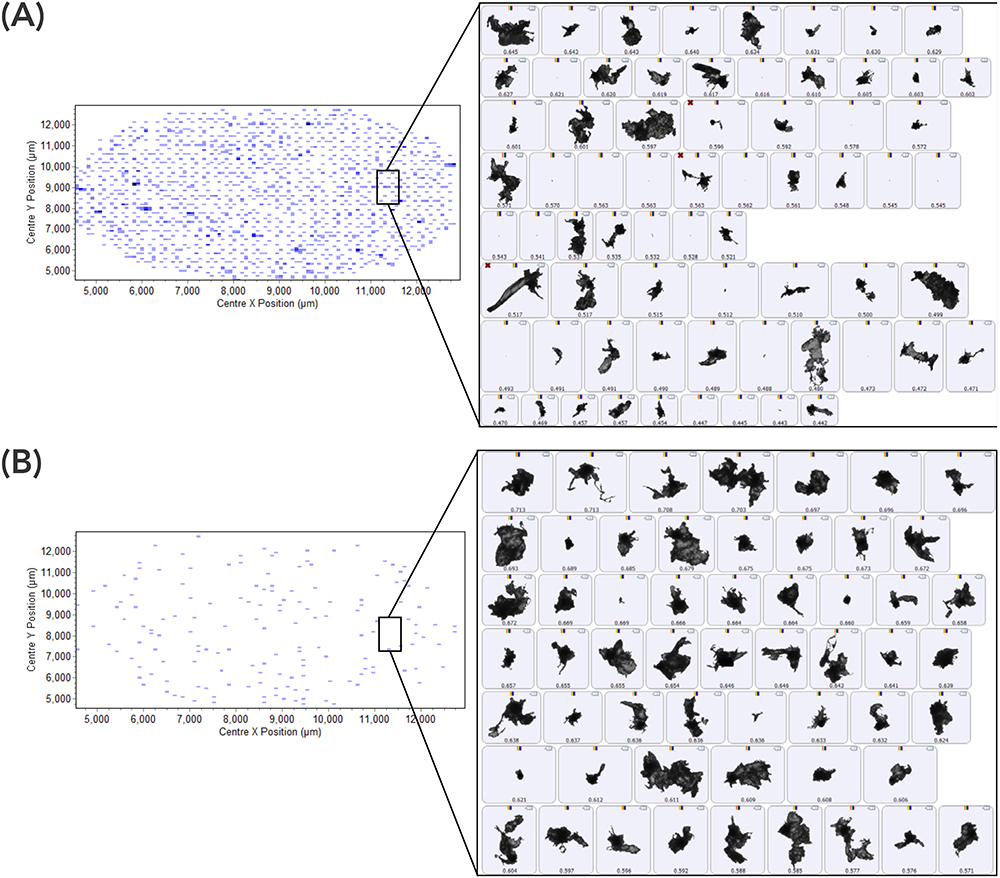
Figure 2: Example of MDRS scattergrams and automated particle images from two generic pMDI batches using mometasone furoate.
Raman analysis added another layer of information. In Batch A, the principal Raman-active contaminant produced spectra consistent with polypropylene. As polypropylene is used in pharmaceutical packaging and device components, its identification provided a sensible starting point for considering possible sources. Batch B was more complicated; some particles again produced spectra consistent with polypropylene, while others could not be adequately identified by Raman under the conditions used.
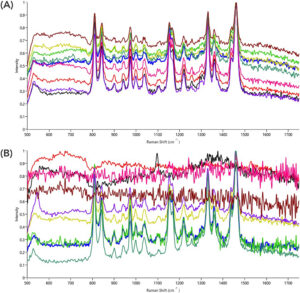
Figure 3: Example of Raman characterisation of foreign particulates detected by MDRS.
Examples of the Raman spectra results are shown in Figure 3. These data illustrate both the value of molecular identification for Raman-active particles and the analytical limitation encountered when a particle does not provide an adequate spectrum under the measurement conditions used.
SEM-EDX supplied the missing information. The particles examined from Batch A were predominantly organic in nature, consistent with the Raman findings. Batch B contained a more heterogeneous population; alongside organic material, elemental analysis identified particles containing iron and aluminium. As such, these were not simply two batches with different particle counts but evidence of different particulate profiles, which is a much more useful starting point for a root-cause investigation.
Examples of the SEM-EDX and elemental maps are shown in Figure 4. The complementary elemental information was particularly important for the Batch B population that could not be fully characterised by Raman spectroscopy alone.
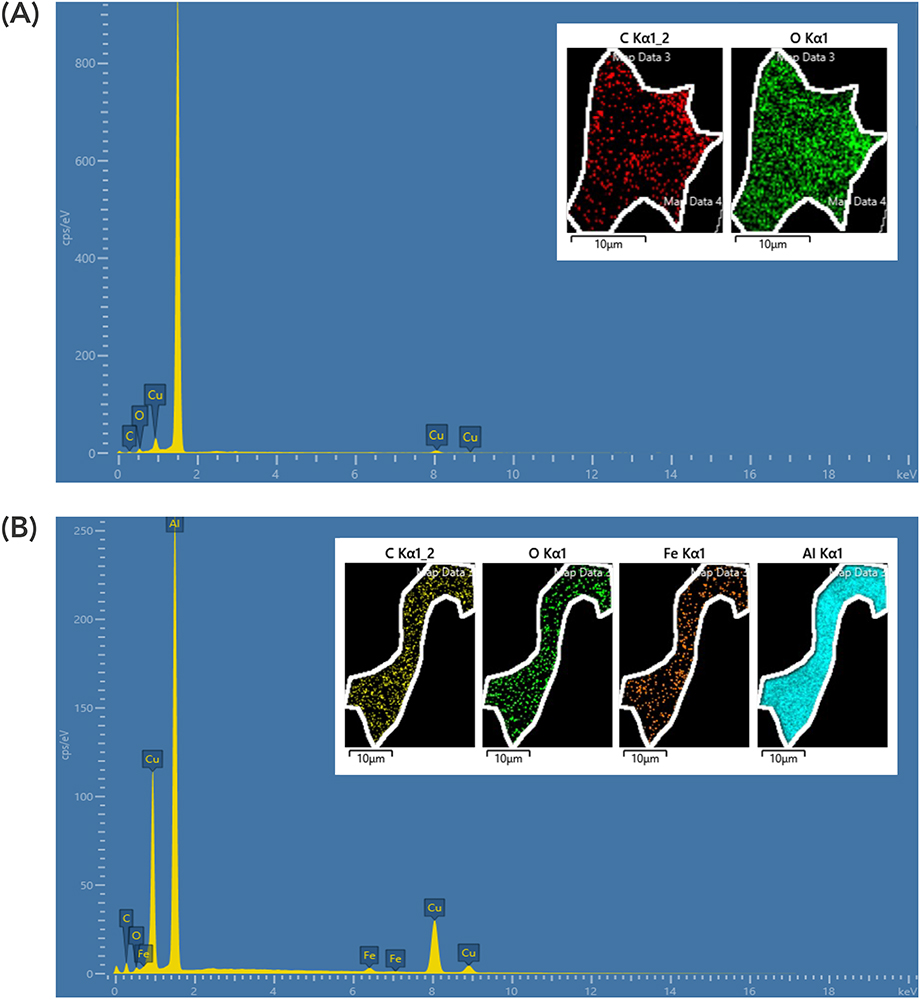
Figure 4: Example of SEM-EDX analysis of foreign particulates from batches A and B.
“IDENTIFYING THE COMPOSITION OF A PARTICLE IS NOT THE SAME AS PROVING ITS ORIGIN.”
IDENTIFICATION DOES NOT PROVE THE SOURCE
Identifying the composition of a particle is not the same as proving its origin. Finding polypropylene does not demonstrate, by itself, that a particular valve or packaging component generated the particle. Similarly, finding iron does not automatically mean equipment wear and finding aluminium does not identify a particular manufacturing operation.
Analytical identification narrows the investigation; it does not replace it. Source attribution requires the result to be considered alongside the formulation, raw materials, device materials, manufacturing equipment, processing history, cleaning procedures, environmental controls and previous particulate data.
UNDERSTANDING WHAT IS NORMAL
Foreign-particle testing is often discussed reactively – something unusual has been observed, a complaint has been received or an investigation has been opened. By that stage, one of the most useful pieces of information is a good understanding of what is normally present in the product. That justifies characterisation earlier in the product lifecycle. A good investigation therefore moves through a series of questions:
- Is the particle genuinely present?
- What are its size and morphological characteristics?
- What is it made from?
- Which known materials within the product, device or process could reasonably be associated with it?
- Does the wider manufacturing evidence support that hypothesis?
If the typical particulate population is understood during development and process characterisation, later observations can be assessed against a meaningful baseline. A familiar particle type within an established profile raises a different question than that raised by the sudden appearance of a new material or a substantial change in an existing population. A trend based only on total particle count may show that something has changed; a trend that also considers morphology and identity may help explain what changed. This does not mean that every particle from every batch needs exhaustive spectroscopic and elemental analysis – a risk-based approach is more sensible.
LET THE QUESTION CHOOSE THE TECHNIQUE
There is a natural temptation with advanced analytical methods to ask which technique is best. The better question is: “What do we need to know?” Orthogonal analysis should not mean running a sample on every available instrument. Each technique should earn its place by answering a question that the preceding technique could not answer with sufficient confidence. More analytical data do not automatically produce more understanding.
FROM PARTICLE DATA TO PRODUCT KNOWLEDGE
Foreign particulate characterisation in OINDPs has moved beyond simple enumeration. Counting remains essential but it is only one part of a wider picture. Imaging shows what particles look like. Molecular spectroscopy can help establish what they are made from. Elemental and surface-analysis techniques can provide another level of understanding. Knowledge of the formulation, device, container closure system and manufacturing processes then provides the context needed to interpret those findings.
This is the key point for future particulate investigations – the strongest investigation is not the one with the most measurements; it is the one in which each measurement tests a sensible scientific hypothesis. Certainly, investigators should continue asking how many particles are present, but also what they are, whether they are expected, what analytical uncertainty remains and where they might reasonably have come from. That is how particle data become product knowledge rather than simply another set of results.
“FINDING THE PARTICLE IS THE BEGINNING OF THE INVESTIGATION, NOT THE END OF IT.”
Finding the particle is the beginning of the investigation, not the end of it. When particle count, morphology, molecular identity and elemental composition are brought together with sound knowledge of the product and process, foreign-particle analysis becomes more than a test result. It becomes part of the scientific understanding of the product throughout its lifecycle.
REFERENCES
- Blanchard J et al, “Foreign particles testing in orally inhaled and nasal drug products”. Pharm Res, 2004, Vol 21(12), pp 2137–2147.
- Blanchard J et al, “Best practices for managing quality and safety of foreign particles in orally inhaled and nasal drug products, and an evaluation of clinical relevance”. Pharm Res, 2007, Vol 24(3), pp 471–479.
- Pilewski S et al, “Determination of Foreign Particulate Matter in Metered Dose Inhalers (pMDI) by Light Obscuration”. RDD IX, 2004, Vol 3, pp 629–632.
- “Container Closure Systems for Human Drugs and Biological Products”. Draft Guidance for Industry, US FDA, Aug 2026.
- Farias G et al, “A Systematic Approach in the Development of the Morphologically-Directed Raman Spectroscopy Methodology for Characterizing Nasal Suspension Drug Products”. AAPS J, 2021, Vol 23(4), art 73.
- Kim M et al, “Morphologically-Directed Raman Spectroscopy as an Analytical Method for Subvisible Particle Characterization in Therapeutic Protein Product Quality”. Sci Rep, 2023, Vol 13(1), art 20473.
- Hindelang F, Roggo Y, Zurbach R, “Forensic investigation in the pharmaceutical industry: Identification procedure of visible particles in (drug) solutions and different containers by combining vibrational and X-ray spectroscopic techniques”. J Pharm Biomed Anal, 2018, Vol 148, pp 334–349.
- Liu T et al, “Transmission electron microscopy sample preparation method for micrometer-sized powder particles using focused ion beam”. Micron, 2021, Vol 143, art 103030.
- Finšgar M, “Contemporary Techniques and Prospects in Pharmaceutical Tablet Surface Analysis”. ACS Meas Sci Au, 2026, Vol 6(2), pp 430–444.
- Lewen N, “The use of atomic spectroscopy in the pharmaceutical industry for the determination of trace elements in pharmaceuticals”. J Pharm Biomed Anal, 2011, Vol 55(4), pp 653–661.
- Galdino JNS, César IC, “Comparison of Analytical Methods for the Determination of Elemental Impurities in Pharmaceutical Products”. Crit Rev Anal Chem, 2026, online ahead of print.