
To Issue 186
Citation: Compel S, Hendricks A, “Excipient Landscapes: High-Throughput Screening to Solve Viscosity Bottlenecks for Biologic Therapeutics”, ONdrugDelivery, Issue 186 (May 2026), pp 116–120.
Dr Scott Compel and Dr Alex Hendricks discuss AEMS Corp‘s automated, microscale screening platform that enables viscosity reduction, using innovative approaches to test excipient combinations effectively.
Next-generation therapeutics, from small interfering RNAs (siRNAs) to antibody-drug conjugates, are moving towards subcutaneous (SC) self-administration. Viscosity remains a persistent bottleneck. Today’s excipient-based approaches to solving viscosity problems leave the vast majority of the formulation space uncharted.
AEMS has introduced an automated, microscale screening platform that draws on tools from materials science and machine learning (ML) to navigate the multicomponent excipient space to identify optimal formulation components that conventional methods can miss. The platform provides development teams with the data they need to reduce viscosity, de-risk device pairing and advance stalled programmes while making efficient use of scarce drug substances.
THE VISCOSITY BARRIER IN NEXT-GENERATION THERAPEUTICS
The shift from clinic-based intravenous (IV) infusion to SC self-administration is well established. SC biologics account for more than half of the global biologics market, exceeding US$250 billion (£185 billion) in annual drug revenue out of a total sector valued at roughly $487 billion.1,2 The advantages are clear: patients gain autonomy, clinical burden drops and adherence improves.3
However, SC delivery for high-dose therapeutics comes with hard physical constraints. Standard prefilled syringes (PFSs) and autoinjectors hold fluid volumes of 1–2 mL, which correlates to the maximum volumes that can conventionally be injected into SC tissue.3 Fitting a full therapeutic dose into that volume often means pushing API concentrations above 100 mg/mL.3 At these concentrations, molecular crowding and drug-drug (or drug-excipient) interactions cause viscosity to rise steeply and non-linearly (Figure 1).4,5
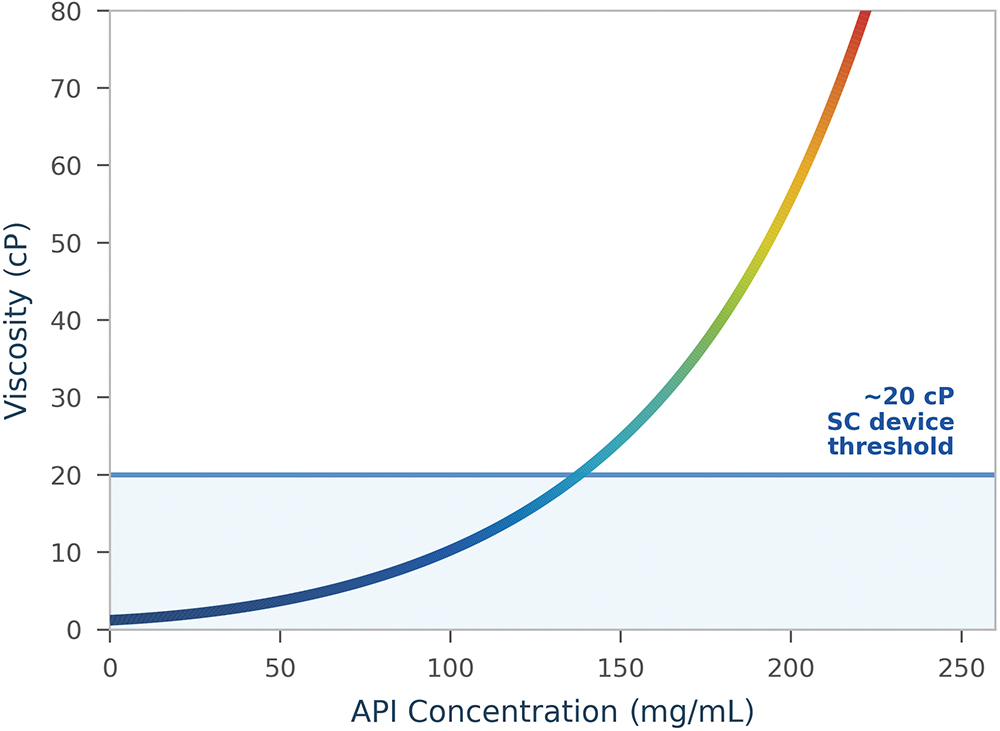
Figure 1: Relationship between biologic API concentration and formulation viscosity, illustrating the device-feasibility threshold for standard SC delivery.
Once viscosity exceeds roughly 20 cP, a commonly cited threshold for SC delivery through 27G needles,5 the downstream problems multiply: injection forces climb, administration takes longer, patient discomfort increases and the mechanical load on injection devices can lead to stalling or syringe failure. If the viscosity problem cannot be solved, drug programmes stall. In many cases, programmes may abandon the SC route and default to IV administration, or alternatively may never reach the market.4
“THE PUSH TOWARDS BROADER TISSUE DELIVERY IS INTRODUCING NEW FORMULATION COMPLEXITY REGARDING STABILITY, EXCIPIENT COMPATIBILITY AND DELIVERY VEHICLE OPTIMISATION.”
This is not just a monoclonal antibody (mAb) problem.6 For other high-concentration biologics, viscosity, stability and excipient interactions become critical constraints. Peptide therapeutics – a sector valued at $50 billion in 2025 and projected to nearly double by 20347 – face growing viscosity and stability challenges as formulations push towards higher concentrations for SC delivery.8 siRNA therapeutics face analogous hurdles. While all six US FDA-approved siRNA drugs currently target the liver via N-Acetylgalactosamine conjugates, the push towards broader tissue delivery is introducing new formulation complexity regarding stability, excipient compatibility and delivery vehicle optimisation.9 The siRNA sector was valued at $2.7 billion in 2024 and is projected to reach $12.6 billion by 2033.10 As viscosity is governed by the physical interactions between molecules and excipients rather than by any single drug class, insights gained for one modality translate directly to others. AEMS’s screening platform is agnostic to the biomolecules being studied: the same combinatorial methods and ML models that optimise a mAb formulation generate transferable knowledge about excipient behaviour that accelerates screening for peptides, siRNA and other emerging modalities.
CURRENT APPROACHES LEAVE MOST OF THE FORMULATION SPACE UNEXPLORED
The most advanced viscosity-reduction technologies currently on the market operate in a two-component space. Merck’s (Darmstadt, Germany) Viscosity Reduction Platform, for example, offers curated excipient pairs: one excipient selected from a first group and another from a second group, yielding a small set of predefined binary combinations.11 This is a real advantage over single-excipient strategies, as these platforms have shown that paired excipient synergies can reduce viscosity more than either component alone.
The issue is scale. Pharmaceutical formulators routinely work with around 40 FDA-approved excipients for parenterals. Pairwise combinations of those 40 excipients yield roughly 780 unique pairs. Step up to three-component systems and the number jumps above 9,800. Once varying ratios and concentrations are factored in, the number of accessible formulation conditions becomes essentially limitless. This is both the opportunity and the problem. A space this large offers countless levers to tune towards a desired viscosity target, but no established tools exist in pharma to systematically explore it beyond two components.
AEMS’s work solving complex formulation problems has repeatedly shown that the best viscosity outcomes often hide in the three-, four- or five-component space. Small changes in excipient selection, buffer concentration or surfactant ratio can evoke large, non-linear effects. Two-component screening methods cannot detect these multi-parameter synergies. Sequential trial-and-error cannot reach them without burning months and large amounts of API.
The problem is clearest in early development, when SC-versus-IV decisions must be made at pilot manufacturing stages when limited drug substance is available for formulation experiments. When the material runs out before the formulation space has been adequately explored, teams default to suboptimal formulations based on incomplete data, embedding stability and manufacturing risks into the programme that are costly to correct later.12,13
“THE STUDY OF METALLIC ALLOYS AND COMPOSITE MATERIALS IN PARTICULAR HAS PRODUCED WELL-ESTABLISHED METHODS FOR MAPPING PROPERTY LANDSCAPES ACROSS THREE OR MORE INTERACTING COMPONENTS.”
THE AEMS APPROACH: MATERIALS SCIENCE MEETS PHARMACEUTICAL FORMULATION
Navigating an effectively limitless formulation space requires tools that the pharmaceutical industry has not traditionally used. AEMS brings expertise from materials science, where researchers have spent decades developing systematic approaches to engineer multicomponent systems. The study of metallic alloys and composite materials in particular has produced well-established methods for mapping property landscapes across three or more interacting components. These methods are high-throughput combinatorial screening, phase-diagram construction and statistical models for multicomponent optimisation.14,15
AEMS adapts these methods for pharmaceutical formulations, combining them with ML trained on formulation screening data. The ML models identify molecular trends that guide each round of experiments towards the most productive chemical choices, rather than exhaustively testing every possible combination. This iterative, model-guided approach (Figure 2) is what makes it practical to work with three or more components, using FDA-approved excipients favoured by industry.

Figure 2: The AEMS iterative formulation workflow. Every experiment feeds a ML model that sharpens the next round of screening. Custom software automates the full cycle, from design of experiments through preparation, measurement and model update, enabling hundreds of experiments per week with minimal hands-on time.
The ML capability is not speculative. In a Small Business Innovation Research (SBIR)-funded collaboration with the University of California (UC), Davis, (US) AEMS used its ML-guided screening platform to develop novel antimicrobial seed coatings from mixtures of food-grade, Generally Recognized As Safe organic acids. The models identified multicomponent formulations whose synergistic effects achieved 100-fold pathogen reductions on alfalfa sprouts, outperforming any single acid while simultaneously improving germination rates and sprout mass relative to the industry-standard chlorine treatment.16
The underlying problem was the same one AEMS now addresses for injectable biologics: navigating multicomponent formulations to find combinations whose collective performance exceeds that which any individual ingredient can deliver. The tools that discovered synergistic antimicrobial coatings are the same tools now screening excipient combinations for viscosity reduction.
Two operational parameters make AEMS’s approach viable for early-stage programmes:
- Microscale Capability: AEMS runs formulation experiments at volumes as low as 20 µL per experiment. This allows for broad, multidimensional screening while consuming only a small fraction of the drug substance that other methods would need. When early-stage API is expensive and scarce, this matters.
- Throughput: The automated pipeline supports over 600 unique experiments per week. Paired with ML-guided experimental design, this throughput turns what would normally take months of iterative screening into weeks of structured, data-rich exploration.
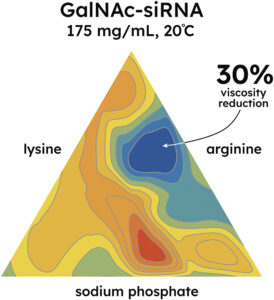
Figure 3: Ternary diagram showing relative viscosity of GalNAc-siRNA (175 mg/mL, 20˚C) across combinations of three excipients. Synergistic low-viscosity regions (blue) emerge at specific multicomponent ratios that are not predicted by a single excipient’s individual performance.
EVIDENCE OF EXECUTION
AEMS has applied its screening platform to formulations spanning mAbs, peptides and siRNA therapeutics. Figures 3 and 4 show representative ternary- and triangular-prism excipient maps generated from these campaigns. Each point represents a formulation screened at microscale (20 µL), with the resulting viscosity mapped across the combinatorial landscape. The diagrams reveal regions where specific excipient combinations produce viscosity reductions that no single component achieves alone – clear signals of synergistic interaction. These are not theoretical projections; they are experimental measurements drawn from AEMS’s automated screening infrastructure, running over 600 formulations per week using exclusively FDA-approved excipients.
The temperature-dependent prism in Figure 4 illustrates a further advantage of high-throughput mapping. By screening the same excipient landscape at 4°C, 20°C and 40°C, AEMS can identify formulation regions where low viscosity persists, independent of temperature. Rather than optimising for a single condition and subsequently testing thermal robustness, the platform selects for thermal stability from the outset. The result is a formulation that performs under cold-chain storage, ambient handling and accelerated stability testing without requiring re-optimisation at each stage.
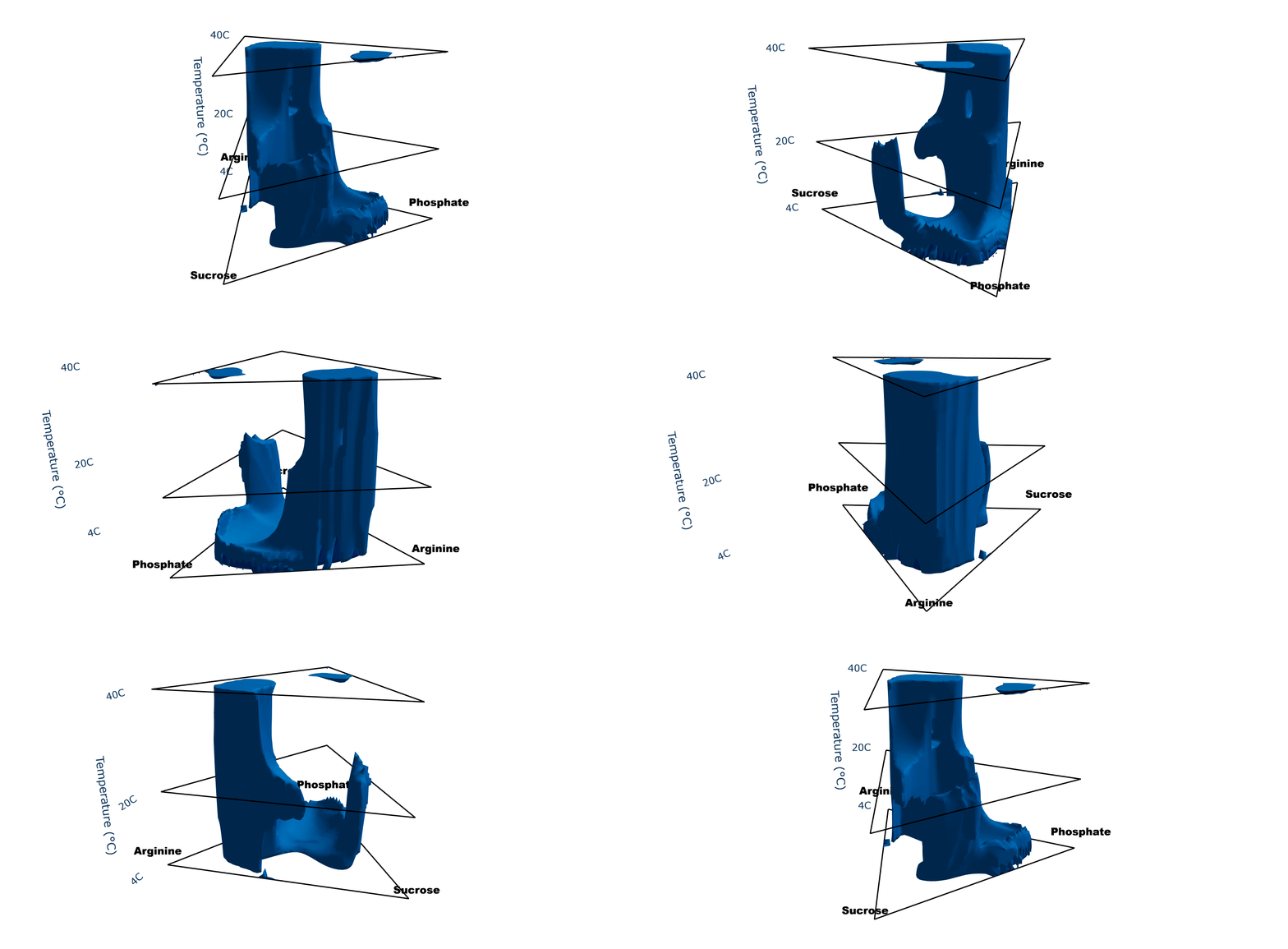
Figure 4: Temperature-dependent ternary prism showing relative viscosity of 175 mg/mL Immunoglobulin G across combinations of three excipients at 4˚C, 20˚C and 40˚C. By overlaying the three temperatures, the platform identifies formulation regions (blue) where low viscosity is maintained independent of temperature. This approach selects for thermal robustness during primary screening rather than verifying it downstream, reducing the risk of late-stage reformulation.
IMPLICATIONS FOR DEVICE AND COMBINATION PRODUCT DEVELOPMENT
Solving viscosity early changes device development entirely. When device engineers receive an optimised, low-viscosity formulation, the hardware picture simplifies. Viscosity below the standard SC threshold means commercially available PFSs work, and finer-gauge needles (27G or thinner) become an option, improving patient comfort.17
For teams evaluating SC feasibility for high-dose siRNA or biologic programmes, AEMS provides the viscosity data needed to make a confident route-of-administration call early, before committing to a specific device architecture or regulatory pathway. Furthermore, because the platform works exclusively with FDA-approved excipients, optimised formulations carry no additional excipient-related approval risk.
The practical result is not a single “magic excipient”. It is a systematic, data-driven navigation of chemical combinations that locates multicomponent interactions, while preserving flexibility for manufacturing, compatibility and regulatory requirements. Early screening data suggest that certain excipient combinations reduce viscosity across structurally distinct biologics, pointing towards underlying interaction principles that may reach beyond any single molecule. As the dataset grows, AEMS expects these recurring patterns to coalesce into reusable formulation starting points that accelerate development timelines for new candidates, regardless of modality.
CONCLUSION
- The Viscosity Barrier is Real and Growing: High-concentration biologics routinely hit viscosity limits that block SC delivery and standard device compatibility.
- Two-Component Screening is Not Enough: Current approaches cover only a tiny fraction of the available excipient combinations. Finding the most effective formulations often requires screening three or more components.
- Materials Science and ML Tools Show the Way: AEMS applies combinatorial screening methods and ML, validated in a published, SBIR-funded collaboration with UC Davis.
- Insights Transfer Across Modalities: Early data suggest that excipient combinations effective for one biologic class reduce viscosity in others, pointing towards reusable formulation starting points that accelerate future campaigns.
- Microscale Precision Preserves Scarce Material: Performing over 600 experiments per week at 20 µL volumes enables comprehensive, multi-dimensional screening using only FDA-approved excipients, without depleting early-stage drug substance.
- The Platform Screens for Thermal Robustness from the Start: By mapping viscosity across temperature simultaneously, AEMS identifies formulations that hold up under cold-chain storage, ambient handling and accelerated-stability conditions, reducing the risk of late-stage reformulation.
REFERENCES
- “Subcutaneous Biologics Market”. Report, Roots Analysis, Jun 2025.
- “Biologics Market Size, Share and Trends 2026 to 2035”. Report, Precedence Research, Jan 2026.
- Badkar AV et al, “Subcutaneous Delivery of High-Dose/Volume Biologics: Current Status and Prospect for Future Advancements”. Drug Des Devel Ther, 2021, Vol 15, pp 159–170.
- Mijangos LRR, Harding SE, Darton NJ, “Developing High-Concentration Monoclonal Antibody Formulations for Subcutaneous Administration to Improve Patient Treatment”. Biophys Rev, 2025, Vol 17(4), pp 1013–1031.
- Ghosh I et al, “Systematic Review of Commercial High Concentration Antibody Drug Products Approved in the US: Formulation Composition, Dosage Form Design and Primary Packaging Considerations”. mAbs, 2023, Vol 15(1), art 2205540.
- Cruz MA, Blanco M, Ekladious I, “Mechanistic and Predictive Formulation Development for Viscosity Mitigation of High-Concentration Biotherapeutics”. mAbs, 2025, Vol 17(1), art 2550757.
- “Peptide Therapeutics Market Size & Growth Report 2034”. Report, imarc.
- Hu C et al, “A New Approach for Preparing Stable High-Concentration Peptide Nanoparticle Formulations”. Pharmaceuticals, 2024, Vol 17(1), art 15.
- Anand P et al, “Metabolic Stability and Targeted Delivery of Oligonucleotides: Advancing RNA Therapeutics Beyond The Liver”. J Med Chem, 2025, Vol 68(7), pp 6870–6896.
- “siRNA Therapeutics Market Research Report 2033”. Report, Data Intelo, Sep 2025.
- ”Addressing Viscosity Challenges for Subcutaneous Injections”. Web Page, Merck, accessed Mar 2026.
- Hsuan N, “Excipient Selection in Biologics and Vaccines Formulation Development”. Eur Pharm Rev, 2014, Vol 19(1), pp 16–20.
- Zhang W et al, “Developability assessment at early-stage discovery to enable development of antibody-derived therapeutics”, Antib Ther, Vol 6(1), 2023, pp 13–29.
- “Methods for Phase Diagram Determination” (JC Zhao, ed). Elsevier Science, 2007.
- Potyrailo R et al, “Combinatorial and High-Throughput Screening of Materials Libraries: Review of State of the Art”. ACS Comb Sci, 2011, Vol 13(6), pp 579–633.
- Bridges DF et al, “Treatment of Alfalfa Seeds With Food-Grade Organic Acid Mixtures Reduces Loads of Pathogenic Escherichia Coli O157:H7 and Salmonella Typhimurium on Sprouts Without Reducing Germination Percentage or Sprout Mass”. J Food Prot, 2025, Vol 88(7), art 100513.
- Wang Y et al, “Improving Prefilled Syringe Injectability: Influences of Critical Component Attributes and Human Factors”. Eur J Pharm Biopharm, 2025, Vol 217, art 114901.