To Issue 188
Citation: Valencia D, Giralt M, “Injection-Moulded Prototypes From 3D-Printed Tooling: Accelerating Drug Delivery Device Development”, ONdrugDelivery, Issue 188 (Jul 2026), pp 68–71.
David Valencia and Martí Giralt discuss the value that 3D-printed tooling can bring to prototyping injection-moulded components for drug delivery devices, enabling rapid turnaround and iteration of designs while remaining functionally representative of the final commercial parts.
Industrialisation timelines for drug delivery devices are tightening, while regulatory expectations and human factors evidence requirements are increasing. Bridging early design intent with production-realistic mechanical performance is therefore critical for de-risking decisions and compressing time to market. 3D-printed mould inserts for injection moulding provide a direct path to functional polymer parts within days, enabling faster learning and earlier verification.
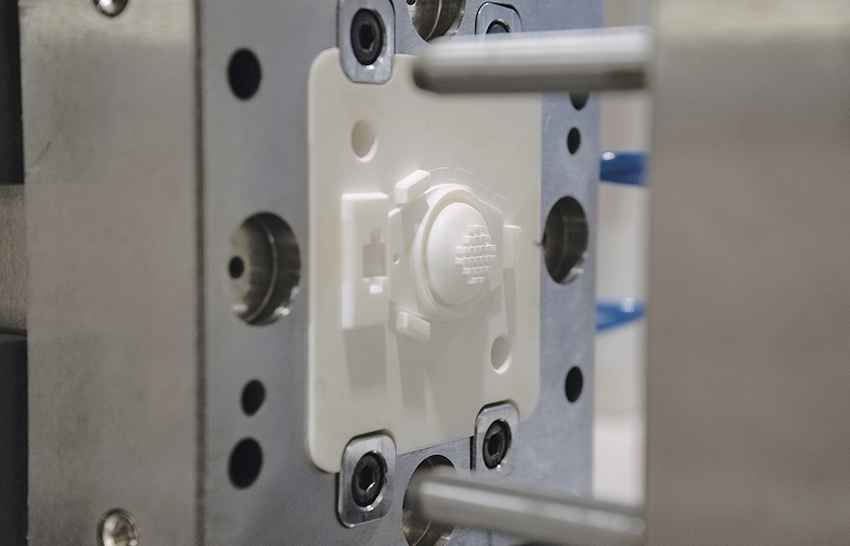
H&T Presspart now combines 3D-printed cavities, cores and inserts with laboratory injection moulding to produce prototype components in production-intended polymers within days, under production-like process conditions (Figure 1). This closes the gap between appearance models and functionally representative parts, de-risking critical design decisions for drug delivery device components while complementing the capabilities of the company’s Global Technology Centre.
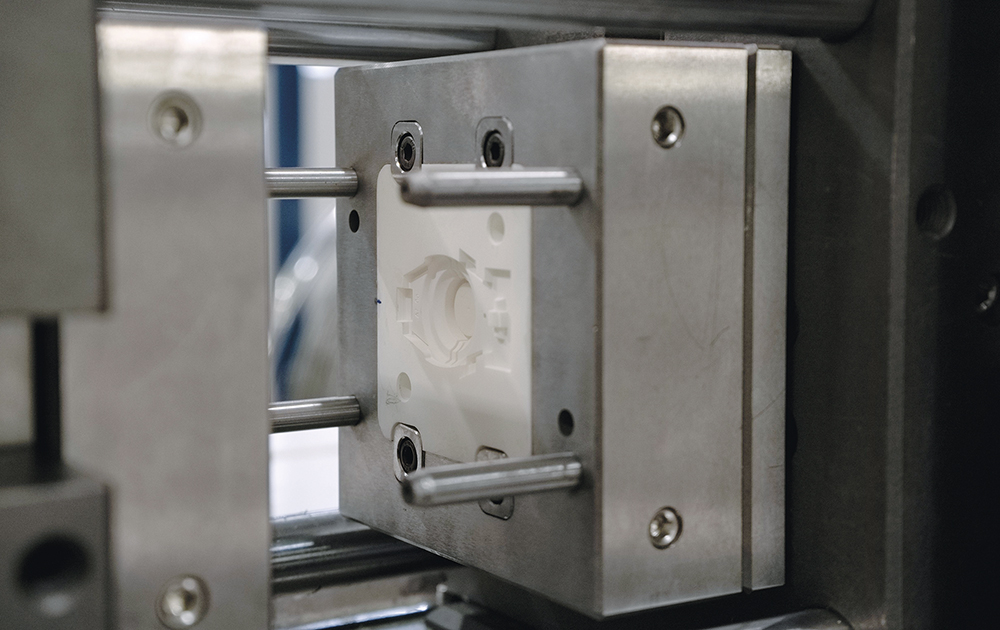
Figure 1: Whole cavity printed in ceramics, mounted in a frame tool and ready for moulding run.
“EARLY 3D-PRINTING IS INVALUABLE FOR FIT, FORM AND USER STUDIES, YET PRINTED MATERIALS RARELY REPLICATE THE MECHANICAL BEHAVIOUR OF THE FINAL APPLICATION-SPECIFIC POLYMERS.”
DESIGNING FOR REALITY: MECHANICAL FIDELITY IN DRUG DELIVERY DEVICES
Drug delivery devices live at the intersection of human factors, stringent performance requirements and regulatory scrutiny. Early 3D-printing is invaluable for fit, form and user studies, yet printed materials rarely replicate the mechanical behaviour of the final application-specific polymers. When decisions hinge on snap-fits that must survive multi-use cycles, torque transmission in dose counters, hinge durability in caps or creep- and dimensional stability-related concerns, teams typically wait weeks for machined steel tooling, incurring long lead times, high costs and increased risk.
Figure 2: Lilac moulded part in a cavity printed with high temperature resin.
PRODUCTION-REALISTIC PARTS, EARLY
Cavities, cores and inserts can be additively manufactured in high-temperature technical resins and used to mould short prototype runs in the same polymer grades that are intended for commercial production (Figure 2). Even with the limited lifespan of these printed tool components, the resulting parts provide:
- Expanded Material Exploration: Affordable, parallel evaluation of multiple polymer grades can be enabled by printing insert variants, enabling data-driven selection of material-geometry combinations early.
- Representative Mechanics: Parts reflect the true behaviour of final polymers processed by injection moulding.
- Faster Iteration: Insert designs, gate geometries and vent strategies can be reprinted overnight.
- Better Design for Moulding and Assembly: Weld lines, sink marks and warpage can be observed early, allowing part and tool designs to be optimised before production tools are started.
Modular Tooling with Specialist Support
In partnership with Cronomol SL (Barcelona, Spain), specialists in small components and micro-moulding, H&T Presspart has developed a modular mould base that can accept printed inserts. This architecture allows rapid swapping of resin cavities or inserts to match geometric and mechanical requirements, as well as enabling localised changes to specific features without rebuilding the full tool. The workflow is illustrated in Figure 3.
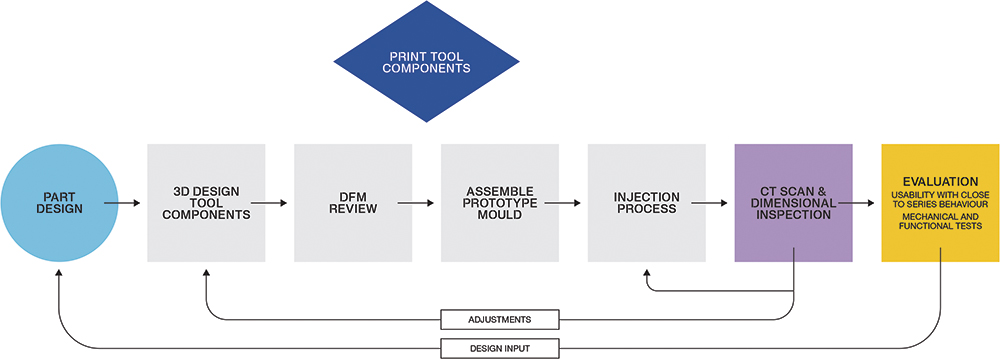
Figure 3: Workflow diagram.
Printed Insert Materials
- Ceramic-Filled Resin: Very high stiffness (~10 GPa) and heat deflection temperature (HDT) of > 280°C. Printed on a Stratasys (Minnetonka, MN, US) Origin+.
- High-Temperature Resin: HDT ≈ 240°C, with greater toughness than the ceramic-filled options. Printed on a Formlabs (Somerville, MA, US) Form4.
- Water-Breakable Resin: Withstands up to 300°C and dissolves or breaks down in water after moulding. This allows single-shot parts with complex geometries, avoiding costly and time-consuming sliders or other active mould mechanics. Even geometries not achievable with conventional injection moulding are possible. Printed on a Formlabs Form4.
“BY USING THE TARGET PLASTIC GRADES, MECHANICAL RESPONSES – SUCH AS STIFFNESS, IMPACT AND CREEP – CAN BE CLOSELY ALIGNED WITH THOSE OF THE PRODUCTION PARTS, ENABLING CREDIBLE FUNCTIONAL TESTS AND EARLY VERIFICATION ACTIVITIES.”
LABORATORY MOULDING UNDER CONTROLLED CONDITIONS
Prototype moulding is conducted on a BOY (Northants, UK) injection-moulding machine in a controlled laboratory environment. Target production parameters – melt and mould temperatures, injection and holding profiles, and cooling – are mirrored to bracket the future manufacturing window. By using the target plastic grades, mechanical responses – such as stiffness, impact and creep – can be closely aligned with those of the production parts, enabling credible functional tests and early verification activities (Figure 4).
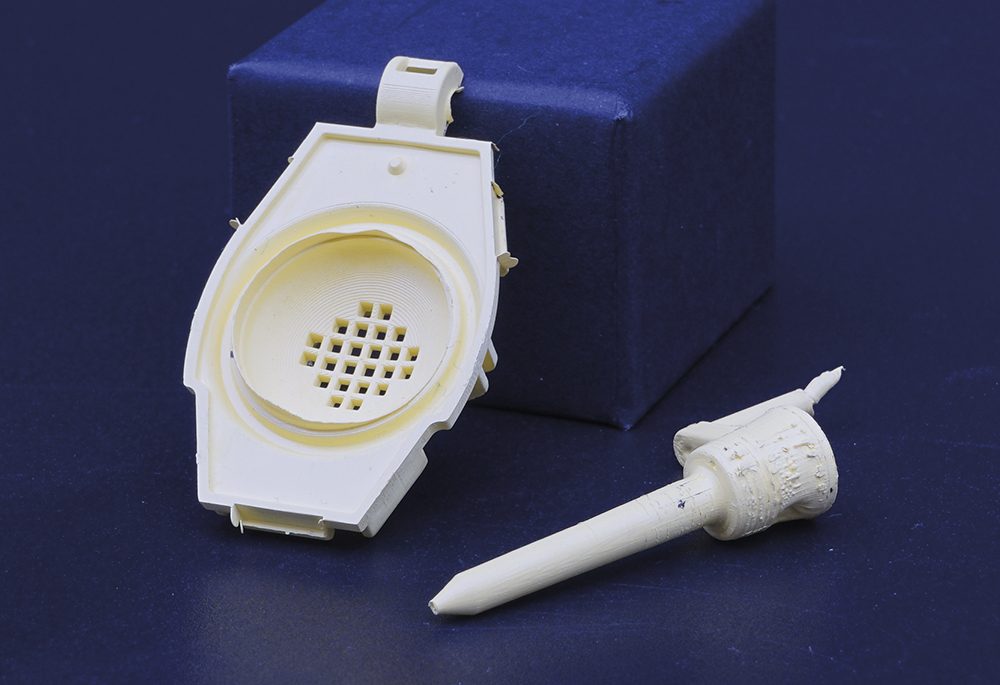
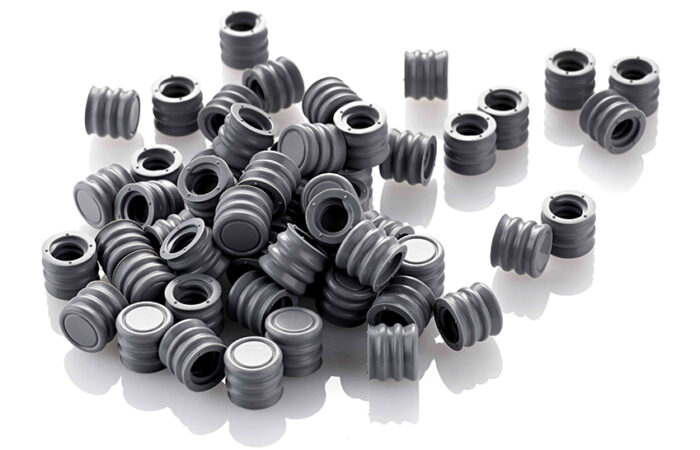
Figure 4: Prototype parts and cold runner sprue, moulded in first test run with high-temperature resin mould (some flashes and details to be optimised in subsequent loops).
Typical insert lifespans range from the tens to the low hundreds of shots, depending on resin, part geometry, gating, venting and cycle parameters. The lifespan can be extended by optimising gate and vent design, reducing melt and mould temperatures within spec, smoothing radii, improving cooling profiles and applying hybrid finishing where critical features require durability.
Accuracy, Finishing and Metrology
While printed polymer inserts do not equal steel in precision or wear resistance, several measures can help to narrow the gap:
- CT-Driven Iteration: Computed tomography (CT) metrology can guide dimensional corrections and rapid reprints
- Hybrid Refinement: Local milling or grinding of printed inserts where tight tolerances matter
- Surface finishing: Polishing and structuring of cosmetic or functional surfaces.
What This Enables in Device Programmes
- Early functional reliability with accurate dimensions, realistic snap-fits, flexible hinges, threads, gears and actuation mechanisms – by using the same material intended for the final product, the mechanical properties are effectively equivalent
- Moulded prototypes are suitable for formative human factors studies where tactile feedback and mechanical behaviour can influence results
- Early insights into gate and vent strategy, ejection and handling can provide input for mould and assembly design
- Reduction of development risks and more mature part understanding can reduce the need for tool reworks and facilitate faster convergence on robust designs.
Practical Boundaries
- Shot counts are limited by the insert resin, part geometry and process conditions
- Tolerances are wider than those of hardened steel, so critical features may require hybrid finishing
- The thermal conductivity of ceramic or resin inserts differs from an all-steel mould, often requiring longer cycle times due to reduced cooling to protect the inserts and achieve a stable process.
Process Steps
- Determine inputs, including computer-assisted design files, target polymers, estimated shot counts and critical features regarding quality and function
- Review part requirements against constraints of current setup and define any mould frame adjustments or hybrid metal features, if needed
- Select the insert material, the gate and vent strategy, and an iteration plan aligned with the verification needs and timelines
- Design and optimise the 3D prints to deliver reliable and consistent mould components, drawing on the expertise of the 3D-printer manufacturer and resin supplier
- Run prototypes under controlled parameters, capturing CT and functional data to drive rapid iterations.
CONCLUSION
By merging additive tooling with real-polymer injection moulding, production-realistic parts can be introduced into the earliest design loops. This approach accelerates learning, strengthens evidence for design development and human factors work, and reduces the risk of costly, time-consuming errors on the path to production tooling and market entry.