To Issue 188
Citation: Chen C, Flores A, “Innovation and Automation Reunited – Enabling Scalable Final Assembly for Cartridge-Based Autoinjectors”, ONdrugDelivery, Issue 188 (Jul 2026), pp 10–15.
Christy Chen and Alberto Flores explore the critical synergy between flexible automation architecture and expert final assembly services. Using SHL Medical‘s Reunite™ dual-chamber autoinjector and SHL Advantec‘s AOU™ assembly machine platform as a case study, the authors discuss how integrating agile automation technologies with robust final assembly operations can help to build highly resilient supply chain strategies that enable seamless scalability from clinical validation through to commercial launch and post-market scale-up.
The first wave of commercialised complex biologics changed self-injection devices in ways the industry did not anticipate. Treatments once limited to complex, manual handling processes were introduced into easy-to-use autoinjectors, establishing them as the industry benchmark for the self-injection experience.
Almost two decades after the launch of those first modern autoinjectors, complex biologics are introducing another layer of difficulty. Roughly a third of US FDA-approved parenteral medications entering the market are lyophilised products,1 and the entire injection device ecosystem is feeling the pressure. Device developers need to develop patient-centric devices that afford patients the level of convenience and safety that they expect; manufacturers and CMOs must accelerate speed-to-market to help their pharmaceutical customers capitalise on stringent launch windows; and equipment suppliers need to respond with agile manufacturing infrastructure capable of absorbing unpredictable surges in commercial demand.
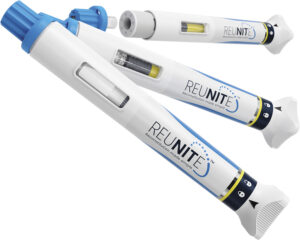
Figure 1: The Reunite autoinjector displayed in its three states of use (from bottom to top): locked, unused device with lyophilised drug visible; unlocked device following automated reconstitution; final post-injection state with extended needle shield.
From a device perspective, the industry is addressing the user experience gap through a range of innovative dual-chamber technologies, as highlighted in ONdrugDelivery’s first dual-chamber delivery systems issue, published in 2025.2 Prominent among these solutions is SHL Medical’s Reunite™ autoinjector – a three-step, dual-chamber device that automates reconstitution and injection while incorporating SHL Medical’s market-proven Needle Isolation Technology (NIT®), an integrated, pre-attached needle system that allows cartridges to function as ready-to-use autoinjectors (Figure 1).
The first lyophilised therapy using the Reunite autoinjector technology received marketing authorisation for prurigo nodularis and atopic dermatitis in the US in 2024, followed by the EU, UK and Switzerland in 2025. This milestone makes it the first lyophilised monoclonal antibody to be commercialised in a dual-chamber autoinjector with automated reconstitution and injection.
“THE ENGINEERING ELEGANCE THAT MAKES REUNITE SIMPLE FOR PATIENTS INTRODUCES UNIQUE REQUIREMENTS ON THE MANUFACTURING FLOOR – PARTICULARLY AT FINAL ASSEMBLY, THE LAST CRITICAL STOP BEFORE MARKET LAUNCH.”
The engineering elegance that makes Reunite simple for patients introduces unique requirements on the manufacturing floor – particularly at final assembly, the last critical stop before market launch. For pharmaceutical companies backing therapies with uncertain demand trajectories, the challenge is not just getting the device right; it is deploying an assembly infrastructure agile enough to support a quick initial launch that is also capable of scaling with the drug demand. By proactively synchronising the technical transfer of sub-assemblies with final assembly, CMOs can reduce the risk of capacity constraints at this critical stage and secure a smooth trajectory to commercialisation.
A HISTORY OF PIONEERING INNOVATION
SHL’s ability to scale complex technologies is rooted in over two decades of first-to-market innovations, including the launch of the syringe-based DAI® and Molly® autoinjectors in 2006 and 2015, respectively, and the first NIT-based cartridge autoinjector in 2017.
While these devices set the baseline for standard self-injections, SHL’s experience with lyophilised delivery represents yet another highly specialised lineage. SHL has previously successfully developed three separate devices for lyophilised therapies (Figure 2), making the fourth, Reunite, the culmination of 25 years of engineering excellence. While earlier iterations inherently required more user steps, SHL Medical’s underlying purpose remained uncompromisingly patient-centric, hiding the needle and automating critical user steps to reduce the burden and risk of manual preparation.
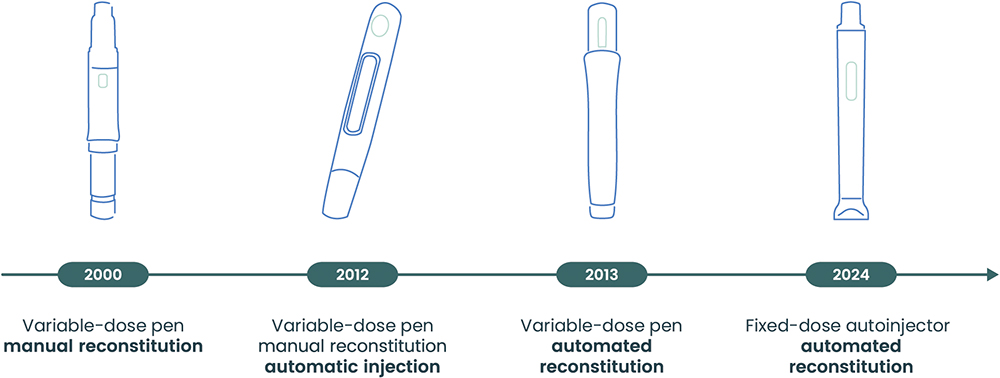
Figure 2: SHL Medical’s extensive history delivering dual-chamber device solutions for lyophilised therapies.
For all these projects, SHL’s automation engineers and final assembly experts played crucial roles in delivering the manufacturing infrastructure required for project success. This fully aligned approach to device design and production ensures that complex handling requirements are engineered into assembly and final assembly from day one, establishing the foundation for the manufacturing agility and scalability often required for innovative therapies.
DESIGNING RECONSTITUTION FOR SCALE
As SHL Medical’s flagship dual-chamber autoinjector platform, Reunite was designed to solve a multifaceted manufacturing challenge: supporting a combination drug product’s clinical validation – proving that a new formulation and an equally novel device mechanism functioned as intended in the clinical phase – while ensuring that the device could be assembled efficiently at commercial scale.
“REQUIRING JUST THREE STEPS – UNLOCK, UNCAP AND INJECT – TO OPERATE, REUNITE’S DUAL-CHAMBER CARTRIDGE RELIES ON HIGHLY PRECISE INTERNAL BYPASS MECHANICS AND STRICT SPATIAL TOLERANCES TO EXECUTE AUTOMATED RECONSTITUTION.”
From a final assembly perspective, translating this validated clinical performance to commercial production presented unique mechanical considerations. Requiring just three steps – unlock, uncap and inject – to operate,3 Reunite’s dual-chamber cartridge relies on highly precise internal bypass mechanics and strict spatial tolerances to execute automated reconstitution. The final assembly process needs to safeguard these features while the manufacturing equipment ensures that separate components – the NIT front sub-assembly (FSA), dual-chamber cartridge and rear sub-assembly (RSA) – are treated as a single, interconnected system whose ultimate clinical integrity depends on final assembly tolerances (Figure 3).
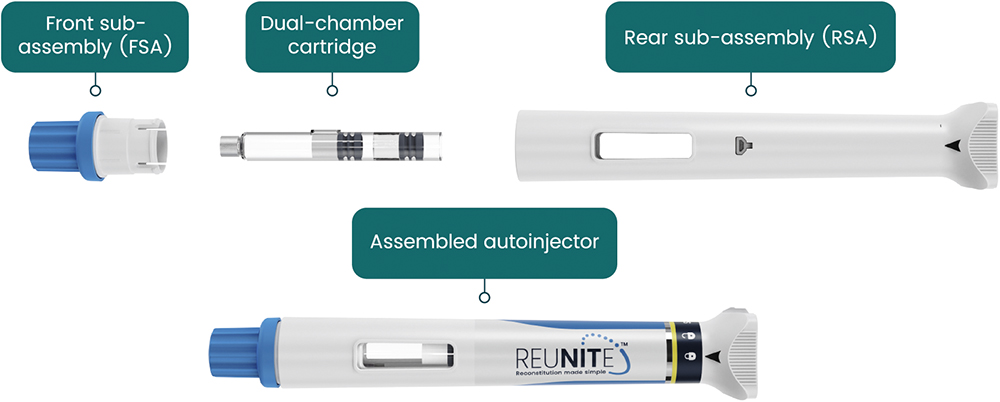
Figure 3: Reunite autoinjector parts for final assembly. Unlocking the RSA enables automated reconstitution. The FSA houses the sterile NIT system, which connects the needle to the cartridge septum upon cap twisting.
To bridge this gap between clinical validation and commercial reality, the device design and final assembly teams at SHL Medical, along with the automation engineers at SHL Advantec, adopted a concurrent design for manufacturing and assembly (DfMA) strategy during the early phases of development. Rather than adapting the final assembly process after device design was completed, the teams co-developed Reunite and the final assembly equipment’s architecture specifically to optimise automated handling.
This early alignment dictated stringent assembly requirements. The final assembly process was thoughtfully engineered to control orientation, verify alignment and monitor component insertion forces. High-resolution checks confirm part presence and orientation before any critical operation, while insertion forces are governed by exact control ranges. Coupled with final height verification and the automated segregation of nonconforming units, this integrated approach ensures that every autoinjector meets precise dimensional standards before progressing downstream.
By embedding these DfMA principles into the platform from the beginning, the micro-stresses and alignment errors that commonly plague complex multicomponent devices were prevented and breakthrough mechanics validated in the clinical phase were preserved at commercial scale.
ENSURING AGILITY AND QUALITY AT LAUNCH
Bringing cutting-edge therapies to market in novel drug delivery devices such as Reunite is a complex balancing act between quality, speed and navigating market uncertainty. This pressure is felt particularly by final assembly CMOs who bear the brunt of capital equipment investments. While lower initial launch volumes naturally call for entry-level, lower-throughput machines, the underlying market future extends beyond the volume forecast of a single commercialised product – it also encompasses the broader pipeline of subsequent drug-device projects on their way to help millions of patients manage their treatments.
To give the launch of the first Reunite project immediate agility and long-term scalability, SHL Advantec deployed the Advantec Oval Unlimited (AOU™) platform – a market-proven, oval track technology designed for highly flexible manufacturing strategies at SHL Medical’s final assembly site in Deerfield Beach (FL, US). The machine is currently configured for semi-automatic operations with manual loading and unloading stations, serving as an agile, cost-effective entry point for the drug’s initial commercialisation volumes.
“SHL’S COMMITMENT TO THE SUCCESS OF THE PROJECT IS UNDERPINNED BY A CULTURE OF UNCOMPROMISING QUALITY AND REGULATORY READINESS DEMONSTRATED AT ITS DEERFIELD BEACH SITE. FOLLOWING A RECENT FDA SURVEILLANCE INSPECTION, THE SITE SUCCESSFULLY CONCLUDED THE AUDIT WITH ZERO OBSERVATIONS.”
SHL’s commitment to the success of the project is underpinned by a culture of uncompromising quality and regulatory readiness demonstrated at its Deerfield Beach site. Following a recent FDA surveillance inspection, the site successfully concluded the audit with zero observations. This achievement highlights the critical synergy between advanced equipment architecture and expert final assembly services, proving that aligned manufacturing operations can deliver both speed and compliance.
INSIDE AOU: MODULARITY, PRECISION AND SCALABILITY
A deeply integrated modular platform, SHL Advantec’s AOU supports various manufacturing configurations in terms of device compatibility, container variation and production volume. This flexibility is enabled by decoupling the core machine base from project-specific modules and component feeding systems. Specifically, this strategic architecture delivers several distinct technical advantages:
- Multiproject Compatibility: AOU uses interchangeable grippers and fixtures equipped with a patent-pending Quick Project Change interface (Figure 4). Paired with a modular control system and an easy-to-operate human machine interface, AOU’s architecture enables efficient project changeover, supporting the rapid and flexible onboarding of a new device variant onto the same equipment.
- Primary Container Versatility: AOU features a fully automatic loader that can be built with in-feeding modules for tubs and/or Rondo trays. Capable of handling both syringes and cartridges – including dual-chamber systems – on the same equipment, the machine can be configured for a wider range of device types. This project-to-project adaptability significantly reduces capital expenses by eliminating the need to build dedicated, siloed lines.
- In-Line Quality Controls: AOU uses a suite of integrated technologies – including vision systems, force-monitoring load cells and laser sensors – to verify the integrity of the primary container, assembly processes and the final, assembled device. This rigid, data-driven approach to quality ensures that every device leaving the manufacturing floor meets critical quality attributes and performs exactly to its validated clinical specifications.
- Integrated Labelling Capabilities: AOU offers the flexibility to incorporate labelling modules from leading industry suppliers into the final assembly line. Thus, device assembly, labelling and packaging can be consolidated into a single manufacturing line, ensuring strict serialisation and traceability while significantly reducing overall equipment footprint.
- Seamless Automation Upgrades: AOU incorporates manual sub-assembly loading and assembled device unloading modules that can be efficiently replaced with fully automated handling systems as commercial demand grows. By removing the need for a complete machine overhaul, this modular approach allows throughput to scale with minimal downtime and significantly compressed revalidation cycles.
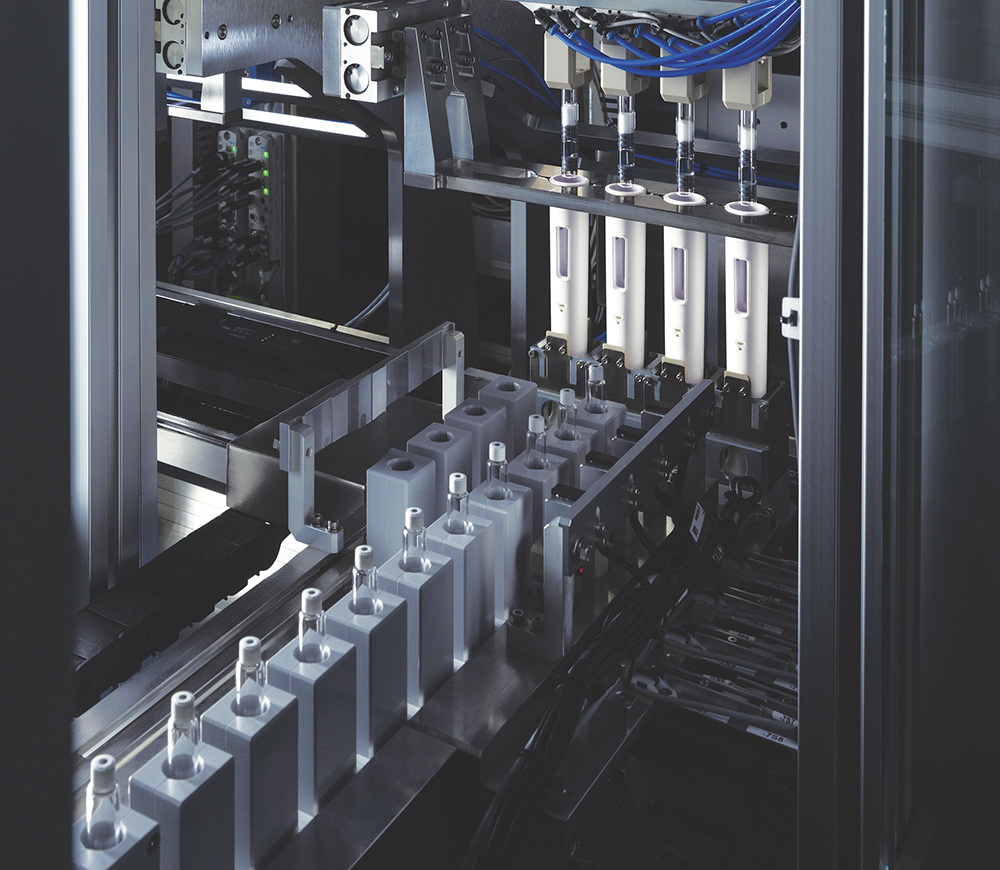
Figure 4: Interchangeable, project-specific puck carriers, fixtures and grippers on the transportation and assembly modules enable multidevice compatibility.
By isolating customisable modules from core assembly operations, final assembly sites can dynamically adapt to shifting pipeline demands, continuously deriving value from the original equipment infrastructure (Figure 5).
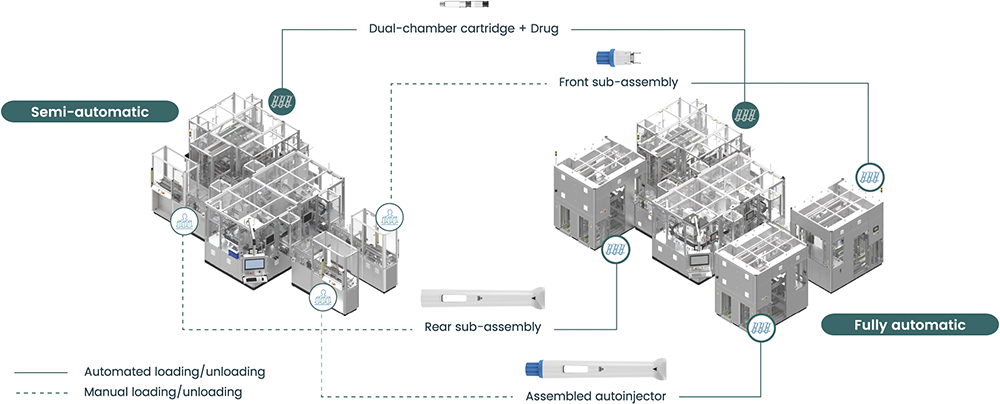
Figure 5: The final assembly AOU automation upgrade pathway with the Reunite autoinjector as an example. The semi-automatic configuration (left) is upgraded to a fully automated line (right) by replacing the manual handling stations with automated modules. The primary container loader remains unchanged.
CONCLUSION
The real-world impact of this modular assembly machine strategy is already unfolding at SHL Medical’s final assembly operations in Deerfield Beach. The first combination product built on the Reunite technology has generated a strong market response since launch, and preparations to upgrade the current semi-automatic line to a fully automated, high-speed commercial configuration are already underway. Furthermore, capitalising on the AOU’s inherent multiproject versatility, SHL’s engineering teams are actively collaborating to integrate two additional cartridge-based NIT autoinjectors – Maggie 3.0 and Maggie 5.0 – onto the same equipment, expanding the site’s output without requiring new machine installations.
Ultimately, the successful commercialisation of new therapies requires more than just cutting-edge drug delivery devices – it demands a manufacturing foundation capable of absorbing market uncertainty without compromising speed or quality. By adopting a highly robust platform-based equipment architecture, final assembly services can protect their investments while securing both launch agility and long-term scalability. When pharma, medtech and equipment engineers share a singular vision for patient care, the traditional barriers to scaling complex combination products dissolve. This shared commitment reflects the power of being aligned and united, working together to ensure that complex, innovative science safely reaches the patients who need it.
REFERENCES
- Kumar S et al, “Application of lyophilization in pharmaceutical injectable formulations: An industry and regulatory perspective”. J Drug Deliv Sci Technol, 2024, Vol 100, art 106089.
- Fetz N, “Advancing Lyophilised Drug Delivery with Reunite™: Reconstitution Made Simple”. ONdrugDelivery, Issue 177 (Sep/Oct 2025), pp 26–31.
- “Reunite™”. Product web page, SHL Medical, accessed Jun 2026.