To Issue 188
Citation: “Technology Showcase: Covestro – Digital Twin Technology for Autoinjectors”, ONdrugDelivery, Issue 188 (Jul 2026), pp 16–17.
Covestro outlines how digital twin methodologies, physics-based virtual models spanning structural testing, drop-test simulation and injection-moulding analysis, are helping engineers develop polycarbonate autoinjector components, reducing physical prototyping, tooling iterations and time to market while maintaining safety and reliability.
Digital twins – physics-based virtual models of materials, components and processes – enable engineers to simulate the full lifecycle of a part or device. From optimising mechanical and impact performance to simulating manufacturing by injection moulding, digital twins minimise or eliminate the need for physical prototyping, improving reliability, accelerating time-to-market and, ultimately, reducing costs.
Autoinjectors rely on precision-engineered plastic components that must maintain mechanical performance and dimensional stability under everyday conditions. Medical-grade polycarbonate is widely used for these applications due to its combination of toughness, transparency and chemical resistance. It is used for housings, plungers and safety guards, among other components, due to the following characteristics:
- Consistent toughness and rigidity across a wide temperature range
- Dimensional stability, which is critical for precise actuation and component fit
- Compatibility with common chemicals and sterilisation methods
- Amenability to micro-moulding for mass production of miniature components.
Newer designs favour high mechanical loads with the thinnest possible components, which presents challenges to both design and manufacturing. Polycarbonate has a long history and has been well-characterised, enabling digital-twin-based simulations and optimisation prior to building tooling.
STAGE 1 – STRUCTURAL AND MECHANICAL TESTING
Designs often begin with the evaluation of the mechanical performance of a material as a component in a device, under realistic loads. Finite-element analysis (FEA) predicts stress, strain and deformation under actuation, assembly forces and environmental conditions. Therefore, comprehensive materials data are required, going far beyond typical technical data sheet data.
This step validates whether the design can withstand the required loads and identifies potential weak points. The parts are subjected to a static load from a preloaded spring in the ready-to-use state while maintaining mechanical integrity (Figure 1). By comparing virtual predictions with physical measurements, the digital twin can be calibrated for improved accuracy in subsequent iterations, reducing the need for repeated prototyping.
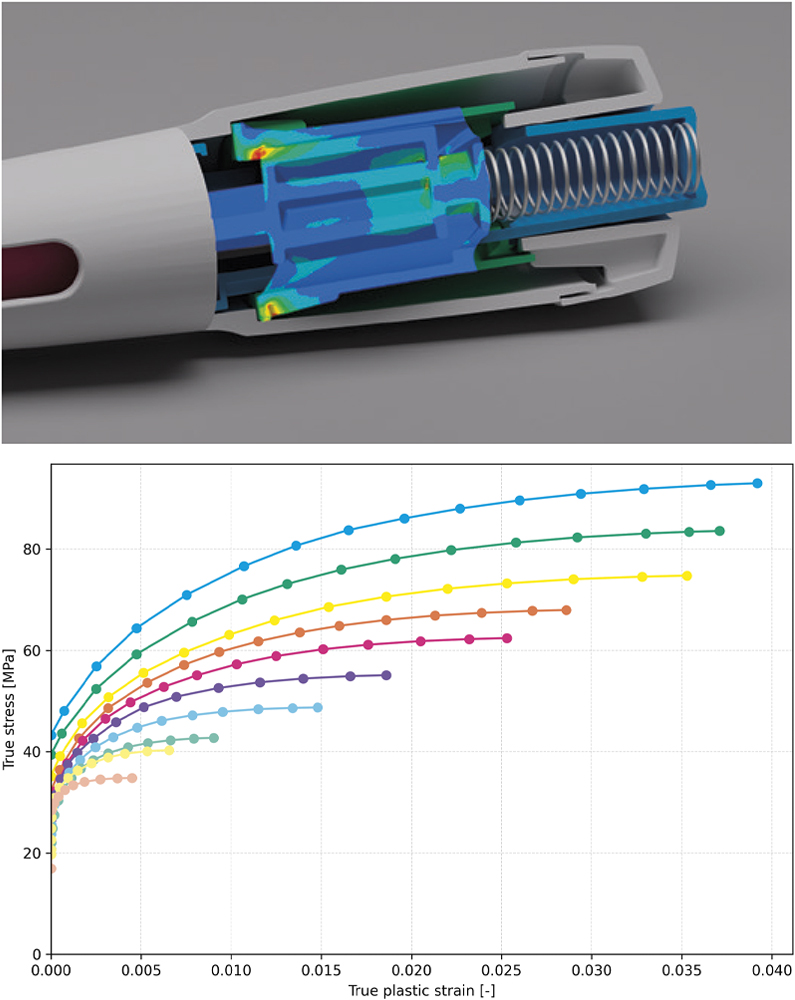
Figure 1: Evaluation of a static load case.
To increase time efficiency further, basic mechanical components, such as snap hooks, can be virtually designed and optimised with calculation tools that use artificial intelligence (AI). Covestro’s “FEMSnap AI” is an AI-powered tool that reliably predicts the snap-fit performance of designs with Covestro’s material portfolio early in development, based on extensive FEA data under realistic loading scenarios, accelerating designs towards an optimised geometry. This can significantly reduce testing and design-verification efforts or the risk of snap-fit failures, increasing reliability.
STAGE 2 – DROP-TEST SIMULATION
The next step evaluates impact resistance, simulating accidental drops that a device might experience during handling. Explicit-dynamics FEA captures transient stress and deformation, identifying areas of potential fracture or mechanism failure. High-quality material cards of the selected materials are required to generate accurate and reliable results.
Digital twin simulations enable the systematic assessment of design variations such as wall thickness, fillet radius and material selection, as well as helping to ensure structural robustness and minimise material usage. Upon validation, dynamic analyses, such as drop-test simulations (Figure 2), can be employed to significantly reduce the extent of physical testing required.
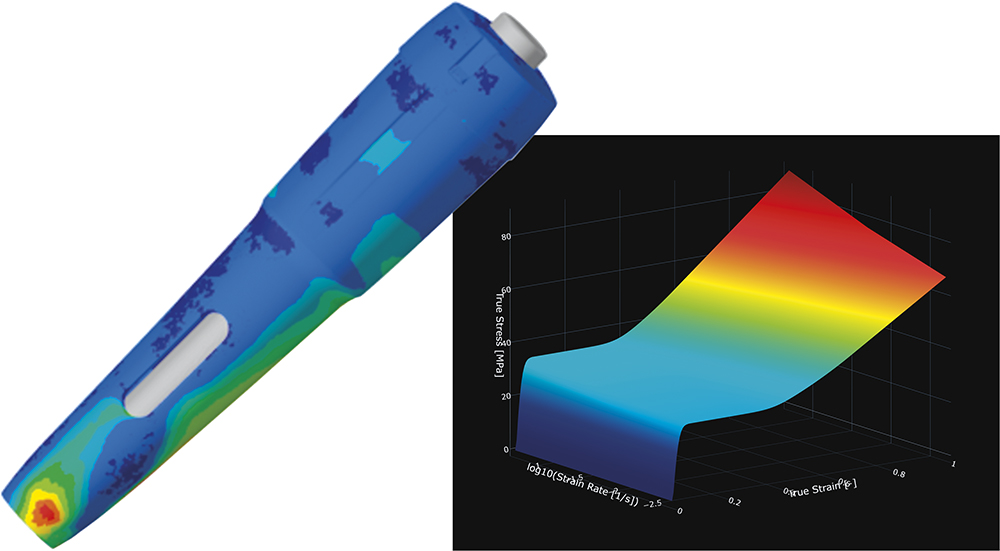
Figure 2: Drop test of an autoinjector.
STAGE 3 – FILLING SIMULATION
The final layer of the digital twin models is the injection-moulding process, predicting how the polycarbonate fills, cools and packs within the mould. Simulation tools such as Moldflow® or Moldex3D® allow engineers to assess:
- Flow-front progression and potential air traps
- Prediction of cavity pressure during the process
- Approximation of the location of weld lines (Figure 3)
- Cooling profiles and residual stresses
- Crucial information for the selection of injection-moulding machinery.
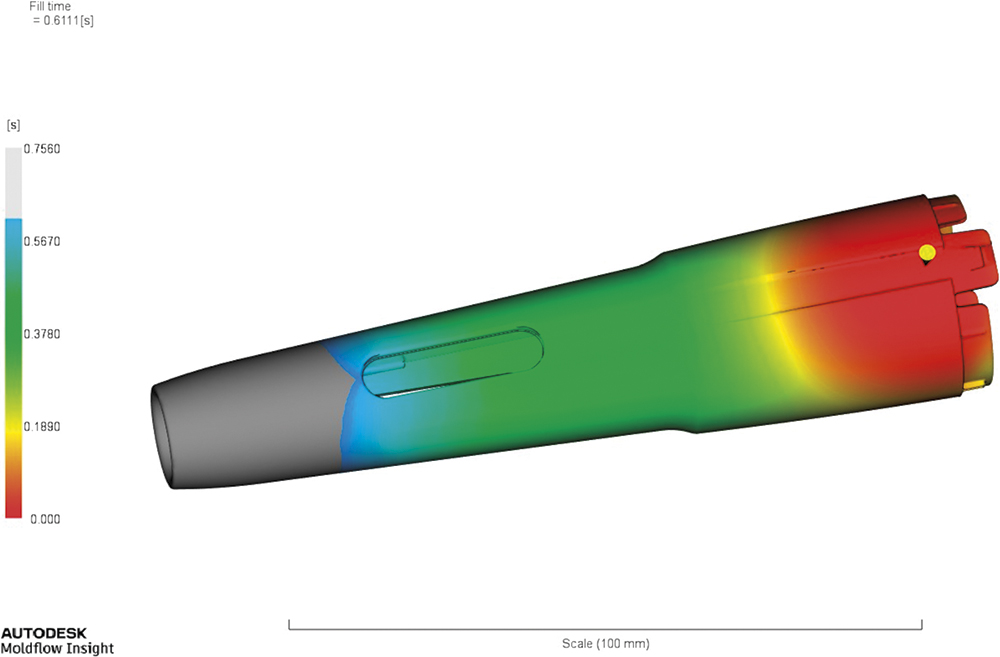
Figure 3: Filling simulation, identification of weld lines.
Filling simulations enable the optimisation of gate placement, moulding parameters and cooling channel locations to help maximise dimensional accuracy, reduce scrap rates and support thinner-walled or more complex designs without physical trial and error. Furthermore, cycle times can be simulated to estimate production speed and support more refined cost-per-part calculations.
SUMMARY
The application of digital twin methodologies to the development of polycarbonate components for autoinjectors presents significant technical, economic and sustainability advantages. By integrating injection-moulding simulations, structural analyses and dynamic impact assessments within a unified framework, design iterations can be evaluated virtually, reducing tooling loops, scrap and manufacturing costs, as well as accelerating time to market.
The predictive capability of digital twins is reinforced through systematic physical validation. Mechanical testing under representative service loads allows direct comparison between simulated and experimental results, enabling calibration of the virtual model and increasing confidence in subsequent design iterations. This approach significantly reduces the cost and time spent on physical tests while maintaining compliance with demanding safety and reliability requirements.
The effectiveness of this methodology relies on the availability of accurate and comprehensive material data. Covestro can provide validated material cards for injection moulding, structural and impact simulations. Where application-specific or extended datasets are required, missing material parameters can be measured and generated in-house, ensuring consistency across all simulation domains and enabling a high level of predictive accuracy.
Overall, digital twins present a comprehensive and sustainable engineering framework for autoinjector development, supporting thinner, lighter and more complex polycarbonate components without compromising safety or reliability, while simultaneously reducing development costs, material usage and environmental impact.