

To Issue 188
Citation: “Interview with David Karvani and Greg Moakes: Off The Critical Path: Bringing Device Strategy Forward in Combination Product Development”, ONdrugDelivery, Issue 189 (Sep 2026), pp 64–68.
While emerging biotech and small-to-mid-sized pharmaceutical companies often possess strong molecules, they have limited in-house device and combination product infrastructure, meaning that, if they treat the delivery system as a late-stage procurement decision, it can frequently land squarely on the critical path. Considering this situation, David Karvani and Dr Greg Moakes discuss how, to navigate the complex technical and regulatory hurdles inherent to device development efficiently, pharma sponsors increasingly need to enter into a collaborative ecosystem early in the development lifecycle.
Q Emerging biotech and small-to-mid pharma often have a strong molecule but limited device and combination product infrastructure – where do these companies struggle most, and how do your respective roles make it easier?
DK The pattern across the industry is fairly consistent: a company spends years de-risking its molecule and the device gets treated as something to solve later, until a clinical or regulatory milestone forces the issue and it suddenly lands on the critical path. By then, the team is making device decisions under time pressure, often without the in-house design controls, human factors or combination-product regulatory experience to give them the confidence they need.
As an integrated device partner, taking that work off the critical path before it becomes a crisis is exactly what we do, serving as a complete device organisation for our pharma clients. Early on, that means translating the target product profile – dose, volume, viscosity, patient setting and dosing frequency – into a concrete set of device requirements so that the pharma company can choose a delivery approach against defined criteria rather than simply reacting to whatever is in front of it. After that, we do the feasibility work that connects the formulation to a real device and primary container so that the development team does not lock in a formulation that no available device can actually deliver.
GM Based on what I have seen, this is where the synergy between a proven platform manufacturer and an integrated device partner creates value. At LTS, for example, we bring significant electroanalytical and biomechanical engineering depth, validated on-body delivery system platforms, extensive device master file data and active clinical and regulatory support. In so doing, we help translate complex formulation realities into reliable, validated device inputs.
On the other side, integrated device partners can provide the flexible execution support that many emerging sponsors lack, including establishing the design control framework, risk management, human factors planning, as well as a combination product regulatory strategy that is decided deliberately rather than defaulted into. Underneath all of that is programme management that keeps the device workstream aligned with the clinical and chemistry, manufacturing and controls (CMC) timelines so that they arrive together. This way, the sponsor’s team can stay focused on its molecule while an experienced device infrastructure runs the programme in parallel. What changes is that decisions are made earlier, with better information and with fewer expensive reversals later.
“THE TROUBLE SHOWS UP AT THE INTERFACES – WHO OWNS THE USE-RELATED RISK ANALYSIS, WHOSE DOCUMENT IS THE SOURCE OF TRUTH FOR A GIVEN REQUIREMENT AND HOW DO DESIGN CHANGES FLOW BACK INTO DRUG STABILITY?”
Q Once a company decides to move forwards, how do you actually divide the work, and where are the handoffs between an integrated device partner and a platform manufacturer?
DK The honest answer starts with how it usually goes wrong. A sponsor typically contracts a device manufacturer and a fill-finish CDMO separately and then tries to co-ordinate them itself while running clinical programmes. The trouble shows up at the interfaces – who owns the use-related risk analysis, whose document is the source of truth for a given requirement and how do design changes flow back into drug stability?
The cleanest way to think about the division is by constituent parts (Figure 1). First, the device platform manufacturer owns the platform design, device level design history file, device master record and validated manufacturing processes. Secondly, the integrated device partner sits on the sponsor side to help manage system-level requirements, creation and management of the combination product-level design history file and risk management file, human factors execution, quality system updates and regulatory strategy, along with managing the device manufacturers and vendors. Finally, the pharma sponsor owns the molecule, the clinical programme, the overall combination product design history file (DHF) and the final regulatory submission.
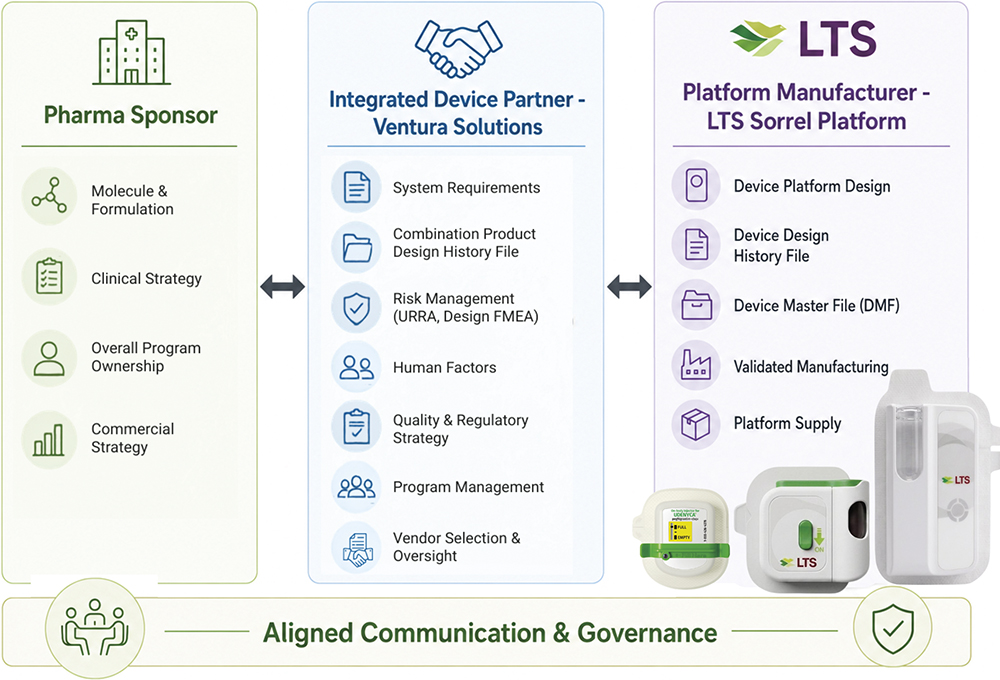
Figure 1: Collaborative model and ownership across the pharma sponsor, integrated device partner and platform manufacturer.
GM The point worth emphasising is that, while external partners can bridge resource gaps, the sponsor always retains ultimate ownership of the full combination product system and the DHF. In practice, the device team defines the system requirements from the target product profile and passes on the device-relevant ones to the platform manufacturer, who confirms what the platform can achieve and feeds back its design inputs and constraints.
The important point is that the sponsor builds and owns its own combination product DHF, and that work sits with the sponsor device team, whether it is internal or external. The combination product DHF incorporates that device design information, but it remains the sponsor’s document, created on the sponsor side, not inherited. Design reviews are the sponsor’s own internal process, run by the sponsor’s device team, not a joint exercise with the platform manufacturer. Furthermore, change control is led by the sponsor, with the platform manufacturer brought in as needed based on what a given change actually touches, so any device-relevant change gets the manufacturer’s input while the sponsor stays accountable for the combination product as a whole.
“THE BREAKDOWN WE SEE MOST OFTEN IS THE LATE HANDOFF, WHEN A SPONSOR HANDS A FINISHED FORMULATION TO A PLATFORM MANUFACTURER, OR A FINISHED DEVICE TO A FILL-FINISH PROVIDER, WITH NO INTEGRATING PARTY, AND THE INTERFACES GET DISCOVERED DURING VERIFICATION OR, WORSE, DURING A REGULATORY REVIEW.”
This only works if that split is agreed at the start. The breakdown we see most often is the late handoff, when a sponsor hands a finished formulation to a platform manufacturer, or a finished device to a fill-finish provider, with no integrating party, and the interfaces get discovered during verification or, worse, during a regulatory review. Defining the division early is not bureaucracy – it is what prevents the need for rework down the line.
This approach also lets the device platform manufacturer do what it does best. When the requirements arriving at its door are clear and the regulatory path is already chosen, a validated platform can be quickly configured against those requirements, rather than absorbing requirement churn.
Q For the sponsor, what actually changes when both a device team and a platform manufacturer are engaged early? What does it mean for project risk, timelines and decision-making?
DK The benefits are easiest to see by looking at where combination-product programmes usually lose time and money, which is late in development. Costly failures include reopening a design freeze to address previously unidentified human factors issues, reworking formulations due to primary container compatibility issues or revising regulatory pathways that do not support the intended product presentation or labelling.
“ENGAGING A DEVICE TEAM AND DEVICE PLATFORM MANUFACTURER EARLY HELPS TO IDENTIFY THESE ISSUES SOONER. THE SAME QUESTIONS ARE ADDRESSED AT THE START, WHEN ANSWERS ARE EASIER AND LESS COSTLY TO ACT ON, RATHER THAN DURING VERIFICATION OR REGULATORY REVIEW.”

Figure 2: The delivery device sits at the intersection of the molecule, primary container, manufacturing, human factors, design and regulatory workstreams.
Engaging a device team and device platform manufacturer early helps to identify these issues sooner. The same questions are addressed at the start, when answers are easier and less costly to act on, rather than during verification or regulatory review. For the sponsor, this reduces development risk in practical terms – fewer late design changes, fewer human factors surprises and a regulatory strategy selected deliberately rather than discovered by default (Figure 2).
Taking this approach also improves the quality of decision-making. A lot of the device missteps we see come from a narrow view of what is available. A company defaults to the modality it has seen before and either overengineers a problem or picks an approach the molecule does not actually need. Mapping the solution space up front, with people in the room who have run these programmes before, means that choices are made against defined criteria rather than by habit. The sponsor is not guessing.
GM There is a capital efficiency angle too, and it applies to both halves of the collaboration. On the device platform side, a validated platform avoids paying to design and qualify a device architecture from scratch – a substantial investment for a capability the sponsor may only need intensively during specific phases. The same logic then applies on the development side; standing up a full design control, human factors and combination product regulatory team in-house is a large investment to make right at the start of a programme.
Most sponsors will grow into these capabilities in time – they tend to need them for lifecycle management and as their portfolio expands, and many build out their own device teams as they scale. The real question is timing. An external device team can provide that capability in the early phase, when building it internally would be premature, and the internal function gets built later, when the timing is right rather than under pressure. Between the two, the money stays pointed at the molecule and the clinic.
The honest caveat is that most of this upside depends on engaging early. The same two parties can still help a programme when brought in late, but by then the work is mitigation rather than prevention, and the savings are smaller. If there is one benefit that the sponsor feels most directly, it is the speed of reaching clinic.
Q If you could give an emerging biotech one piece of guidance before they start their device programme, what would it be? And what does getting it right look like?
DK If there is one thing worth changing, it is not only the timing but also the resources brought into the programme. Many teams treat the device as a procurement decision to be made near the end of development, once the molecule has been de-risked and the formulation largely finalised. This instinct is understandable because no sponsor wants to commit significant resources to a device for an asset that may not progress through early clinical development. However, waiting too long, or proceeding without the appropriate device engineering, human factors, quality and regulatory expertise can allow critical decisions to be made without fully considering their implications for the combination product.
“ENGAGING EARLY DOES NOT MEAN LAUNCHING A FULL DEVICE DEVELOPMENT PROGRAMME OR COMMITTING SIGNIFICANT CAPITAL BEFORE THE ASSET IS READY, IT MEANS ESTABLISHING THE APPROPRIATE FOUNDATION.”
Engaging early does not mean launching a full device development programme or committing significant capital before the asset is ready, it means establishing the appropriate foundation. A sponsor can define the target product profile, assess technical feasibility, identify potential platform and primary container options, and develop an initial regulatory strategy while meaningful flexibility still exists.
This early work may also include determining whether engagement with the US FDA or another regulatory authority would help clarify the proposed development pathway, intended presentation or combination product requirements. In parallel, the sponsor can begin assessing whether its pharmaceutical quality system requires additional procedures or updates to support applicable combination product requirements, including the integration of device-related quality system requirements.
At the product level, the team can establish the initial design control framework, begin building the sponsor-owned DHF, develop preliminary system and device requirements, initiate risk management and define how responsibilities will be divided among the sponsor, platform manufacturer, primary container supplier, fill-finish partner and other development providers. The cost of this foundational work is generally modest relative to the overall programme. More importantly, it allows subsequent platform selection, development planning and capital commitments to be made using technical evidence and a defined regulatory and quality framework, rather than under deadline pressure.
GM I would add that a sponsor should treat the device as a system-level development decision rather than as a component purchased at the end. The questions that matter are development questions, not procurement ones. Can the formulation be delivered at the intended volume and viscosity? Does the use scenario introduce risks that must be addressed through design, labelling or training? Does the proposed regulatory pathway support the intended product presentation and labelling? These questions are less costly and less disruptive to answer before the platform and formulation are locked.
What “good” looks like is often fairly unglamorous. It is the kind of work that may go unnoticed precisely because it prevents a problem from occurring. Consider, for example, a mid-sized biopharmaceutical company developing a high-volume, high-viscosity biologic. In a late-engagement scenario, the team may finalise the formulation without sufficient input from the device and primary container workstreams. It could then discover during later development that delivery forces, container performance, delivery duration or other system constraints are incompatible with the intended presentation. Addressing those issues at that stage may require changes to the formulation, primary container, device strategy or clinical plan.
Conversely, when the sponsor engages a device platform manufacturer and an experienced combination product device partner during initial product profiling, feasibility can be assessed before the formulation and primary container configuration are finalised. The team can evaluate established platform parameters, including deliverable volume, viscosity, flow rate, delivery duration, container compatibility and intended use conditions.
For example, the LTS Sorrel platform has been characterised using primary container configurations supporting delivery volumes of up to 25 mL and formulations with viscosities exceeding 170 cP. Its software-controlled delivery profile also allows delivery parameters to be adjusted within the platform’s operating range based on the characteristics of the drug product and the intended administration profile.
Using these platform-specific data early allows the sponsor to determine whether the formulation, primary container and delivery requirements are compatible before key product decisions are locked. Where constraints are identified, the formulation or delivery strategy can be adjusted while options remain available, reducing the likelihood that device feasibility becomes a critical-path issue later in development.
By the time the molecule reaches its next key clinical milestone, the sponsor can already have a defined device strategy, preliminary requirements, informed regulatory pathway and feasible platform direction. This helps keep the device workstream aligned with the clinical and CMC programmes rather than allowing it to become a source of delay.
This is also why the entry point matters. A sponsor does not need to commit immediately to a full device development programme to benefit from early engagement. A focused feasibility effort can answer the questions that matter most, including rheological feasibility, primary container compatibility, delivery profile, intended use and platform fit. This targeted work represents a relatively small investment compared with the overall programme and allows the sponsor to make critical decisions using real data before significant capital is committed.
“EMERGING COMPANIES RARELY RUN INTO TROUBLE BECAUSE THEY LACK AMBITION; MORE OFTEN, THE DEVICE QUESTION SIMPLY GETS ASKED TOO LATE, AFTER THE FORMULATION, THE PRIMARY CONTAINER, THE CLINICAL STRATEGY OR THE INTENDED USE HAS ALREADY NARROWED THE OPTIONS.”
Q Any final thoughts for a team about to start?
DK If I had to leave a sponsor with one thought, it is this – the device is not a late-stage purchase, it is an early development decision. Emerging companies rarely run into trouble because they lack ambition; more often, the device question simply gets asked too late, after the formulation, the primary container, the clinical strategy or the intended use has already narrowed the options. Bringing a platform manufacturer and a device partner into the conversation early, before the formulation is locked and while the regulatory path is still open, does not add cost or complexity, it removes the reversals that quietly consume both. For a lean team with a promising molecule, that is often the difference between a device workstream that supports the development programme and one that ends up holding it back.