
To Issue 191
Citation: McGrattan P, “End-of-Dose Click-Bait: Harder Than it Sounds”, ONdrugDelivery, Issue 191 (Oct 2026), pp 40–43.
Peter McGrattan focuses in on the particular challenge of engineering an end-of-dose click for autoinjectors, examining the key design tensions, increasing regulatory attention, the trade-offs between different power mechanisms and how potential alternative feedback mechanisms may play into the design.
Engineering the “perfect” end-of-dose click has long been recognised as a deceptively difficult challenge. While often viewed as a relatively small feature, the ability to generate a reliable and meaningful end-of-dose indication can be strongly influenced by the wider device architecture. As injectable therapies become increasingly commonplace, driven in part by the rise of glucagon-like peptide-1 (GLP-1) products, and device requirements continue to evolve towards larger volumes, longer injections and more demanding delivery profiles, this seemingly simple challenge has only become more relevant.
End-of-dose clicks can play a critical role in helping users identify when dose delivery is complete, reducing the risk of premature device removal resulting in an incomplete delivery. As regulators place increased focus on essential drug delivery outputs, end-of-dose indication is increasingly being treated as a critical aspect of device performance that must be understood, characterised and assessed. However, defining, designing and validating an acceptable click is not straightforward. A click that is clearly audible during laboratory testing may be far less noticeable during real-world use, making it essential to assess click performance in representative conditions early in development.
With rising demand for powered injectors, including both autoinjectors and on-body devices capable of delivering larger volumes and more viscous drugs, longer injection times are becoming increasingly common. As delivery times increase, users become ever more reliant on clear, unambiguous feedback to know when dosing is complete. In some cases, a traditional end-of-dose click may no longer be sufficient, making alternative forms of user feedback increasingly relevant.
While the challenge of creating reliable end-of-dose feedback remains, today’s device architectures introduce a new question: how can the mechanism used to generate end-of-dose feedback influence the architecture of a powered injection device itself? As the industry moves beyond traditional spring-powered systems in pursuit of accommodating increasingly demanding drug products, end-of-dose feedback is becoming more than a usability consideration – it is increasingly shaping fundamental architectural decisions that can ultimately affect patient error, device complexity and treatment effectiveness.
TIMING SENSITIVITY
Human factors teams will often, understandably, want the end-of-dose click to indicate that delivery is complete and the device is safe to remove. In practice, this can be deceptively difficult to achieve. The reason is that, to trigger a click, something generally has to be moving. To ensure robust performance against manufacturing variation, the trigger will typically be actuated while the plunger is still moving. At that moment, the drug may still be flowing and delivery is therefore not yet complete.
This is one reason that users are often instructed to wait for a period after hearing the click before removing the device. That hold time effectively compensates for variability in manufacturing tolerances, friction, fluid properties and delivery dynamics. As a result, it must generally be longer than required for most individual devices to ensure robust performance across the wider product population.
Demonstrating that this margin remains adequate under all foreseeable conditions can be challenging. Towards the end of delivery, available drive energy and flow rate may be at their lowest, while visual cues, such as plunger movement, become increasingly subtle. These effects are particularly significant for high-viscosity, low-flow-rate systems, where relatively small changes in viscosity, friction or available energy can disproportionately affect the final stages of delivery. This creates a fundamental timing trade-off (Figure 1):
- Trigger the click too early and the user may remove the device before delivery is complete
- Trigger it too late and friction, tolerance stack-up or an exhausted energy budget may prevent it from occurring at all.
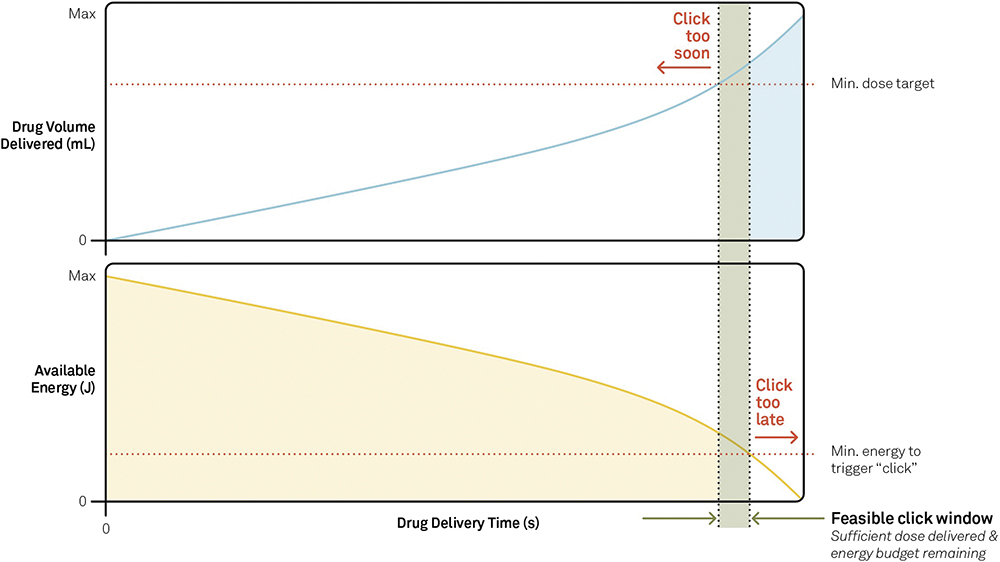
Figure 1: Visualising the challenge of timing an end-of-dose click.
“THE GOAL IS NOT SIMPLY TO GENERATE A CLICK, BUT TO GENERATE ONE AT THE RIGHT MOMENT, EVERY TIME.”
The goal is not simply to generate a click, but to generate one at the right moment, every time. Whether that is achievable depends heavily on the underlying device architecture and, perhaps most importantly, where the energy for that feedback comes from.
CLICK OR TWIST?
For decades, spring-powered autoinjectors have dominated the injection-device landscape. More recently, gas-powered and electromechanical architectures have emerged that may be better positioned to support the move towards larger volumes and longer injection durations. In theory, these approaches can offer greater delivery capability for a given device size while reducing reliance on highly stressed components required to retain large spring loads over extended periods.
But what impact do these alternative energy sources have on end-of-dose feedback? Do they offer meaningful advantages over traditional spring-powered systems, or do they simply introduce a different set of engineering and usability challenges?
Gas-Powered Systems: A Click and a Hiss?
Gas-powered systems can offer significantly greater delivery capability for a given device size. From an end-of-dose feedback perspective, this can also appear attractive. Unlike spring-powered systems approaching full extension, there may still be substantial energy available to generate a noticeable click at the end of delivery.
However, the timing challenge does not disappear – it may even become more complex. Gas venting often needs to begin before delivery is truly complete, meaning any end-of-dose trigger must either occur while the drug is still flowing or rely on an additional mechanism that operates after delivery has ended. In this sense, the architecture changes the problem rather than eliminates it.
Gas-powered systems can also introduce more prominent competing sounds. A click generated during or shortly after gas venting may need to compete with an accompanying hiss. Unlike the familiar click associated with many mechanical devices, patients may have little prior experience interpreting such sounds as indicators of dose completion. As a result, designers may be more inclined to supplement or replace audible indicators with tactile or visual feedback mechanisms.
Electromechanical Systems: Click by Choice or Consequence?
Electromechanical systems present a different set of opportunities and challenges. Unlike spring- and gas-powered architectures, the end-of-dose indication need not be directly coupled to the delivery mechanism itself. However, motors and drive systems often generate a range of noises throughout delivery, meaning that there may already be a number of clicks and buzzes to contend with before any deliberate end-of-dose feedback is introduced. These competing signals may need to be managed to ensure that the intended feedback remains clear and unambiguous.
With sufficient battery capacity remaining, designers have considerable freedom to generate audible, tactile or visual feedback at dose completion. This flexibility can be attractive from a user-feedback perspective, although the associated complexity and cost often make such systems better suited to reusable platforms than disposable devices.
Spring-Powered Systems: Better the Devil You Know?
Spring-powered systems offer some obvious advantages. The relationship between stored spring energy and delivery performance is well understood, making these devices highly predictable, simple and cost-effective. Unsurprisingly, they remain the dominant architecture for single-use injection devices. However, spring-powered systems also present some particular challenges when it comes to end-of-dose feedback.
As already discussed, managing feedback close to dose completion becomes increasingly difficult because the available spring energy is approaching its minimum. In many devices, the prominence and reliability of the click are therefore closely linked to how that remaining energy is managed. Various delayed-click mechanisms have been introduced to overcome these limitations by storing and releasing energy independently of the delivery spring. While effective, these approaches add parts, complexity and cost, and may also introduce additional timing sensitivities of their own.
Choosing the Right Power Source
It is clear that no power source completely solves the end-of-dose feedback problem. Spring, gas and electromechanical systems simply shift the balance between timing, energy availability, complexity and cost. While electromechanical systems may offer the greatest freedom to generate deliberate feedback events, their cost clearly favours reusable platforms. For disposable devices, the humble spring-powered click remains difficult to beat for simplicity, while gas-powered systems may offer a more favourable energy budget for a given form factor.
Ultimately, the decision should come down to the requirement and what is considered acceptable. After all, feedback is not free. Is the goal the click of a computer mouse or a torque wrench? And what impact do the energy, space and complexity required to achieve that feedback have on other aspects of device performance, from delivery capability to the risk of premature device removal?
ENGINEERING THE PERFECT CLICK
Engineering the perfect end-of-dose click remains anything but a simple design challenge. Today, designers have a wide range of device architectures, energy sources and feedback mechanisms to consider. End-of-dose, and even dose progression feedback, may be delivered through a traditional mechanical click, gas venting, a deliberate electromechanical event or visual and tactile indicators.
However, these alternatives do not necessarily solve the click challenge. They simply provide different ways of tackling it. Reliability, timing and user interpretation remain critical, while competing sounds, delivery dynamics and the interaction between the drug product and device architecture continue to influence how feedback is perceived. As injection volumes and viscosities increase, flow rates may decrease and delivery durations extend, reducing the prominence of traditional end-of-dose indicators and increasing the potential for user uncertainty.
“A DEDICATED DELAY MECHANISM MAY IMPROVE THE TIMING AND PROMINENCE OF A CLICK, BUT IT CAN ALSO ADD PARTS, COMPLEXITY AND WASTE TO A SINGLE-USE DEVICE.”
The rapid growth of frequently administered injectable therapies, including GLP-1 products, is increasing the scrutiny on device cost, material use and sustainability. A dedicated delay mechanism may improve the timing and prominence of a click, but it can also add parts, complexity and waste to a single-use device. Reusable platforms may make that investment or inclusion of electronics easier to justify, yet they must deliver clear, consistent feedback across a potentially broader range of drug products and delivery profiles.
End-of-dose feedback should therefore be considered early in development, not retrospectively justified at the end. Energy budgeting, tolerance analysis, sensitivity studies and focused subsystem testing can all help to determine whether the intended feedback will remain sufficiently prominent and reliable across manufacturing variation and foreseeable use conditions.
Whether the chosen solution is spring-driven, gas-powered or electromechanical, the feedback mechanism must ultimately be considered as part of the wider device architecture. Understanding the interaction between the user, drug product, delivery system and manufacturing process capability is essential to reducing the risk of premature device removal, incomplete delivery and ineffective treatment.
When something as seemingly simple as a click can be the difference between effective and ineffective treatment, it should not be left until the later stages of development. A poorly optimised end-of-dose signal can lead to longer-than-necessary hold times for frequently administered therapies or the need for additional electronics and visual indicators to achieve the required user confidence. It should be there in the very first series of napkin sketches.