To Issue 191
Citation: Ibisate I, “Engineering the Next Generation of Autoinjectors”, ONdrugDelivery, Issue 191 (Oct 2026), pp 100–103.
Iker Ibisate examines the significant potential of springs and stamped metal components to broaden the design space for autoinjector platform developers by condensing an increasing array of key functions into a minimal number of high-precision parts.
“THE ADVENT OF BIOLOGIC DRUGS, HIGH-CONCENTRATION FORMULATIONS, COMBINATION PRODUCTS, CONNECTED THERAPEUTICS AND MORE DEMANDING SAFETY EXPECTATIONS HAS PUSHED DEVICE DESIGNERS TOWARDS MORE INTEGRATED ARCHITECTURES.”
THE AUTOINJECTOR IS BECOMING A SYSTEM
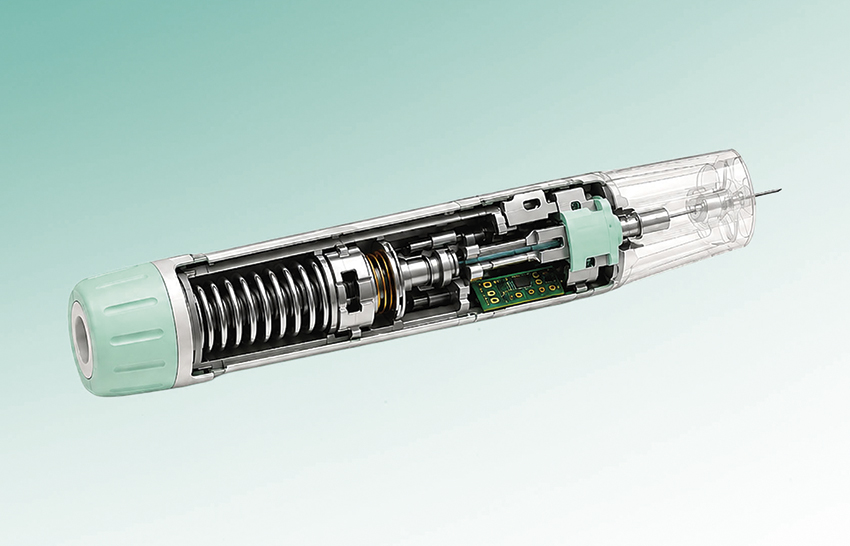
Autoinjectors are no longer simple spring-driven devices designed only to insert a needle and deliver a fixed dose. The advent of biologic drugs, high-concentration formulations, combination products, connected therapeutics and more demanding safety expectations has pushed device designers towards more integrated architectures. Modern autoinjectors must manage force, fluid flow, sequencing, user interaction, electrical functionality and patient safety within a tightly constrained volume. In that context, precision metal components are increasingly becoming a strategic necessity (Figure 1).
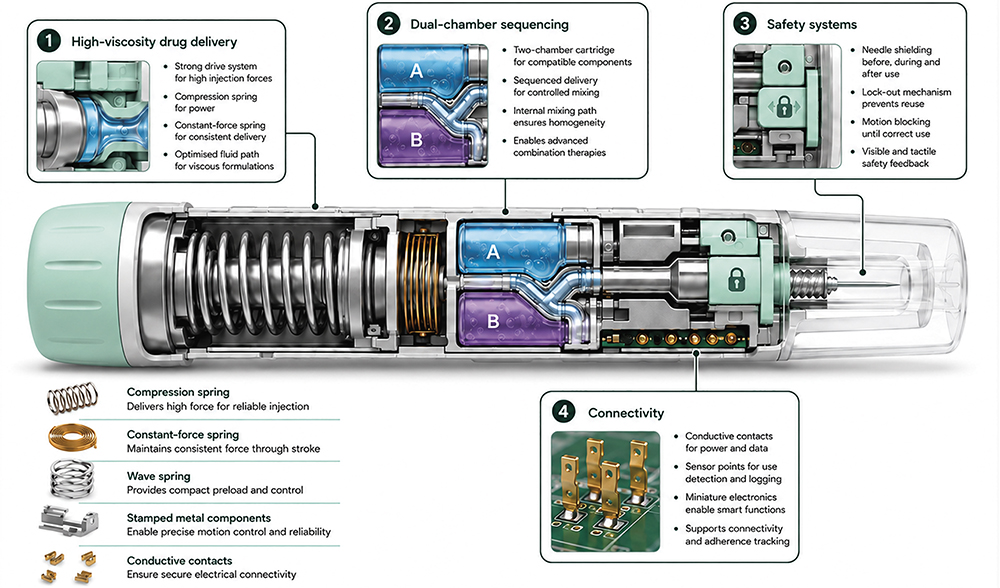
Figure 1: More functionality within the same device envelope – conceptual overview showing how precision metal components support high-viscosity drug delivery, dual-chamber sequencing, safety systems and connectivity within a compact autoinjector architecture.
HIGH-VISCOSITY DRUGS: MORE FORCE WITHOUT A LARGER DEVICE
High-viscosity formulations place immediate pressure on an autoinjector’s mechanical architecture. They frequently require higher plunger forces, tighter control of the fluid path and careful management of injection time. Simply increasing size of the drive spring is rarely ideal, as it can enlarge the device, increase the stress on nearby components and reduce design freedom elsewhere in the system. The challenge, therefore, is not only to generate more force, but to do so in a compact, repeatable and manufacturable way.
This is where the selection of spring technology becomes critical. Compression springs remain the most familiar solution for generating high drive force in a compact format. However, constant-force springs can offer a more uniform force profile throughout the stroke, which may help designers looking for more consistent delivery conditions. Wave springs also become attractive when high loads must be delivered within a very limited axial space, such as in preload, retention or compact actuation functions (Figure 2).
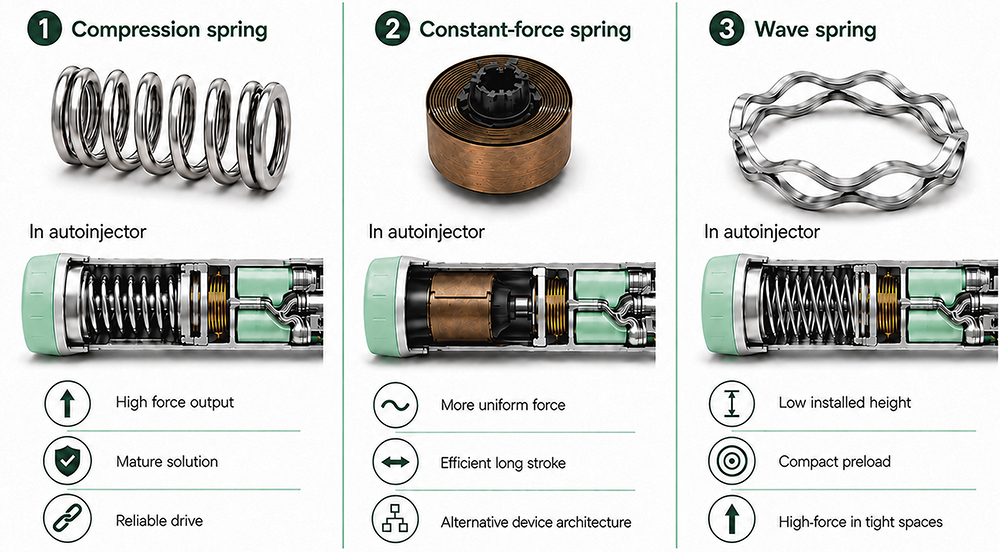
Figure 2: Choosing the right spring architecture – comparison of compression, constant-force and wave springs, highlighting how different spring types help designers manage force, stroke length, installed height and motion control.
DUAL-CHAMBER DEVICES: MECHANICAL SEQUENCING BECOMES A DESIGN DISCIPLINE
Dual-chamber and reconstitution devices add another layer of complexity. Instead of a single actuation event, the mechanism may need to co-ordinate several sequential actions: activation, release, communication between chambers, mixing or reconstitution, dose delivery and end-of-use safety. As a result, the internal architecture is defined not only by force generation but also by force timing, release thresholds and motion control. Precision metal parts can help designers mechanically programme these sequences by combining spring energy, retention features, guiding functions and controlled release points into the same assembly.
SAFETY SYSTEMS: ADDITIONAL FUNCTIONS IN THE SAME FOOTPRINT
Needle shielding, lock-out mechanisms, anti-reuse features and tactile or audible user feedback are now expected features of many autoinjector platforms. Each new function competes for space and increases the number of interfaces inside the device. As such, function integration is becoming increasingly valuable. The opportunity is not simply to miniaturise each component, but to combine several functions into a single precision metal part (Figure 3). A well-designed stamped and formed component can simultaneously provide elastic preload, locking, retention, positional guidance and even electrical contact. This approach reduces part count, saves space, simplifies assembly and improves robustness.
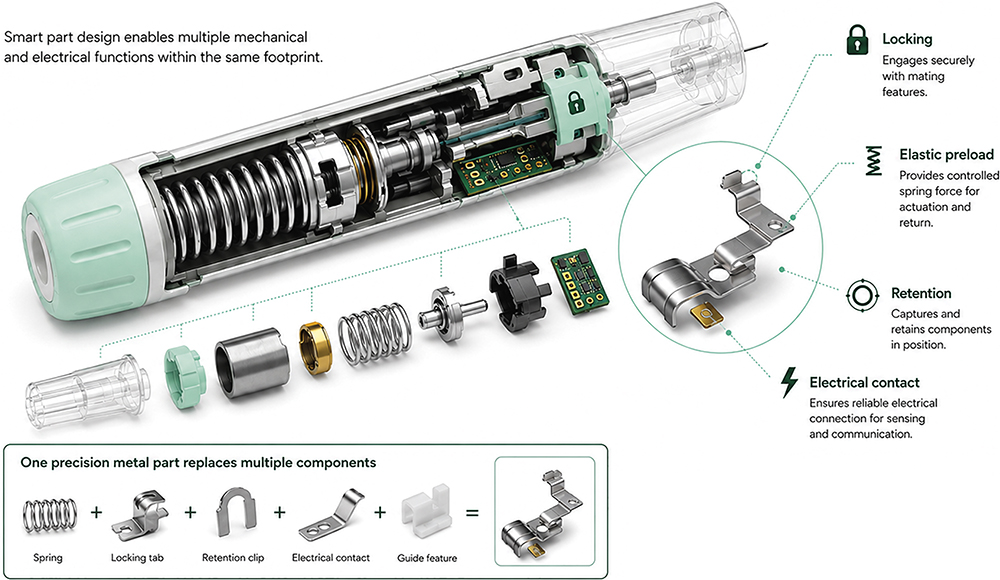
Figure 3: Function integration in a single precision metal part – illustration showing how one precision metal component can combine locking, preload, retention and electrical contact functions, helping to reduce part count and improve robustness.
MINIATURISED CONNECTIVITY: WHEN ELECTRICAL PERFORMANCE DEPENDS ON MECHANICAL PRECISION
Connectivity is another factor reshaping autoinjector design. Devices are increasingly expected to confirm dose delivery, support adherence programmes, communicate with companion apps or provide traceability over the course of treatment. These functions rely on miniature electrical interfaces that must remain reliable despite tight tolerances, polymer variation and repeated mechanical loading. In practice, miniaturisation makes electrical performance increasingly dependent on mechanical accuracy. Contact force, alignment, repeatability and surface quality become essential. This creates crucial roles for both miniature conductive parts and conventional precision conductive components, whether for battery terminals, sensor interfaces, spring contacts or compact stamped terminals for signal and power transfer (Figure 4).
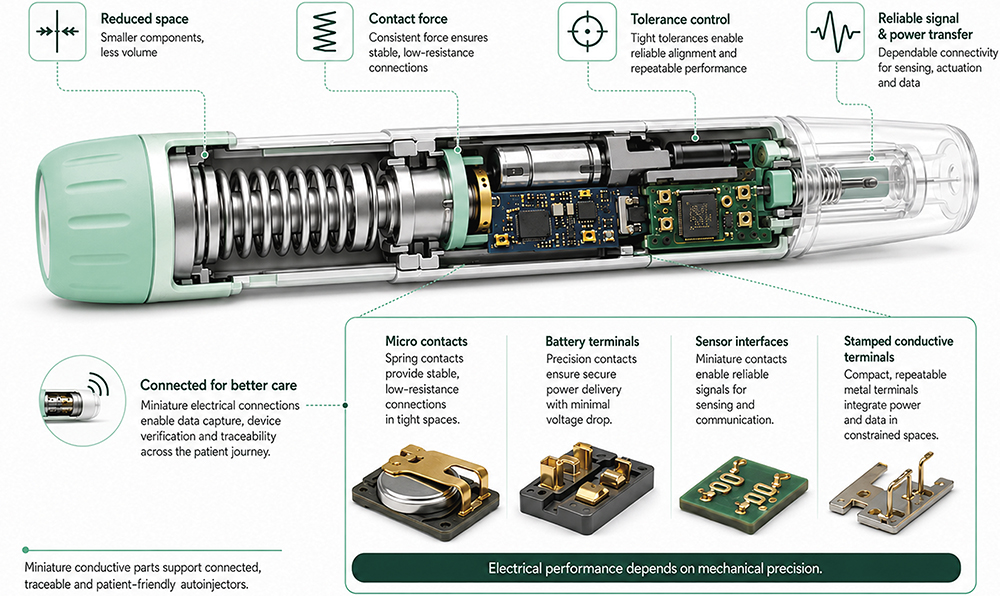
Figure 4: Miniaturised connectivity – illustration showing how micro contacts, battery terminals, sensor interfaces and stamped conductive terminals support connected autoinjectors and how electrical performance increasingly depends on mechanical precision.
DESIGN OPPORTUNITY FOR RPK MEDICAL
For autoinjector designers, the opportunity is no longer limited to selecting a standard spring or a standalone conductive clip. The greater opportunity lies in co-engineering more integrated architectures from the outset of development. RPK Group’s expertise in precision components manufactured from strip and wire creates a useful toolbox for this challenge:
- High-performance compression springs for power
- Constant-force springs for long-stroke or more uniform force delivery
- Wave springs for compact preload and high force in restricted spaces
- Stamped and formed metal parts for guidance, locking and retention
- Miniature conductive parts for power, sensing and data transfer.
Together, these technologies can help device developers increase functionality without proportionally increasing size or complexity.
CONCLUSION
The next generation of autoinjectors will be defined by the need to handle more demanding drugs, more complex mechanical sequences, more sophisticated safety systems and more connectivity capabilities within the same device envelope. That pressure creates a major opportunity for precision metal engineering. By combining mechanical and electrical functions into compact, robust, manufacturable metal parts, device designers can reduce part count, improve reliability and unlock new design architectures. In this sense, the future of autoinjectors will not only be shaped by the drug and the electronics, but also by the intelligence embedded in the smallest metal components inside the device.