

To Issue 188
Citation: Cui H, Niedermann O, James S, “Flying on Two Wings: Ypsomed’s Dual-Engine Strategy for Success in China”, ONdrugDelivery, Issue 188 (Jul 2026), pp 30–34.
Hong Cui, Orfeo Niedermann and Shawn James discuss how Ypsomed has succeeded in China, highlighting the importance of integrating into the local market, keeping in stride with the pace of development and maintaining alignment with global quality standards.
MOVING THE NEEDLE: THE EVOLUTION OF CHINA’S INJECTABLE MARKET
China’s pharmaceutical market, the second largest in the world, is expected to see spending on medications exceed US$190 billion (£140 billion) by 2029 (Figure 1).1 But scale alone does not capture what is happening; over the past decade, China’s biopharma sector has undergone a structural shift, one that is redefining what the market demands and what it takes to compete within it.
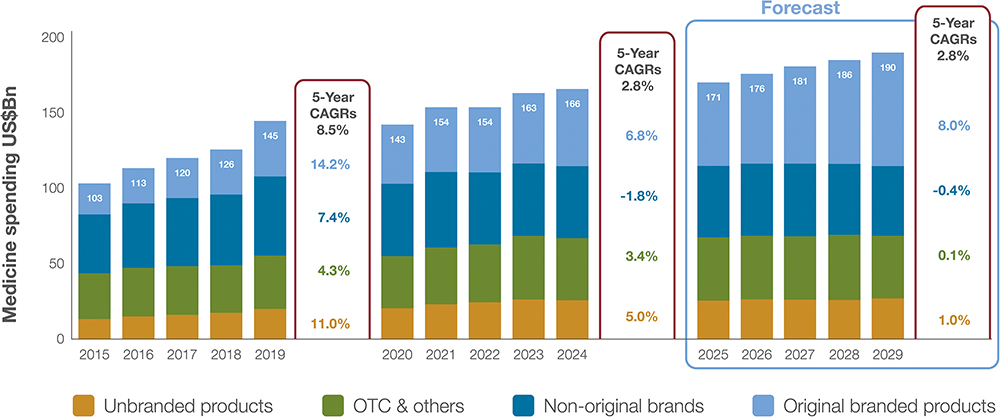
Figure 1: Spending on medications within the Chinese market sorted by product type (2015–2029). Data sourced from IQVIA Institute for Human Data Science. Available from www.iqviainstitute.org.1
The evidence is striking – in the first half of 2025, 46% of all new drug molecules entering human trials originated from Chinese biopharma companies.2 Regulatory reforms from the National Medical Products Administration and increasing alignment with ICH standards, which China joined in 2017, have accelerated that trajectory, creating a more sophisticated and internationally connected development environment. In its 2025 report, IQVIA noted that a growing number of originally branded medicines are being introduced by domestic companies rather than multinational firms, a shift that is changing China’s pharmaceutical sector and influencing markets both across the region and globally.1
Nowhere is this more visible than in injectable drug delivery. China has rapidly expanded its pipeline of subcutaneous therapies across oncology, autoimmune diseases, metabolic disorders and diabetes, with demand for self-injection devices growing alongside it. Chinese pharmaceutical companies are no longer developing therapies for domestic consumption alone. They are building globally competitive biologics and injectable programmes with serious international licensing and commercialisation ambitions. At the same time, multinational pharmaceutical companies are seeking to enter or deepen their presence in the Chinese market.
Both groups face the same underlying challenge – they need a device partner capable of delivering local manufacturing, local expertise and globally recognised standards from inside China itself. That combination, two capabilities working in concert, is what the next chapter of China’s pharmaceutical growth will demand.
“GROWTH IN PIPELINE COMPLEXITY AND INTERNATIONAL AMBITION CHANGES WHAT PHARMACEUTICAL COMPANIES NEED FROM A DEVICE PARTNER – SIMPLY SELECTING A DEVICE PLATFORM IS NO LONGER THE STARTING POINT IT ONCE WAS.”
GOOD CHEMISTRY: THE NEW FORMULA NEEDED FOR PARTNERSHIP
Growth in pipeline complexity and international ambition changes what pharmaceutical companies need from a device partner – simply selecting a device platform is no longer the starting point it once was. Today’s demands are broader and more integrated: speed of development, supply continuity, regulatory fluency across multiple markets and the ability to support programmes from early device selection through to commercial scale.
For Chinese pharmaceutical companies, these demands are particularly acute. Programmes are moving faster, pipelines are more sophisticated and the expectations placed on device partners have never been higher. For multinational companies entering the Chinese market, the challenge is different but related: how does a global organisation maintain seamless alignment with its worldwide development programmes while operating at the pace that the Chinese market demands?
The answer to both questions points in the same direction. What the market now requires is a device partner genuinely embedded in China, one with the global quality standards and regulatory experience to support programmes wherever they are ultimately headed, built on two foundations: manufacturing inside the country and cross-functional expertise on the ground. Neither is sufficient alone.
Familiar Territory: a Longtime Local
Ypsomed’s presence in China did not begin with the opening of its Changzhou manufacturing facility. It began more than 20 years ago, when the company established its first commercial presence in the Chinese market, at a time when the country’s pharmaceutical industry looked very different to what it is today (Figure 2).
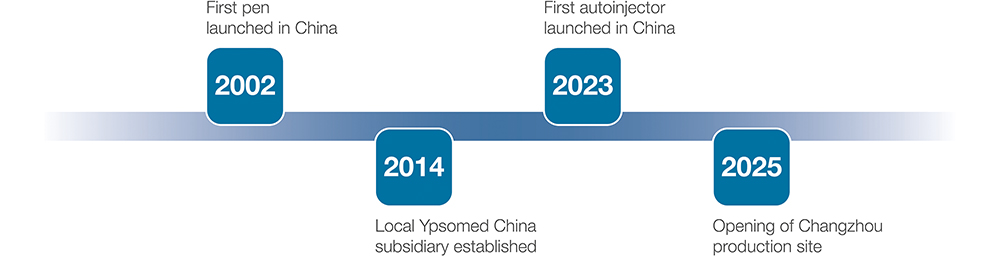
Figure 2: Key Ypsomed China milestones.
The entry point was diabetes care, a deliberate choice given both the scale of unmet need in China and the growing demand for reliable, high-quality injection devices to support long-term therapy adherence. From that foundation, Ypsomed progressively expanded its local presence, moving from an initial commercial footprint to a dedicated office in 2014, steadily building out teams across commercial, technical, regulatory and project management functions.
As the Chinese pharmaceutical market evolved, so did Ypsomed’s scope within it. The company expanded beyond diabetes into peptide therapies delivered through pen injectors and autoimmune disease programmes supported by autoinjector platforms, tracking the broader diversification of China’s injectable therapy pipeline.
The results of that sustained investment are visible in Ypsomed’s track record. The company has realised more than 25 product launches in collaboration with Chinese pharmaceutical customers, across more than 20 years of partnership. Two in three of Ypsomed’s Chinese customers have partnered with the company on more than one programme. That pattern of long-term, multiprogramme partnerships reflects both the confidence customers place in a partner that has consistently delivered, and the operational credibility that only comes from sustained presence in a market over time.
Factory Settings: a Concrete Commitment in Changzhou
In April 2023, Ypsomed broke ground on a new production facility in Changzhou’s National Hi-tech District, a high-tech industrial park near Shanghai that is home to more than 10,000 companies (Figure 3). The facility opened in June 2025, representing an investment of over $100 million and a manufacturing footprint of more than 15,000 m2, with an additional 30,000 m2 secured for future expansion.
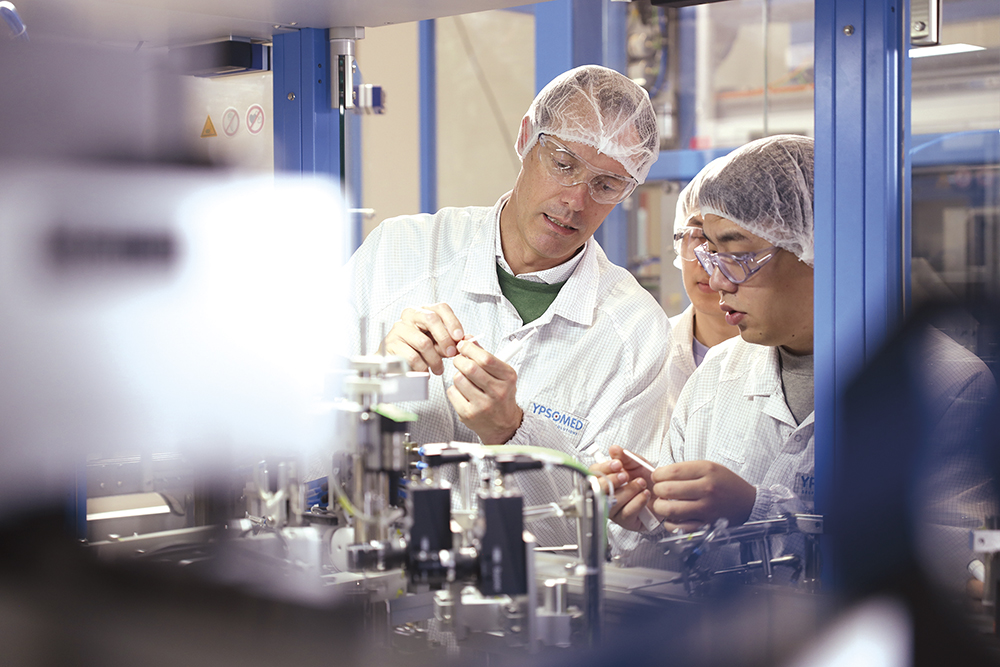
Figure 3: Inside the Changzhou manufacturing site.
The decision to build in China rather than expand exports from Europe was deliberate. Ypsomed was not relocating capacity from its European facilities but adding new capacity, designed from the outset to serve the Chinese market directly. For pharmaceutical companies managing complex development and commercialisation timelines, locally manufactured supply removes a layer of operational risk that cross-border models cannot fully eliminate – customs procedures, import documentation, transportation lead times and exposure to broader supply chain disruption. Bringing manufacturing into China simplifies that picture considerably and secures access to therapies where continuity of treatment is critical, especially for chronically ill patients.
At the same time, local manufacturing supports greater production flexibility. Compared with globally centralised supply models, a manufacturing presence within China allows for closer alignment with local customer needs and faster adaptation to changes in order volumes, accelerated timelines and more efficient logistics. That responsiveness is particularly valuable in a pharmaceutical market that is continuing to evolve at exceptional speed.
The facility has been built to Ypsomed’s global standards throughout. ISO 13485 certification for medical devices has been completed by TÜV Süd (München, Germany) and the site has achieved LEED Platinum certification, making it one of the most sustainable industrial buildings in the world. All staff are trained and qualified in line with Ypsomed’s global quality framework. The industrialisation of drug-device programmes within China, taking a product from development through to commercial scale, can now be managed locally and reliably, without compromise on the standards set by Ypsomed and that global programmes demand.
FLYING ON TWO WINGS: SPANNING PRODUCTION AND PEOPLE
Local manufacturing and local expertise are each valuable in their own right. But it is their combination that defines Ypsomed’s operating model in China, and that combination is deliberate – this is Ypsomed’s “two wings” framework (Figure 4).
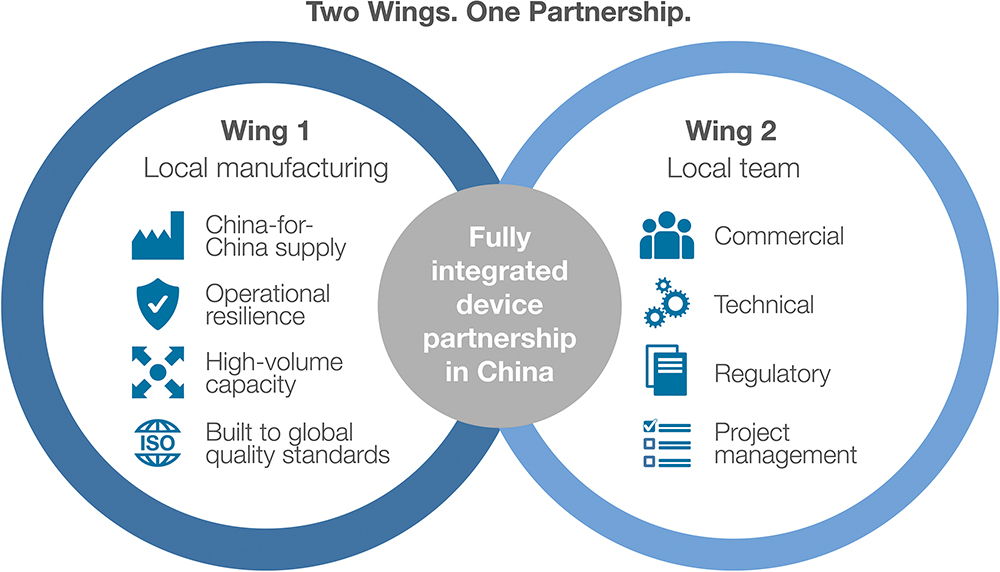
Figure 4: The “two wings” framework.
Ypsomed’s Changzhou facility does not operate in isolation. It is supported by a multifunctional team based in China, spanning commercial, technical, regulatory and project management functions. Those two capabilities, manufacturing presence and cross-functional expertise together allow Ypsomed to support Chinese pharmaceutical customers across the full arc of a programme, from initial device selection and technical compatibility discussions, through regulatory co-ordination and project management, to commercial launch and supply.
For Chinese pharmaceutical companies developing their first autoinjector or pen injector programme, this integrated model removes a layer of complexity that would otherwise require managing multiple partners across different geographies. Local language, local time zones and local currency, combined with reduced complexity around cross-border supply and import processes, mean that day-to-day collaboration is simpler and faster – one partner, operating locally, capable of supporting the entire journey (Figure 5).
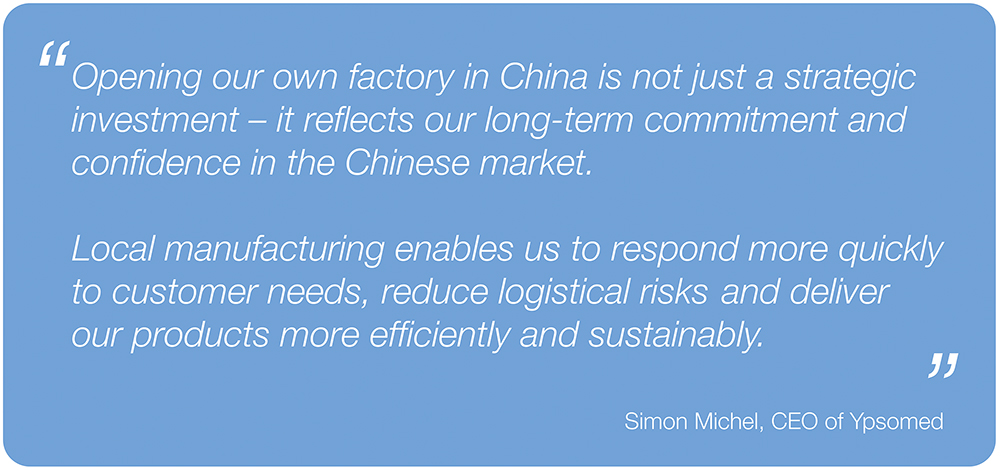
Figure 5: Quote from Simon Michel, CEO of Ypsomed.
For multinational pharmaceutical companies seeking to enter or expand within China, Ypsomed’s model serves a different but equally important function. It acts as a bridge between a customer’s global development programmes and the specific regulatory, operational and supply requirements of the Chinese market, providing local regulatory fluency, local supply capability and local project co-ordination.
For Chinese pharmaceutical companies with international ambitions, the model also addresses a less obvious but increasingly important consideration. As more Chinese companies pursue global licensing and commercialisation strategies, partner credibility on intellectual property protection becomes a genuine concern. With more than 240 patent families, Ypsomed brings an established IP framework that can help customers prepare their products for international markets with confidence.
Underpinning all of this is a broader ecosystem approach. Collaborations with partners across primary packaging and automation, combined with ready-to-use final assembly capabilities, allow Ypsomed to co-ordinate across multiple parts of the drug-device value chain, reducing complexity for customers that manage increasingly demanding development programmes.
NO EXPIRY DATE: A POTENT FUTURE
China’s pharmaceutical industry is not approaching a plateau. The pipeline of biosimilars, novel biologics and increasingly sophisticated injectable therapies continues to expand, and the international ambitions of Chinese pharmaceutical companies continue to grow along with it. As programmes become more complex and commercialisation strategies reach further across global markets, the demands placed on device partners will only intensify.
Ypsomed’s position in China was built with this trajectory in mind, with more than 20 years of local presence, a multifunctional team embedded in the market and a manufacturing facility designed for scale. These are not fixed assets. They are an operating model, one capable of expanding alongside both the complexity of customer programmes and the continued growth of China’s pharmaceutical industry. This commitment has not gone unrecognised. At BIO CHINA 2026, one of the most significant industry gatherings in the world, Ypsomed was named Outstanding Supplier of the Year – an acknowledgement of the trust that Chinese pharmaceutical and biotech partners place in the company.
“YPSOMED’S OPERATING MODEL OFFERS SOMETHING RARE: A DEVICE PARTNER THAT IS GENUINELY LOCAL IN ITS OPERATIONS, GENUINELY GLOBAL IN ITS STANDARDS AND GENUINELY COMMITTED TO CHINA FOR THE LONG TERM.”
For both Chinese pharmaceutical companies advancing towards global biologics leadership and multinational organisations deepening their presence in the market, Ypsomed’s operating model offers something rare: a device partner that is genuinely local in its operations, genuinely global in its standards and genuinely committed to China for the long term.
REFERENCES
- “The Global Use of Medicines Outlook Through 2029: Increasing Access, Use, and Spending”. Report, p 45, IQVIA Institute for Human Data Science, 2025. Available from www.iqviainstitute.org.
- “China is increasing its share of global drug development”. Goldman Sachs, Dec 2025.
Previous article
DE-RISKING POST-MARKET CHANGE THROUGH PILOT PRODUCTIONNext article
INDUSTRIALISING DRUG DELIVERY IN AN UNCERTAIN WORLD