To Issue 186
Citation: Rüstenberg I, Müller R, Schmid Y, “From Small to Large Molecules: Advancing Precision Pump Technology for Biologic Drug Delivery”, ONdrugDelivery, Issue 186 (May 2026), pp 22–27.
Dr Ines Rüstenberg, Roger Müller and Dr Yannick Schmid discuss solutions for large-molecule drug delivery, highlighting the applicability of two Gerresheimer infusors, Gx InPuls and Gx InPuls Flex, which employ micropump technology to overcome challenges with large-molecule delivery.
The biologics sector continues to grow, with an increasing number of drugs entering pharmaceutical pipelines and achieving market approval. Additionally, biologics are showing a clear tendency towards subcutaneous (SC) routes of administration. In 2025, the US FDA approved 46 new drugs with biologics, comprising 26% of total approvals. Nine of the biologics were monoclonal antibodies (mAbs), two were antibody-drug conjugates and one was a fusion protein,1 with half of them formulated for SC delivery.
SC administration of large-molecule biologic drugs poses specific challenges due to their complex protein structures, sensitivity and high concentrations leading to higher viscosities. For dose volumes or delivery profiles that are unsuitable for autoinjectors, on-body or wearable infusion pumps are required. Such devices must provide the necessary infusion accuracy and flow rates for viscous large-molecule drug delivery. Concurrently, they must safeguard the structural integrity of sensitive proteins from physical factors such as shear stress or adsorption, which could cause aggregation, potentially affecting therapeutic efficacy. While infusion rates can be modelled reliably with fluid dynamic models, the risk of protein damage is not easily modelled and requires empirical experimentation.
MICROPUMP TECHNOLOGY FOR SC DRUG DELIVERY
Pumps for SC drug delivery on the market today employ various actuation technologies. Piston-actuated pumps, for example, expel drugs by pushing on a cartridge stopper, forcing the drug out of the primary packaging and through the cannula.
Conversely, wetted pump systems, such as the SensCore from Gerresheimer, draw the liquid drug through a pump mechanism before expelling it through the fluid path. They are generally smaller than piston-pump systems, facilitating a more compact pump design and enabling a high level of infusion control over extended periods while also providing backflow resistance and infusion pause features.
Benefits of the SensCore Micropump
The design of the novel SensCore wetted micropump from Gerresheimer employs a rotary piston action. This provides a high level of infusion control across a broad range of infusion rates, including basal infusions over multiple days and rapid bolus injections at high flow rates.
“THE SENSCORE MICROPUMP TECHNOLOGY IS INCORPORATED INTO THE GX INPULS CARTRIDGE-BASED, ON-BODY INFUSOR PLATFORM AND THE GX INPULS FLEX BELT-WORN, VIAL-BASED INFUSOR PLATFORM.”
The SensCore micropump technology is incorporated into the Gx InPuls™ cartridge-based, on-body infusor platform and the Gx InPuls Flex™ belt-worn, vial-based infusor platform designed to support the high accuracy requirements of small-molecule infusions (Figure 1). In these devices, the SensCore micropumps are implemented downstream of a primary drug container. The simple, two-component design comprises a pump housing and a pump shaft, with each pump having a stroke volume representing the smallest dosing increment that can be delivered per rotation. Currently, two configurations are developed with stroke volumes of 2 and 10 µL.
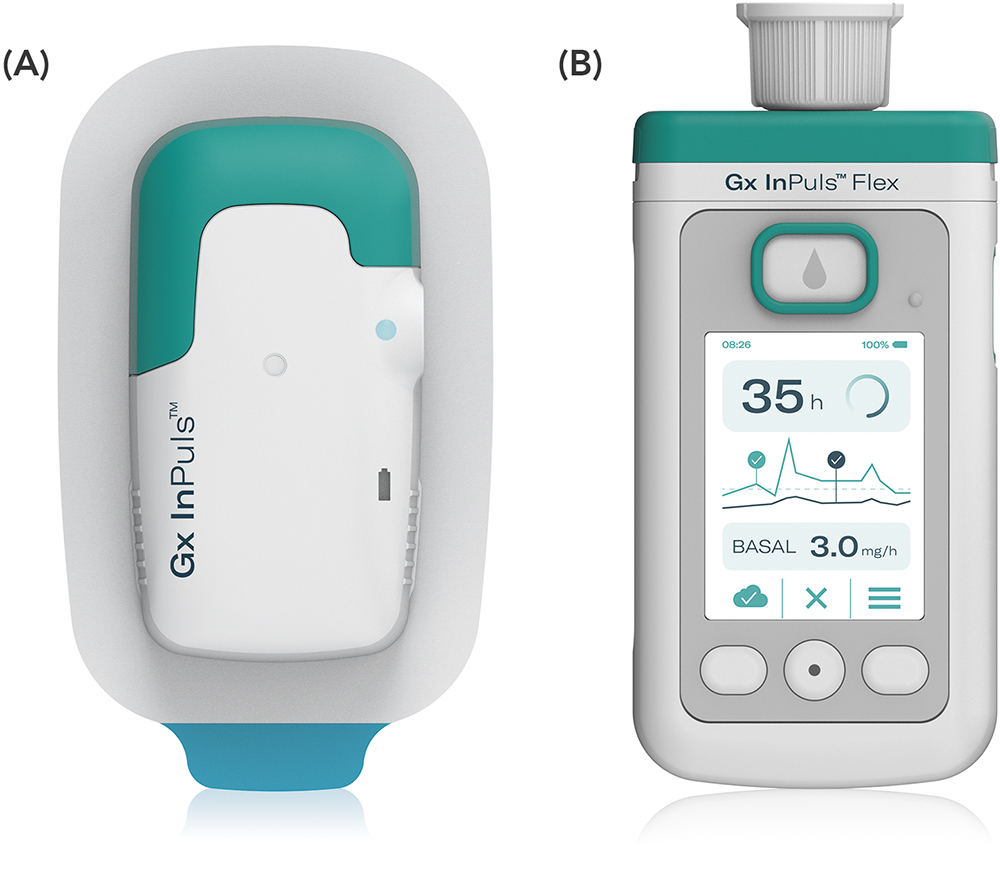
Figure 1: The Gx InPuls infusor (A) and Gx InPuls Flex infusor (B) platforms.
The valve structure in the pump mechanism provides double protection against free flow and backflow, as there is only ever one pathway open – when the pump is inactive, both valves are closed simultaneously (Figure 2). This has benefits for infusions with pulsatile infusion characteristics, paused infusions and low infusion rates where low pressure differentials alone would not prevent backflow.
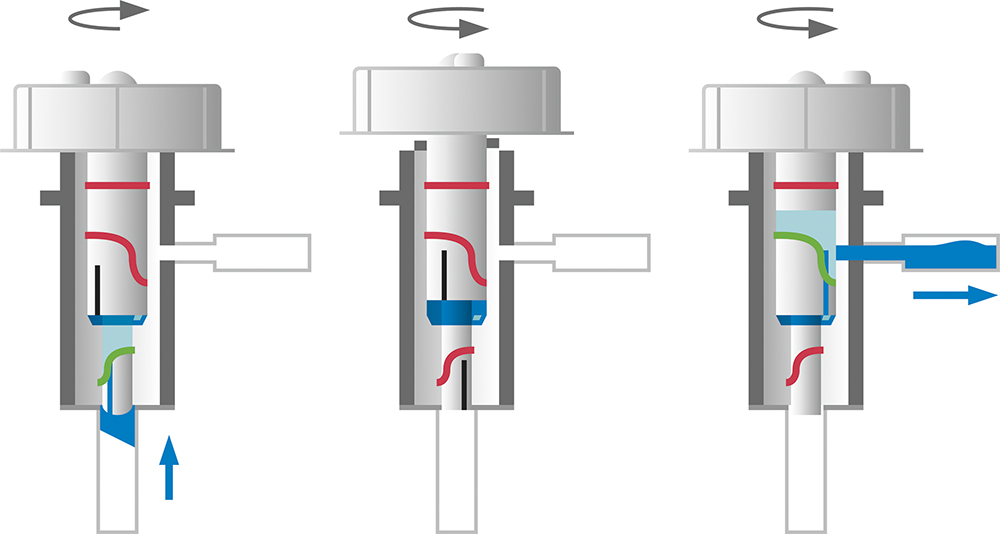
Figure 2: SensCore micropump shaft and housing show drug flow. Green: valve open. Red: valve closed.
Free flow and backflow in on-body or belt-worn infusion medical devices may represent clinical risks, as they can disrupt the intended controlled delivery of medication. Free flow refers to uncontrolled infusion of drug fluid into the patient when the device is no longer regulating the flow, which can result in unintended rapid dosing or multiple boluses. Backflow may cause inaccurate or reduced drug delivery and may also promote clogging in an infusion set, particularly at low flow rates. Both issues could compromise therapy accuracy and thus increase patient risk through treatment failure or contamination.2
“COMBINATION PRODUCTS BASE ON THE GX INPULS AND GX INPULS FLEX WITH THE SENSCORE MICROPUMP ARE CURRENTLY APPROVED AND MARKETED IN THE US AND EUROPE FOR DELIVERY OF SMALL-MOLECULE DRUGS.”
CHALLENGES OF EXTENDING MICROPUMP TECHNOLOGY TO LARGE MOLECULES
Combination products based on the Gx InPuls and Gx InPuls Flex with the SensCore micropump are currently approved and marketed in the US and Europe for delivery of small-molecule drugs. However, large molecules, such as immunoglobulin G (IgG) and mAbs, are more challenging to deliver due to their high protein concentrations (up to approximately 150 mg/mL) and their vulnerability to aggregation, which may lead to loss of biologic functionality.
To evaluate the suitability of the micropump for delivery of large molecules, it was necessary to investigate both the potential for aggregation and the capability to deliver higher viscosities at required flow rates.
Potential Impact of Shear Rates on Aggregation
Mechanical stresses encountered during the manufacturing and delivery of protein therapeutics – such as stirring, pumping, filtration and temperature cycles – may destabilise proteins. This could lead to partial unfolding and exposure of aggregation-prone regions, ultimately triggering proteins to aggregate. Such aggregates can reduce therapeutic efficacy and may trigger immune responses, highlighting the need to carefully control physical stresses during formulation, storage and administration of biologics.
Analysis of the SensCore micropump using fluid dynamic models found that the shear rate between the pump shaft and the pump housing during pump rotation was 200 s-1 compared with shear rates of up to 6,000 s-1 experienced by a drug moving through a commonly used, 27G thin wall needle (Figure 3). The negligible effect of shear rate was confirmed by expelling an IgG and a mAb through the micropump at a constant flow rate of 30 mL/h, then probing the molecular integrity of the pumped molecules using size exclusion chromatography and capillary electrophoresis.
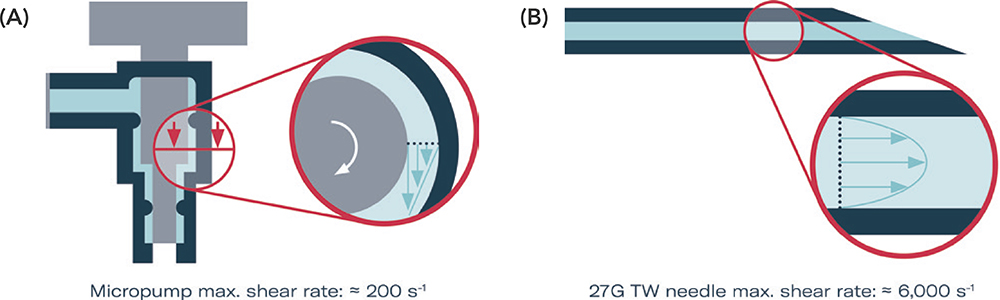
Figure 3: (A) Illustration of flow through a 10 μL SensCore Micropump compared with (B) a 27G thin wall needle.
Potential Impact of Surface Interactions
With a wetted pump design, as employed in the SensCore micropump, multiple surfaces come into contact and potentially interact with a protein in a biologic drug. Initial testing with a large-molecule formulation revealed that subvisible particles were present after the drug was expelled via the micropump. A hypothesis was established that proteins might interact with the pump shaft surface and then aggregate during pumping, resulting in particles appearing in the expelled liquid drug.
Assuming the hypothesis was correct, two options were identified that could potentially mitigate this effect: hydrophilic surface modification of the pump shaft or replacement of the shaft material to reduce protein adsorption.3
COMBATTING SURFACE INTERACTIONS
To confirm or disprove the hypothesis of surface interaction, 18 new shaft materials and coatings with various hydrophilic properties were selected and implemented into a prototype micropump system. Initial testing revealed that three of these produced significantly lower subvisible particles: one new pump shaft material and two coating options. Subsequent testing was performed on the three selected options, using light obscuration according to US Pharmacopeia (USP) <787> and focusing on the number of subvisible particles in the range of ≥ 10 µm and ≥ 25 µm, as defined by the standard. A significant reduction of subvisible particles was observed for each of the options in comparison to the original micropump.
The results showed that the shaft material option was highly compatible with the tested mAbs but less compatible with the IgG, whereas the coating options were compatible to a greater or lesser degree with both the mAbs and the IgG. To understand these results, the formulations of the tested drugs were evaluated. Significantly, the IgG formulation used in the experiments did not contain a surfactant, while the mAbs were formulated with polysorbate. An assumption was made that the combination of hydrophilic modifications and surfactants used in the mAbs contributed to the lower surface interactions. To confirm this, 100 mg/L of polysorbate 80 was added to the IgG and then retested with the new shaft material. The turbidity was reduced to a comparable level with that measured on a reference sample, confirming the assumption.
As more than 90% of SC mAbs approved by the FDA between 2002 and 2020 contained surfactants at concentrations between 100 and 2000 mg/L,4 the new shaft material was selected as the optimal solution for delivering the majority of large-molecule biologic drug products.
EFFICACY OF OPTIMISED SENSCORE MICROPUMP FOR LARGE MOLECULES
Optimised Material Exceeds Requirements for Particle Count
Following the success with the prototype micropump, the new shaft material was implemented into the existing 2 and 10 µL micropumps used in Gx InPuls and Gx InPuls Flex for confirmation of the previously observed results. Two approved mAbs (mAb 1 and mAb 2) were selected for testing. mAb 1 had an API concentration of 120 mg/mL and surfactant concentration of 100 mg/L. mAb 2 had an API concentration of 140 mg/mL and surfactant concentration of 600 mg/L. These mAbs were considered representative of typical formulations as referenced above.
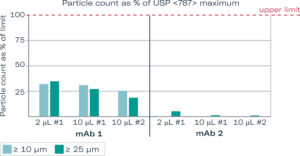
Figure 4: Subvisible particle count measured with light obscuration and assessed in comparison with particle limits specified in USP <787>.
Both mAbs were pumped through a 2 and 10 µL micropump and subvisible particle counts were measured using light obscuration (Figure 4). All micropump and mAb combinations were considerably lower than the USP <787> limits for ≥ 10 µm and ≥ 25 µm particle sizes.
High Flow Rate for High-Viscosity Infusions
SensCore micropumps were designed to be highly precise at low flow rates. To confirm suitable delivery of high flow rates for high-viscosity infusion too, the Gerresheimer development team conducted a series of tests. Glycerol and distilled water were mixed in varying viscosities according to an established calculation script. Both micropump sizes were tested with a variety of commonly used needle sizes.
“THE TWO MICROPUMPS CAN COVER INFUSION RATES BETWEEN 10 AND 60 mL/H AND VISCOSITIES OF UP TO APPROXIMATELY 50 cP.”
Results showed that the two micropumps can cover infusion rates between 10 and 60 mL/h and viscosities of up to approximately 50 cP with an accuracy error of ≤ 5% (Figure 5). This demonstrates the scope of the pumps to handle a significant proportion of the viscosities of marketed mAbs.5 Testing by the expert laboratory team at a Gerresheimer site or the customer site enables confirmation of delivery parameters for a specific formulation.
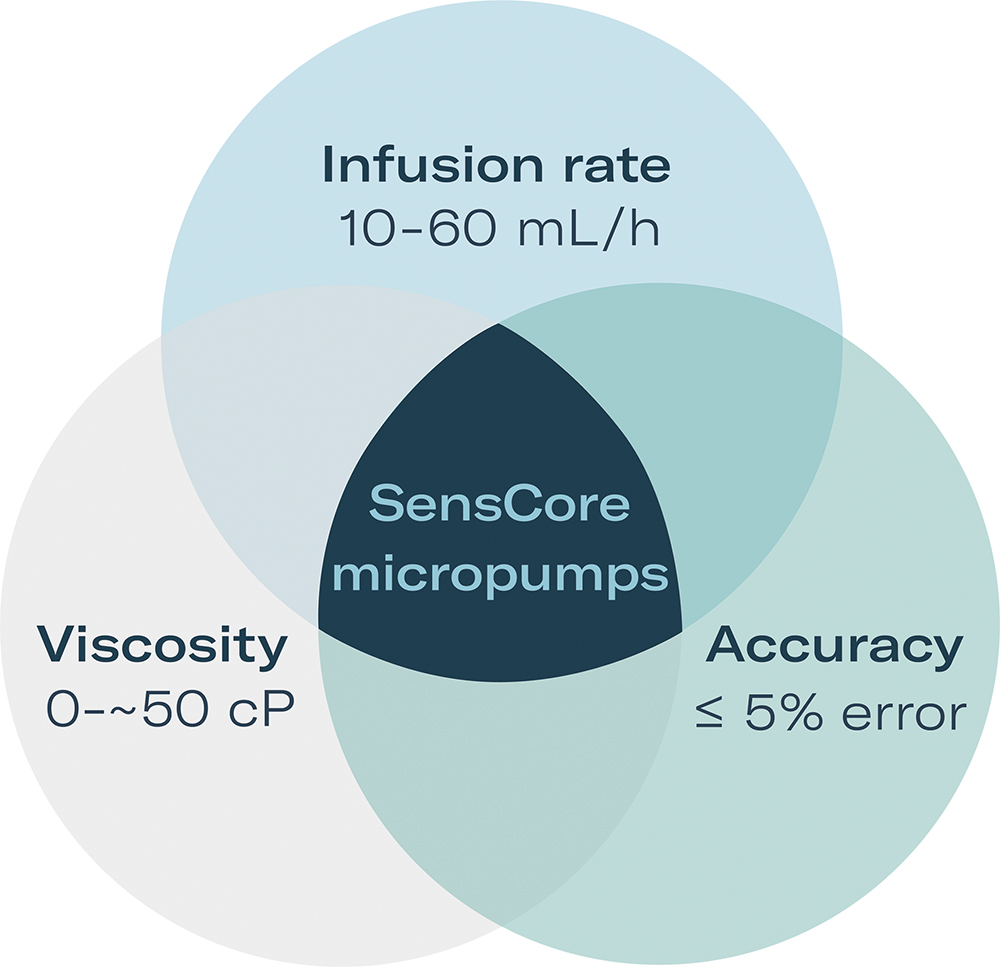
Figure 5: The tested capabilities of the SensCore 2 and 10 μL micropumps to handle various flow rates and viscosities.
Versatility for Varied Therapy Regimens
The micropumps with new shaft material can be incorporated into the Gx InPuls on-body infusor and the Gx InPuls Flex belt-worn infusor platforms from Gerresheimer, expanding their capabilities to handle a wide variety of viscosities, flow rates and delivery profiles.
The Gx InPuls on-body infusor platform incorporates a 2 µL SensCore micropump and 3 mL prefilled cartridge for precise, controlled drug delivery. A combination product based on the platform is already approved by the FDA for treatment of oedema in congestive heart failure, which minimises future development risk. The cartridge-based infusor is particularly suited for slow basal infusions, with different pre-defined flow rates and boluses. It is now proven to effectively deliver high-flow rate infusions of high-viscosity drugs, for example 15 cP, 30 mL/h with a 29G regular needle. For delivery of larger volumes, a concept is in development that employs the tested 10 µL micropump and a 10 mL prefilled cartridge.
The Gx InPuls Flex is a belt-worn infusor for 24/7 therapy delivery up to 20 mL. The Flex platform design allows for fast adaptation to a specific drug formulation and can deliver slow basal infusions with different pre-defined flow rates and boluses, as well as high-flow rate injections of high-viscosity drugs, for instance, 50 cP, 40 mL/h with a 27G thin wall needle. A combination device based on the Gx InPuls Flex is approved in Europe for treatment of Parkinson’s disease, highlighting its suitability for treatment of chronic diseases, as delivery profiles can be adjusted to individual patients’ needs.
CONCLUSION
Biologic therapeutics, particularly mAbs and other proteins, are expected to substantially influence the future development of SC drug formulations. Advances in formulation science, including high-concentration protein formulations and stabilisation strategies, together with the development of device-enabled delivery systems (e.g. on-body or belt-worn delivery devices), are facilitating the SC administration of larger volumes and doses.
These developments support a shift towards more patient-centred delivery of therapies in a home-care setting. This supports patient independence and reduces treatment burden, thereby complementing or replacing intravenous in-clinic infusions in select cases. Consistent with this trend, recent scientific reviews and regulatory approvals highlight SC formulations of established biologics as well as novel SC biologic products.
“THROUGH SHEAR STRESS ANALYSIS AND SURFACE INTERACTION EXPERIMENTS, GERRESHEIMER HAS SUCCESSFULLY ADDRESSED POTENTIAL CAUSES OF AGGREGATION AND DEMONSTRATED THE CAPABILITY OF THE DEVICES TO HANDLE HIGH-FLOW, HIGH-VISCOSITY INFUSIONS WHILE MAINTAINING THE INTEGRITY OF LARGE-MOLECULE BIOLOGIC DRUG FORMULATIONS.”
The optimisation of SensCore micropump technology in the Gx InPuls and Gx InPuls Flex infusor platforms responds to the market trend by transforming them into robust, versatile solutions for the effective and precise delivery of both small- and large-molecule drugs. Through shear stress analysis and surface interaction experiments, Gerresheimer has successfully addressed potential causes of aggregation and demonstrated the capability of the devices to handle high-flow, high-viscosity infusions while maintaining the integrity of large-molecule biologic drug formulations.
The versatility of Gx InPuls and Gx InPuls Flex platforms allows Gerresheimer to cater to a variety of therapeutic needs, offering reliable, adaptable infusion control and precise dosing for SC administration. As the devices are already on the market as part of approved combination products, pharma companies can rely on the experience of the Gerresheimer team to efficiently and effectively support the full development process, from early-phase formulation testing through regulatory submission and manufacturing at scale.
REFERENCES
- de la Torre BG, Albericio F, “The Pharmaceutical Industry in 2025: An Analysis of FDA Drug Approvals from the Perspective of Molecules”. Molecules, 2026, Vol 31(3), art 419.
- Cohen MR, Davis NM, “Free Flow Associated with Electronic Infusion Devices: an Underestimated Danger”. Hosp Pharm, 1992, Vol 27(5), pp 384–390.
- Lefebvre G, Maize A, Jimenez RAP, “Surfactant Protection Efficacy at Surfaces Varies with the Nature of Hydrophobic Materials”. Pharmaceutical Research, 2021, Vol 38(12), pp 2157–2166.
- Strickley RG, Lambert WJ, “A review of Formulations of Commercially Available Antibodies”. J Pharm Sci, 2021, Vol 110(7), pp 2590–2608.
- Wang SS et al, “US FDA-approved therapeutic antibodies with high-concentration formulation: summaries and perspectives”. Antib Theraps, 2021, Vol 4(4), pp 262–272.