
To Issue 189
Citation: Moakes G, “Why Smarter Wearables are the Simple Answer to Intelligent Drug Delivery”, ONdrugDelivery, Issue 189 (Sep 2026), pp 8–12.
Dr Greg Moakes considers how complex devices such as LTS’s Sorrel™ on-body delivery system can facilitate the self-administration of injectable therapies while continuously monitoring and verifying the device’s critical delivery functions.
Jeopardy is unwelcome in the world of drug delivery. For healthcare professionals (HCPs) and their patients, the proven model of “the right dose, in the right way, at the right time” is fundamental to the aim of securing positive treatment outcomes.
Failure in any of these three aspects is likely to have consequences. This could be as serious as failing to safely and accurately deliver life-saving medication or, in less grave circumstances, it could result in financial loss from wasted doses of complex, high-value biologics.
Often, of course, it is patients themselves who can be the root cause of these problems. From those with needle phobias to those who struggle to adhere to the structure of a treatment regimen, there are a myriad of personal reasons why individuals fail to engage with their therapy correctly. Subsequently, these points of friction all have the potential to hinder compliance and hamper the chances of a prescribed drug having the desired pharmacological effect.
“BY REMOVING THE NEED TO ATTEND A MEDICAL FACILITY AND DIRECTLY INVOLVE HCPs, DEVICES THAT ENABLE SELF-ADMINISTRATION ANSWER THE EVER-INCREASING DEMAND FOR GREATER PATIENT CONVENIENCE.”
In parallel with this ongoing issue of patient compliance is the growth of at-home self-administration. By removing the need to attend a medical facility and directly involve HCPs, devices that enable self-administration answer the ever-increasing demand for greater patient convenience, which, in turn, contributes to an enhanced experience, improved compliance and preferential outcomes.1 It is for these reasons that combination devices in their various forms continue to be a primary focus for innovation in drug delivery.
COMPLEX DEVICES DESIGNED TO SIMPLIFY PATIENTS’ LIVES
A broad spectrum of devices have emerged into the combination device space, all providing the means for patients to self-inject, but with varying levels of convenience, functionality and capability built in. Building on the foundations of the pen injector, autoinjectors further reduce the level of manual manipulation required. On-body delivery systems (OBDSs) represent yet another step forward, providing a platform for discreet automated dosing, while also supporting higher drug volumes and extended injection times to overlap into territory previously only occupied by infusions.
These OBDSs, with their advanced “hands-free” functionality, provide particular benefits for those affected by chronic conditions, where treatment is required on a sustained, long-term basis. The potential for slower delivery via finer gauge needles can help to reduce injection pain. Moreover, they have the potential to be configured to great effect. As well as accommodating formulations with a wide range of viscosities and volumes, OBDSs can integrate sensors and connectivity functions to support activity logging and data transfer, and they can also be programmed to deliver formulations at specific rates and to specific absorption profiles (Figure 1).2
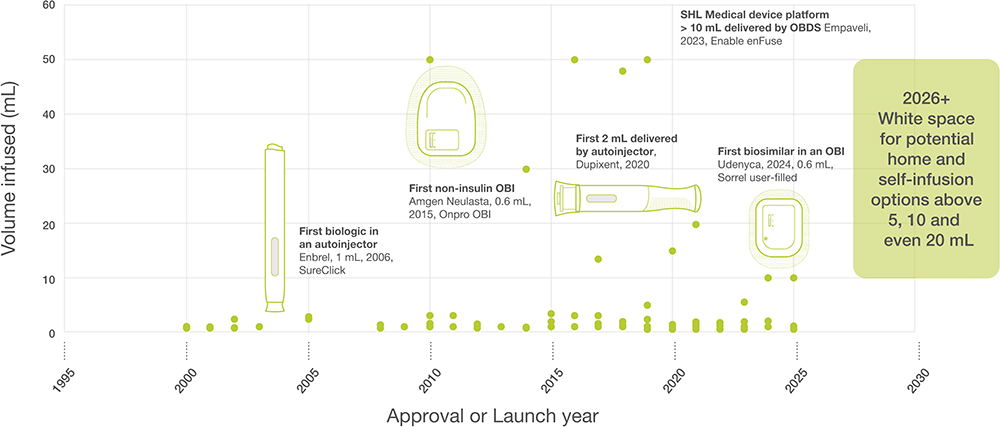
Figure 1: Increasing volumes of subcutaneous FDA-approved drug products, 2000–2025.
“FOR PATIENTS, CAREGIVERS AND PAYERS, THE POTENTIAL FOR AN OBDS TO FACILITATE SUBCUTANEOUS INJECTIONS OF DRUGS IN HIGHER VOLUMES, EVEN VISCOUS BIOLOGICS, HAS ONLY INCREASED MOMENTUM BEHIND THE SHIFT TO TREAT CHRONIC ILLNESSES AT HOME.”
For patients, caregivers and payers, the potential for an OBDS to facilitate subcutaneous injections of drugs in higher volumes, even viscous biologics, has only increased the momentum behind the shift to treat chronic illnesses at home. Key questions then surround how far wearable devices can reasonably push beyond autoinjectors and into infusion territory, and whether they can provide a truly patient-centric platform for the safe, reliable delivery of valuable drugs in higher volumes.
In recent decades, milestones in this area have continually been targeted and exceeded. Currently, the clinical “pinch point” is around 15 mL therapies, where patients still largely rely on HCP-led administration via a manual syringe infusion system involving multiple preparatory steps. With OBDS platforms, however, the gap between higher-volume therapies and patient autonomy is closing fast. Already, devices with volumes 15 mL are on the market, pointing to acceptance and tolerance of these devices for infusion-type applications (Figure 2).
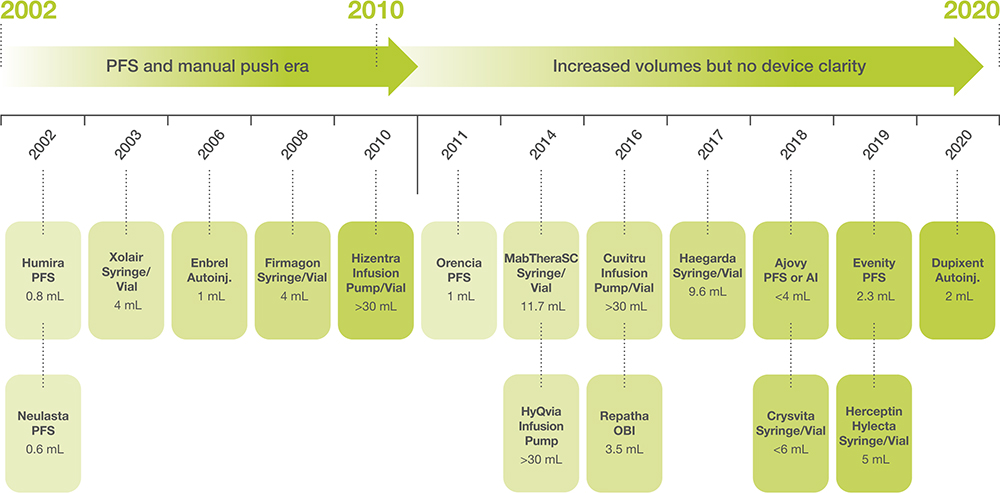
Figure 2: Subcutaneous delivery – a volume journey over 25 years.
UNCOVERING EVIDENCE OF OBDS TOLERABILITY
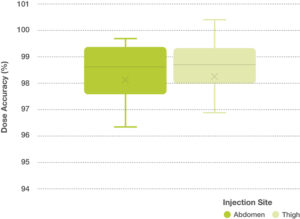
Figure 3: Dose accuracy of delivery by Sorrel into the thigh and abdomen during a clinical trial.
LTS conducted a study to assess patient tolerability of OBDS-based drug delivery for a dose volume typically delivered either by HCPs via multiple syringes or by infusion via a durable pump.
In a clinical trial, 22 healthy subjects were subject to two high-volume injections of ~15 mL using LTS’s Sorrel™ electro-mechanical OBDS. The injections were delivered into the lower abdomen and thigh of subjects, with each lasting around 15 minutes (Figure 3). Patients self-reported pain scores at various times after device placement and during delivery, while also completing post-treatment questionnaires to provide an evaluation of their overall experience. Injection sites were visually assessed to check for bleeding, bruising, irritation, rash, bleb formation or leakage. Dosing accuracy was measured by weighing the device pre- and post-injection to verify the on-board device readings.
From a device perspective, the results showed that doses were delivered in full, with no errors or inconsistencies, and there was no evidence of fluid reflux onto the skin following removal. Skin reactions were limited and in line with predictions. Out of 19 reports of redness, the majority cleared within 60 minutes of device removal, and the remainder cleared within 24 hours. Mild skin warmth was reported in two cases, but this dissipated within 15 minutes.
In terms of tolerability, peak levels of patient-reported pain occurred five minutes into the injection, but the level was low for most subjects, indeed, some described the experience as an unfamiliar sensation rather than pain. There were no requests to abort treatment, and for all subjects, pain was fully resolved 15 minutes after treatment, underlining the speed of recovery.
Overall, the vast majority of participants (91%) agreed that the device was comfortable to use, with the same proportion saying they felt confident in handling it independently at home without medical supervision.
A COMPELLING CASE FOR DEVICE COMPLEXITY
These study results send an unequivocal message regarding the significant untapped potential of OBDSs. They can enable patients with chronic conditions to benefit from convenient home-based treatment rather than relying on subcutaneous infusion in a medical facility. With LTS’s Sorrel™ OBDS, the entire process is supported by data that confirm when an infusion occurred, if it was successful, how long it took, the precise volume of drug delivered and any potential user- or device-related errors.
“THIS EXTENSIVE TECHNICAL CAPABILITY COMES WITH COMPROMISE: COMPARED WITH OTHER SUBCUTANEOUS SELF-ADMINISTRATION MODALITIES, AND INDEED OTHER OBDS PLATFORMS, SORREL™ IS INHERENTLY MORE COMPLEX FROM A DESIGN AND ENGINEERING PERSPECTIVE.”
Admittedly, however, this extensive technical capability comes with compromise: compared with other subcutaneous self-administration modalities, and indeed other OBDS platforms, Sorrel™ is inherently more complex from a design and engineering perspective.
As such, for applications where drug volumes are pushing the 2.25 mL threshold for autoinjector delivery, pharmaceutical and biotech organisations must consider which delivery route is more reliable for their injectable formulation, with the simpler option of a handheld, patient-controlled autoinjector pitted against the more sophisticated, software-controlled OBDS.
In this scenario, many factors will filter into the final calculation, from compliance and clinical outcomes to the cost of development and manufacture. Faced with such a complex decision-making process, there is a risk that judgement may be clouded by an inherent human bias towards simplicity, resulting in a tendency, in the pursuit of cognitive efficiency, to favour options that do not require more intense reasoning or analysis.3 In this example, fewer device components and simpler functionality appear to signal fewer points of risk (and vice versa), leading to a flawed conclusion that autoinjectors are the preferable route.
SOFTWARE: ADDING A LAYER OF INVISIBLE DEVICE INTELLIGENCE
Upon closer inspection, the relationship between device complexity, functionality and reliability is not as simple as it seems. Perhaps counterintuitively, there is a strong argument that an OBDS, despite being a more technically advanced platform, represents a more reliable and predictable delivery option. This logic is explained by one of the core features that differentiate an electro-mechanical device from a purely mechanical one: software.
The control software within an OBDS is akin to the device’s “brain”, with responsibility for orchestrating operations and elevating the hardware into an “intelligent” system. One key aspect of this intelligence is the ability to capture the exact time, duration and successful completion of an infusion. Such data have the potential, permissions allowing, to be integrated into companion apps or healthcare provider networks.
Another key aspect is the ability of an OBDS to continually perform self-checks and encode this activity into memory, meaning that every device contains a fully traceable status history that can bring critical insights into product integrity. This provides valuable support for dosing reliability, as data on compromised integrity and the potential for a failed injection can be relayed from the device in the field, triggering its removal from circulation.
By way of contrast, it is helpful to highlight the inherent limitations of traditional mechanical delivery systems. Here, there is no ongoing monitoring or feedback on device status, meaning that there is no way to gain insights into the device’s functionality or performance. During manufacturing, verification processes provide a layer of quality assurance, but once released into the supply chain, the absence of control software means these “dumb” units are not equipped to assess their own condition, detect degradation from environmental factors or respond to unexpected conditions during patient use. Factors such as temperature exposure, mechanical creep, ageing or transportation stress may significantly impact performance, but in the absence of a software-controlled “flagging” mechanism, such issues can remain undetected, only manifesting themselves through a fault at the moment of injection, resulting in wastage of a potentially high-value dose.
This can be thought of as an “open loop”: without control software, there is no monitoring of delivery, detection of mechanical failures or intervention if something goes wrong. If, for example, there is increased tissue resistance, misalignment or incomplete actuation, the suboptimal mechanical device continues its process “blind”, potentially resulting in a wet injection, incomplete dosing or patient injury.
Conversely, an OBDS platform, such as LTS’s Sorrel™, uses software to create a “closed loop”, where correct performance of critical delivery functions can be continuously verified throughout the device’s life at four key stages. If post-manufacturing checks highlight deviations, such as loss of intended positioning, the system can immediately detect, respond to and safely interrupt the injection process in real time – a fundamental reliability advantage that mechanical systems simply cannot provide.
- Production Stage Verification: During manufacturing, the OBDS software executes a comprehensive suite of automated tests performed on every single device to ensure repeatable and objective quality verification. These checks include position and alignment verification using indexed multisampling measurements, electrical validation and controlled actuation tests that validate movement consistency. All test results, including raw measurements and error events, are automatically recorded in a production database, providing full traceability and facilitating continuous improvement.
- Pre-Treatment Validation (Pre-Client Test): Before a patient begins treatment, the OBDS performs an automated, software-controlled self-test to ensure that it remains fully functional after shipping and storage. This sequence includes a built-in test of internal systems, battery validation and position verification to ensure correct alignment prior to delivery initiation. If any deviation is detected, a software-driven gating mechanism prevents treatment initiation and transitions the device to a safe fault state.
- Real-Time Treatment Monitoring: During drug delivery, embedded software algorithms continuously monitor device performance. Key functions include tracking delivery progress, verifying positioning and detecting flow-related anomalies inferred from actuation patterns. If any abnormality is detected, the device stops, retracts the on-body needle and registers the error.
- Post-Treatment Data Traceability: At the end of the treatment cycle, the device records a complete execution history stored in non-volatile memory, including treatment completion status, the full sequence of operational states and the cause of any fault conditions.
While autoinjectors might log and relay information on activation events, the OBDS lifecycle data log delivers a full, traceable audit of real-world events. It represents a rich seam of insight, even incorporating possible field failure modes that would otherwise remain hidden, thus allowing pharma companies to establish a feedback loop for continuous improvement of manufacturing and device performance.
DETAILING PERFORMANCE, EVIDENCING TOLERANCE
On reflection, it is no surprise that the technology for facilitating self-administration of injectable therapies continues to become increasingly complex. To provide an enhanced experience for patients, a device must have the in-built intelligence to monitor and manage each injection event, controlling the conditions for the safe and complete delivery of a dose, while also fuelling a data feedback loop to optimise manufacturing and treatment efforts. Such a multiplicity of objectives is only possible to achieve with more advanced layers of functionality. Add into this picture the industry’s movement towards connected health and personalised medicine, and it is easy to see that complexity, far from being a multiplier of risk, is in fact the intelligent answer to delivering improved outcomes in the face of ever more complicated healthcare challenges.
With a combination of robust data on device performance and higher-volume dose tolerance, software-controlled wearable technologies root patient-centric injectable delivery in evidence and insight. In doing so, stakeholders can be assured that jeopardy is removed at the very moment it matters most, maximising the potential for the right dose to be delivered in the right way at the right time.
REFERENCES
- Mohr D et al, “Teaching patients to self-inject: pilot study of a treatment for injection anxiety and phobia in multiple sclerosis patients prescribed injectable medications”. J Behav Ther Exp Psychiatry, 2002, Vol 33(1), pp 39–47.
- Sunstrom N, Sunstrum F, “Wearable Devices for Subcutaneous Delivery of Large-Volume Biologics: Design, Use, and Regulatory Perspective”. Biomed Mater Devices, 2026, Vol 4, pp 4116–4135.
- University of Waterloo, “Simplicity is key: Study finds our minds favor simple explanations and efficient actions”. ScienceDaily, Nov 2024.
Previous article
SCALING ON-BODY DELIVERY FOR LARGE-VOLUME THERAPIESNext article
CONFERENCE PREVIEW: CPHI MILAN