To Issue 193
Citation: Martin P, Taylor J, “Connected Inhaler Testing: Strengthening Control, Consistency and Traceability”, ONdrugDelivery, Issue 193 (Nov 2026), pp 60–63.
Paul Martin and James Taylor explore how fragmented inhaler testing workflows can compromise consistency, data integrity and traceability, and how greater connectivity between equipment, software and data can strengthen control, scalability and productivity.
Inhaler test methods and set-ups have advanced considerably in recent decades. Innovations in impactors, interfaces, flow control and breathing simulators have transformed testing practices and enhanced clinical relevance. The inclusion of realistic aerodynamic particle size distribution (rAPSD) within evolving US FDA Product-Specific Guidances (PSGs) illustrates the growing role of more advanced in vitro testing in bioequivalence (BE) assessments and the potential of in vitro methods to reduce reliance on clinical studies.
“DIGITALISING INHALER TESTING WORKFLOWS COULD HELP LABORATORIES REDUCE VARIABILITY AND OPERATIONAL RISK BY IMPROVING THE CONSISTENCY, TRANSFERABILITY AND SCALABILITY OF INHALER TESTING.”
However, inhaler testing workflows have changed far less and remain heavily reliant on manual interventions, manual inputs and manual recording. The result is operational risk and underlying variability that can erode data integrity, control and auditability. To realise the full value of in vitro data, these limitations in established practice need to be addressed. Digitalising inhaler testing workflows could help laboratories reduce variability and operational risk by improving the consistency, transferability and scalability of inhaler testing.
WHERE FRAGMENTATION REMAINS IN CURRENT WORKFLOWS
Inhaler testing workflows typically combine multiple standalone instruments, manual set-up and parameter entry, analyst-dependent interventions and separate systems for recording and processing data. While automation has already reduced operator-dependent variability and improved efficiency in key steps, connectivity between individual workflow elements often remains limited. As a result, equipment, test parameters, analyst actions and data may still need to be brought together manually to create the complete test record.
Laboratory workflows often combine product-specific test procedures with separate processes for recording, calculating and storing results. Moving data between these steps can require manual transcription or export, adding time to the analytical process, and opportunities for error.
Some laboratories, typically larger organisations, have a laboratory information management system in place, but these systems are not specifically designed for inhaler testing and may not readily bring together methods, equipment information and test data across the full testing workflow. This creates an important role for dedicated inhaler testing software that interfaces effectively with inhaler testing equipment.
In the absence of this level of integration, workflows tend to be fragmented, with multiple points of potential for operational error, variability and compliance risk. Every point at which information is transferred between equipment, software, records or locations creates an opportunity for inconsistency or loss of traceability. If information control is weak, reproducibility can suffer and investigating unexpected or out-of-specification results becomes more difficult.
Focusing on Cascade Impaction
Closer examination of the workflow and information handled in APSD measurement highlights the limitations of current routine practice. APSD is a critical quality attribute for all orally inhaled products (OIPs), providing information relevant to likely in vivo deposition. Cascade impaction is the established technique for APSD measurement, providing aerodynamic particle sizing of the drug in the respirable size range.
Figure 1 shows a compendial cascade impactor test set-up for measuring the APSD of metered dose inhalers (MDIs). Key points to note about this set-up are:
- It comprises multiple standalone items that must be correctly configured and connected
- Equipment suitability, calibration/maintenance status and operating parameters must all be associated with the test
- Drug recovery from the cascade impactor can generate up to ten samples for assay, typically by high-performance liquid chromatography (HPLC)
- Each assay must be correctly linked to the corresponding impactor stage/component and stored within the test record for APSD calculation and reporting.
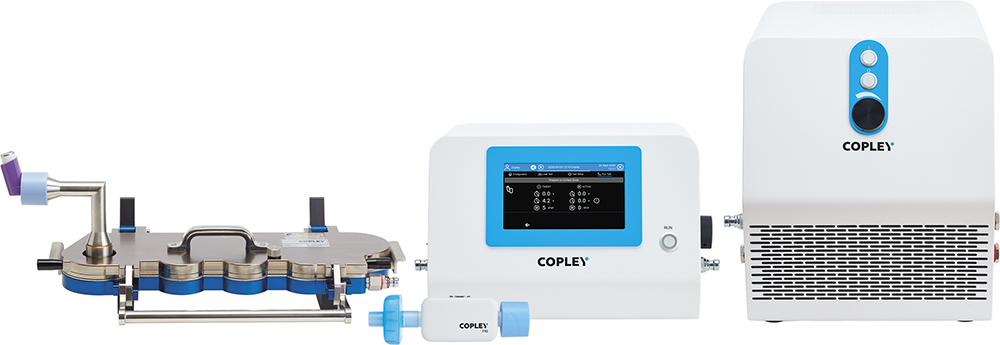
Figure 1: A compendial test set-up for APSD measurement for MDIs showing (left to right): next-generation impactor (NGI) with induction port and test device, flow rate sensor, critical flow controller and vacuum pump.
To summarise, each APSD measurement depends on multiple equipment records, operating parameters, analyst actions and data sources. The information necessarily recorded for each individual measurement ranges from results confirming the suitability and performance of the chosen equipment through experimental and environmental parameters, such as flow rate, humidity and temperature, to sample assays. All of it must be correctly linked to the same test to create a complete record.
Delivered dose uniformity testing, which also quantifies a critical quality attribute, is closely similar in many respects, albeit simpler. In both cases, the extent of manual input can make consistent method execution, documentation and transfer difficult, both between sites and when working with external partners.
EXAMINING THE DRAWBACKS AND RISKS OF CURRENT PRACTICE
These limitations become clearer when considering what inhaler testing needs to achieve. The goals are to produce reliable, reproducible data as efficiently as possible while maintaining complete, traceable records that support data integrity in line with ALCOA+ principles and applicable regulatory requirements.
Fragmented and highly manual workflows can make these goals harder to achieve by:
- Introducing potential for inconsistency and error at multiple steps
- Embedding time-consuming manual actions and processes within the workflow
- Requiring extensive training/re-training with individual analysts to achieve and maintain high levels of consistency
- Making it difficult to maintain an integrated, complete, auditable data record that is fully compliant and easy to interrogate.
“THE SCOPE FOR VARIABILITY IS ESPECIALLY IMPORTANT BECAUSE EVEN RELATIVELY SMALL DEPARTURES FROM A DEFINED METHOD CAN IMPACT MEASURED VALUES.”
The scope for variability is especially important because even relatively small departures from a defined method can impact measured values. These deviations can occur more easily than might be expected, for instance, when assembling an impactor, pipetting defined solvent volumes during drug recovery or transcribing data. In each case, the issue is not only preventing the deviation but being able to establish the cause and impact quickly and confidently during an investigation. On a larger scale, this scope for variability can make precise method transfer and scale-up major challenges for commercialisation and global manufacture.
Recognising or tracking down an error that has entered the data chain can often be both difficult and time-consuming. Disparate, manually linked data sources make auditing any individual measurement extremely complex and, in the worst-case scenario, critical information may simply go unrecorded. Investigating out-of-specification results can therefore become lengthy and costly, potentially delaying development or submission activities.
“AUTOMATED, CONNECTED AND DIGITALISED EQUIPMENT, COMBINED WITH CENTRALISED SOFTWARE, CAN GENERATE DATA THAT FLOW WITHOUT MANUAL INTERVENTION.”
THE PROMISE OF DIGITALISATION
Across the pharmaceutical industry, the potential benefits of digitalisation are well-rehearsed. Automated, connected and digitalised equipment, combined with centralised software, can generate data that flow without manual intervention. Cited gains typically include:
- More consistent execution of defined methods
- Reduced reliance on manual transcription and data transfer
- Stronger links between equipment, operating parameters, samples and results
- Faster reconstruction of events during investigations
- Easier adherence to controlled, compliant laboratory practices
- A more complete and readily audited data trail well-matched to regulatory requirements.
In this context, connectivity is not simply moving data between systems. Its value lies in creating a more controlled workflow and a more complete and accessible record of what happened during a test. For many laboratories, full digitalisation will not be an immediate or practical objective, which reinforces the case for a progressive rather than wholesale approach to connected testing.
At the same time, several converging pressures are increasing the demands placed on inhaler laboratory workflows, creating motivation to act. More specifically:
- Continued growth and geographical diversification in the inhaled product market, increasing testing volumes and the need to reproduce methods consistently across laboratories, sites and external partners
- Ongoing MDI reformulation with new low global warming potential propellants, to aggressive timescales
- The introduction of revised FDA PSGs for certain OIPs with BE pathways that eliminate the need for comparative clinical endpoint studies, increasing the importance of robust and discriminatory in vitro evidence
- The delivery of inhaled biologics and other increasingly complex products, which can introduce more demanding in vitro testing requirements and additional workflow complexity
- Continued regulatory pressure around data integrity, traceability and demonstrable information control across analytical workflows and data chains.
The combined effect is an increase in not only the volume of inhaler testing but also in its complexity and the demands placed on laboratories to demonstrate consistent information control. Whether laboratories respond by increasing productivity, scaling operations across multiple sites or outsourcing elements of testing, the ability to reproduce methods consistently and maintain complete, traceable records becomes increasingly important. Greater connectivity, digital records and automation can all play a role in realising the necessary information control.
BUILDING TOWARDS CONNECTED TESTING
Moving towards connected testing does not require laboratories to digitalise or automate an entire workflow at once. A practical starting point is to examine existing processes, identify where manual hand-offs, disconnected records or repetitive analyst interventions create the greatest risk or burden, and prioritise those areas. A pragmatic strategy might involve:
- Introducing automation tools (Box 1) where repetitive or operator-dependent steps create unnecessary variability or burden
- Improving the connectivity between test equipment and software
- Bringing equipment identity, calibration and maintenance information into the test record, including for purely mechanical equipment, such as cascade impactors
- Using specialist software to centralise methods, equipment records, analytical data and test information, supporting more consistent execution and easier review.
The appropriate starting point will vary between laboratories. For some, greater control of methods and equipment records may deliver the greatest immediate benefit; for others, reducing manual data transfer or automating a particularly operator-dependent step may be the priority. The important point is that connected capability can be built progressively around the areas of greatest need.
The pace and extent of digitalisation will vary between laboratories. Progress can be incremental, starting with manual inputs, disconnected records or operator-dependent steps that create the biggest risk or burden.
For laboratory managers, the key question is therefore not how quickly to create a fully digital laboratory but where greater control would make the biggest difference today.
BOX 1: Automation – A complementary strategy for variability reduction
Connected testing and automation are distinct but complementary. Connectivity can strengthen how test information is captured, stored and accessed, while automation can reduce the number of repetitive or operator-dependent interventions within the workflow.
Manual steps may remain within a connected workflow, but each intervention introduces another point that must be controlled and documented. Where appropriate, automation can reduce operator-related variability, while also making it easier to capture process information within the overall test record.
Consider the process of drug recovery from an NGI. Manually dispensing solvent into each collection cup, agitating the cups to dissolve the drug and transferring samples into HPLC vials for assay all depend on consistent analyst execution. The associated process information may also need to be recorded manually, creating additional opportunities for error or incomplete records.
In contrast, using an automated tool for solvent dispensing, agitation and sample extraction can improve the consistency of all these steps, minimising the risk of variability in drug recovery. Where automation is connected to centralised software, relevant process information can also transfer directly into the test record.
In summary, automation can deliver benefits in its own right while also supporting the development of more connected and traceable workflows.