To Issue 191
Citation: Khanolkar A, Vilaplana M, White S, Evans P, “A Large-Volume and High-Viscosity Autoinjector Delivery Platform for Biotherapeutics”, ONdrugDelivery, Issue 191 (Oct 2026), pp 145–150.
Asmita Khanolkar, Marta Vilaplana, Susanna White and Pete Evans present SMC’s Bios platform, designed to simplify device development for the delivery of biologics while maintaining identical key design aspects across all Bios variants.
As today’s medicines evolve to include biotherapeutics, the complex delivery needs for the self-administration of high-concentration, high-viscosity and large-volume doses continue to increase. Achieving the optimal concentration for therapeutic efficacy in a patient-preferred, self-administration setting requires new device solutions for subcutaneous (SC) rapid delivery. SMC’s Bios autoinjector platform solution has capability for large-volume delivery (up to 5.5 mL) and high viscosity for rapid delivery (under 30 seconds).
“DOSE VOLUMES OF 3–5 mL IN A RAPID DELIVERY SETTING VIA AN AUTOINJECTOR CONTINUE TO REMAIN AN AREA OF DEVELOPMENT, AS THERE ARE SEVERAL CHALLENGES TO CONSIDER WHILE DEVELOPING AN AUTOINJECTOR SOLUTION FOR LARGE-VOLUME SC DELIVERY.”
RAPID SC DELIVERY
Although it has been established that SC delivery of larger volumes is feasible, this has mainly been established for injections with longer injection times. Dose volumes of 3–5 mL in a rapid delivery setting via an autoinjector continue to remain an area of development, as there are several challenges to consider while developing an autoinjector solution for large-volume SC delivery.
Mechanical Design Limits
The power required to deliver large volumes via an autoinjector is substantially higher than for typical volumes (around 1 mL). Although high-energy springs can be used, they increase in size substantially and pose challenges for material creep limitations on components in the design. A more flexible energy source is necessary. Compressed gas as an energy source poses a better alternative to compression springs, as the energy density is sufficient to cover the design limits within a realistic size. Additionally, gas management (release and control of pressure) is predictable and consistent.
Injection forces and pressure must increase within the system to achieve rapid delivery. Most biologics use glass containers where vulnerability to fracture can limit capabilities. Staked-needle syringes offer more flexibility for ready-to-fill solutions and offer the potential to use both glass or polymeric options for syringes that can tolerate high pressure. However, in general, options are limited for high-pressure systems in currently available standard syringe containment closure system configurations.
Additionally, drug compatibility and silicone-free requirements may limit the selection even further. Luer Lock syringes may not withstand the required pressures, although they can be suitable for low-pressure applications (e.g. 5 bar). Staked-needle options are now available for glass up to 5.5 mL, although polymeric options for staked-needle syringes are not currently commercially available for large-volume applications.
Dose and Tolerability
Several factors need to be considered regarding patient tolerability with rapid injections, such as pharmacokinetics, pain, discomfort, leakages and injection site reactions. Some considerations, such as concentration, viscosity, temperature, pH, homogeneity and flow properties, are drug-related factors to be optimised. On the device side, needle selection, injection time and depth play an important role for patient tolerability. Smaller needle gauges are associated with less pain, although the speed of injection and jetting effects may potentially affect pain levels. Delivery optimisation with the injection parameters can be considered and mapped ahead of use, even in the case of suspensions or non-Newtonian formulations where the flow behaviour may be influenced by environmental factors (Figure 1).1
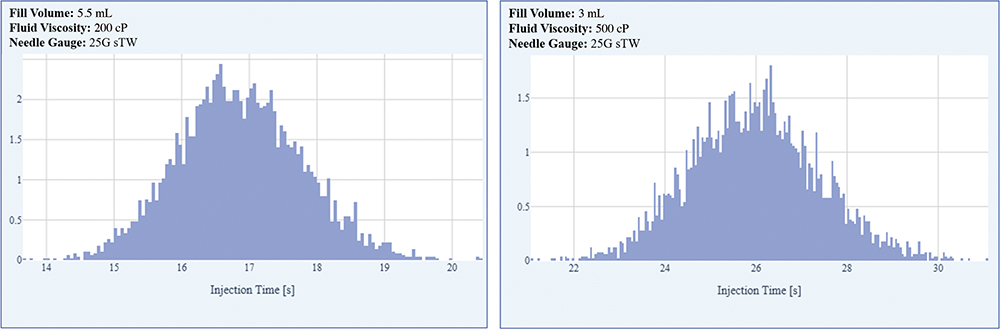
Figure 1: Delivery time evaluation with dose (fill volume), viscosities and needle sizes.
“WHILE SIZE AND FORM FACTORS ARE AN IMPORTANT CONSIDERATION, WHEN DESIGNING FOR LARGE-VOLUME DELIVERY, THE PATIENT’S ABILITY TO HOLD THE AUTOINJECTOR IN PLACE FOR THE DURATION OF INJECTION IS ESSENTIAL, AS EARLY REMOVAL CAN RESULT IN WET INJECTIONS AND INCOMPLETE DOSING.”
Usability
The size of the device needs to accommodate the large-dose container as well as the form factor suitable for self-administration. Autoinjectors that can provide ease of use for a large dose can improve patient adherence and device adoption. While size and form factors are an important consideration, when designing for large-volume delivery, the patient’s ability to hold the autoinjector in place for the duration of injection is essential, as early removal can result in wet injections and incomplete dosing. Dexterity, vision and hearing considerations for the target population must also be considered while designing the viewing window, other audio and visual dose confirmations, and general grip and handling of the device.
Instructions for use and packaging require additional scrutiny for large-volume injections. In most cases, a change requiring larger-volume delivery stems from higher dose requirements, a transition from intravenous to SC delivery or a move from daily, weekly, monthly or quarterly injections (towards less frequent injections). In all these examples of large-volume SC delivery, the goal is to maintain the pharmacokinetic and pharmacodynamic profile for therapeutic efficacy while dose changes are implemented. In the case of refrigerated formulations sensitive to viscosity changes related to environmental conditions, the combination-product interactions (dose, syringe and device) must be understood as part of early feasibility studies. These help to inform the content of instructions for use and build real-use scenarios in subsequent formative studies. These are essential, as if the patient cannot use the device correctly, the dose is not delivered completely and the therapeutic effect is not achieved.
“GIVEN THE CHALLENGES OF LARGE-VOLUME DELIVERY, A PLATFORM APPROACH IS IDEAL FOR THE MULTIPLE VOLUME, VISCOSITY AND NEEDLE REQUIREMENTS TO CONSIDER FOR TARGETED THERAPIES AND PRECISION MEDICINES DESIGNED TO BE SELF-ADMINISTERED OR DELIVERED IN A HOME SETTING.”
THE BIOS PLATFORM APPROACH
Delivery of biotherapeutics is challenging, as these formulations are typically delivered at high concentrations and/or high doses to achieve therapeutic effect. A balance must be struck between concentration/viscosity and volume as well as the delivery time for self-administration. Other factors to be considered for biotherapeutics are stability and shelf life. As sensitive formulations, they are prone to agglomeration and degradation. Container strength, shear forces through the needle, container compatibility and cleanliness are additional requirements for container selection. Flexibility of multiple syringe/rigid needle shield/stopper combinations and a high-energy power source are requisites for a solution to accommodate the challenging delivery requirements.
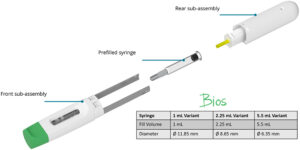
Figure 2: Bios platform configuration with 1 mL long, 2.25 & 5.5 mL ISO 11040-compliant variants.
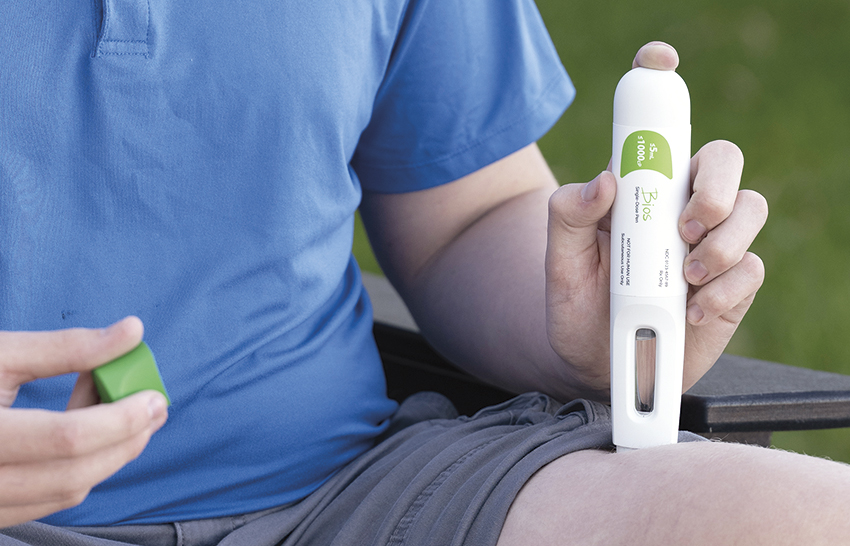
Given the challenges of large-volume delivery, a platform approach is ideal for the multiple volume, viscosity and needle requirements to consider for targeted therapies and precision medicines designed to be self-administered or delivered in a home setting. Bios is a flexible platform solution, which includes a gas-powered powerpack and accommodation of ISO 11040 staked-needle options.2 It also accommodates the geometries of commercially available 1 mL long, 2.25 and 5.5 mL staked-needle syringes without a major change in form factor (Figure 2 & Table 1). The mechanisms defining device function and performance, as well as critical part features are the same across all Bios variants. Platform benefits include a patient-centric design, flexible and simple reconfiguration, sterilisation path options and appropriate drug contact materials. Key features include a simple two-step, one-handed operation, audible, visual and tactile feedback, along with a permanently hidden needle and passive needle safety aspects.
| Device Specifications | 1 mL Variant | 2.25 mL Variant | 5.5 mL Variant |
| Primary Container | 1 mL long | 2.25 mL | 5.5 mL |
| Delivered Volume | 0.5–1 mL | 1–2 mL | 3–5 mL |
| Viscosity | Up to 1,000 cP | Up to 1,000 cP | Up to 500 cP |
| Staked-needle diameter | 25–29G | 25–29G | 25–27G |
| Injection time target | Under 10 s, dependent on patient tolerability | Under 15 s, dependent on patient tolerability | Under 30 s, dependent on patient tolerability |
| Prefilled syringe shield | Rigid | Rigid | Rigid |
| Target needle insertion depth | ~6 mm | ~6 mm | ~6 mm |
| Injection feedback | Audible and Visual | Audible and Visual | Audible and Visual |
Table 1: Bios platform device specifications.
The rear sub-assembly, which contains the powerpack and the activation mechanisms (including the pressure chamber and gas canister), is kept the same across all Bios configurations. The front sub-assembly holds the syringe and has change components that can hold all three different syringe sizes. Configurable prefilled syringe options with ISO 11040-compatible containers address the high-pressure requirements. A powerful gas-powered powerpack addresses delivery in acceptable injection times.
Human Factors Research
Human factors research is an integral part of development when considering a truly patient-centric approach for self-administration. Understanding and implementing patient preferences helps to ensure smooth usability of platform devices.
A 20-participant study of adults with two patient groups was completed. The first group was a mix of potential users that included both autoinjector-aware and naïve users; the second group consisted of users with manual dexterity issues. Patients with chronic diseases such as rheumatoid arthritis, Crohn’s disease, multiple sclerosis and metabolic and autoimmune diseases were also included in the study. The study was successfully completed by all participants with no use errors.
Some of the human factors considerations for the Bios platform included low force to hold the device in place during injection – an especially relevant consideration for large-volume injections – device size, grip, presentation and visual and audible confirmation of injection.
Delivery Modelling
Multiple empirical studies across various larger-dose volumes and viscosities have been conducted to gather data for the Bios platform delivery model. Testing using viscosity mimics and a range of fill volumes from 0.5 to 5 mL were used to develop the model. Functional device testing was also conducted to assess cap removal, activation force, extended needle depth, dose accuracy, injection time, delivered dose and needle safety as part of the platform development. The design testing envelope covered fill volumes from 0.5 to 5 mL over a range of viscosity mimics and a range of gas pressures from 60 to 205 bar.
“OUTCOMES CAN BE DERIVED BASED ON DIFFERENT INPUT SCENARIOS TO PREDICT INJECTION TIME, DELIVERY CONSISTENCY, FORCES AND PRESSURES.”
Based on empirical data, using the ideal gas law and the Hagen-Poiseuille equation framework, a mathematical model has been created for use of the Bios platform (Figure 3). Outcomes can be derived based on different input scenarios to predict injection time, delivery consistency, forces and pressures. This validated model is the foundation for understanding specific configurations of the platform design envelope – it improves the accuracy of predicted results without costly and time-consuming testing of multiple variables.
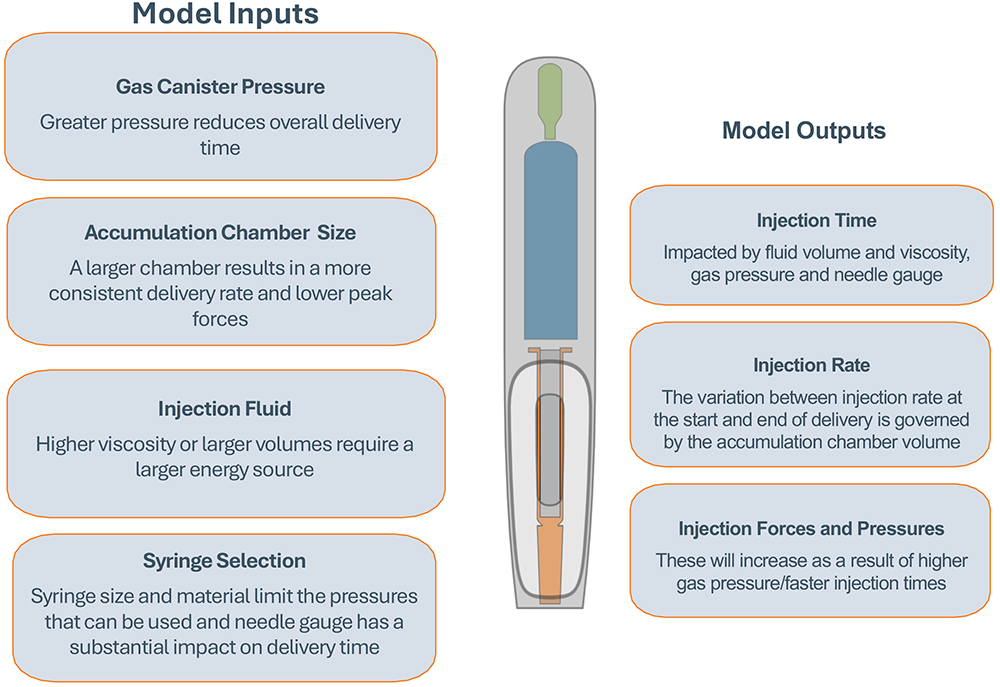
Figure 3: Model development for the Bios platform configuration.3
Platform Capability
The Bios platform capability covers a large range of doses and viscosities for various formulations (Figure 4). Based on the combination of product requirements, the energy source, syringe selection and syringe needle combinations can be configured to achieve optimal delivery. The device can also be manufactured to configurations for clinical and commercial volume launches.
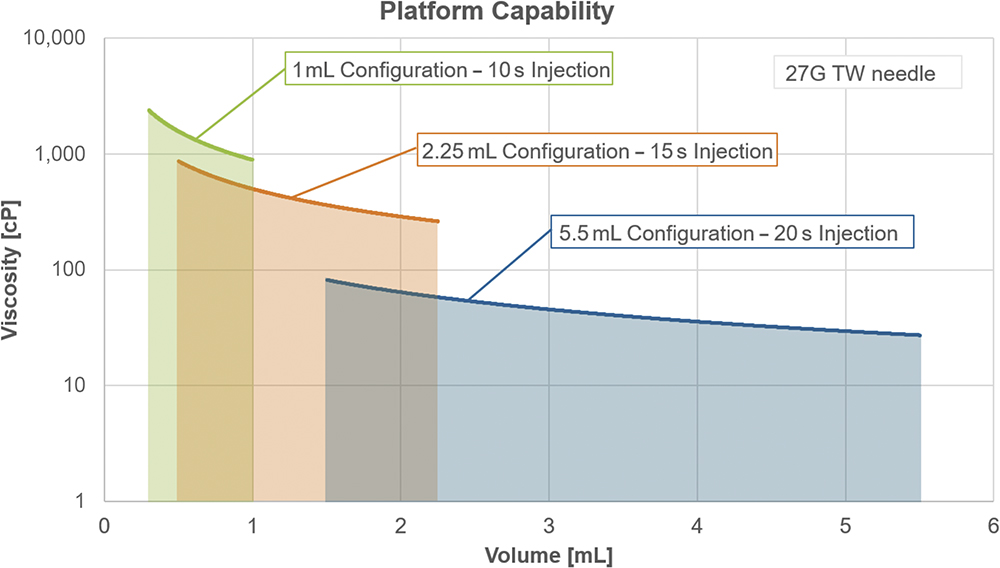
Figure 4: Bios platform delivery capability for a 27G thin-wall needle and specific target delivery times.
“THE BIOS AUTOINJECTOR PLATFORM IS CAPABLE OF DELIVERY OF LARGE-VOLUME (UP TO 5.5 mL), HIGH-CONCENTRATION FORMULATIONS, HELPING TO PROVIDE ADDITIONAL OPTIONS FOR SELF-ADMINISTERED DELIVERY OF COMPLEX FORMULATIONS
TO THE PATIENTS THAT NEED THEM.”
CONCLUSION
The Bios autoinjector platform is capable of delivery of large-volume (up to 5.5 mL), high-concentration formulations, helping to provide additional options for the self-administered delivery of complex formulations to the patients that need them. The platform offers configurability of energy source, container and needle selection, thus providing freedom to optimise challenging therapeutic formulations and their delivery.
REFERENCES
- Khanolkar A, White S, Margerison E, “A Novel Method to Optimize Drug Delivery for Parenteral Products Involving New Therapies and Unmet Needs”. Pharm Res, 2023, Vol 40(10), pp 2303–2315. The PDA Miniverse: Medical Devices, Combination Products and Connected Health Conference Poster, May 2026, Dublin, Ireland.
- Khanolkar A, Vilaplana M, “A Configurable Patient-Centric Delivery Platform for Biologics and High-Concentration Formulations”. ONdrugDelivery, Issue 178 (Oct 2025), pp 42–47.
- Vilaplana M, White S, Evans P, “Applications of Math modeling to the development and expansion of a High Viscosity Large Volume Autoinjector Platform”.