To Issue 191
Citation: Köhler C, “Assembly Concepts for Wearable Injectors Based on ROI”, ONdrugDelivery, Issue 191 (Oct 2026), pp 165–170.
Dr Carsten Köhler looks at how assembly concepts drive the return on investment in the wearable injectors market and the effect of automation on these metrics.
The wearable injection device market is expanding, driven by demand for at‑home therapies, chronic disease management and patient‑centric care that requires convenience and adherence. The combination of miniaturisation, connectivity, and disposable or reusable form factors is driving innovation that, in conjunction with stringent regulatory and pharmacological requirements, is pushing manufacturers towards a reliable production set-up and full supply chain traceability. Accordingly, assembly processes for wearable injectors integrate precision mechanics, sterile fluid handling, electronics and controlled packaging into a seamless workflow to deliver safe and reliable drug delivery systems.
“ASIDE FROM THE PRODUCTION SET-UP, ROBUST QUALITY CONTROL IS ESSENTIAL, WHETHER PAPER-BASED FOR MANUAL ASSEMBLY OR AUTOMATIC UPLOADS TO AN MES IN FULLY “A FULLY AUTOMATED ASSEMBLY LINE FOR WEARABLE INJECTORS CONSISTS OF AN INTEGRATED MES ENGINEERED TO MINIMISE MANUAL INTERVENTION AND MAXIMISE PRODUCT TRACEABILITY.”AUTOMATED SYSTEMS.”
Assembly steps begin with modular subassemblies – drive mechanisms, reservoirs, needle/cannula components, adhesive patient interfaces and electronic modules – each inspected for dimensional tolerance, cleanliness and function before integration. Primary assembly takes place in cleanrooms, if necessary, with sterile builds executed in aseptic closed automation using robotic pick‑and‑place. Together with the integrated quality control via a programmable logic controller (PLC), patient safety is a top priority. Aside from the production set-up, robust quality control is essential, whether paper-based for manual assembly or automatic uploads to a manufacturing execution system (MES) in fully automated systems.
WEARABLE MEDICAL DEVICES
Wearable medical devices are body-worn technologies designed to monitor, diagnose or treat health conditions outside traditional clinical settings, including continuous glucose monitors, wearable ECG patches, ambulatory blood pressure monitors and wearable insulin pumps. These devices typically incorporate sensors that collect physiological signals (heart rate, glucose levels, activity, temperature), microprocessors for data processing, wireless modules for connectivity (Bluetooth, Wi‑Fi, cellular) and user interfaces for feedback.
Wearables enable real-time monitoring and long-term trend analysis to support personalised interventions at an early stage – key applications include chronic disease management (diabetes, cardiac arrhythmias, hypertension) and medication adherence – while providing medical personnel with richer datasets and actionable information for patients.1
Wearable injectors are a specific subclass of these devices focused on delivering injectable drugs or biologics through the skin while being worn. Wearable injectors contain reservoirs for medication, delivery mechanisms (microfluidics, pumps, needles, microneedle arrays) and dosing control systems. Their functional modules include sterile fluid paths, precise dosing accuracy, disposable components and safety features to prevent leakage or accidental needle exposure. These devices must demonstrate both device performance and drug delivery safety, whereas monitoring wearables focus on measurement accuracy and data integrity. Key design features for wearables include comfort, usage time, data accuracy, signal artefact reduction, privacy and security of health data, and regulatory approval for medical claims.
ASSEMBLY PROCESSES
As already outlined, the many features of wearable injectors range from the fluid path and dosing mechanism to electronics with app connectivity. This leads to an assembly set-up that must facilitate a wide range of processes, including feeding of parts, screwing, gluing, ultrasonic welding, label application, electronic assembly, battery contacts and laser marking.2 Depending on the product design, the internal features may limit the assembly steps to manual or semi-automatic assembly. Specifically, the handling of complex or unstable parts may be too complicated to automate or limit the achievable overall equipment effectiveness of the complete set-up due to unplannable stops.
Another integral part of the assembly set-up is the in-line testing of each assembly process to ensure a flawless product at the end of the assembly line. One of the most important parts is the fluid path from the reservoir or cartridge to the cannula.3 Here, the fluid path is split between two build groups, as the cannula applicator is often a separate component from the reservoir. Another key test feature is the electronic integrity – after uploading the code onto the control board, the connectivity must be tested to ensure a stable connection with the software application. Overall, the process flow is a continuous transition from assembly to testing stations to ensure a flawless device at the end of the steps, regardless of the level of automation.
ASSEMBLY CONCEPTS
Manual Set-Up
A manual assembly set-up for wearable injectors with only essential automation requires low capital investment, offers high flexibility and quality control, and minimises human error in the most critical steps. The production area is typically a cleanroom for standard assembly operations.
When a more controlled environment is required, gowning and laminar flow hoods are installed for operations involving sterile components; workstations are used as bench-top systems with trays for build groups instead of a workflow with carriers. Most steps are executed manually and only technical essentials, such as ultrasonic welding, are automated. Visual inspections are typically performed by the operators, whereas critical functional tests are performed by automated test fixtures. Each production step is supported by fixtures to ensure the accurate placement of components. Some set-ups may use visually aided assembly with cameras and light features to enable the operator to follow the correct assembly routine (Figure 1).
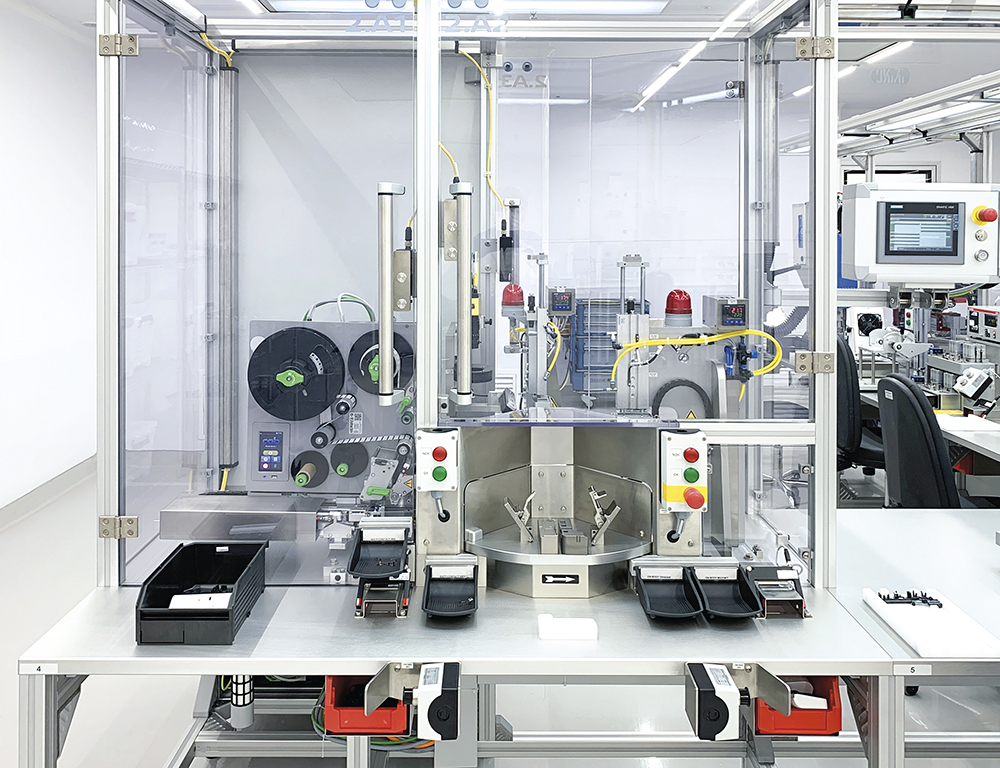
Figure 1: Semi-automatic workstation.
Figure 2: Manual workstation without carrier system.
Semi-Automatic Installation
A semi-automatic assembly set-up targeting approximately three to five parts per minute (ppm) for wearable injectors balances the mechanisation of repetitive precision tasks with human oversight for flexibility and ease of inspection (Figure 2). The facility is organised in a linear production flow within a cleanroom; an isolator may be required for fluid path and reservoir assembly. The assembly stations are usually arranged in a linear fashion with a simplified work piece carrier set-up. The workpiece carriers can either be on a manual slide or be moved freely on a conveyor system. Component feeding mainly remains a manual process, except for difficult-to-handle parts, where a feeding system is more efficient. The assembly stations are mostly integrated into a PLC for process control and data tracking. Quality control is either performed visually by the operators or automatically within the assembly stations directly after the assembly step. Dedicated test stations at the end of the line provide final approval of the product (Figure 3).
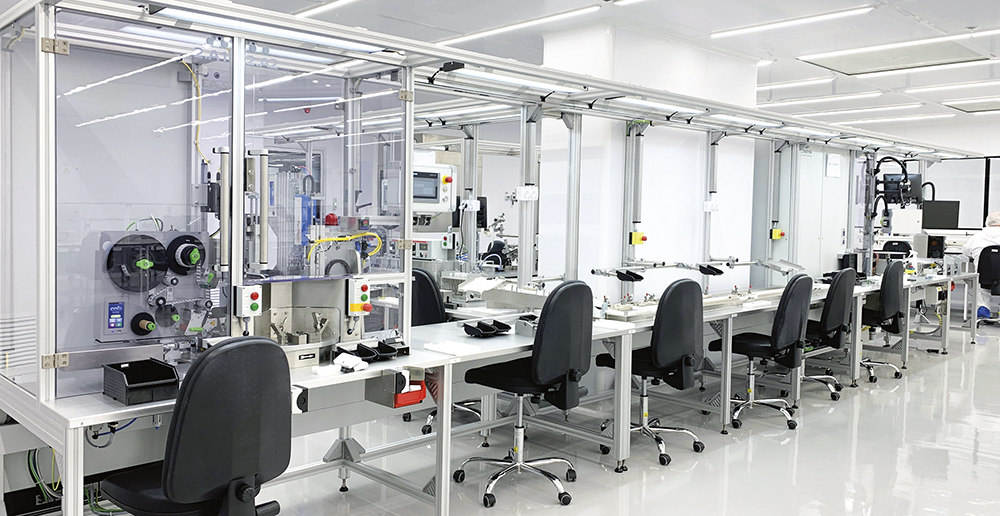
Figure 3: Semi-automatic linear set-up.
The assembly process is managed with barcode-driven controlled work orders and a small automated feeder rack to present components to operators. Component feeding uses vibratory bowl feeders or manual loading stations to keep cycle times consistent, depending on the complexity of the part and quality constraints. Mechanical subassembly tasks (e.g. drive springs, actuator housings and reservoir seating) run on semi-automated fixtures – pneumatic presses and pick-and-place actuators perform alignment and insertion with operator loading and verification. Torque-controlled electric screwdrivers and visually-guided assembly aids ensure repeatable fastening and placement.
The electronic part of the wearable device is pre-assembled offline and presented to the assembly system in trays. The integration of electronic modules into mechanical assemblies is semi-automated – either the operator loads the printed circuit board (PCB) into a fixture, where the station completes the fastening and automatic connection, or a robotic loading system performs the entire process. The final step for integrating electronics is the writing of the software onto the PCB and the following quality check. This configuration achieves ~3–5 ppm by automating the bottleneck precision tasks (e.g. preassembly, closure, flashing, test) while retaining human flexibility for changeovers, visual judgement and exception handling. It reduces manual variability, improves yield and traceability, and shortens validation time and capital investment compared with full automation.
“A FULLY AUTOMATED ASSEMBLY LINE FOR WEARABLE INJECTORS CONSISTS OF AN INTEGRATED MES ENGINEERED TO MINIMISE MANUAL INTERVENTION AND MAXIMISE PRODUCT TRACEABILITY.”
Fully Automated Production
A fully automated assembly line for wearable injectors consists of an integrated MES engineered to minimise manual intervention and maximise product traceability. The line is located within purpose-built production zones, which incorporate enclosed automated cells that execute critical operations under controlled conditions. Facility layouts may adopt linear or cell-based configurations, depending on preferences. Material feeding is completely automated with vibratory bowls or robot-based feeding installations. Workpiece carrier systems (e.g. indexing chains or servo-driven pallets) provide synchronous transfer between feeding, subassembly, final assembly, inspection, serialisation and packaging stations. A PLC controls each production cell and manages the integrated assembly and test steps. Additionally, the process data are collected and uploaded to the MES system. The MES manages process recipes and records real-time quality and process data for regulatory compliance and process control.
The overall process flow is initiated by specialised feeding systems per component; in general, there are vibratory feeder bowls for each component. For product variants, a flexible feeder system comprising camera identification and a robotic picker is used. The most sensitive parts (i.e. PCBs and scratch-sensitive surfaces) are fed into the assembly flow by tray loaders. Due to the high investment required, this is usually the least preferred feeding solution. The actual assembly then takes place on a workpiece carrier. Depending on the assembly system set-up, the stations can be all in one frame, such as a BBS Automation linear transfer system (Figure 4), or broken up into separate cells. As the production numbers for wearable injection systems typically do not exceed 30 ppm, the latter is the more common approach.
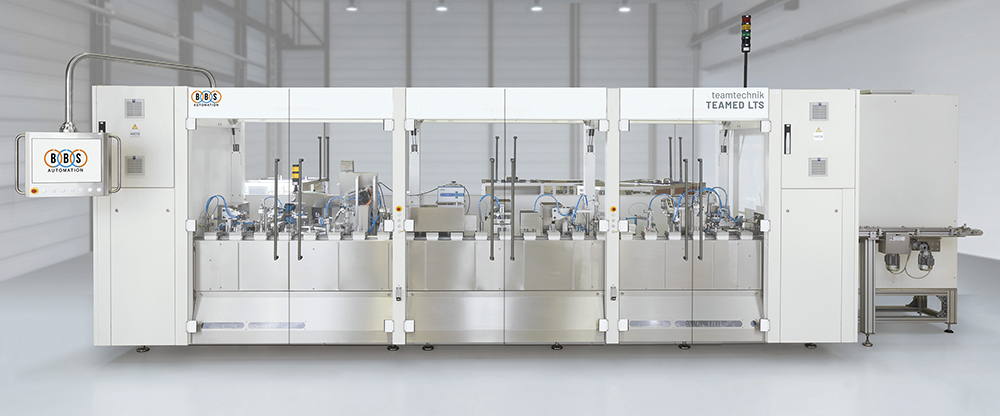
Figure 4: Fully automated linear system.
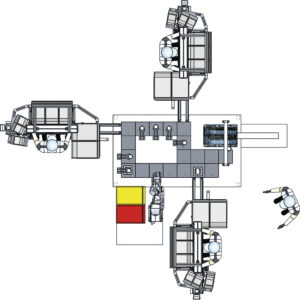
Figure 5: Concept for modular planar automation.
In contrast to other high-speed assembly systems in the medical industry, cam-driven stations are not widely used in wearable injector assembly systems. There is a general preference for modular builds that allow design features to be reused, minimising engineering demands for similar applications (Figure 5). Even if a single base frame could be used for all stations, the process requirements may still require a split configuration. If some assembly steps need defined environmental controls (i.e. a Class 5 cleanroom) then a split configuration is required. This could also be triggered by the electronics integration due to electromagnetic compatibility protection.
Completing the set-up are the checking stations, which ensure consistent quality after each process step, limiting waste and security. Serialisation from the start ensures batch control and traceability, helping to avoid unwanted issues being identified during offline checks. By default, all process data from automated processes are transferred to the MES, linking production results to key performance indicators to support continuous improvement. From an operational perspective, the line is designed for relatively high throughput and consistent cycle times.
Automation enhances yield and process capability by mitigating human error and decreasing scrap and rework. Accordingly, workforce requirements for automated lines transition towards specialised personnel with expertise in automation maintenance, process control and quality-data analysis.
ROI JUSTIFICATION
Full automation demands substantial upfront investment and MES/PLC integration and validation. However, at high and steady volumes, the per-unit manufacturing cost falls dramatically due to lower labour, higher yield, reduced scrap and fewer quality incidents. The return on investment (ROI) is attractive when annual volumes are high enough to amortise the initial investment. Key metrics include equipment cost, expected throughput, labour savings, yield improvement, quality failure cost reduction and product lifecycle length. This results in differences in the calculations and expectations for manual assembly, semi-automated and fully automated production lines. When the ROI is a key investment criterion, low-volume expectations are a limiting factor for investment, making manual or semi-automatic assembly more attractive.
Depending on the installation region, this could still be the case for mid-volume production targets; production volumes need to reach higher numbers for fully automated installations to justify the investment. However, this requires an environment with high labour costs and strict quality requirements. If the product requires high-end technology for assembly and finish, a fully automated assembly system may be the default. The ROI then relies on the market value of the device rather than the production costs.
The ROI can also be undermined by poor product demand forecasts or a short product life, both of which can be mitigated through modular automation that can be repurposed, leasing equipment or phased investment tied to volume milestones. Robust supplier and maintenance contracts, spare parts planning and strong process validation can reduce downtime and protect the ROI.
“FULL AUTOMATION DELIVERS THE BEST
LONG-TERM ROI FOR WEARABLE INJECTORS WHEN DEMAND IS HIGH AND STABLE, PRODUCT DESIGN IS MATURE AND THE ORGANISATION CAN SUPPORT THE TECHNICAL AND REGULATORY COMPLEXITY.”
In summary, full automation delivers the best long-term ROI for wearable injectors when demand is high and stable, product design is mature and the organisation can support the technical and regulatory complexity. For variable or early-stage programmes, a staged approach, transitioning from semi-automation to full automation as volumes justify the capital expenditure, can often optimise returns.
Embedded Quality Control
Quality assurance and regulatory requirements tighten as the level of automation increases, with each level shifting where risks and controls concentrate. Manual processes demand rigorous operator training, environmental monitoring and extensive sampling to mitigate human error and contamination. For the most critical assembly steps, automated tabletop test rigs can be installed. Documentation is often paper-based or semi-digital, increasing the risk of data-integrity issues.
Semi‑automated set-ups reduce the variability of critical steps (e.g. assembly, screwing, adhesive dispensing) and enable targeted electronic records; however, strong operator controls and validated human‑machine interfaces are still essential. Validation scope expands to include equipment qualification (i.e. installation qualification/operational qualification/performance qualification) for automated stations, software verification and calibration programmes. Specifically, software integrity and connectivity are under tight scrutiny during the qualification process. Process controls and in‑process inspection points must be defined to capture automation-specific failure modes.
Fully automated systems elevate expectations for electronic data integrity, software lifecycle management and continuous process verification. Regulators expect comprehensive validation of automation, MES/PLC systems, controlled workflows and tight security for connected elements, including cybersecurity elements. Fully automated inspection can reduce end‑product sampling, although validation of inspection efficacy (i.e. false positives/negatives) is still required. Traceability through serialisation and electronic batch records simplifies batch control but demands robust change control and audit trails.
Across all levels, combination product regulations apply – device and drug interfaces, extractables/leachables and biocompatibility must all still be addressed. Risk management (ISO 14971), human factors engineering and post‑market surveillance remain mandatory. Automation changes the risk profile and must be reflected in the design history file, quality management system (ISO 13485) and regulatory submissions.4
SUMMARY
The wearable injectors market is growing due to demand for at‑home therapies, chronic disease management and patient‑centric care. The drive for miniaturisation, connectivity and reusable form factors is pushing boundaries to overcome current device limitations.
At the same time, strict regulations must be adhered to and supported by full traceability. To accomplish this, assembly integrates precision mechanics, sterile fluid handling, electronics and packaging with an integral quality control. Modular subassemblies, such as drive units, reservoirs, cannulas, adhesive interfaces and electronic modules, are inspected for cleanliness and function and integrated into set-ups either manually or via automatic stations.
Assembly approaches range from manual, through semi‑automatic up to fully automated systems. Manual assembly is flexible and requires minimal investment. Semi-automated lines mechanise repetitive precision tasks with PLC integration, vision aids, torque‑controlled tools, barcode work orders and off‑line electronic preassembly. Fully automated systems minimise manual intervention with automated feeding; synchronous transfer between feeding, subassembly, inspection, serialisation and packaging; and PLC integration for process recipes and electronic batch records, together with MES upload.
The ROI depends on volume – full automation needs high upfront investment but reduces per‑unit cost at scale, while manual/semi‑automated approaches suit low or variable volumes. Mitigations include modular automation, leasing, phased investment and robust supplier/maintenance contracts. The regulatory expectations for combination products apply at all levels, while automation increases the requirements for validation, electronic data integrity, software lifecycle management and cybersecurity. Overall the range of automation is a decision driven by the achievable market volume and required quality controls.
REFERENCES
- Huang X et al, “Technological Advances of Wearable Device for Continuous Monitoring of In Vivo Glucose”. ACS Sens, 2024, Vol 9(3), pp 1065–1088.
- Dorati R et al, “On-body drug delivery systems: State-of-the-art technologies, clinical application, and future perspectives”. Drug Discov Today, 2026. Vol 30(9), art 104441.
- Moawad F et al, “From implantable to wearable: recent advances in microfluidic platforms for precision drug delivery”. Adv Drug Deliv Rev, 2026, Vol 235, art 115906.
- Sunstrom N, Sunstrum FN, “Wearable Devices for Subcutaneous Delivery of Large‑Volume Biologics: Design, Use, and Regulatory Perspective.” Biomed Mater, Devices, 2026, Vol 4, pp 4116–4135.