To Issue 189
Citation: Eden O, Stout M, “Scaling On-Body Delivery for Large-Volume Therapies”, ONdrugDelivery, Issue 189 (Sep 2026), pp 14–18.
Mike Stout and Dr Oliver Eden examine the shift towards large-volume subcutaneous administration, what on-body delivery systems make possible and why bringing them to market at scale depends as much on manufacturing as on design, going on to explore how the collaboration between TxSphere and Jabil combines device innovation with engineering-led manufacturing to help bring these technologies to market.
Pharmaceutical development is undergoing one of its most significant transitions in decades. Advances in biologics and other complex injectable medicines are expanding therapeutic possibilities across oncology, immunology and many chronic diseases while simultaneously reshaping how those therapies are delivered to patients.
Unlike traditional small-molecule medicines, many of these therapies cannot be delivered orally and depend on parenteral administration throughout their commercial life. As pharmaceutical pipelines evolve, formulation scientists are increasingly working with larger dose volumes and more viscous drug products, creating engineering requirements that extend beyond the practical design envelope of conventional handheld injection devices.
The result is a broad transition from intravenous (IV) infusion towards subcutaneous (SC) administration wherever clinically appropriate. Patients increasingly expect treatment that fits more naturally around their everyday lives, healthcare systems continue to seek opportunities to reduce reliance on resource-intensive infusion services, and pharmaceutical companies are investing in drug-device combination products that support self-administration and simplify lifecycle management across growing therapeutic portfolios.
Traditional autoinjectors remain the preferred solution for many injectable medicines. However, their practical operating range typically accommodates doses between approximately 0.3 and 2.25 mL, whereas many emerging biologics require substantially larger SC delivery volumes. Those evolving therapeutic requirements are accelerating innovation in wearable on-body injectors engineered specifically for larger-volume therapies.
In 2024, roughly 15% of all approved or clinical-stage IV and SC biopharmaceuticals were large-volume SC therapies – predominantly monoclonal and bispecific antibodies for cancer (41%) and autoimmune conditions (27%),1 with most falling within the 2–20 mL range. Non-cancer therapies tend to sit in the lower 2–5 mL tier, within reach of handheld autoinjectors, while most cancer therapies fall within the 5–20 mL range and are still administered in hospitals or clinics – the part of the market where the demand for capable home-delivery systems is now concentrating. And the category is broadening beyond biologics; the US FDA’s October 2025 approval of Lasix ONYU (SQ Innovation, Burlington, MA, US), an at-home SC furosemide combination for heart-failure oedema, extends on-body delivery to small-molecule therapies and everyday chronic-care management.
“AS THE TRANSITION FROM IV TO SC DELIVERY ACCELERATES, WEARABLE ON-BODY DELIVERY SYSTEMS ARE BECOMING AN INCREASINGLY IMPORTANT ENABLING TECHNOLOGY – CHANGING BOTH WHERE AND HOW PATIENTS RECEIVE INJECTABLE THERAPIES.”
As the transition from IV to SC delivery accelerates, wearable on-body delivery systems are becoming an increasingly important enabling technology – changing both where and how patients receive injectable therapies. Responding to that opportunity increasingly requires collaboration between device innovators and manufacturing partners capable of supporting combination products from development through commercial scale.
ENGINEERING ON-BODY INJECTORS FOR LARGE-VOLUME SELF-ADMINISTRATION
Designing an effective on-body delivery system requires balancing two equally important objectives. It must accommodate the larger volumes, higher viscosities and broader range of formulations emerging from today’s pharmaceutical pipelines while also remaining compact, intuitive and comfortable enough for patients to use with confidence. TxSphere has developed its platforms to be mindful of both.
An on-body injector changes the relationship between device and patient. Because it is adhered to the body rather than held in the hand, it is no longer constrained by the delivery window expected of a conventional autoinjector; delivery profiles can instead be optimised around patient comfort and tolerability rather than injection speed.
“THE SLOWER INFUSION ENABLED BY ON-BODY DELIVERY ALLOWS FLUID TO DISPERSE GRADUALLY THROUGH THE SC TISSUE AND LYMPHATIC SYSTEM, REDUCING PATIENT DISCOMFORT WHILE IMPROVING TOLERABILITY. AT A CONTROLLED RATE, EVEN RELATIVELY LARGE VOLUMES CAN BE ADMINISTERED COMFORTABLY.”
The slower infusion enabled by on-body delivery allows fluid to disperse gradually through the SC tissue and lymphatic system, reducing patient discomfort while improving tolerability. At a controlled rate, even relatively large volumes can be administered comfortably. For example, the transition of immunoglobulin therapies from IV to SC, where 50–60 mL per injection site is administered over roughly an hour, illustrates what becomes possible at the upper end of the dosing spectrum.2
Larger dose volumes also reduce the pressure to reformulate. Compressing larger therapeutic doses into smaller injection volumes requires increasing drug concentration and, as concentration rises, viscosity rises with it, introducing additional formulation and stability challenges for delivery devices designed around conventional handheld injection.3 Considerations such as this are why the delivery device can no longer be considered a late step in drug product development. Designing and validating the drug and device together in the early phases of development is more crucial than ever for patient success.
By accommodating larger dose volumes, on-body injectors give formulation scientists greater flexibility to optimise the therapy rather than the delivery constraint. Lower viscosities can improve formulation stability while reducing the need for high-force delivery mechanisms that complicate both device design and manufacturing. Together, these advantages simplify development, shorten timelines and expand opportunities for SC self-administration across a broader range of therapies. The device should adapt to the drug formulation, not the other way around.
DESIGNING A WEARABLE THAT PATIENTS WILL ACCEPT
Engineering performance alone does not determine the success of a delivery platform – patient acceptance is equally important. A wearable device intended for long-term therapy must be compact, intuitive and comfortable enough that patients are willing to incorporate it into their everyday lives. Many existing wearables are simply just too large and cumbersome to be acceptable for consistent use. Ultimately, the success of any wearable platform depends in part on a simple question – will patients actually use it?
Despite exceptional advancements in therapeutics and medical devices since the WHO published its foundational adherence report in 2003, current clinical data continue to frame a frustrating reality: long-term adherence rates for chronic illnesses in developed nations still hover around 50%.4 Decades ago, US Surgeon General C Everett Koop emphasised the point in deliberately plain language – drugs do not work in patients who do not take them.
TxSphere’s answer to these challenges is to miniaturise a precedented technology rather than introduce a novel one, an approach Jabil found compelling given its vast experience manufacturing device sub-assemblies. At the core of the platform is a linear volumetric peristaltic pump, derived from the company’s experience in infusion pump development – a mechanism with a long clinical track record, reduced to a scale that can be worn. The architecture is modular and two-piece: a reusable pump module and a disposable drug container holding the drug reservoir and an automated soft cannula injector.
TxSphere’s first on-body injector, introduced late in 2024, delivers at least 10–20 mL from an integrated internal reservoir while remaining not much larger than an insulin patch pump. The company’s newer addition retains those innovations but draws medication from standard vials or cartridges rather than an internal reservoir. That change required a moderate increase in size while preserving the compact form factor and, in return, delivers compatibility with established filling, storage and distribution infrastructure. Together, the two devices offer developers a genuine choice: one prioritises the patient experience with a slightly less efficient filling process, while the other prioritises efficiency in filling, storage and distribution (Figure 1).
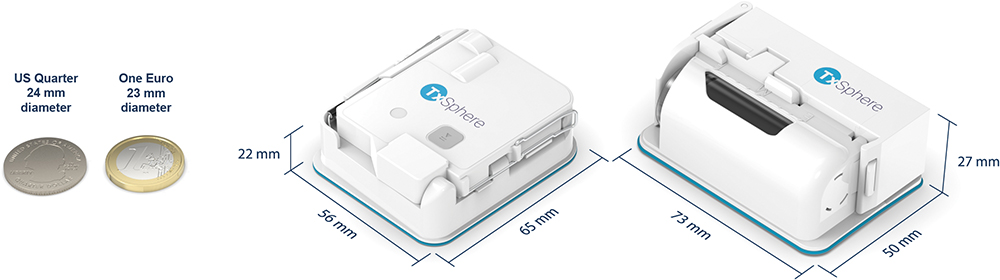
Figure 1: Left – TxSphere’s wearable injector with internal reservoir. Right – TxSphere’s wearable injector for standard vial/cartridges. Both depicted in 10 mL configurations.
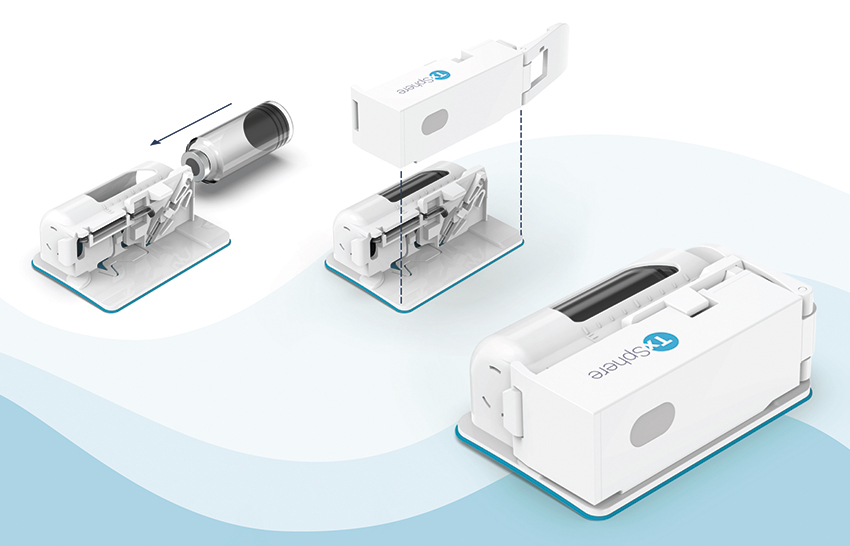
The automated soft cannula is concealed from view and inserted gently, and is more comfortable than a needle over an extended wear period. Preparation takes only a few steps – insert the vial or cartridge into the disposable drug container, connect the pump, adhere it to the skin and press “Run” (Figure 2) – with sensors verifying each action before delivery begins, reducing the risk of user error and the wasted doses that follow from it. Delivery is hands-free, so normal activity can continue during the infusion.
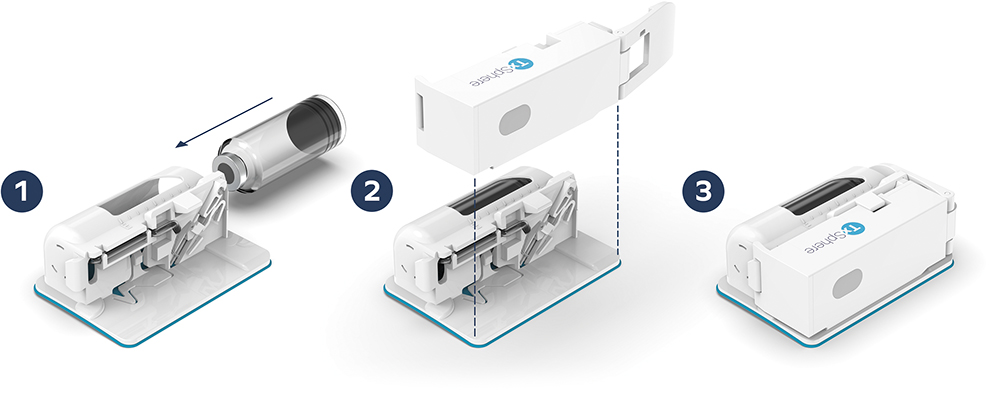
Figure 2: The two-piece modular platform of TxSphere’s wearable injectors consist consists of a reusable pump and a disposable drug container for standard vials and cartridges. Three steps are all that is needed to deliver an injection.
Because TxSphere wearables draw medication from the reservoir rather than forcing it under high pressure, neither the drug product nor its primary container is subjected to the stresses associated with high-force mechanical delivery. This reduces the need for robust, specialised container solutions while accommodating a broad range of dose volumes, delivery rates and viscosities. It also gives developers greater flexibility to work with lower-concentration formulations, including those using permeation enhancers. By addressing formulation, container and delivery considerations together, the platform simplifies development and helps accelerate the path to commercialisation.
The platform’s modular architecture also reflects the industry’s growing emphasis on sustainability. Many wearables and autoinjectors require disposal of the entire unit after each use. Reusing the electromechanical components while discarding only the sterile fluid path reduces waste and lowers the cost per dose across long-term treatment programmes – an economic plus as much as an environmental one.
“PROVEN MANUFACTURING AND COMMERCIALISATION EXPERTISE EFFECTIVELY SERVE AS A BARRIER TO ENTRY AND, WHERE IT CANNOT BE BUILT ORGANICALLY, THE PRACTICAL ROUTE TO ACHIEVE IT IS PARTNERSHIP.”
COMBINING PROVEN TECHNOLOGY WITH PROVEN MANUFACTURING
As pharmaceutical companies expand investment in large-volume SC therapies, their success will depend on how effectively device engineering, primary packaging, fill-finish and manufacturing are developed together. Device performance, supply chain resilience and commercial scalability all become part of the evaluation for drug manufacturers who are, by nature, risk averse. Proven manufacturing and commercialisation expertise effectively serve as a barrier to entry and, where it cannot be built organically, the practical route to achieve it is partnership.
This is the basis of the manufacturing collaboration between TxSphere and Jabil, under which Jabil will manufacture TxSphere’s reusable on-body injector technology, with the option to integrate fill-finish services for the device’s primary drug pack within the same manufacturing ecosystem. The collaboration reflects Jabil’s broader strategy to meet the needs of a changing market by expanding offerings across the combination product lifecycle. In the past two years, Jabil has completed the strategic acquisition of Pii for drug development and sterile fill-finish and expanded its collaboration with Kymanox for design and regulatory consultation. Today, Jabil offers total system design and manufacturing, from drug development through aseptic fill-finish and secondary packaging.
Traditionally, formulation development, device selection, primary packaging, fill-finish and commercial manufacturing have progressed as sequential workstreams managed across multiple organisations. Each discipline contributes important expertise, but co-ordination between them frequently occurs only after significant design decisions have already been made. In addition, each hand-off or transition between suppliers can introduce risk and cause delays.
“AS INJECTABLE THERAPIES GROW MORE COMPLEX, THIS SEQUENTIAL MODEL CONSTRAINS FLEXIBILITY PRECISELY WHEN A PROGRAMME WOULD MOST BENEFIT FROM PRESERVING IT; AN INTEGRATED MODEL, ON THE OTHER HAND, APPROACHES THESE DISCIPLINES AS ELEMENTS OF A SINGLE ENGINEERING SYSTEM.”
As injectable therapies grow more complex, this sequential model constrains flexibility precisely when a programme would most benefit from preserving it; an integrated model, on the other hand, approaches these disciplines as elements of a single engineering system. Design engineering informs manufacturability; primary packaging decisions shape delivery platform selection; fill-finish strategy develops alongside the device architecture; and supply chain planning begins during development rather than after approval.
TxSphere contributes the delivery platform and device design expertise. Jabil contributes design-for-manufacturability, advanced healthcare manufacturing at global scale and sterile fill-finish for the primary drug pack. The platform accommodates multiple primary pack configurations across a dosing range of 3–50 mL on a reusable drive unit, so a single architecture can serve a broad portfolio rather than requiring a new device programme for each asset.
Jabil has applied this systems-thinking approach across multiple drug-delivery programmes, including development of the Qfinity™ reusable autoinjector platform, where design-for-manufacturability, modularity and sustainability have been treated as engineering requirements from the outset rather than as later refinements. Applied to on-body delivery, the same discipline speaks to what pharmaceutical companies weigh most heavily when selecting a large-volume device – confidence that it can be made consistently, at volume, to the standards a combination product requires.
FROM CONCEPT TO COMMERCIALISATION, PARTNERSHIP DELIVERS
For the next generation of injectable therapies, the combination product itself is increasingly becoming the innovation. Engineering-led collaboration between pharma technology development teams and manufacturing solutions partners will play an important role in translating promising molecules into practical, patient-centric therapies that can be delivered confidently, consistently and at scale.
The pipeline continues to move towards larger dose volumes, higher viscosities and care delivered outside traditional clinical settings. No single delivery technology will serve every development programme, but the opportunities for on-body delivery continue to expand as pharmaceutical pipelines evolve. The platforms that succeed will be those that combine thoughtful engineering with the industrial capability required to translate innovation into commercial reality.
REFERENCES
- Green P, Schneider A, Lange J, “Navigating large-volume subcutaneous injections of biopharmaceuticals: a systematic review of clinical pipelines and approved products”. MAbs, 2024, Vol 16(1), art 2402713.
- Jolles S et al, “New Frontiers in Subcutaneous Immunoglobulin Treatment”. Biol Ther, 2011, Vol 1(2), art 3.
- Badkar AV et al, “Subcutaneous Delivery of High-Dose/Volume Biologics: Current Status and Prospect for Future Advancements”. Drug Des Devel Ther, 2021, Vol 15, pp 159–170.
- Patel S, Huang M, Miliara S, “Understanding Treatment Adherence in Chronic Diseases: Challenges, Consequences, and Strategies for Improvement”. J Clin Med, 2025, Vol 15(17) art 6034.