To Issue 192
Citation: Fromont Y, Saunier C, “Bringing Pharmaceutical Elastomer Waste into a Circular Economy”, ONdrugDelivery, Issue 192 (Oct/Nov 2026), pp 8–12.
Yann Fromont and Clovis Saunier discuss Aptar Pharma and Moine Recyclage‘s partnership and explain how clean elastomer production scrap from the manufacture of injectable components is recovered and repurposed for durable technical applications.
As pharmaceutical companies extend their decarbonisation commitments into the supply chain, the environmental footprint of primary packaging, including the elastomeric components that are in direct contact with injectable drugs, has moved firmly onto the agenda. For Aptar Pharma’s injectables division, addressing this footprint is both a scientific challenge and a responsibility to the drug developers the company partners with.
Elastomeric components for the primary packaging of injectable drug products must meet particularly demanding quality requirements, yet their manufacture generates vulcanised scrap that is difficult to recover and reintroduce into conventional processes. Working with Moine Recyclage, Aptar Pharma has established a dedicated process to divert this material from incineration and recover it for durable applications. This is a step towards a long-term goal – regenerating rubber to replace a proportion of new material in compounds.
PHARMACEUTICAL ELASTOMERS: ESSENTIAL, HIGH-PERFORMING AND DIFFICULT TO RECYCLE
Vial stoppers, prefilled syringe plungers, needle shields and other sealing components used for injectable drug products are designed to protect formulations that may be highly sensitive. They must maintain container closure integrity, limit gas exchange, withstand washing and sterilisation processes, and meet stringent requirements for particles, extractables and leachables.
Rubber meets these needs through complex formulations combining an elastomer with mineral fillers, pigments, curing agents and other additives. After mixing and moulding, vulcanisation creates a crosslinked three-dimensional network that gives the component its elasticity and stability. That same structure, however, is an obstacle to recycling; unlike a thermoplastic, vulcanised rubber cannot simply be remelted and reshaped.
End of life introduces a further constraint. Once used, components that have been in contact with a drug product or patient enter dedicated healthcare-waste streams and, under current conditions, cannot be considered a source of recyclable material. Therefore, the most accessible opportunity to recycle these components lies upstream, in the clean production scrap generated during manufacturing, before any pharmaceutical use.
“LIKE ALL DIVISIONS WITHIN THE COMPANY, APTAR PHARMA’S INJECTABLES DIVISION PLAYS A KEY ROLE IN MEETING THE COMPANY’S CLIMATE AND DECARBONISATION GOALS.”
USING LCA TO GUIDE A MULTI-LEVER REDUCTION STRATEGY
Aptar has set emissions-reduction goals that are validated by the Science Based Targets Initiative. These targets for Scope 1 and 2 emissions reductions are in line with the goal to keep global warming to 1.5°C by 2030. In addition to these, Aptar has established Scope 3 emissions and renewable electricity targets. As with all divisions within the company, Aptar Pharma’s injectables division plays a key role in meeting the company’s climate and decarbonisation goals. The division has placed a focus on sourcing electricity from renewable sources, improving energy efficiency and heat recovery, reducing water consumption, and optimising secondary packaging, material reduction and formulation development.
To prioritise these actions, the division developed a cradle-to-gate lifecycle assessment (LCA) model covering everything from raw material extraction and production through to customer delivery. Built using Sphera® LCA for Experts (Sphera, Chicago, IL, US) and aligned with the principles set out in ISO 14040 and ISO 14044, the model can be adapted to different formulations, geometries, manufacturing steps, packaging formats and logistics scenarios.
Initial results showed that raw materials were the largest contributor to the global warming potential of elastomeric components, accounting for up to 75% of the total. Within the rubber compound itself, the elastomer represents, on average, approximately 85% of the compound’s climate-change impact. Depending on the component and its level of preparation, the observed cradle-to-gate footprint is around 4–7 kg CO2eq per kilogram of component. These results are based on Aptar LCA modelling and have not been independently verified by a third party.
To make progress on reducing the carbon footprint of these products, action is needed both now and in the future. In the longer term, the greatest reductions will likely come from raw materials: non-fossil alternatives, mass-balance approaches, compound optimisation and, where regulatory requirements allow, qualified recycled feedstocks. In the shorter term, manufacturing scrap can be diverted from incineration and directed into a material loop – this is the operational initiative presented here.
MOINE RECYCLAGE: A DEDICATED ROUTE FOR TECHNICAL RUBBER
Implementing such a material loop requires a partner capable of identifying chemical families, segregating streams and ensuring reproducible preparation. Aptar Pharma’s injectables division decided to partner with Moine Recyclage, a specialist in recycling technical rubber that processes approximately 20,000 tonnes of industrial production scrap and end-of-life products per year.
When it comes to injectable component scrap, it is not only volume that matters but discipline – incoming material must be sorted by chemical family before granulation, which consists of grinding rubber into small, uniform granules. This process ensures that different elastomer types are never mixed. This matters because the value and safety of any recovered rubber depend first on knowing precisely what the feedstock is.
“BEYOND PREPARING THE MATERIAL, MOINE RECYCLAGE ALSO GIVES IT A DEFINED SECOND LIFE, ENGINEERING THE RECOVERED RUBBER INTO TECHNICAL SURFACES.”
The division’s pharmaceutical production scrap, which is clean, homogeneous and fully documented, is particularly well suited to this controlled approach. Beyond preparing the material, Moine Recyclage also gives it a defined second life, engineering the recovered rubber into technical surfaces. The scrap is therefore not simply collected, but performs a real function in a new application – a credible first step towards circularity.
BACKTOMOINE®: ORGANISING THE MATERIAL’S NEXT LIFE
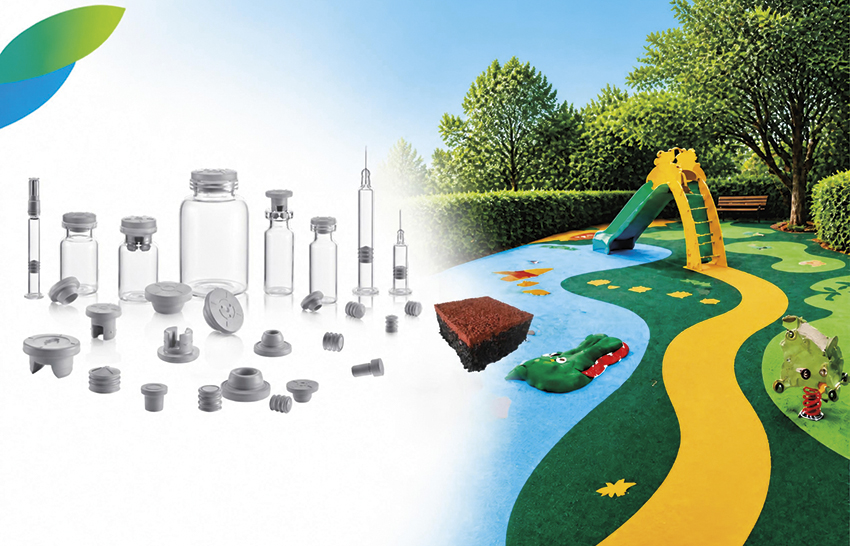
Aptar Pharma and Moine Recyclage’s partnership addresses a stream of up to approximately 600 tonnes of clean rubber production scrap per year. After pre-shredding and separation according to formulation, the material is transferred to Moine Recyclage’s authorised Installation Classified for the Protection of the Environment (ICPE) facility, where it is granulated and prepared for a new technical function, notably as a shock absorbing underlayer for playgrounds and sports surfaces. The approach begins with this controlled transfer – a known, homogeneous industrial feedstock is kept in material use rather than being sent for disposal or incineration.
BackToMoine® keeps this first cycle from being an end point. The granulated rubber is bound into durable sports and leisure surfaces – playground and multisport flooring, athletics tracks, tiles and underlayers – where it performs a defined mechanical function, rather than serving as low-grade filler.
In addition, these surfaces can be recovered at end of life, subject to acceptance and sorting criteria, potentially keeping the material in use across successive cycles. Each returned surface is assessed on arrival and directed to the most suitable recovery pathway, then cleaned and reprocessed into new secondary raw material; only the fractions that cannot be recovered as material are sent to energy recovery. Across the programme, around 97% of collected material is recovered as secondary raw material, with only 3% directed to energy recovery, helping retain material value over successive cycles.1
Although regenerated material is not currently authorised for use in pharmaceutical components, this application helps retain the material’s value over several cycles and contributes to the technical knowledge needed to explore potential higher-value uses in the future, subject to the applicable qualification, safety and regulatory requirements (Figure 1).
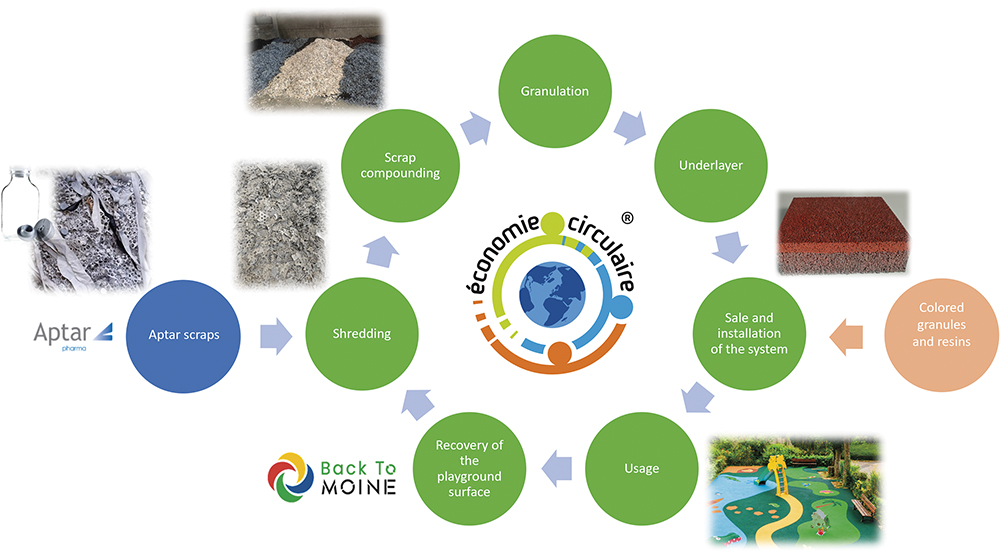
Figure 1: The Aptar–Moine BackToMoine® loop.
QUANTIFYING AVOIDED EMISSIONS
In an initial environmental analysis, the estimated annual climate benefit of granulation was compared with an incineration end-of-life scenario. For 600 tonnes of scrap, the emission factor for incineration was 2.66 kg CO2eq/kg, whereas the granulation scenario was estimated at 0.20 kg CO2eq/kg. On this basis, the associated emissions would be 1,596 tCO2eq and 120 tCO2eq, respectively – a difference of approximately 1,476 tCO2eq for the annual volume considered (Table 1). These results are based on Aptar LCA modelling and have not been independently verified by a third party.
| Scenario | Climate factor | Result for 600 t per year | Difference versus incineration |
| Incineration | 2.66 kg CO2eq/kg | 1,596 tCO2eq | Reference |
| Granulation | 0.20 kg CO2eq/kg | 120 tCO2eq | −1,476 tCO2eq |
Table 1: Environmental comparison of granulation versus incineration.
This value represents the difference between two treatment scenarios using the assumptions currently available. A critical review of the study is underway and may lead to further refinement of the system boundary, background datasets, allocation rules, transport assumptions and, where applicable, benefits associated with material substitution.
FROM MICRONISATION TO DEVULCANISATION: RETAINING MORE MATERIAL VALUE
Granulation and micronisation make it possible to use vulcanised rubber as a solid fraction in certain compounds. However, incorporation rates are generally limited, often to approximately 5–10% for a simple micronised material,2 because the original crosslinked network remains intact.
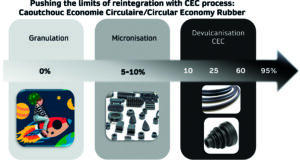
Figure 2: The CEC process.
Moine Recyclage’s CEC process (Caoutchouc Économie Circulaire/Circular Economy Rubber) is designed to lift that ceiling through thermomechanical devulcanisation; by selectively breaking part of the sulphur crosslinks while preserving the polymer backbone, it restores a material that can be compounded and revulcanised again. This opens the way to higher incorporation rates and to partial substitution of conventional elastomer, which has already been explored for technical parts in the automotive sector (Figure 2).
TOWARDS REINCORPORATION: A PROGRESSIVE AND CONTROLLED PATHWAY
Reusing regenerated rubber in a sports surface is one thing; bringing it back into a pharmaceutical component is another. For injectable applications, the regenerated material could not simply be added to a formulation – it would need to be qualified as a raw material, with a defined and traceable feedstock, agreed specifications and a full quality-control plan. In practice, that would mean demonstrating consistent behaviour on the parameters that govern component performance: how the rubber flows and cures (rheology and Mooney viscosity), how evenly it disperses, its mechanical strength and sealing behaviour (compression set) and, critically for parenteral use, tight control of extractable substances.
Due to these requirements, progress must be gradual and evidence-based. The first stage is qualifying the process using homogeneous, well-characterised streams. The second stage involves demonstrating the reproducibility of the regenerated material and its ability to replace a fraction of conventional elastomer in non-pharmaceutical technical applications. The third stage involves investigating Aptar Pharma’s specific compounds and components while verifying that functional performance, quality and safety remain fully preserved.
This is a long-term pathway, but its value today is in building the knowledge base. It puts the experience gained from production scrap to work, deepens understanding of how the regeneration process shapes formulation and properties, and lays the technical groundwork for higher-value circularity.
A FIRST CONCRETE INITIATIVE WITHIN A BROADER STRATEGY
Reducing the environmental footprint of elastomeric components does not depend on a single solution. Site energy efficiency, renewable electricity sourcing, material reduction, logistics optimisation, secondary packaging, non-fossil elastomers and compound improvement are all valuable strategies that can be pursued.
“WHAT SETS THE APTAR PHARMA–MOINE RECYCLAGE LOOP APART IS THAT IT TAKES A STREAM THAT WAS PREVIOUSLY DIFFICULT TO RECOVER – CLEAN MANUFACTURING SCRAP THAT WOULD OTHERWISE BE INCINERATED – AND KEEPS IT IN PRODUCTIVE USE, WITH A DEFINED ROUTE FOR RECOVERING IT AGAIN OVER SUCCESSIVE CYCLES.”
What sets the Aptar Pharma–Moine Recyclage loop apart is that it takes a stream that was previously difficult to recover – clean manufacturing scrap that would otherwise be incinerated – and keeps it in productive use, with a defined route for recovering it again over successive cycles. Aptar Pharma’s internal LCA provides an initial sense of the benefit, with a critical review underway intended to ensure that the benefit is interpreted rigorously rather than overstated. For a drug developer, this is a tangible example of how a packaging partner can help reduce the Scope 3 emissions embedded in a finished product.
Devulcanisation represents the next step – moving from recovered waste to regenerated material capable of replacing new feedstock so that the sector retains more of the value embedded in rubber and moves closer to a genuine circular economy. For pharmaceutical applications, the pathway will necessarily be progressive, in materials science, industrial control and close collaboration between recyclers, compounders, manufacturers, regulatory authorities and pharmaceutical partners. It is a direction where Aptar Pharma is working to make progress, in close partnership with customers and the industry working towards similar goals.
REFERENCES
- “Back To Moine – Moine Recyclage”. Web Publication, Moine Recyclage, accessed Oct 2026.
- Choupas S, “Study of the recyclability of rubber waste from end-of-life vehicles (excluding tires): Project ORMAT 2025”. Financing Agreement No. 21IFD0161, 20