To Issue 192
Citation: Veasey R, “Designing for a World Under Strain: The Role of Eco-Design in Improving Sustainability and Supply-Chain Security”, ONdrugDelivery, Issue 192 (Oct/Nov 2026), pp 34–37.
Rob Veasey discusses the core concepts of eco-design as applied to drug delivery devices, examining how sustainability principles can improve not only the environmental impact of the industry’s products and processes but also how they can contribute to better supply-chain robustness and resilience.
Designing a new drug delivery device involves balancing a complex set of design inputs. Two of the broadest and most challenging drivers of these are environmental sustainability and supply-chain security. Their importance is rising fast, reflecting a global landscape marked by energy price shocks, geopolitical volatility, transport instability, resource constraints, climate-related disruptions and public health crises. These factors collectively ensure that sustainability and supply-chain resilience are likely to influence future corporate decision-making at the highest level.
These challenges do not simply influence procurement or operational decision-making; they shape the format and function of new products. In the pharmaceutical and medical device context, where post-approval changes are notoriously difficult, the stakes are even higher. Once a device is validated, changing materials or manufacturing processes can be prohibitively costly and time-consuming. This means that future vulnerabilities must be anticipated early, not retrofitted later. This article explores how an intelligent approach to product development can address both sustainability and supply-chain risks, focusing particularly where solutions naturally align.
THE TREND TOWARDS COMPLEX DISPOSABLE DRUG DELIVERY DEVICES
Most drug delivery devices today are single-dose or multi-dose disposable products, and for good reason. Disposable formats typically require fewer operating steps and are inherently easier to keep sterile and safe than reusable systems. They are less vulnerable to wear or contamination, and many self-disable at end of life, supporting adherence and reducing the risk of adverse events. As self-administered therapies have expanded to wider populations, disposability has become a dominant feature across most major device categories, including autoinjectors and dry powder inhalers.1,2
As drug delivery devices have gained new applications and adopted disposable formats, annual sales volumes have also risen significantly.3 At the same time, efforts to improve usability, safety and performance have driven greater device sophistication. Early dry powder inhalers, such as Diskhaler® (GSK) and Spinhaler® (Fisons Pharmaceuticals), contained fewer than ten components, whereas more recent designs comprise around 30.4,5 Designers have also used an expanding array of polymer grades, often enhanced with specialised additives to improve performance.
“THESE TRENDS CARRY CLEAR IMPLICATIONS FOR ENVIRONMENTAL SUSTAINABILITY BUT ALSO HAVE SIGNIFICANT CONSEQUENCES FOR SUPPLY CHAINS.”
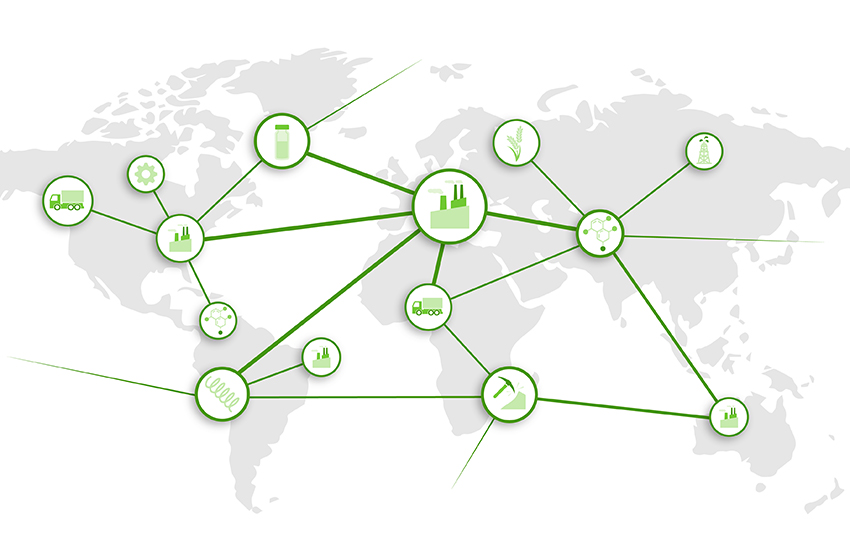
These trends carry clear implications for environmental sustainability but also have significant consequences for supply chains. They have unfolded in a business environment where global corporations have spent decades optimising their supply chains for efficiency. In many cases, this has produced geographically dispersed networks of companies involved in manufacturing, storing and distributing each device.
Whilst globalisation has delivered major benefits in cost and quality, it has also increased exposure to disruption when trade flow is interrupted. Recent events have made these vulnerabilities more visible, which is especially concerning for manufacturers of drug delivery devices that millions of people rely on. As a result, it is to be expected that there will be greater focus on strengthening both the robustness (the ability to cope with external change) and the resilience (the ability to recover from shocks) of supply chains for future generations of drug delivery devices.
THE ECO-DESIGN FRAMEWORK
As one of the fundamental pillars of the “circular economy”, the concept of environmentally conscious design – also known as eco-design – seeks to define development strategies that can be followed to minimise environmentally destructive impacts when creating new products. IEC 62430:2019 provides a framework covering eco-design strategies across five stages of a product lifecycle, as illustrated in Figure 1.
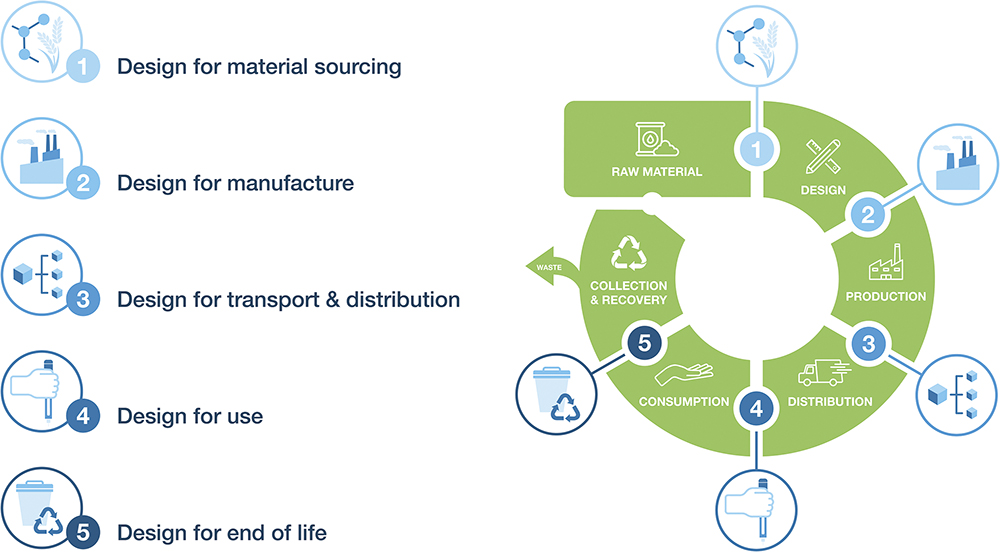
Figure 1: Eco-design strategies.
“WHILE ECO-DESIGN STRATEGIES HAVE GAINED TRACTION IN HELPING TO REDUCE THE ENVIRONMENTAL IMPACT OF NEW PRODUCTS, THEY CAN ALSO PLAY A ROLE IN IMPROVING SUPPLY-CHAIN ROBUSTNESS AND RESILIENCE.”
While eco-design strategies have gained traction in helping to reduce the environmental impact of new products, they can also play a role in improving supply-chain robustness and resilience. Structured by the eco-design framework, this article will discuss some key strategies that can be deployed to improve both sustainability and supply-chain security of drug delivery devices.
Design for Material Sourcing
Designing drug delivery devices with environmentally conscious material strategies begins with understanding the landscape of viable polymer options. Although there is an enormous range of polymer types and grades available, two categories of polymers are most suitable for drug delivery applications when sustainability, regulatory compliance and security of supply are taken into account: polymers manufactured from renewable feedstocks and low-energy polymers.
Polymers manufactured using renewable feedstocks include grades derived from non-food-competing bio‑sources, chemically recycled polymers or oils, and carbon‑capture processes. Many suppliers now offer such materials as medical-grade, with certification under the “ISCC PLUS” mass-balance scheme, enabling verifiable sustainability claims. Because these grades are chemically and mechanically identical to their fossil‑derived equivalents, they can often be adopted with minimal design or manufacturing changes, though typically at a modest cost premium.
Depending on the proportion of renewable content, these materials can often deliver 30–60% reductions in global warming potential (GWP) per component compared with conventional polymers. However, the benefits vary significantly between grades, especially where renewable feedstock percentages are low. Published lifecycle assessments (LCAs) from major polymer producers indicate that switching from fossil‑derived polymers to ISCC PLUS‑certified bio‑attributed materials reduces cradle‑to‑gate GWP by approximately 30–60%. SABIC reports a 61% reduction for its renewable polycarbonate grades, Celanese documents GWP reductions of around 35–45% for its ISCC PLUS‑certified engineered polymers and LyondellBasell (Houston, TX, US) shows 30–40% lower CO2e for its bio‑attributed intermediates compared with fossil‑based equivalents.
A second strategy is to specify polymers that inherently require less energy to produce and process. Commodity polymers such as polypropylene (PP) and high-density polyethylene (HDPE) typically have substantially lower embodied energy than engineering polymers such as polyamide (PA), polybutylene terephthalate (PBT), polyoxymethylene (POM) and polycarbonate (PC). In theory, this can yield a reduction in GWP of around 50% per unit mass; published LCAs show that commodity polymers such as PP and HDPE have cradle‑to‑gate GWPs of roughly 1.5–2.2 kg CO2e/kg, whereas engineering polymers commonly used in drug delivery devices, such as POM, PA, PBT and PC, typically fall in the 3–9 kg CO2e/kg range. However, the trade‑off is mechanical performance. PP and HDPE offer lower strength and stiffness, making them less suitable for some components and device architectures.
Environmentally conscious material choices can also strengthen supply‑chain robustness. Reducing reliance on fossil‑derived polymers helps limit exposure to volatility in oil and gas markets. Commodity polymers, such as PP and HDPE, offer the additional advantages that they are easier and cheaper to manufacture and more widely available. This increases opportunities for local sourcing, shortens supply chains and reduces dependency on geographically dispersed suppliers.
Design for Manufacture
Reducing the size, mass or component count of a product is a common strategy for minimising resource consumption in manufacture. However, for mature drug delivery device formats, such as injection pens and autoinjectors, large reductions in these attributes are difficult to achieve without altering the primary pack or compromising robustness and usability. When material content cannot be significantly reduced, switching to renewable energy sources for manufacturing processes can still deliver substantial environmental gains, potentially cutting the GWP of some components by up to about 30%. Injection‑moulding-related CO2 emissions can be reduced by 0.2–0.9 kg CO2 per kg of moulded plastic when switching from average grid electricity to renewable electricity, depending on regional grid intensity and machine efficiency.
Another environmentally conscious design for manufacture strategy with major implications for supply chain resilience is reducing the number of material types used within the device. This approach not only supports recycling goals, which will be discussed later, but also creates opportunities for dual sourcing. Dual sourcing allows manufacturers to substitute one material for another if supply becomes constrained. Although common in many industries, dual sourcing is rare in drug delivery devices because each potential material combination typically requires separate performance verification. For complex, multicomponent devices, this quickly becomes impractical.
The scale of the challenge can be illustrated with a simple example. Consider a device with four components; if each part uses a different material, dual sourcing each material creates 16 unique component combinations (i.e. 42), each of which may require separate verification. In contrast, if all components are made from a single material, dual sourcing produces only two potential combinations, dramatically reducing the verification burden and making this strategy far more feasible.
Design for Transport and Distribution
For most drug delivery devices, there is substantial potential to reduce the size of secondary packaging. Device and packaging development are often handled by separate teams, which can lead to conservative decisions and missed opportunities. For example, most devices are engineered to withstand freefall impact and significant static loads, yet complex trays and oversized cartons are still widely used to provide additional protection during transport.
In the case of some autoinjectors, the volume of the secondary pack exceeds the volume of the medicine contained within by more than a factor of 1,000, highlighting the level of over-packaging that exists. Reducing pack size is especially important for injectable products that are distributed via cold chain, where significant energy is required to maintain temperature stability. For many such devices, doubling, or even quadrupling, packaging density appears achievable without compromising device protection. Doing so would enable major reductions in shipping volume and the energy consumed during refrigerated transport, improving both environmental impact and supply-chain efficiency.
Design for Use
A major determinant of the environmental sustainability of a drug delivery device is its effective lifetime. For disposable devices with a non-replaceable primary pack, this is defined by the number of doses contained within it. A prefilled syringe-based device typically delivers a single dose, which means that, where the dose regimen and product stability allow, shifting to an injector with a multidose pack could significantly reduce the carbon footprint of a therapy. For example, a once-weekly therapy currently delivered via single-use autoinjectors could transition to a four-dose pen, cutting device-related material use and associated carbon emissions by around 75%. This would also reduce supply-chain complexity by dramatically reducing the manufacturing and distribution capacity required to support the therapy.
Reusable injection devices offer even greater potential to reduce both carbon impact and supply-chain burden. In the same once-weekly scenario, a single reusable injector could replace more than 100 single-use devices over the course of a two-year treatment. However, these benefits come with important considerations. Reusable devices are only suitable for long-term or chronic therapies, and they typically introduce additional user steps to exchange the primary pack and reset the device. Some primary packs, such as prefilled syringes, are not optimised for reusable devices, adding complexity that, if managed poorly, may affect adherence.
Design for End of Life
The concept of the circular economy depends on recovering materials from products at the end of their life so that they can be reused in future applications. For products predominantly made from polymers, two main recycling pathways are used: mechanical recycling and chemical recycling. Both rely on rapidly evolving technologies, but mechanical recycling is by far the more established and cost-effective option today.
Mechanical recycling separates parts by material type until waste streams are sufficiently pure for reuse. Although theoretically suited to high-quality polymers, this method is not widely applied to drug delivery devices due to safety risks and the difficulty of separating the diverse materials used in their construction. This raises the question, “how can mechanical recycling be made easier for drug delivery devices?”
A priority is developing safe and effective return schemes that minimise adverse events such as needlestick injuries. Several pharmaceutical companies have initiated such programmes,6,7 though adoption remains limited. Despite added operational complexity, such schemes could generate exceptionally pure, high-value waste streams.
Mechanically recycled materials cannot yet achieve the purity required for reuse in drug delivery applications, but maximising recyclate quality remains important for value in other markets. Selecting polymers that are widely recycled and supported by established end-markets is therefore beneficial. Conveniently, low-energy polymers, such as HDPE and PP, are among the most commonly recycled materials, making them strong candidates for new “recycle-ready” devices.
Recyclability can be further improved by limiting the number of polymer types used in a device, ideally to one or two that are easy to separate, such as PP and POM. This simplifies mechanical separation and increases the likelihood of producing high-value recyclate. Removing pigments is also advantageous, as colourants cannot be separated mechanically and reduce the quality and market value of recycled material.
“THE GAINS DEPEND ENTIRELY ON SPECIFICS SUCH AS DEVICE COMPLEXITY, MANUFACTURING GEOGRAPHY, USE REGIMEN, DRUG CHARACTERISTICS AND THE CONSTRAINTS OF EXISTING INFRASTRUCTURE.”
CONCLUSION
It is impossible to make blanket claims about how much environmental improvement or supply-chain resilience eco-design can deliver – the gains depend entirely on specifics such as device complexity, manufacturing geography, use regimen, drug characteristics and the constraints of existing infrastructure. But one thing is clear – the stakes are high. The industry is in a period of significant growth in demand for complex drug delivery devices, and this growth has the potential to collide head-on with unprecedented environmental pressures. At the same time, the drug delivery device industry remains deeply tied to the global polymer sector, which itself is dependent on fossil fuel markets that are increasingly exposed to geopolitical and economic shocks.
These factors combine to create a simple reality – the next generation of devices should target a smaller carbon footprint and lower vulnerability to supply-chain disruptions. While eco-design principles will not solve everything, they offer practical tactics that can make a real difference, enabling companies to make informed design choices to shape the environmental impact and supply-chain robustness of drug delivery systems for decades to come.
REFERENCES
- “Autoinjectors Market Size, Share & Global Forecast 2026-2035”. Market Report, S&S Insider, 2026.
- “Dry Powder Inhalers Market Size & Share Analysis – Growth Trends and Forecast (2026 – 2031)”. Market Report, Mordor Intelligence, 2026.
- “Drug Delivery Market Size, Share & Industry Analysis, 2019-2026”. Market Report, Fortune Business Insights, 2026.
- “Ventolin Diskus”. Product Monograph, GSK, Nov 2017.
- Grant AC et al, “The ELLIPTA® Dry Powder Inhaler: Design, Functionality, In Vitro Dosing Performance and Critical Task Compliance by Patients and Caregivers”. J Aerosol Med Pulm Drug Deliv, 2015, Vol 28(6), pp 474–485.
- “Introducing ReMed™”. Web Page, Novo Nordisk, Accessed Sep 2026.
- “RePen Recycling”. Web Page, Sanofi, Accessed Sep 2026.