To Issue 191
Citation: Xu J, “From Fragmented Procurement to Integrated Assembly: How the Injectable Device Industry is Rethinking Equipment Strategy”, ONdrugDelivery, Issue 191 (Oct 2026), pp 136–139.
Jordan Xu examines the shift from fragmented procurement to integrated, turnkey assembly solutions, exploring the deep technical and regulatory drivers behind this evolution as the industry increasingly recognises that the real differentiator is not the speed of individual machines but the seamless integration of the entire assembly process.
The pharmaceutical landscape is undergoing a profound transformation, driven largely by the explosive growth of biologics and the meteoric rise of glucagon-like peptide-1 (GLP-1) receptor agonists. With the global GLP-1 analogues market projected to reach US$268.4 billion (£198.1 billion) by 2030 at a compound annual growth rate of over 30.6%, the demand for sophisticated injectable drug delivery systems – specifically injection pens and autoinjectors – has reached unprecedented levels.1 The clinical pipeline is equally impressive, with molecules such as semaglutide, tirzepatide, retatrutide and survodutide all progressing through late-stage development, each requiring high-volume, high-precision device assembly at commercial scale.
However, this clinical and commercial success has exposed a critical vulnerability in the manufacturing supply chain: the challenge of scaling device assembly from clinical batches to tens of millions of units annually while maintaining uncompromised precision and data integrity. The real bottleneck is no longer drug development – it is manufacturing readiness.
Historically, pharmaceutical manufacturers and CDMOs have relied on a fragmented approach to equipment procurement. A pre-assembly machine might be sourced from one vendor, the final assembly line from another and inspection or serialisation systems from a third. While this multi-vendor strategy allows companies to select what they perceive as “best-in-class” standalone machines, it introduces profound integration challenges that can delay time-to-market by, for example, 12–18 months, complicate regulatory compliance and increase the total cost of ownership.2
“IN A MULTI-VENDOR ASSEMBLY ENVIRONMENT, THE BURDEN OF INTEGRATION FALLS HEAVILY ON THE CDMO OR THE PHARMACEUTICAL INNOVATOR.”
THE PITFALLS OF FRAGMENTED PROCUREMENT
In a multi-vendor assembly environment, the burden of integration falls heavily on the CDMO or the pharmaceutical innovator. When equipment is sourced from disparate suppliers, the resulting assembly line is often a patchwork of different software architectures, control philosophies and mechanical platforms. This fragmentation manifests in several critical areas that demand careful examination.
THE CHALLENGE OF UNIFYING SOFTWARE ARCHITECTURE
Modern injection pens consist of 15–25 intricate components – dosing mechanisms, clutch systems, drive sleeves, dose buttons and outer shells – requiring precise synchronisation between numerous assembly stations. When a pre-assembly line operating at 160 units per minute must feed into a final assembly line operating at 80 units per minute, the handshake between these systems must be flawless.3
In a fragmented line, machines often use different programmable logic controllers (PLCs). Achieving synchronisation across disparate systems requires custom middleware, protocol converters and complex programming. Each additional interface point increases the risk of communication failures, unplanned downtime and data loss. In contrast, an integrated platform uses a unified kernel framework where the overall structure of the controlling code and common components are standardised. In such advanced architectures, specific applications – such as station initialisation, motor commands and numerical control axis functions – run seamlessly in a single, high-performance PLC environment (such as the Siemens S7-1500 CPU 1517-3PN/DP), dramatically reducing latency and integration risk.
DATA INTEGRITY AND 21 CFR PART 11 COMPLIANCE
Ensuring data integrity in compliance with Part 11 of Title 21 of the Code of Federal Regulations (21 CFR Part 11), is exponentially more difficult across a fragmented line. Regulatory agencies demand comprehensive audit trails, electronic signatures and secure data logging for every critical process parameter. When multiple machines generate data in different formats and store them in isolated databases, consolidating this information into a unified batch report becomes a monumental task.4
Without a unified approach to 21 CFR Part 11 compliance, organisations face risks such as inconsistent audit trails, uncontrolled user access across different systems and the inability to demonstrate continuous data integrity during regulatory inspections.5 In an integrated system, an automated audit trail feature runs automatically after the device is started. Any change made to the system – whether it is a parameter modification on a load cell device or a recipe adjustment – generates a secure entry capturing the timestamp, logged-in user, initial value, new value and a mandatory user comment. These data are securely stored at the system human-machine interface (HMI) and Line PC, preventing modification or deletion and ensuring absolute compliance and readiness for US FDA audits.
VALIDATION ALIGNMENT
The validation process – encompassing installation qualification (IQ), operational qualification (OQ) and performance qualification (PQ) – is resource-intensive. When dealing with multiple vendors, a CDMO must harmonise different IQ/OQ templates, varying interpretations of factory acceptance testing (FAT) and site acceptance testing (SAT) protocols, and distinct alarm challenge matrices. This lack of standardisation inevitably prolongs the validation timeline. What should be a six-month qualification programme can easily extend to 12 months or more, consuming engineering resources and delaying revenue generation.
THE CONVERGENCE OF ADVANCED TECHNOLOGIES ON A SINGLE PLATFORM
To address these challenges, the industry is moving towards single-platform solutions that integrate advanced technologies into a cohesive assembly system. Three key technologies are driving this convergence: electronic cam synchronisation, multi-point vision inspection and force-controlled pressing (Figure 1).
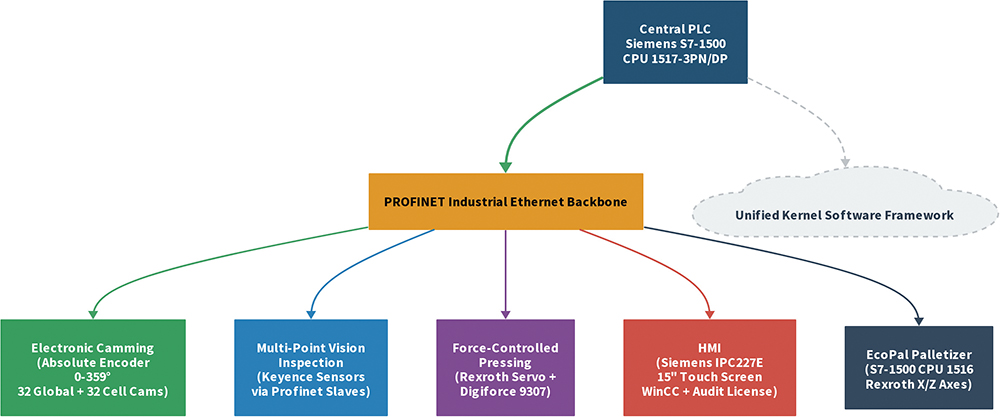
Figure 1: Unified platform architecture – electronic camming, vision inspection and force control converge on a single Profinet backbone.
ELECTRONIC CAM SYNCHRONISATION
Traditional mechanical cams are rigid and require significant downtime for changeovers between different pen geometries. Modern integrated lines use advanced electronic camming systems. In these set-ups, an absolute encoder connected to the machine’s camshaft provides the control system with a numerical value indicating the angle of rotation from 0° to 359°.
This system employs both global cams and cell cams to control system-level functions.6 Cell cams, reserved for base machine functions such as pallet indexing and data tracking, ensure that all stations operate in perfect harmony. With a unified control logic – managed through an intuitive HMI graphical display – operators can rapidly execute changeovers between different pen designs (disposable, reusable or GLP-1 specific) while minimising the cumulative tolerance issues that plague fragmented lines.
MULTI-POINT VISION INSPECTION
As assembly speeds increase beyond 100 units per minute, manual inspection becomes physically impossible. Integrated systems embed multi-point vision inspection directly into the assembly workflow via industrial ethernet protocols such as Profinet. High-speed vision sensors, such as those made by Keyence (Osaka, Japan), are deployed at critical stations to verify component orientation, check for surface defects and confirm proper seating. By catching errors immediately and communicating directly with the central PLC, the system prevents defective sub-assemblies from progressing downstream, significantly reducing the final rejection rate.
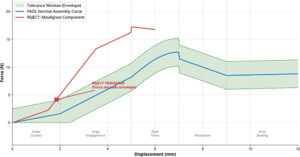
Figure 2: Force-displacement curve monitoring – real-time envelope analysis during snap-fit assembly.
FORCE-CONTROLLED PRESSING
The mechanical integrity of an injection pen dictates its dosing accuracy and user feel. Snap-fit connections, press-fits and thread engagements require precisely controlled forces. Integrated systems use servo pressing (e.g. Bosch Rexroth (Lohr am Main, Germany) linear axes) paired with precision-force monitoring units (e.g. Digiforce 9307 (Burster, Gernsbach, Germany) controllers communicating via ProfiBus). This set-up enables recording of real-time force-displacement curve at every station. As these data are captured within a unified software architecture, they can be instantly analysed against predefined tolerance windows, transforming force monitoring from a post-hoc quality check into a real-time process control mechanism (Figure 2).7
THE IMPACT ON FAT AND SAT
The shift towards integrated assembly has a profound impact on the equipment qualification lifecycle, particularly during FAT and SAT – two milestones that are critical to regulatory compliance and project timelines.8
In a multi-vendor scenario, FAT is often conducted in silos. The pre-assembly machine is tested at Vendor A’s facility, while the final assembly machine is tested at Vendor B’s facility. The true test of integration – whether these machines can communicate, synchronise and produce compliant products together – only occurs during SAT at the CDMO’s site. This is the worst possible time to discover compatibility issues.
Conversely, when an entire assembly line shares a common control framework provided by a single system integrator, the FAT becomes a comprehensive evaluation of the complete process. The entire line – from component feeding through pre-assembly, final assembly and end-of-line inspection – can be staged and tested as a unified system before it leaves the supplier’s floor. This holistic FAT ensures that the software architecture is fully integrated, data integrity protocols generate compliant audit trails and mechanical transfer between stations operates within the specifications. Consequently, the SAT becomes a streamlined verification process, dramatically accelerating the path to commercial readiness (Figure 3).
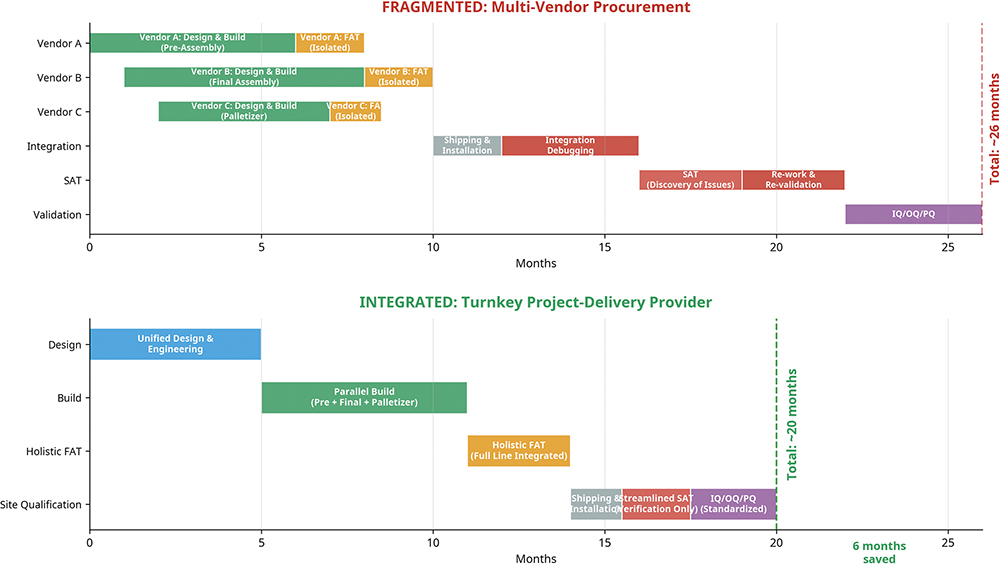
Figure 3: Fragmented versus integrated validation timeline – comparing multi-vendor FAT/SAT with turnkey holistic qualification.
THE POSITIONING OF LEADING SYSTEM PROVIDERS
As the demand for integrated solutions grows, equipment providers across the globe are adapting their strategies to meet this evolving market need. Established European and North American manufacturers, such as Syntegon and ATS Life Sciences (Cambridge, Canada), have long been recognised for their high-quality original equipment manufacturer machines. Syntegon offers flexible rotary and linear pen and autoinjector assembly platforms capable of outputs between 3 and 200 parts per minute.9 ATS Life Sciences provides comprehensive automation solutions for autoinjector and pen needle assembly, with pre-configured platforms designed for lower design costs and faster delivery.10 These companies excel at building individual machines of exceptional quality.
However, a new paradigm is emerging, championed by project-delivery system providers, particularly those based in Asia, who are positioning themselves not merely as machine builders but as holistic integration partners who take responsibility for the entire project lifecycle. They focus on filling the gap between “machine delivered” and “project ready” – a gap that has traditionally been the CDMO’s problem to solve. By offering equipment supply, platform co-ordination and structured validation support – including standardised IQ/OQ templates, FAT/SAT protocols and alarm challenge matrices – they provide CDMOs with a unified turnkey solution that mitigates integration risk and accelerates time-to-market.2,3,7
CONCLUSION: FROM ISOLATED MACHINES TO PROJECT READINESS
The era of fragmented procurement in injectable device assembly is giving way to a more strategic, integrated approach. As the volume and complexity of therapies such as GLP-1 receptor agonists continue to rise, CDMOs and pharmaceutical innovators can no longer afford the inefficiencies and risks associated with multi-vendor assembly lines. The manufacturing readiness gap – rather than clinical success – will determine which molecules reach patients on time.
By embracing single-platform solutions that unify software architecture, ensure end-to-end data integrity and streamline the validation lifecycle, manufacturers can achieve the high-speed, high-precision assembly required to meet global demand. The future of injectable device manufacturing lies not in isolated machines, however excellent they may be individually, but in cohesive, turnkey systems that deliver true project readiness – from the first component fed into the line to the final validated batch released to market.
REFERENCES
- “Global GLP-1 Analogues Market to Reach $268.4 Billion by 2030”. Press Release, BCC Research, Jan 2026.
- Xu J, “Overcoming Fill-Finish Capacity Bottlenecks in Automated Pen Injector Assembly Lines”. News, Pharm Tech, Jun 2026.
- Xu J, “Engineering High-Speed Pen Injector Pre-Assembly Machine: Overcoming Dimensional Variability in Multi-Component Mechanism Integration”. News, Pharm Tech, Aug 2026.
- “FDA 21 CFR Part 11: Data Integrity in Labeling Systems”. Company Web Page, Quadrel Labeling Systems, accessed Sep 2026.
- “Achieving 21 CFR Part 11 Compliance in Integrated Systems for the Pharmaceutical Industry”. Emorphis, Dec 2025.
- “Electronic Camming: Enabling Superior Flexibility in Advanced Motion Control Systems”. A3 Association for Advancing Automation, Apr, 2026.
- Xu J, “Engineering High-Speed Pen Injector Final Assembly Machine: Solving the Cartridge Press-Fit Challenge”. News, Pharm Tech, Jul 2026.
- “FAT and SAT: What Is the Difference and Why Are They So Important?”. Company Web Page, PQE Group, accessed Sep 2026.
- “Supporting Self-Medication with Cutting-Edge Assembly Solutions”. Syntegon, Sep 2025.
- “Autoinjector Assembly”. Company Web Page, ATS Life Sciences, accessed Sep 2026.