To Issue 190
Citation: Babaee S, Hancock M, “Enabling Delivery of Lyophilised Biologics via Simulation-Led Development of Dual-Chamber Systems”, ONdrugDelivery, Issue 190 (Sep/Oct 2026), pp 72–75.
Dr Sahab Babaee and Dr Matthew Hancock discuss the potential of using modelling and simulation when designing dual-chamber injection devices, which can enable device designers to investigate the complex interactions that take place within a dual-chamber system without a physical prototype and discover potential failure modes much earlier in the design process.
“IT IS ESTIMATED THAT OVER 60% OF BIOLOGICS ON THE MARKET TODAY WOULD NOT BE POSSIBLE WITHOUT LYOPHILISATION.”
Biologics, including monoclonal antibodies, antibody-drug conjugates, peptides, proteins and vaccines, now represent a large and growing share of the pharmaceutical pipeline. There has been considerable growth in BLAs and approvals over the last several years, with a market size projected to be over US$1 trillion (£740 billion) by 2035.1,2 Formulation stability challenges are a key factor in developing these molecules – many of them are not stable in liquid form for the shelf lives required by regulators and markets, and must be freeze-dried, or lyophilised, to preserve their structure and potency.3,4 It is estimated that over 60% of biologics on the market today would not be possible without lyophilisation.5 As the number of lyophilised biologic and vaccine candidates continues to grow, so too does the need for delivery systems that can reconstitute them reliably, safely and with minimal burden on the patient or caregiver.
WHY DUAL-CHAMBER DELIVERY SYSTEMS?
Historically, reconstituting a lyophilised drug for parenteral administration has consisted of several manual steps and components: withdrawing diluent, injecting it into a vial, swirling or inverting to dissolve the cake for robust reconstitution and then drawing the reconstituted solution into a syringe prior to injection. Each step is an opportunity for a dosing error, contamination or delay, along with other human factors-related use errors. Furthermore, the process assumes a level of manual dexterity, training and confidence that may vary across care settings. These challenges are particularly concerning for emergency-use products, paediatric and geriatric populations, and self-administered chronic therapies.6
“IN PARTICULAR, DUAL-CHAMBER DELIVERY SYSTEMS HAVE EMERGED AS PROMISING PLATFORMS TO ENABLE INTEGRATED RECONSTITUTION AND SELF-ADMINISTRATION OF LYOPHILISED DRUG PRODUCTS WITHIN A SINGLE COMBINATION PRODUCT.”
These constraints have driven sustained industry interest in delivery devices that can automate reconstitution rather than delegating it to the user. In particular, dual-chamber delivery systems have emerged as promising platforms to enable integrated reconstitution and self-administration of lyophilised drug products within a single combination product.7,8
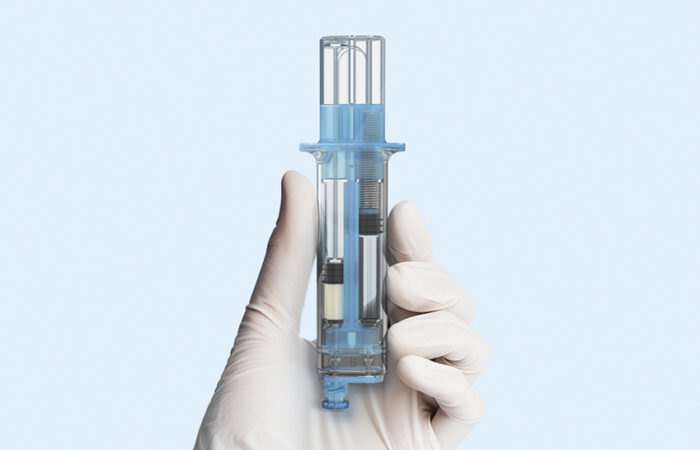
Autoinjectors with dual-chamber cartridges (AIDCs) respond directly to this unmet need. A single cartridge stores the lyophilised drug and liquid diluent in two compartments separated by a plunger stopper. Upon activation by the patient, a spring-driven mechanism moves the diluent into the drug chamber via a bypass channel, mixes and dissolves the lyophilised drug, then primes the needle and injects the ready-to-use solution, all resulting in one continuous, patient-triggered process.7,9
This approach offers a range of substantial advantages, including automated reconstitution and injection in a single platform, reduced user burden and training requirements, potential for at-home administration rather than in-clinic dosing, improved usability and treatment adherence, protection of sensitive drug products until the point of use and applicability across biologics, vaccines and emergency-use products alike.6,8
THE ENGINEERING COMPLEXITY BEHIND AIDCs
However, this simplicity for the patient is bought with considerable engineering complexity for the developer. An AIDC must execute a precise sequence of physical events, in the right order and within a tight time window, using a single drive spring or gas canister and no external power source – transfer diluent into the lyophilised drug chamber via a bypass channel, ensure that the lyophilised cake fully wets and dissolves, attach and prime the needle, and inject into tissue at an acceptable rate and within an appropriate timeframe.9 The spring, two stoppers, bypass design, air compression, fluid motion and tissue backpressure all interact,9,10 and AIDC-specific failure modes – missed stopper-position targets causing the stopper to fail to allow or prevent bypass flow, and incomplete reconstitution resulting in an inhomogeneous drug solution – can arise from interactions that simply do not exist in single-chamber syringes or autoinjectors.9
WHY CONVENTIONAL DEVELOPMENT APPROACHES ARE NOT ENOUGH
The conventional response to this complexity has been iterative prototyping: build a device, test injection time and force, redesign, retest.11 This approach becomes disproportionately slow and expensive for AIDCs, because:
- The design space is larger and multi-dimensional, with multiple contributing parameters – including spring force, stopper friction and insertion depth, bypass channel design, chamber air volumes, cake formulation, diluent volume and tissue backpressure – all being interdependent.
- Some failure modes only reveal themselves late in development after experimental reconstitution and injection testing.
- Small dimensional tolerances in needle geometry translate into disproportionately large swings in injection force (via the fourth-power dependence of Poiseuille flow on needle radius), yet many early-stage models simulate only nominal geometry and friction conditions rather than sampling realistic manufacturing tolerances.11
Simulation-led technical due diligence can change this dynamic. Physics-based and reduced-order models let developers explore spring stiffness, stopper friction, chamber air volumes, diluent volume, bypass design, cake properties and tissue backpressure ranges computationally, evaluating device and formulation configurations virtually and narrowing the design space to a small number of high-confidence candidates before committing to tooling or running full physical or clinical verification.12,13
This approach does not eliminate physical testing, but rather changes its role – from broad exploratory search to targeted confirmation – consistent with the risk-informed credibility principles in the American Society of Mechanical Engineers Verification & Validation (V&V) 40 and the US FDA’s Computational Modelling and Simulation (CM&S) credibility guidance, both of which recognise that adequately validated models can reduce the burden of physical verification for well-defined contexts of use.13–15 The FDA’s 2016 reporting guidance further standardises how a CM&S study should be documented, including governing equations, system properties, numerical methods, validation and limitations, so that a reviewer can judge whether a model’s credibility matches its intended decision-support role, and a similar risk-based credibility framework has been applied to assess model risk for other device classes.16,17
A PHYSICS-BASED FRAMEWORK FOR PREDICTING AIDC PERFORMANCE
A modelling framework applicable to a broad class of spring-driven AIDCs for lyophilised drug and vaccine delivery makes this possible in practice. Consider a reduced-order model, developed and experimentally validated for AIDCs, that has been explicitly structured around the following stages (Figure 1A):
- Activation
- Pre-reconstitution, with drive-spring preload and initial stopper positions
- Bypass-enabled diluent transfer into the front injection chamber and lyophilised cake reconstitution
- Needle priming
- Injection.9
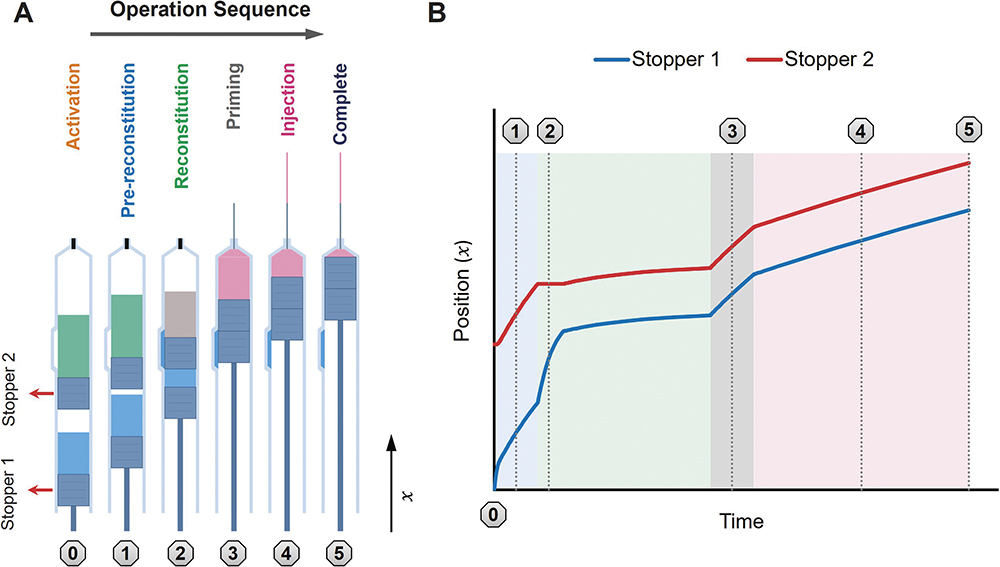
Figure 1: (A) Schematic illustration of the five-stage operational sequence of an AIDC, including: (0) activation, (1) pre-reconstitution, (2) diluent transfer into the front injection chamber via bypass channel and reconstitution of the lyophilised drug, (3) needle priming and (4) injection. (B) Model-predicted transient AIDC response, showing stopper positions throughout AIDC operation stages corresponding to the representative snapshots illustrated in A.
The equations of motion for the AIDC’s two stoppers are coupled to the ideal gas law for the chamber air pockets and to an experimentally derived stopper-friction-versus-glide-speed relationship, giving predictions of the stoppers’ trajectories (Figure 1B), reconstitution, priming and injection times, as well as injection flow-rate time profile, peak tissue backpressure and failure modes, such as missed stopper-position targets causing the stopper to fail to allow or prevent bypass flow.9
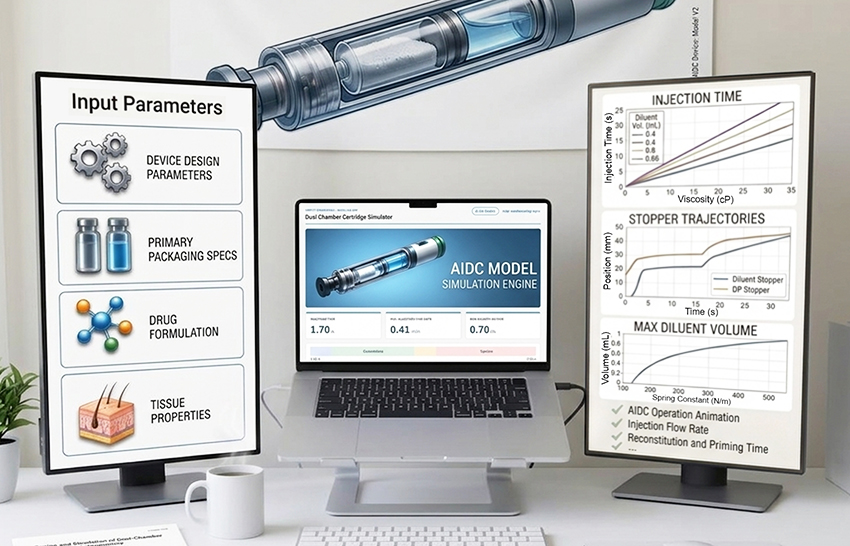
This AIDC modelling framework does not require advanced simulation software to run. A snapshot of an HTML implementation is shown in Figure 2, highlighting the input variables incorporated into the model and the resulting predictions of AIDC behaviour, including the essential performance requirements across its stages of operation.
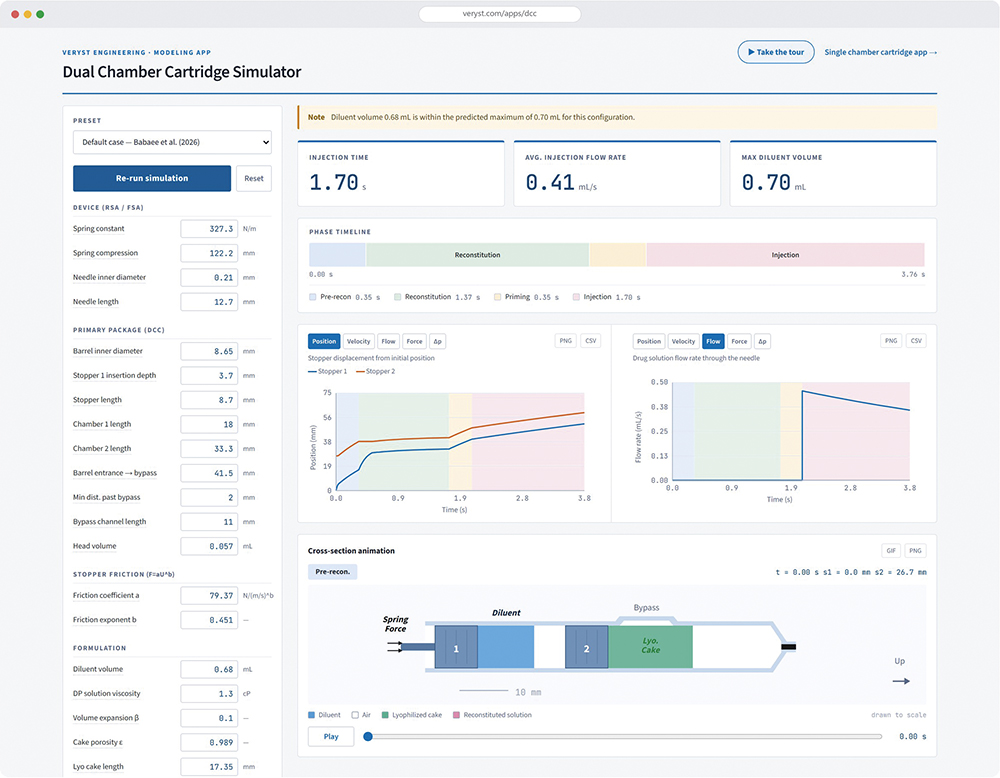
Figure 2: Snapshot of an HTML implementation of the AIDC model simulator.
The stopper friction was found experimentally to follow a power law with glide speed rather than a classical constant or linear friction law, consistent with a lubricated stopper-barrel interface (i.e. silicone oil between a siliconised elastomer stopper and glass barrel, rather than dry solid-on-solid contact). A hybrid modelling framework built for precisely this interface captures the resulting Stribeck-type behaviour, where friction shifts between boundary, mixed and hydrodynamic lubrication regimes as glide speed changes, adding a data-driven component to describe what purely mechanistic friction laws miss.9,18 Validation against measured injection times across a range of formulation and device configurations showed good agreement between predicted and experimental behaviour.9
“AS THE MODEL LINKS EVERY STAGE EXPLICITLY, IT CAN FLAG COMBINATIONS OF SPRING FORCE, DILUENT VOLUME, STOPPER FRICTION, CHAMBER AIR VOLUMES AND RECONSTITUTED DRUG SOLUTION VISCOSITY THAT WOULD OTHERWISE ONLY REVEAL A FAILURE MODE AFTER PHYSICAL TESTING.”
Understanding the Interplay Between Formulation and Device Design
As the model links every stage explicitly, it can flag combinations of spring force, diluent volume, stopper friction, chamber air volumes and reconstituted drug solution viscosity that would otherwise only reveal a failure mode after physical testing.9 As an illustrative example, increasing spring force can shorten reconstitution time by accelerating diluent delivery into the cake, but at the cost of higher injection forces or greater cavitation risk;9,19 a gentler reconstitution profile may be kinder to the cake and formulation but push total patient-facing time (i.e. reconstitution plus injection) beyond a comfortable window. Mechanistic reconstitution models developed for formulation science, describing wetting, capillary penetration, cake disintegration and dissolution can be coupled directly to device-level bypass flow rate, turning cake microstructure and diluent delivery rate into explicit design variables alongside spring force and bypass design, rather than a lumped, black-box delay.3,4,20–22
Two further refinements would sharpen these predictions: first, coupling to finer-grained numerical dissolution models, such as particle- or continuum-scale simulations that move beyond classical one-dimensional dissolution formalisms;23 second, replacing the current constant-viscosity assumption with the shear-thinning, non-Newtonian rheology that many concentrated antibody formulations actually exhibit, where viscosity drops sharply at the higher shear rates seen in narrow-gauge needles.24
DIGITAL DEVELOPMENT AND MODEL-INFORMED DEVICE DESIGN
Dual-chamber delivery systems are particularly well-suited to digital development because of their complex, multiphysics behaviour – no single test rig or bench measurement captures the full interaction between spring, stopper friction, air compression, bypass flow, reconstitution kinetics and tissue response. The industry is increasingly adopting model-informed drug device development, digital twins, virtual prototyping and simulation-based design optimisation as standard tools for precisely this class of problem, and has begun to explore artificial intelligence (AI)-based methods for accelerating parameter identification and design search. Any such AI-assisted step would itself need to sit inside the same verification, validation and uncertainty quantification credibility framework described above before it could inform regulatory-facing decisions.13,14
Future Opportunities for Dual-Chamber Delivery Platforms
As the biologics and vaccines pipeline diversifies, dual-chamber delivery platforms are well placed to serve high-concentration biologics, messenger RNA (mRNA) and next-generation vaccines, long-acting injectables, emergency-use products, personalised medicines and connected or smart autoinjectors that log dose and adherence data. Each of these applications adds its own formulation and device constraints, and simulation offers a practical way to explore them before committing to a fixed platform. A further extension worth pursuing is coupling AIDC-specific models to tissue-level outcomes downstream of the needle, including depot formation, interstitial flow and absorption kinetics, as well as how patient variability in body-mass index and tissue composition shapes them, as injection conditions and device parameters can influence depot shape and, potentially, drug absorption and tolerability.25,26
CONCLUSION: FROM DEVICE SELECTION TO CLINICAL READINESS
As dual-chamber delivery systems become increasingly important for enabling self-administration of lyophilised biologics, development success will depend not only on device innovation but on the ability to understand and predict complex formulation-device interactions.9 Simulation-led technical due diligence and model-informed development offer a practical framework to accelerate platform selection, reduce experimental burden and improve confidence in clinical and commercial success – turning dual-chamber development from a series of expensive physical iterations into a structured, model-informed path from device selection to clinical readiness.13,14
REFERENCES
- “Biologics Market Size, Scope, Revenue Report 2026 to 2035”. Market Report, InsightAce, Feb 2026.
- Mullard A, “2025 FDA approvals”. Nat Rev Drug Discov, 2026, Vol 25(2), pp 81–87.
- Sane P et al, “Reconstitution of Highly Concentrated Lyophilized Proteins: Part 1 Amorphous Formulations”. J Pharm Sci, 2020, Vol 109(5), pp 1681–1691.
- Kulkarni SS et al, “Mechanisms by which crystalline mannitol improves the reconstitution time of high concentration lyophilized protein formulations”. Eur J Pharm Biopharm, 2018, Vol 131, pp 70–81.
- DiFranco N, “Lyophilization of Pharmaceuticals: An Overview”. Web Page, Agno Pharma, accessed Aug 2026.
- D’hers S et al, “Rapid reconstitution packages (RRPs) for stable storage and delivery of glucagon”. Drug Deliv Transl Res, 2019, Vol 9(3), pp 631–640.
- Werk T et al, “Technology, Applications, and Process Challenges of Dual Chamber Systems”. J Pharm Sci, 2016, Vol 105(1), pp 4–9.
- Ingle RG, Fang W-J, “Prefilled dual chamber devices (DCDs) – Promising high-quality and convenient drug delivery system”. Int J Pharm, 2021, Vol 597, art 120314.
- Babaee S et al, “A modeling framework for spring-driven autoinjectors with dual-chamber cartridges”. Drug Deliv Transl Res, 2026, Vol 16(2), pp 522–538.
- Thomsen M et al, “Model study of the pressure build-up during subcutaneous injection”. PLoS One, 2014, Vol 9(8), art e104054.
- Rathore N et al, “Variability in syringe components and its impact on functionality of delivery systems”. PDA J Pharm Sci Technol, 2011, Vol 65(5), pp 468–480.
- Zhong X et al, “An experimentally validated dynamic model for spring-driven autoinjectors”. Int J Pharm, 2021, Vol 594, art 120008.
- “V&V 40 – Assessing Credibility of Computational Modeling through Verification and Validation: Application to Medical Devices”. ASME, 2018.
- “Guidance for Industry: Assessing the Credibility of Computational Modeling and Simulation in Medical Device Submissions”. US FDA, Nov 2023.
- Pathmanathan P et al, “Credibility assessment of in silico clinical trials for medical devices”. PLoS Comput Biol, 2024, Vol 20(8), art e1012289.
- “Guidance for Industry: Reporting of Computational Modeling Studies in Medical Device Submissions”. US FDA, Sep 2016.
- Morrison TM et al, “Assessing Computational Model Credibility Using a Risk-Based Framework: Application to Hemolysis in Centrifugal Blood Pumps”. ASAIO J, 2019, Vol 65(4), pp 349–360.
- Friso A, Palmer M, Galvanin F, “A hybrid modelling framework for the description of friction forces in autoinjector devices”. Int J Pharm, 2026, Vol 701, art 127080.
- Zhong X et al, “Hydrodynamic considerations for spring-driven autoinjector design”. Int J Pharm, 2023, Vol 640, art 122975.
- Kulkarni SS et al, “Reconstitution time for highly concentrated lyophilized proteins: role of formulation and protein”. J Pharm Sci, 2020, Vol 109(10), pp 2975–2985.
- Cheng Y et al, “Practical advice in the development of a lyophilized protein drug product”. Antib Ther, 2025, Vol 8(1), pp 13–25.
- Zhang X et al, “Multiple approaches to reduce reconstitution time of lyophilized drug products with high protein concentration”. Antib Ther, 2024, Vol 7(1), pp 67–76.
- So C, Chiang P-C, Mao C, “Modeling Drug Dissolution in 3-Dimensional Space”. Pharm Res, 2022, Vol 39(5), pp 907–917.
- Fischer I et al, “Calculation of injection forces for highly concentrated protein solutions”. Int J Pharm, 2015, Vol 493(1–2), pp 70–74.
- Leng Y et al, “Using poro-elasticity to model the large deformation of tissue during subcutaneous injection”. Comput Methods Appl Mech Eng, 2021, Vol 384, art 113919.
- Derakhshandeh R et al, “Subcutaneous depot formation and diffusion in autoinjector delivery: insights from high-speed synchrotron imaging”. Int J Pharm, 2025, Vol 681, art 125804.