To Issue 191
Citation: “Interview with Patrick Jeukenne and Frédérique Pedretti-Abel: Contamination Control in Practice: BD’s Global, Risk-Based Approach to Supporting Sterile Drug Manufacturing”, ONdrugDelivery, Issue 191 (Oct 2026), pp 56–59.
Q Why has contamination control become such a critical topic for sterile drug manufacturers?
PJ Contamination control has become a central consideration in sterile drug manufacturing. The primary concern is the potential impact of contamination on the quality and safety of medicines and, ultimately, on patients. Beyond this fundamental responsibility, contamination also creates significant operational and compliance challenges for pharmaceutical manufacturers.
Since the publication of the revised EU GMP Annex 1 on August 25, 2022, and its full implementation on August 25, 2023, the Contamination Control Strategy (CCS) has become central to sterile manufacturing, with pharmaceutical companies increasingly expecting their suppliers to demonstrate robust, risk-based and continuously improving contamination control practices.
“A CONTAMINATION EVENT CAN TRIGGER A CASCADE OF DEVIATIONS AND INVESTIGATIONS, REJECTED BATCHES, LINE STOPPAGES OR SUPPLY DISRUPTIONS, AFFECTING BOTH PERFORMANCE AND CONFIDENCE.”
The consequences of contamination reach further than many people would assume. Around 30% of injectable drug recalls are linked to foreign-matter contamination.1 First and foremost, contamination can directly affect the quality and safety of a medicine and, ultimately, the patient receiving it. The impact is also operational. A contamination event can trigger a cascade of deviations and investigations, rejected batches, line stoppages or supply disruptions, affecting both performance and confidence.
The contamination risk also extends across the full value chain. No single actor can control every part of it, which makes it essential for each of us to take responsibility for the risks within our own scope.
Q How has the revised EU GMP Annex 1 changed expectations around contamination control?
FPA Annex 1 marks a key shift for our industry. Contamination control is no longer approached as a collection of separate requirements, but as an integrated strategy across the manufacturing system. Manufacturers are expected to take a holistic, risk-based approach, with controls proportionate to the identified risks and supported by documented rationale.
This approach encompasses the key elements that can influence contamination risk, including people, processes, equipment, materials, environmental monitoring, facilities and utilities. These elements must be considered together within the CCS, which should be reviewed regularly and continuously improved as risks, processes and manufacturing practices evolve.
As a supplier, we are increasingly expected to demonstrate how our own contamination control practices contribute to the overall control of risks across the pharmaceutical value chain. What matters most for the pharmaceutical industry is that responsibility now extends beyond manufacturers’ own facility walls, and that can only be addressed collectively through aligned, transparent collaboration.
Q What commitments has BD made to strengthen contamination control across operations?
PJ We know that commitment needs to be visible in the budget and in the targets. Otherwise, it remains only language.
We have set explicit improvement targets that we track and report: a 15% year-on-year reduction in foreign-matter internal deviations, and a 10% year-on-year reduction in contamination complaints. These commitments reflect our responsibility to improve the quality of the components supplied to customers and, ultimately, to contribute to the safety of medicines delivered to patients.
“BD PHARMACEUTICAL SYSTEMS’ CONTAMINATION CONTROL INVESTMENT IS PLANNED TO INCREASE BY A FACTOR OF 3.5 BETWEEN FY26 AND FY27.”
A clear signal of our commitment is investment. BD Pharmaceutical Systems’ contamination control investment is planned to increase by a factor of 3.5 between FY26 and FY27. This deliberate step change reflects both the importance of the topic and where we believe industry expectations are heading.
Beyond our targets and investment is a strategy that is deployed globally rather than site by site. It combines executive governance, global quality policies and priorities, transversal programmes that cut across functions and locations, and a consistent risk-based approach (Figure 1).
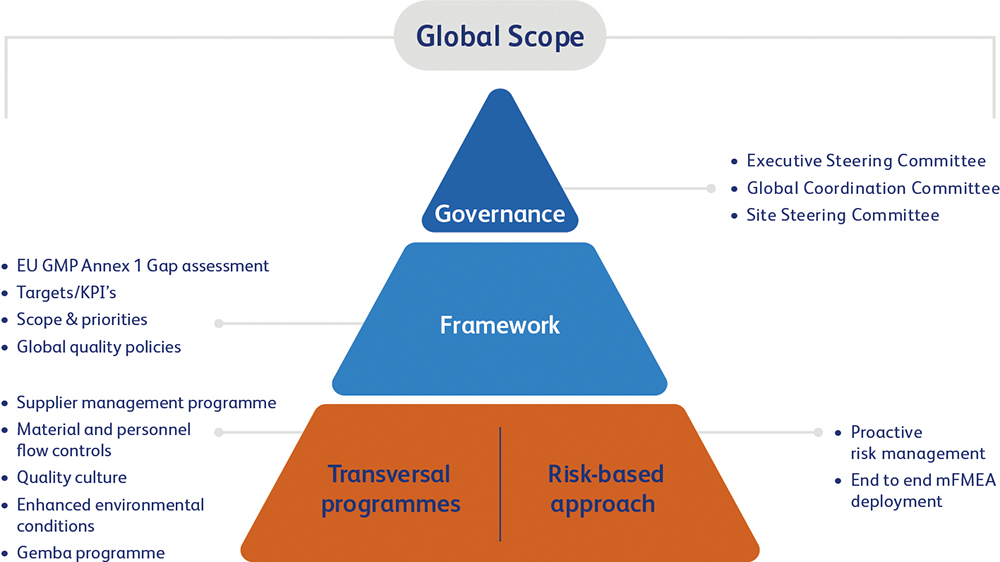
Figure 1: BD global CCS framework.
Q How is BD’s strategy aligned with the expectations of Annex 1?
FPA Risk management is the backbone of our strategy. Rather than creating a separate internal quality programme and then aligning it afterwards, we used Annex 1 expectations as a foundation for the architecture of our approach.
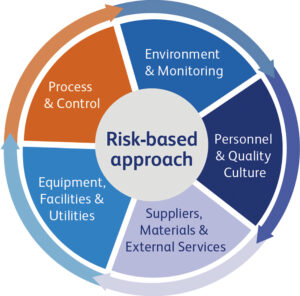
Figure 2: The five pillars of BD CCS.
We have organised the strategy around five pillars (Figure 2). The first two pillars address what BD builds and maintains: environment and monitoring, and equipment, facilities and utilities. The next two pillars focus on how we work: personnel and quality culture, and processes and control. The final pillar extends beyond BD’s own walls: suppliers, materials and external services. Together, these areas reflect the operational reality of sterile manufacturing, where contamination prevention depends on many connected decisions.
Within each pillar, we apply the same disciplined risk-management cycle. We identify contamination risks, assess their criticality, focus resources where risk is highest, define and implement mitigation actions, and then track effectiveness. Residual risk and lessons learned are reviewed regularly and fed back into our continuous improvement process.
Q What does seeing contamination control as a mindset mean within BD?
PJ We know that contamination control cannot belong to the quality department alone. If it does, it will eventually fail. Contamination risk is influenced by decisions made every day across the organisation, from operations and engineering to procurement and maintenance. That is why contamination control needs to be a shared responsibility across businesses.
To combat that, we have deliberately positioned contamination prevention as a business priority rather than solely a quality responsibility. With strong leadership endorsement within BD, contamination prevention is embedded into how we manage and discuss business performance.
Over the past 12 months, we have also started sharing our CCS journey more openly with customers. These exchanges are an important part of our approach, allowing us to share our experience, listen to their perspectives and continue learning together.
FPA Building on what Patrick said, this type of mindset only holds if it is supported by consistent practices. Our task is to make the right behaviour the standard behaviour across BD globally.
That starts on the shop floor, with standardised practices across sites. It continues through training and team engagement because people apply standards more reliably when they understand their purpose and believe in the value they create.
One of the foundational tools we use is the Gemba walk. This practice brings leaders and quality teams closer to the people doing the work, helping identify risks, assess controls and drive continuous improvement together. More than 350 Gemba walks were conducted across BD manufacturing sites in 2026. In the end, this is where culture and system come together.
“OUR CCS IS SUPPORTED BY A MULTIYEAR ROADMAP, WITH CONCRETE ACTIONS ALREADY
IMPLEMENTED AND FURTHER IMPROVEMENTS BEING PROGRESSIVELY DEPLOYED ACROSS OUR MANUFACTURING NETWORK.”
Q How does BD translate its ccs into concrete actions across its manufacturing network?
FPA Our CCS is supported by a multi-year roadmap, with concrete actions already implemented and further improvements being progressively deployed across our manufacturing network. A major initiative is the improvement and standardisation of gowning practices across our global network. This represents a significant investment and a tangible step towards strengthening and standardising contamination prevention practices across our sites. It is complemented by our company-wide awareness campaign, which helps embed contamination prevention into everyday behaviours.
At the same time, we are acting directly on our manufacturing environment and processes. Environmental conditions have already been optimised in high-risk process steps, including selected stopper-loading areas and some Visioguard™ lines, while further upgrades at points of exposure are planned. Risk-based cleaning and disinfection programmes are being implemented, and personnel and material flows are being reviewed to further reduce contamination risks.
Our approach also extends beyond our manufacturing sites. Contamination control expectations have already been reinforced with our top suppliers, with broader deployment planned. In parallel, initiatives such as double-bagging of rubber components and Gemba walks at distribution centres help to address contamination risks across the wider supply chain.
Q How can these upstream actions translate into measurable value for pharmaceutical manufacturers?
FPA The logic of upstream control is straightforward: a contamination risk eliminated at our site is a risk our customer does not need to detect, investigate or absorb.
For customers, more predictable component quality can mean fewer incoming-quality issues, fewer unplanned deviations during production, fewer line interruptions and less product scrap. It can also reduce investigation burden and free quality resources for higher-value work. In addition, relevant documentation can support customers in their own EU GMP Annex 1 assessments and audit-readiness activities.
We have already seen this translate into measurable value in customer-related data. On one dedicated stopper line, implementation of an end-to-end action plan combining risk assessment, enhanced environmental conditions and revised supplier specifications demonstrated a 28% reduction in complaints per million over 18 months.
Q What is the key message you would like pharmaceutical manufacturers to take away?
FPA Annex 1 has made clear that contamination control cannot rely on isolated controls. It requires a connected, risk-based and continuously improving strategy across the supply chain. At BD, we are translating that expectation into concrete actions across our sites, processes and supplier network, with the goal of supporting our customers’ quality, compliance and zero-defect mindset.
PJ Our commitment can be summarised in three dimensions. First, accountability: we are responsible for controlling the risks within our part of the value chain and for contributing to trust in every injection. Second, action: we are investing, setting measurable targets and continuously improving our practices to support our customers’ zero-defect mindset. Third, impact: by addressing contamination risks upstream, we aim to contribute to more predictable manufacturing performance, stronger supply continuity and, ultimately, the quality and safety of the medicines delivered to patients.
REFERENCE
- Kwang KL, Tan WH, Zhang H, “Particulate Matter in Injectables: risks and controls”. World Pharma Today, accessed Sep 2026.