To Issue 192
Citation: Schwartz E, van Oevelen D, Petrov A, “Non-PTFE, NIA-PFAS Polymers for Liquid Drug Delivery Devices”, ONdrugDelivery, Issue 192 (Oct/Nov 2026), pp 14–18.
Dr Erik Schwartz, Dirk van Oevelen and Anton Petrov discuss SABIC’s range of NIA-polyfluoroalkyl polymers and introduce the company’s fully functional autoinjector prototype, which uses the latest generation of resins and compounds from different polymer families.
As demand for safe and efficient drug delivery devices for self-administration and at-home settings continues to rise around the world, SABIC has developed a range of high-performance thermoplastic polymers targeting a growing number of applications, including liquid medication pens and autoinjectors. In addition to complying with medical regulations, these advanced materials also address concerns over formulations based on polytetrafluoroethylene (PTFE) and/or products containing per- or polyfluoroalkyl substances (PFASs). Furthermore, SABIC’s portfolio of medical-grade resin and copolymer compounds can help manufacturers to achieve CO2 reductions, as well as the optional use of bio-renewable content.
Ageing populations across all industrialised and developing countries rely on medication to address the growing burden of chronic and geriatric ailments, such as diabetes, arthritis, asthma, osteoporosis and cardiovascular diseases. Education and a growing trend towards managing these conditions in more convenient and lower cost settings outside of medical centres have created an increasing demand for at-home and self-administered therapies. Next to a vast number of established solid, oral, nasal and ophthalmic products, the highest growth rates in this market are attributed to liquid formulations administered subcutaneously through spring-loaded pens, autoinjectors or wearable injectors.
“THE PRODUCTION OF DRUG DELIVERY DEVICES FOR LIQUID FORMULATIONS REQUIRES MATERIALS CAPABLE OF SUPPORTING DESIGNS THAT IMPROVE USABILITY, RELIABILITY AND PATIENT EXPERIENCE WHILE ALSO BEING COMPLIANT WITH STRICT REGULATIONS.”
ADVANCED MATERIAL SOLUTIONS FOR RELIABLE HIGH PERFORMANCE
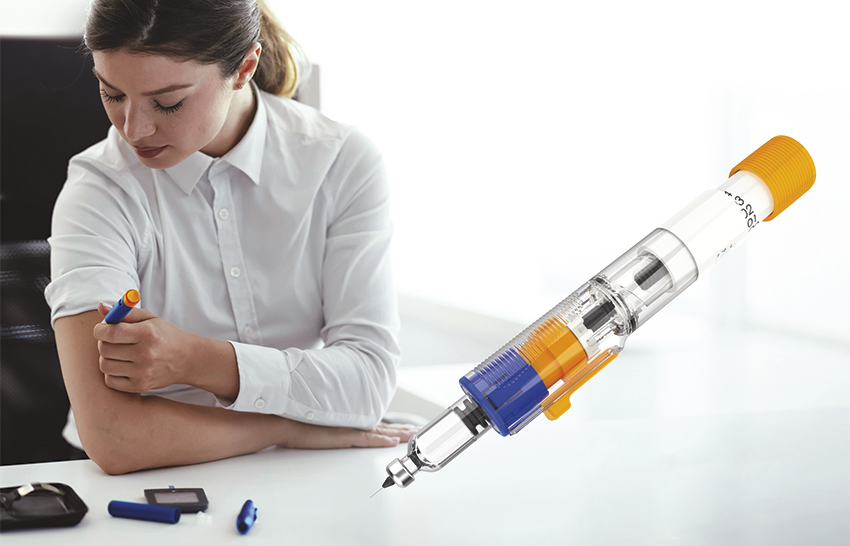
The production of drug delivery devices for liquid formulations requires materials capable of supporting designs that improve usability, reliability and the patient experience while also being compliant with strict regulations. SABIC, a global leader in the chemical industry, and its Specialties business unit are spearheading this segment with a broad portfolio of dedicated medical-grade polymer resins and compounds. To showcase the high-performance potential of these materials, the company has developed a fully functional autoinjector prototype that uses the latest generation of resins and compounds from different polymer families (Figure 1).

Figure 1: Prototype autoinjector developed by SABIC highlights the benefits of using high-performance medical-grade copolymers and compounds for delivering liquid formulations.
The autoinjector features body and vial components that use globally available LNP™ copolymer technology, specifically including LEXAN™ HPX and CYCOLOY™ HCX resins. These thermoplastic materials help to maximise impact strength, including low-temperature impact strength, to store and deliver heat-sensitive products to end users, with excellent aesthetics and customisable colourability or transparency. The chassis and structural parts are moulded in LNP THERMOCOMP™ polycarbonate (PC) compounds, which deliver the strength and modulus required for metal replacement without compromising flatness or dimensional stability.
While all of these materials are optionally available with bio-renewable content for enhanced sustainability, several pen components can also be manufactured with LNP ELCRIN™ iQ polybutylene terephthalate (PBT) resins based on bio-renewable and/or chemically upcycled sources to further minimise their carbon footprints. The PBT content in upcycled LNP ELCRIN iQ resins is derived from post-consumer polyethylene terephthalate (PET) sources, such as discarded bottles.
The formulations can include up to 30% of recycled pre-consumer short glass fibres. The resulting compounds exhibit consistent high-quality physical properties, custom colourability and processability, and have been used successfully as drop-in solutions for incumbent virgin PBT materials. To further support these sustainable designs, the LNP copolymer technology also enables the production of thin-walled parts. An example of the sustainability benefits of certified bio-based LNP ELCRIN HCX1640B resin is shown in Figure 2.
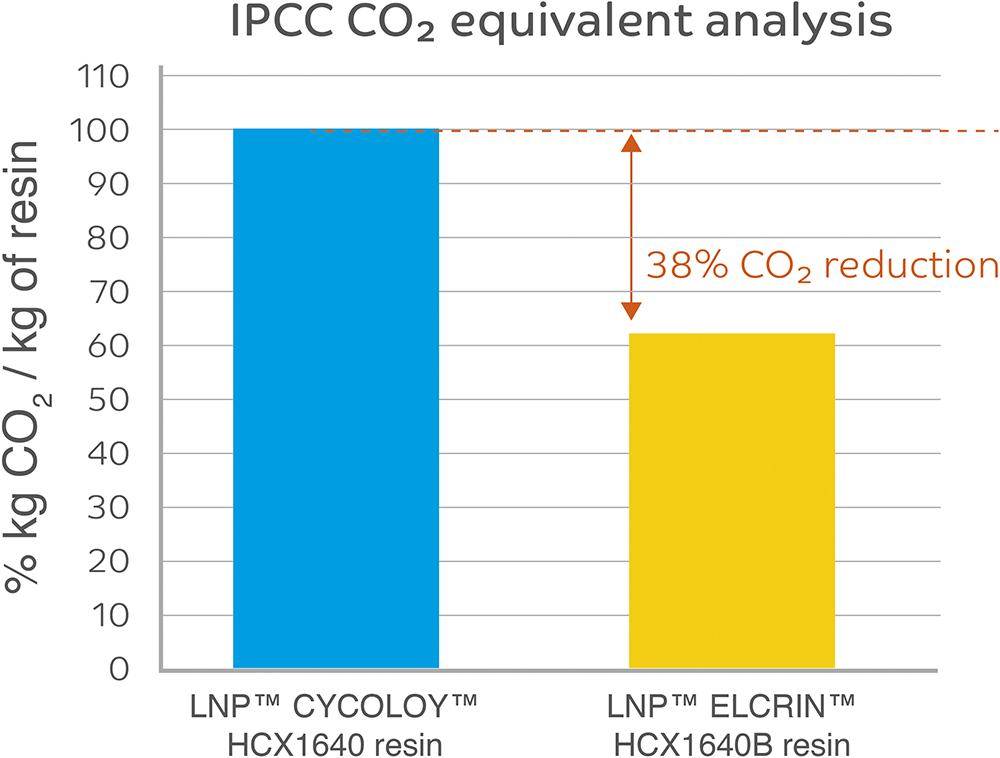
Figure 2: LNP ELCRIN HCX1640B resin containing third-party certified bio-renewable content via the mass balance approach can reduce the carbon footprint by up to 38% versus traditional LNP CYCOLOY HCX1640 resin grade (calculated according to the general principles of a lifecycle assessment as outlined in ISO 14040. IPCC; Intergovernmental Panel on Climate Change).
“ONE OF THE MAJOR CHALLENGES IN THE DESIGN OF PENS AND AUTOINJECTORS IS TO ENSURE THE RELIABLE AND REPEATABLE LOW-FRICTION MOTION OF MOVING PARTS, WHICH IS CRITICAL FOR PRECISE DOSING.”
FINE-TUNED LUBRICITY
One of the major challenges in the design of pens and autoinjectors is to ensure the reliable and repeatable low-friction motion of moving parts, which is critical for precise dosing. Especially in homecare and self-administration settings, friction can severely impact the perceived value and adoption of drug delivery devices, as it may result in a higher amount of force needing to be applied on the mechanism, which typically includes sliders, bushings and spring-loaded plungers.
Adding an internal lubricant to compounds can effectively minimise the coefficient of friction (COF) between parts, whether contact is plastic-on-metal or plastic-on-plastic. Historically, LNP LUBRICOMP™ grades based on PTFE have been the workhorse grades for lubricated solutions.
However, as regulations become more stringent and discussions on the use of PFASs and brominated compounds increase, there is growing demand for alternatives to PTFE-based compounds. In response to this, SABIC has developed a new series of internally lubricated LNP LUBRILOY™ compounds. These formulations are designed without PTFE and use non‑halogenated alloy systems, offering a sustainable solution while maintaining good tribological performance.
Medical-grade LNP LUBRILOY formulations with inherent lubrication have been shown to provide good tribological performance while avoiding the use of PTFE, which is listed among the PFAS-containing materials that may soon be banned or restricted from use in medical devices under EU regulations.
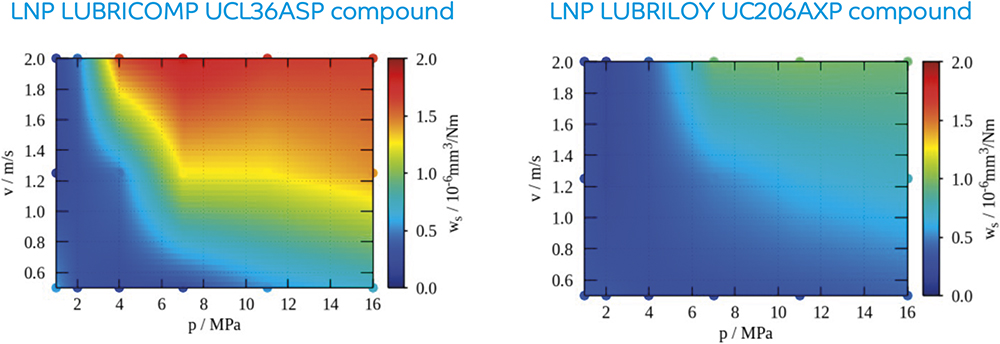
Figure 3: Wear performance of LNP LUBRILOY UC206AXP compound versus PTFE-based reference material (UCL36ASP) tested in a dry sliding 100Cr6 block-on-ring set-up (surface finish roughness average = 0.189 μm), specific wear rate (ws) in 10-6 mm3/Nm with velocity (v) in m/s and pressure (p) in MPa.
For structural components such as rotary locks, SABIC has developed an offset carbon-reinforced polyphthalamide (PPA) compound to its PFTE-based LNP LUBRICOMP UCL36ASP, namely the non-PTFE-based LNP LUBRILOY UC206AXP. In a block-on-ring test, the new LNP LUBRILOY non-PTFE grade (UC206AXP) offers similar or better wear (Figure 3) and friction performance over a wider range of pressures and velocities compared with PTFE-based references (Figure 4).
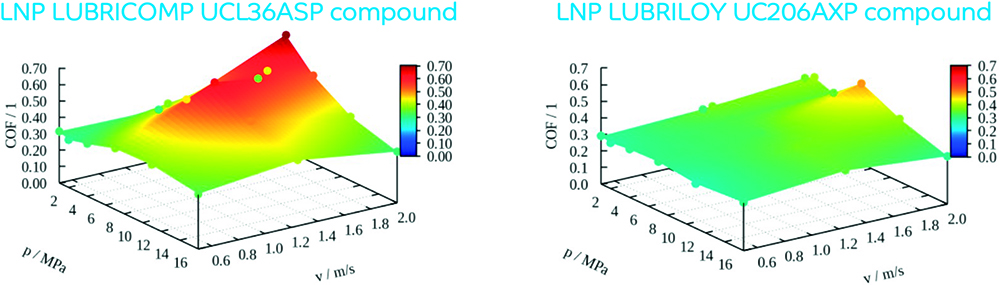
Figure 4: Friction performance – LNP LUBRILOY compounds with proprietary lubrication (UC206AXP) can significantly minimise the COF while avoiding the use of PTFE-based compounds such as UCL36ASP (tested under the same conditions as in Figure 3 in a dry sliding 100Cr6 block-on-ring setup).
LNP LUBRILOY compounds also offer the benefit of lower specific gravity, which enables weight-reduction opportunities while maintaining mechanical properties largely equivalent to those of PTFE-based systems. Table 1 summarises the availability of SABIC’s lubricated compounds for healthcare applications.
| Resin Base | Healthcare Grade |
| ABS | 🟦 AI001XXH |
| PC | 🟨 D2000AXH |
| 🟦 DI001PXH | |
| 🟦 DL003EH | |
| PC-GF |
🟨 DF206XXH |
| 🟦 DFL34H | |
| PEI-GF | 🟦 EFL34HL |
| POM | 🟨 K2000XXH |
| 🟦 KP004AH | |
| PA66 |
🟨 RF206AXH |
| 🟦 RFL36XU | |
| PBT | 🟦 WI001H |
| 🟦 WX07423H | |
| 🟨 W8000 |
Table 1: Lubricated compounds for use in healthcare applications with moving parts.

🟦 PTFE and/or Si modified (LNP™ LUBRICOMP™ compound grade)
🟨 Proprietary alloy (LNP™ LUBRILOY™ compound grade)
STRICT MANAGEMENT OF CHANGE POLICY AND APPLICATION SUPPORT
“BEYOND OFFERING A WIDE RANGE OF MATERIAL SOLUTIONS FOR HEALTHCARE, INCLUDING BIOCOMPATIBLE COMPOUNDS, SABIC SUPPORTS MEDICAL CUSTOMERS WITH A COMPLETE SUITE OF VALUE-ADDED
SERVICES FROM DESIGN AND MOULD-FLOW ANALYSIS TO PREDICTIVE ENGINEERING, TESTING AND COMPLIANCE APPROVALS.”
To ensure the consistent quality, availability and supply of its medical-grade compounds, SABIC maintains a strict management of change policy across its manufacturing and compounding sites. Beyond offering a wide range of material solutions for healthcare, including biocompatible compounds, SABIC supports medical customers with a complete suite of value-added services from design and mould-flow analysis to predictive engineering, testing and compliance approvals. Concept studies and prototype designs complement a focused market approach, which is based on many years of innovative collaboration with leading industry players.
The market of self-administered medication is rapidly growing, and this can be a significant key to success when it comes to designing and implementing new drug delivery devices, such as prefilled syringes and wearable injectors. With liquid therapies for osteoporosis treatment, hormone replacement, pain relief and other therapeutic applications on the rise, the right partner and material choice can accelerate time to market and provide an important competitive edge.