

To Issue 190
Citation: Arora B, Bhatiya H, “Proactive Quality and Regulatory Engagement to Accelerate Product Development“, ONdrugDelivery, Issue 190 (Sep/Oct 2026), pp 72–75.
Bharat Arora and Hirak Bhatiya discuss the quality and regulatory perspective on accelerated development pathways transitioning from an emergency measure to a mainstream route to commercialisation, going over what may be expected of pharmaceutical quality teams to manage this new paradigm.
THE INDUSTRIAL REVOLUTION IN PHARMACEUTICAL DEVELOPMENT
The pharmaceutical industry is experiencing an industrial revolution in drug development. Accelerated pathways – once exceptional accommodations for urgent medical needs – have become increasingly embedded in modern development. This represents a significant shift from the occasional use of accelerated pathways to a more consistent industrial capability.1,2
This shift requires a change in quality management systems (QMSs) and regulatory engagement, moving from passive compliance to a proactive, data-driven and continuous regulatory partnership. Critically, regulatory flexibility exists in the timing and sequencing of data submission, not in the rigour of the underlying requirements. Product specifications, patient safety standards and validation requirements remain essential whether approval occurs through a standard or expedited pathway. What has evolved is the sophistication of QMSs – moving from rigid sequential development to flexible, risk-based approaches that maintain stringent endpoints while strategically phasing the journey to reach them.
A PRODUCT QUALITY MANAGEMENT TRANSFORMATION
“IN THE WORLD OF ACCELERATED PATHWAYS, QMSs SHOULD BE EMBEDDED IN DEVELOPMENT DECISION-MAKING FROM INCEPTION, FUNCTIONING AS PROACTIVE RISK ASSESSORS AND LIFECYCLE STRATEGISTS.”
Traditional pharmaceutical QMSs, historically based on the stability of well characterised commercial processes, are undergoing substantial disruption due to the trends facilitated by accelerated pathways. In the world of accelerated pathways, QMSs should be embedded in development decision-making from inception, functioning as proactive risk assessors and lifecycle strategists. This can be achieved through template-based approaches, standardised frameworks for product families within defined boundaries, sophisticated knowledge management, systematically captured risk assessments and regulatory precedents, as well as cross-programme learning mechanisms in which each programme contributes knowledge to a broader platform.
It is imperative to clarify that this does not mean reduced product quality assurance in product development. Rather, it represents an evolution towards a more sophisticated product quality assurance framework that maintains the same stringent safety and efficacy requirements while using scientific justification and risk-based approaches to determine where and when evidence is most valuable. While fundamental quality standards would remain unchanged, the methodology for demonstrating compliance is evolving towards risk-based decision-making and comprehensive lifecycle commitments.
A science-based product quality approach, combined with regulatory compliance, prioritises risk assessment and ensures that analytical and regulatory resources are applied to the variables that most strongly affect product safety and efficacy. This model requires clear communication and justification of risk assessments, going beyond simple quality assessments to provide an evidence-based rationale for scientific uncertainties. The framework also depends on continuous integration of new information from ongoing monitoring and advanced process analytics to create a living knowledge base, with the objective of establishing a development system in which knowledge generated in one programme becomes an asset for subsequent programmes.
“FOR PRODUCTS SUCH AS PFSs, AUTOINJECTORS AND DUAL-CHAMBER DELIVERY SYSTEMS, PRODUCT QUALITY CANNOT BE CONSIDERED INDEPENDENTLY FROM DEVICE PERFORMANCE AND HUMAN INTERACTION.”
The same principle applies to drug-device combination products and delivery systems. For products such as prefilled syringes (PFSs), autoinjectors and dual-chamber delivery systems, product quality cannot be considered independently from device performance and human interaction. Design verification, human factors, container-closure performance, delivery performance and formulation characteristics can be interdependent. Consequently, quality and regulatory engagement should begin early enough to influence the product architecture and development strategy, rather than occurring after the design has effectively been established.
RISK-BASED DECISION FRAMEWORKS
Accelerated development compresses timelines precisely because it accepts managed uncertainty through rigorous, transparent risk assessment.3 Organisations can employ a three-tier risk categorisation to ensure appropriate focus:
- Patient-Focused Risks (Highest Priority): Any factor directly affecting patient safety, clinical outcomes or therapeutic experience – product impurities with toxicological potential, potency variations affecting dosing, stability failures impacting shelf life, immunogenicity triggers and delivery-system failures.
- Regulatory and Quality Risks: Threats to organisational credibility and data integrity – comparability gaps during process changes, insufficient process understanding, analytical method limitations, validation deficiencies and documentation gaps.
- Operational Feasibility Risks: Practical execution challenges – supply-chain dependencies, analytical throughput limitations, equipment availability, technical-transfer challenges and staffing constraints.
This categorical clarity enables disciplined prioritisation – patient risks drive conservative decision-making; regulatory risks warrant appropriate mitigation strategies; and operational challenges require contingency planning rather than characterisation disproportionate to their potential impact.
For combination products and delivery systems, however, a further dimension is required: use-related risk and platform knowledge. Early quality and regulatory involvement can help determine whether or not a proposed delivery system represents a genuinely new risk or whether its critical user interactions and design characteristics are sufficiently well understood through prior product experience. This distinction can have a substantial impact on the development strategy. Rather than automatically treating every new PFS or delivery system presentation as a novel device requiring a completely new body of evidence, organisations can establish a structured comparison against relevant products in their internal knowledge base.
A US FDA review of Jubbonti (denosumab-bbdz, Sandoz, Basel, Switzerland) provides a practical illustration of this principle.4 Jubbonti was submitted as a 60 mg/mL single-dose PFS with a needle-safety device and was evaluated as a drug-device combination product. The FDA’s review specifically evaluated the applicant’s use-related risk analysis (URRA) and comparative analysis against US-licensed Prolia (denosumab, Amgen, Thousand Oaks, CA, US). The FDA noted that the proposed product had the same indication, intended healthcare-provider user population, use environment, dosing, route of administration and strength as Prolia. The FDA review concluded that the URRA was comprehensive and appropriate and that the comparative analyses did not identify new, different or unique use-related risks or design differences affecting critical tasks. Consequently, a comparative human factors study was not considered necessary.
“A PLATFORM STRATEGY PROVIDES THE KNOWLEDGE BASE AGAINST WHICH A NEW PRODUCT CAN BE ASSESSED; THE PRODUCT-SPECIFIC ASSESSMENT THEN DETERMINES WHETHER THE EXISTING EVIDENCE REMAINS APPLICABLE OR WHETHER DIFFERENCES INTRODUCE ADDITIONAL RISK.”
The importance of this example is not that human-factors evidence can simply be eliminated, but rather that it demonstrates the value of using prior knowledge to determine what evidence is genuinely necessary. A platform strategy provides the knowledge base against which a new product can be assessed; the product-specific assessment then determines whether the existing evidence remains applicable or whether differences introduce additional risk.
This approach is particularly important for organisations developing multiple products using similar delivery technologies. A structured database containing previous device assessments, critical tasks, use-related risks, design verification methods, acceptance criteria, human-factors findings and regulatory precedents can become an important development asset. Quality and regulatory teams can use this information to establish scientifically justified thresholds for when additional studies are necessary and when existing knowledge can be used.
QUALITY AND REGULATORY COMPETENCY MODEL
Accelerated development requires five core capabilities within quality and regulatory organisations (Figure 1):
- Cross-Functional Stakeholder Influence: Quality and regulatory teams should shape development decisions proactively, rather than reactively approving predetermined plans. Industrial maturity means formal integration into stage-gate decisions, cross-functional risk ownership and defined escalation protocols.
- Technical Fluency: Deep scientific understanding enables knowledgeable peer engagement rather than superficial compliance checking. Organisations should establish modality-specific expertise platforms, systematic knowledge capture and continuous learning programmes.
- Product Lifecycle Governance: Development, approval and commercialisation should be viewed as an integrated continuum and should extend into a platform strategy as applicable. This creates an opportunity to establish a product platform knowledge base to build upon previously characterised drug-device architecture for new programmes.
- Structured Risk Management: Systematic, evidence-based approaches enable disciplined decisions under uncertainty. Industrial systems should maintain portfolio-level risk libraries, employ standard assessment templates with clear scoring criteria and use cross-programme analytics to identify patterns.
- Regulatory Narrative Development: Organisations must construct scientifically compelling explanations that build regulatory confidence. Industrial organisations can use template-based narratives that incorporate regulatory precedent, maintain searchable precedent databases and implement cross-functional reviews to ensure consistent messaging.
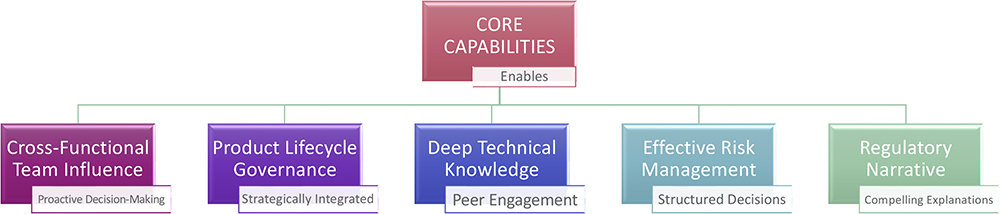
Figure 1: The five core capabilities required of quality and regulatory teams.
HEALTH AGENCY ENGAGEMENT PREPARATION
A quality narrative connects risk assessment, knowledge management and lifecycle planning for a product. Effective narratives should clearly explain why certain product attributes were heavily assessed compared with other attributes and explicitly link critical material attributes and critical quality attributes to patient outcomes. In combination products, these narratives should also explain how device characteristics, critical user interactions and delivery performance affect patient safety and therapeutic outcomes.
Health authority interactions should therefore be treated as a continuous loop.5,6 Prior to engagement with regulatory agencies, organisations should conduct a thorough review of internal databases and regulatory precedents, identify relevant similar products, anticipate questions based on knowledge gaps and build a structured briefing package. For drug delivery systems specifically, early engagement should specifically address three interconnected questions:
- What is genuinely novel?
- What existing knowledge can be used?
- What evidence will the agency expect to demonstrate that the remaining risks are adequately controlled?
This is particularly important for design verification and human factors. The objective of an early regulatory interaction should not simply be to obtain agreement on an individual study protocol. Instead, the organisation should seek alignment on the overall evidence-generation strategy, including the applicability of prior platform knowledge, the proposed use-related risk assessment, the threshold for additional human-factors work and the design-verification strategy.
“A MATURE QUALITY AND REGULATORY ORGANISATION SHOULD MAINTAIN A SEARCHABLE DATABASE OF PRIOR PRODUCTS, REGULATORY QUESTIONS, DEVICE CONFIGURATIONS, HUMAN-FACTORS ASSESSMENTS, DESIGN-VERIFICATION METHODS AND REGULATORY AGENCY DECISIONS.”
The broader organisational lesson is that such analyses should not be reconstructed independently for every development programme. A mature quality and regulatory organisation should maintain a searchable database of prior products, regulatory questions, device configurations, human-factors assessments, design-verification methods and regulatory agency decisions. Such a database can then become a platform for developing evidence-based threshold analyses and regulatory narratives.
CONCLUSION
Accelerated development pathways are no longer episodic responses to urgent medical needs; they are becoming embedded features of modern pharmaceutical innovation. As expedited approaches proliferate across global regulatory agencies, the defining challenge is not simply whether organisations can move quickly, but whether or not they can do so in a manner that is scientifically defensible, regulatorily credible, compliant and operationally sustainable.
“THE SHIFT TO A COMBINED COMPLIANCE MINDSET AND SCIENCE-BASED ENGAGEMENT REPRESENTS MORE THAN A PHILOSOPHICAL EVOLUTION; IT IS AN OPERATIONAL NECESSITY.”
The shift to a combined compliance mindset and science-based engagement represents more than a philosophical evolution; it is an operational necessity. Clinical milestones, chemistry, manufacturing and controls decisions, device development, human-factors assessment, and regulatory interactions are no longer sequential events – they are dynamically interdependent.
For products involving PFSs, autoinjectors, dual-chamber systems and other drug-delivery technologies, this interdependence becomes particularly important. The quality of the final product depends not only on the formulation and manufacturing process but also on the ability of the delivery system to perform as intended and to support safe and effective use.
The lesson for pharmaceutical organisations is broader than an individual product – early quality and regulatory engagement can create alignment around the development strategy itself, including design verification, human factors, use-related risk, platform applicability and the appropriate threshold for generating additional evidence. This enables development teams to use existing knowledge where scientifically justified while directing resources towards genuine uncertainties.
Ultimately, it is critical to dispel any misconception that accelerated pathways compromise quality. The distinction lies in when certain lifecycle data are generated, how knowledge is accumulated and how scientific justification is communicated in support of product quality. Accelerated pathways intensify regulatory scrutiny during development through more frequent interactions and require more sophisticated QMSs capable of managing knowledge gaps transparently while maintaining product quality. This is how accelerated development can become a repeatable organisational capability rather than a one-time achievement.
This article is meant for educational purposes. The statements expressed here are those of the writers or external reference sources and do not reflect the opinion or position of Vertex Pharmaceuticals.
REFERENCES
- “Fast Track, Breakthrough Therapy, Accelerated Approval, Priority Review”. US FDA, Jun 2023.
- “Accelerated assessment”. EMA, accessed Sep 2026.
- Makarova E et al, “Embedding ‘smart quality’ culture and capabilities in the organization”. McKinsey & Company, Jan 2022.
- “Center for Drug Evaluation and Research Application Number 761362Orig1s000 Other Review(s)”. Review, US FDA, Dec 2023.
- “ICH guideline Q12 on technical and regulatory considerations for pharmaceutical product lifecycle management – Step 5”. EMA, Mar 2020.
- “Questions and answers on post approval change management protocols (PACMP) – Revision 1”. EMA, Jan 2026.