To Issue 190
Citation: Dunkley J, “Reconstitution to Co-Delivery: Designing Multichamber Devices for Better Patient Experiences”, ONdrugDelivery, Issue 190 (Sep/Oct 2026), pp 26–28.
Jack Dunkley delves into the architectural principles of multichamber systems for injectable formulations and considers how to overcome the design challenges involved.
The rise of biologics, personalised therapies and home-based treatment is changing what is expected of injectable drug delivery systems. Devices are no longer judged only on whether they can contain and deliver a dose; they must also protect sensitive formulations, simplify preparation, support confident use by patients and caregivers, and remain realistic to manufacture, assemble and validate at scale. For therapies that cannot be supplied as ready-to-inject liquids, this creates an important design challenge: how can the device take on more of the preparation burden while preserving safety, reliability and ease of use?
“ONE OF THE KEY CHALLENGES IN DEVICE DEVELOPMENT TODAY IS REDUCING THE NUMBER OF USER STEPS REQUIRED FOR APIs SUPPLIED IN LYOPHILISED FORM BECAUSE OF STABILITY CONSTRAINTS.”
One of the key challenges in device development today is reducing the number of user steps required for lyophilised APIs because of stability constraints. Some of these products remain stable for only a limited period once reconstituted into a liquid for injection. Therefore they are often supplied in formats that require manual reconstitution before use, commonly involving a drug vial and a separate diluent. In practice, this preparation process may involve many individual handling steps, each of which must be completed correctly before the drug can be administered to the patient.
This has driven growing interest in simplified delivery systems that reduce user burden, ideally moving towards a two-step autoinjector format. For development teams, this is not only a usability challenge but also a systems-engineering challenge, where teams can help customers translate product requirements into practical device concepts.
As with all injectable products, the primary container closure system is the set of components that directly contains the drug product and maintains its integrity until administration. In parenteral delivery systems, this is often a syringe or a cartridge. Both formats commonly use a glass barrel with elastomeric components, although polymer barrels are also used in some applications. Syringes may be supplied with either an integrated needle or a Luer interface, whereas cartridges are typically sealed at the delivery end with a septum and require a separate or integrated mechanism for needle coupling.
The choice between a syringe and a cartridge is often closely linked to the characteristics of the API and its compatibility with the container and delivery-path materials. In some cases, prolonged contact between the formulation and needle materials during storage can contribute to issues such as corrosion, clogging or other compatibility concerns. In some designs, cartridge-based systems can help to mitigate these interactions, but they also require more complex needle-coupling strategies, such as pen needles or automatic coupling arrangements in which the needle is not in fluid contact during storage, sometimes referred to as a “dry needle” configuration. These additional interfaces can introduce further sterility and system-integration considerations, so the container decision needs to be made in the context of the wider delivery system rather than as a standalone component choice.
“WHEN RECONSTITUTING LYOPHILISED PRODUCTS, THE DEVICE MUST STORE THE API IN POWDER FORM AND THE DILUENT SEPARATELY UNTIL THEY ARE COMBINED TO FORM AN INJECTABLE LIQUID.”
When reconstituting lyophilised products, the device must store the API in powder form and the diluent separately until they are combined to form an injectable liquid. A range of architectures exists for this purpose, but one of the most established is the dual-chamber primary container, which has a similar overall form factor to a standard syringe or cartridge. In this arrangement, an additional stopper is positioned part-way along the barrel to create two chambers: the front chamber contains the powder, while the rear chamber contains the diluent and is closed in a similar way to a conventional system. During early concept development, it is important to assess how this type of architecture affects the device envelope, actuation sequence, user interaction and development risk.
To enable mixing, the barrel incorporates a bypass feature that is initially blocked by the forward stopper. When the rear stopper is pushed, the diluent – being effectively incompressible under these conditions – transmits force to the forward stopper. As there is headspace within the powder chamber, the forward stopper can move far enough to expose the bypass, allowing the diluent to flow into the front chamber and mix with the powder. Continued movement of the rear stopper then drives the liquid forward until the two stoppers come together. Figure 1 shows an illustration of the mixing process within a dual-chamber syringe.
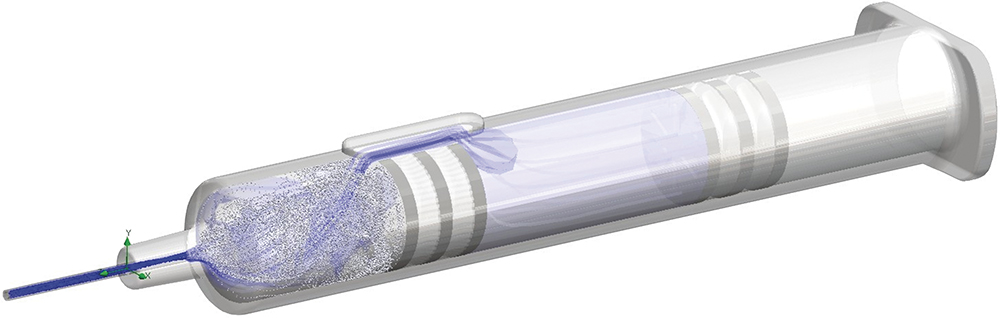
Figure 1: Illustration of mixing within a multichamber syringe.
In some configurations, continued movement of the rear stopper can then be used to expel the reconstituted drug product, meaning that reconstitution and delivery could, in principle, be combined within a single actuation sequence. This would be consistent with a two-step autoinjector user experience in which the patient simply removes the safety cap and presses the device against the skin. However, the feasibility of this process depends on whether the device can reliably complete reconstitution, fluid transfer and injection without introducing unacceptable complexity or uncertainty.
In practice, this assumes that the powder and liquid components can be mixed adequately without delay and without the need for additional agitation. However, in these small-volume systems, flow is typically laminar, which limits passive mixing efficiency and can make rapid reconstitution difficult. For this reason, many systems require an additional user step to promote mixing, such as controlled agitation, inversion or a defined waiting period before injection. Device teams should explore these usability and engineering trade-offs early, before committing to a user sequence that may be difficult to validate or difficult for patients to perform consistently.
Other challenges associated with dual-chamber systems arise during filling and assembly. In dual-chamber syringe formats with a staked needle, the process can be particularly complex because the powder, stoppers and liquid must be introduced in a controlled sequence while maintaining chamber separation, sterility and freedom from cross-contamination. As a result, these systems often require specialised filling processes and may not be compatible with standard filling lines.
“DUAL-CHAMBER SYSTEMS RELY ON A BYPASS FEATURE BUILT INTO THE BARREL GEOMETRY, SO CHANGES TO CHAMBER VOLUMES OR STOPPER POSITIONS MAY REQUIRE NEW PRIMARY CONTAINER COMPONENTS AND ASSOCIATED MANUFACTURING ADJUSTMENTS.”
Customisation can also be more difficult than with conventional single-chamber syringes or cartridges. In a standard system containing a single liquid and stopper, the dose volume can often be adjusted relatively easily by changing the fill volume and stopper position. In contrast, dual-chamber systems rely on a bypass feature built into the barrel geometry, so changes to chamber volumes or stopper positions may require new primary container components and associated manufacturing adjustments. These practical constraints can lead to extended lead times and additional supply chain challenges, making manufacturability an important part of early device strategy.
Another approach is to use two standard cartridges: one containing the lyophilised product and the other containing the diluent. Such an approach can reduce reliance on custom dual-chamber primary containers, and, in some cases, the cartridges may be compatible with existing filling lines and standard components. The trade-off is that the device itself becomes significantly more complex. In this type of architecture, engineers can break the sequence down into functional requirements and identify which interfaces, motions and control steps are likely to drive technical risk.
The device must first bring the two cartridges into smooth contact so that the diluent can be transferred into the powder cartridge for reconstitution. Depending on the formulation and system design, an additional active mixing step may then be required before the device establishes the final fluid path to the delivery needle for injection. These operations are necessary to maintain separation of the constituent components before reconstitution and to ensure that the fluid follows the correct path through the device during both mixing and delivery.
Because this sequence can take longer than in a dedicated dual-chamber system, careful consideration is needed as to what triggers mixing and what triggers injection. For example, removing the cap could initiate reconstitution while pressing the device against the skin could trigger injection, or both steps could occur only once the device is pressed against the skin, potentially increasing hold time. In some cases, this may require an additional user control, such as a separate button or actuator. These choices have a direct impact on usability, perceived simplicity and the level of instruction required for safe and effective use.
These examples illustrate that devices for lyophilised reconstitution and delivery present a range of technical challenges, spanning architectures with complex primary containers and relatively simple devices through to those with simpler primary containers and more complex device mechanisms. Selecting the right solution therefore requires a holistic approach that considers technical complexity, supply chain considerations, the characteristics of the product being delivered and the intended user experience. This is where an experienced development partner can help connect the technical requirements with practical design, prototyping and risk-management activities.
“BY REDUCING WORKFLOW COMPLEXITY, SUCH SYSTEMS MAY ALSO HELP TO MOVE SOME COMPLEX THERAPIES OUT OF HEALTHCARE FACILITIES AND INTO THE HOME, IMPROVING THE PATIENT EXPERIENCE WHILE REDUCING THE DEMAND ON CARE SYSTEMS.”
If these challenges can be addressed successfully, the potential benefits to patients are substantial, including simpler user steps and the potential for more consistent reconstitution. By reducing workflow complexity, such systems may also help to move some complex therapies out of healthcare facilities and into the home, improving the patient experience while reducing the demand on care systems.
Although this article has focused on reconstituting lyophilised drug products, similar architectural principles may also offer advantages in co-delivery systems designed for dual-liquid formulations. Some therapies require two products to be administered within the same treatment event. This can be achieved using two separate autoinjectors delivered sequentially, but it may also be possible to use a single device. With some architectures, the two liquids could be combined during the actuation sequence and delivered through a single needle, while in others the device could incorporate two separate needles each connected to its own primary container. A key potential benefit of co-delivery is the reduction in handling steps for the patient or caregiver, which may be particularly valuable in time-sensitive or otherwise stressful administration scenarios.