To Issue 191
Citation: Barajas M, Falcone K, “Synchronised and Optimised: Following the Path of Integration to Simplify Self-Injection Device Development”, ONdrugDelivery, Issue 191 (Oct 2026), pp 88–91.
Maria Barajas and Katie Falcone introduce the West Synchrony™ S1 prefillable syringe system and explain how streamlining the design, regulatory and manufacturing processes through an innovative platform that uniquely integrates the syringe barrel, plunger and needle shield/tip cap into a fully harmonised, verified system from a single supplier can improve patient adherence and quality of life.
For patients needing regular doses of injectable therapies, having the means to manage their own regimen can be truly transformational in terms of increased adherence and improved quality of life.
In recent years, increasing numbers of patients have felt these benefits, as pharmaceutical companies and biotech innovators have leaned into the seismic potential of self-administration in at-home settings. By developing technologies and devices that meet this growing demand, drug developers are bringing far greater convenience to patients while simultaneously supporting healthcare professionals and payers by mitigating the burdens of time and cost associated with in-clinic administration.
The logical impact of this enhanced convenience is that patients are better equipped to comply with their prescribed therapies, giving them greater control over the management of their condition and, ultimately, increasing their ability to lead a better life on a more independent basis.
“THE SIMPLER THE DELIVERY PROCESS, AND THE MORE READILY IT CAN BE ACCEPTED WITHIN THE EBB AND FLOW OF EVERYDAY LIFE, THE GREATER THE LIKELIHOOD OF COMPLIANCE AND THEREFORE ACHIEVING THE DESIRED THERAPEUTIC OUTCOME.”
Drug delivery is pivotal in this dynamic, heavily influencing whether the expected benefits of self-administration actually translate into desired human behaviours in the real world. Once a combination product is out in the real world there are many opportunities where the patient experience can be subject to unexpected complications and daily disruptions. In this context, the simpler the delivery process, and the more readily it can be accepted within the ebb and flow of everyday life, the greater the likelihood of compliance and, therefore, achieving the desired therapeutic outcome.
Conversely, if the mechanics of delivery are more complex – such as placing a higher preparation burden on the patient – then there is greater potential not only for delivery errors but also for anxiety, confusion and avoidance.1
ADDRESSING HUMAN FACTORS FOR INTUITIVE INJECTIONS
These potential delivery failings underline how the strategic realisation of self-administration must be aligned with a close understanding of real-world patient needs. In an ideal world, these human needs would be answered so fully through intelligent engineering that the act of injecting feels more intuitive than intentional. For the patient, little or no thought is given to the sophisticated mechanics residing beneath the surface of their delivery device, as they are simply not a cause of cognitive burden, friction or concern. Much the same as driving a car, passengers and drivers do not consider the engine/motor, transmission, electrical system, brakes or suspension that are enabling it to move – they are merely sitting and trusting the process.
The contradiction here is that creating an easy experience for patients is far from easy. Indeed, there is a paradoxical relationship between these factors, with ever simpler user experiences intensifying the demand for ever more sophisticated engineering approaches. This underlines the deep complexity of a challenge that involves pulling so many interconnected strands together, including drug formulation, primary packaging and delivery mechanism, all while fulfilling the robust requirements of global regulators.
Consideration of the desired delivery outcome needs to start from the very earliest stages of drug development. Due prioritisation must be given to the primary packaging system, specifying an appropriate device platform that is suitable for the intended patient cohort. Accommodating reliable drug delivery over the course of a product’s lifecycle must also be addressed, and must be based on the specific physical attributes of the formulation.
This gives rise to critical decisions surrounding everything from compatibility of syringe components to precision manufacturing and final device assembly, creating an almost endless list of variables that must be managed to avoid unintended, and often unforeseen, consequences. Material compatibility must be analysed, and dimensional tolerances must be met to ensure that all moving parts coalesce into a precise mechanical sequence and, ultimately, a successful self-injection when the device is in the hands of a patient.
“WEST HAS PURSUED AN INNOVATION STRATEGY THAT SIMPLIFIES AND ACCELERATES THE COMBINATION PRODUCT PATHWAY.”
SIMPLIFYING THE PROCESS WITH AN INTEGRATED, VERIFIED PFS SYSTEM
In acknowledgement of the scale of this task, West has pursued an innovation strategy that simplifies and accelerates the combination product pathway. The West Synchrony™ S1 prefillable syringe (PFS) system is an innovative platform that uniquely integrates the syringe barrel, plunger and needle shield/tip cap into a fully harmonised, verified system from a single supplier. Breaking from the component-by-component model of building a PFS, the West Synchrony S1 platform aids pharmaceutical partners with PFS selection through its comprehensive verification data and regulatory packages. This integrated approach streamlines design, accelerates regulatory submission and secures a reliable supply chain from a single accountable supplier, removing the complexity associated with sourcing and testing individual components from different suppliers.
The compatibility between the PFS platform and the patient-controlled injection device is critical to combination product development. West has therefore conducted characterisation studies to demonstrate how the West Synchrony 1 mL long staked needle system configuration can be employed within a range of autoinjector devices from a variety of leading industry providers, meeting critical tolerances for dimensional fit while also demonstrating the desired extrusion forces to ensure reliable, complete delivery of injectable doses. This compatibility provides pharmaceutical partners with a simplified pathway to combination product development built on two established elements: a PFS system and an injection device platform that work together in harmony to form a complete drug delivery solution.
A DIFFERENTIATED EXPERIENCE THAT PUTS THE PATIENT IN CONTROL
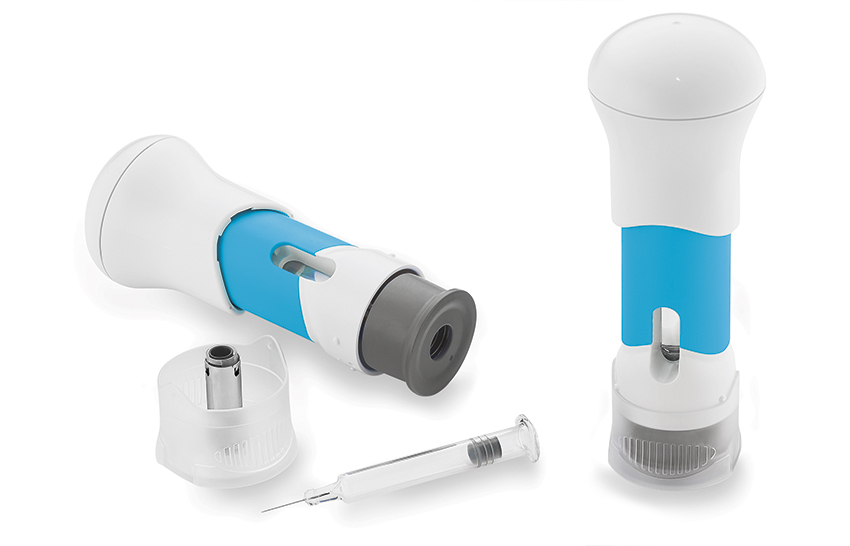
The West SelfDose® patient-controlled injector occupies a standalone space in the market as a truly ergonomic self-injection mechanism. With its manual operation and bulbous handle, the device has been specifically designed to facilitate injections among patients who might struggle with dexterity issues. After removing the large bottom cap, users place SelfDose on their skin and push down on the handle using their palm to activate the injection, avoiding the more common requirement to locate and depress a small button. Patient confidence is further amplified by an audible click and a visual absence of the coloured body to signal injection success.
This user-friendly operation has been a major factor in SelfDose being brought to market with various commercial drugs and indications, particularly demonstrating its suitability in the areas of immunology and neurology. Previous characterisation studies have provided evidence of the device’s compatibility with a range of syringes from different manufacturers, and SelfDose has been designed to work with any ISO 11040-compliant syringe with a small round or cut flange.
In manufacturing terms, SelfDose has been designed in a way that streamlines, accelerates and de-risks development. It comprises just four standardised components (top cap, upper housing, syringe retainer and lower sub-assembly) that come together with a PFS in the final assembly stage. This platform structure provides a pre-verified architecture for integrating the device with a PFS, eliminating the time-consuming and costly challenge of building and validating a combination product from scratch.
CHARACTERISING COMPATIBILITY TO EXTEND THE BENEFITS OF SINGLE-SOURCE SUPPLY
West conducted characterisation testing to analyse the compatibility of the SelfDose device in conjunction with the West Synchrony S1 PFS system, assessing whether the pairing of containment system and delivery platform facilitated a successful end-to-end injection experience. The analysis recorded measurements for the following parameters: cap removal force (N), needle protrusion (mm), needle hide (mm), volume delivered (mL) and injection force (N). A total of 30 samples were used for each test, and the results were assessed against established target benchmarks.
“THESE FINDINGS PROVIDED CLEAR AND ROBUST EVIDENCE THAT, AS AN INTEGRATED OFFERING, THE PFS SYSTEM AND DELIVERY DEVICE FULFIL THE ESSENTIAL PATIENT REQUIREMENTS FOR USABILITY, SAFETY AND DOSE DELIVERABILITY.”
In all tests, the performance of the West Synchrony S1 PFS system and SelfDose combination was found to be within the threshold limit, effectively registering a “pass” result across the board. As such, these findings provided clear and robust evidence that, as an integrated offering, the PFS system and delivery device fulfil the essential patient requirements for usability, safety and dose deliverability.
Of course, this testing is not drug specific; every customer will therefore be required to undergo supplemental testing to characterise the complete device constituent part for their own formulation. What it does provide, however, is an important baseline of data that can help inform pharma companies’ decision-making and feeds into the technical documentation required by regulatory bodies.
Moreover, by evidencing compatibility between the West Synchrony S1 PFS system and SelfDose, this characterisation testing shines a valuable light on a simplified pathway for the development of a patient-centric self-injection device. Particularly for companies serving patient cohorts with dexterity issues, it is now possible to wrap consideration of everything from primary packaging to device and delivery into an integrated journey. The confidence that comes with a verified PFS system can be blended with a flexible delivery device to form a combination product with proven credentials.
PROVIDING PARTNERS WITH A PROVEN, PREDETERMINED PATHWAY
This efficient, integrated model provides pharma innovators, biotechs and generics companies with a far simpler pathway to market than if each element were considered in isolation, with findings from essential studies already built-in and necessary information already prepared.
Of course, this does not equate to a “shortcut”, “cheat” or “hack”. There is no escaping the scientific and engineering rigour associated with developing an effective combination product. And, given the critical scrutiny applied by regulators, submissions must be supported by a detailed dossier of technical data to show that the delivery system as a whole ensures that a drug is contained securely and with integrity, that it can be delivered reliably and safely, and that it can demonstrate efficacy among the target cohort.
Enabling self-administration of an injectable therapy in a way that patients find truly intuitive, uncomplicated and in harmony with the reality of their daily lives may never be an entirely easy task. However, the goal of simplifying and accelerating a development pathway that meets the needs of every part of the ecosystem, from scientist to designer to engineer and patient, is now well within grasp. And that ambition of delivering a truly holistic platform that is synchronised and optimised is becoming an increasingly likely outcome.
West’s SelfDose® patient-controlled injector is not independently cleared or approved by any Regulatory Body for general healthcare professional or patient use, nor is it available for general commercial purchase. Its distribution and use are subject to applicable regulatory requirements for clinical investigation, and for marketing authorization, as used in combination with a specific drug or biological product. Each component of a combination product is subject to the requirements established by the Regulatory Body for that component (drug, biologic or device). The regulatory process can be more complicated for combination products including an evaluation of the product characteristics, delivery system and its functionality, intended users and use environment(s), as well as the potential for undesirable interactions between the drug or biologic and the delivery system. As a result, the authors note that the SelfDose®patient-controlled injector’s compatibility with any particular drug or biologic must be confirmed, and its ability to achieve the desired patient benefits must also be confirmed, on a case-by-case basis in a manner sufficient to meet Regulatory Body requirements. The assembled appearance of the SelfDose® patient-controlled injector is for demonstrative purposes only. The SelfDose® patient-controlled injector is intended to be distributed as an integrated device and is provided disassembled for assembly with, or around, the specific drug or biologic. Products are shown for informational purposes only. Important product and safety information and warnings are available online.
REFERENCE
- Tiktin M, Celik S, Berard L, “Understanding adherence to medications in type 2 diabetes care and clinical trials to overcome barriers: a narrative review”. Curr Med Res Opin, 2016, Vol 32(2), pp 277–287.