To Issue 190
Citation: Buchine B, Ratigan M, Mann A, “The Missing Middle of SC Drug Delivery: How a Dual-Cartridge Architecture Could Unlock the 3–10 mL Opportunity”, ONdrugDelivery, Issue 190 (Sep/Oct 2026), pp 20–25.
Dr Brent Buchine, Mike Ratigan and Aaron Mann argue that the industry’s traditional 2–3 mL boundary for subcutaneous injection reflects the limitations of conventional device and primary-container architectures more than the needs of any particular product or patient, considering whether two widely available cartridges, integrated into a single handheld system, could extend the simplicity and range of autoinjection.
THE BOUNDARY NOBODY ACTUALLY CHOSE
Ask where the subcutaneous (SC) injection-volume limit comes from and the answer will often sound physiological. The tissue can only accept so much. Beyond a few millilitres, injections become painful, leakage increases and local tissue effects become unacceptable. However, the literature suggests a more useful explanation: the traditional volume limit may be a hardware artefact that fused into clinical convention as much as it is a physiological boundary.
Bittner et al describe SC delivery as having been historically constrained to small injection volumes, often 1–2 mL. In examining how that limitation developed, they note that high-dose delivery was not feasible with the conventional 2 mL autoinjectors or syringes available at the time, when required injection volumes often exceeded 5 mL.1
Viewed through this lens, the container came first and the convention followed. That distinction has come to matter more as the handheld autoinjector has evolved. The industry has already moved beyond the 1 mL devices that defined an earlier generation of self-injection and is now developing handheld platforms around substantially larger primary containers. Yet much of the thinking about what constitutes an appropriate SC injection still reflects the assumptions created by those earlier devices.
If the historical boundary was established partly by the container, rather than by the tissue, then perhaps the next increase in handheld delivery volume does not require changing the biology. It may require changing the architecture.
WHAT THE TISSUE WILL ACTUALLY ACCEPT
Clinical evidence is increasingly challenging the idea that 2–3 mL represents a fundamental physiological ceiling. Woodley et al evaluated 192 SC injections in 32 healthy adults using volumes as high as 10 mL in the abdomen and 5 mL in the thigh, across solution viscosities ranging from 1 to 20 cP. The injections were generally well tolerated. Favourable subject responses were at least 79.3% immediately after injection, rising to at least 96.8% at 24 hours.2
The conclusion should not be that every 10 mL formulation is suitable for rapid handheld administration. Formulation viscosity, needle geometry, injection site, flow rate, injection pressure and drug-specific tolerability all remain important factors.
But viewed alongside the broader evolution of large-volume SC delivery, these findings challenge a much simpler assumption: that an injection becomes unsuitable for handheld delivery merely because the volume exceeds 2 or 3 mL.1,2 If SC tissue can accommodate substantially greater volumes, then the practical boundary begins to move upstream from physiology towards device engineering and human factors.
THE PIPELINE HAS MOVED INTO THE GAP
That distinction might have remained largely academic if pharmaceutical pipelines had stayed within the traditional autoinjector volume range. They have not. Green et al identified 182 large-volume SC candidates above 2 mL, representing approximately 15% of the intravenous and SC biopharmaceuticals included in their systematic review.3
The distribution matters more than the total. The authors identified 75 anti-cancer large-volume SC products, which typically required 5–20 mL doses and were generally administered by healthcare professionals. The remaining 107 non-cancer products were more commonly positioned for self-administration, often on a monthly basis, with less than 5 mL representing the predominant volume range.3
These populations begin to converge precisely where conventional device categories blur. At one end are traditional handheld autoinjectors, historically built around relatively small-volume prefilled syringes; at the other end are infusion pumps and on-body delivery systems designed to remain attached to a patient while larger doses are administered over a longer period. Between them is a growing group of products requiring approximately 3–10 mL volumes.
This is the “missing middle” – the gap recognised beyond the device sector. A Bristol Myers Squibb device team recently framed the handheld large-volume autoinjector envelope as 2–10 mL and observed that the 2–5 mL handheld category has, to date, no commercially approved products.4
It is not that the industry lacks ways to deliver these volumes; it has several. A developer can split the dose across multiple injections, move to an on-body system or develop a larger primary container. All are valid strategies. The question is whether they represent the complete set of choices.
THE REAL HANDHELD LIMIT IS TIME
If tissue tolerance does not establish a clear 2–3 mL boundary, another constraint does begin to emerge: how long a patient can reasonably be expected to hold a handheld device against the injection site. Schneider et al evaluated this directly by measuring the force users applied to handheld autoinjectors during simulated injections of varying duration. Both mean and minimum holding force decreased as injection time increased. Participants successfully completed simulated injections lasting up to approximately 30 seconds, while the authors’ extrapolation suggested that, for a device requiring approximately 15 N to trigger and 4 N minimum holding force, an injection duration of up to approximately 56 seconds may be feasible.5
“THE TISSUE MAY ACCEPT 10 mL, BUT THE CONSTRAINT IS HOW LONG THE PATIENT CAN COMFORTABLY HOLD A DEVICE.”
That splits the problem into two – the tissue may accept 10 mL, but the constraint is how long the patient can comfortably hold a device. A conventional autoinjector cannot solve that discrepancy simply by delivering more slowly. Beyond a certain point, slowing the injection solves the fluid-delivery problem while creating a human-factors problem. On-body systems address this elegantly: remove the need to hold the device. That is a genuine advantage, and the reason the category exists, but it also suggests that volume itself may be the wrong variable on which to divide handheld and on-body delivery. Injection time may be the more meaningful boundary. A 10 mL dose requiring 20 minutes to administer is fundamentally different from a 10 mL dose that can be delivered in 30 seconds.
PATIENTS ARE MAKING A TRADE, NOT CHOOSING A DEVICE CATEGORY
Patient preference adds another dimension. A patient-preference study involving 191 participants with self-injection experience examined preferences between handheld autoinjectors and wearable large-volume injectors while varying dosing frequency and administration duration.6
In the base scenario, which compared a weekly three-minute handheld injection with a monthly 33-minute wearable injection, roughly two-thirds of participants preferred the handheld option. Importantly, preference shifted as administration time shortened and dosing frequency decreased.6 The useful conclusion is not that either device class is inherently more successful, rather that patients appear to be making a trade across injection duration, wear time, dosing frequency and convenience.
For device developers, the implication is practical. The question is not simply whether patients prefer handheld devices or on-body devices. It is how much patient burden each architecture creates for a particular treatment regimen. A handheld device capable of completing a larger-volume injection in substantially less time occupies a very different position on that trade curve to one requiring the patient to hold a device in place for several minutes.
THE CURRENT THREE-WAY CHOICE
Consider a product requiring a 6 mL SC dose. One option is to split the dose; two injections can preserve familiar containers and devices, but the additional injection burden lands directly on the patient and repeats with every administration. A second option is an on-body system; this removes the hold-time constraint and provides a compelling solution when the formulation requires longer administration. But it also introduces a wear period, an adhesive-mounted device and may add device complexity that is unnecessary for a formulation capable of much faster delivery.
A third option is to move towards a larger primary container. However, where an appropriate device-ready container is not already available at the required commercial scale and maturity, the pharmaceutical company takes on a new primary-container development and supply-chain challenge simply to enable the device. That can mean additional container qualification, fill-finish integration, component development, capital requirements and programme risk. Standards for larger volume primary containers exist, but the commercial ecosystem around them is less established than the infrastructure supporting more widely used cartridge formats. Each of these approaches may be appropriate for certain products.
There is a fourth possibility: rather than designing one primary container to accommodate the entire dose, distribute the volume across two established containers within one automated handheld device (Figure 1).
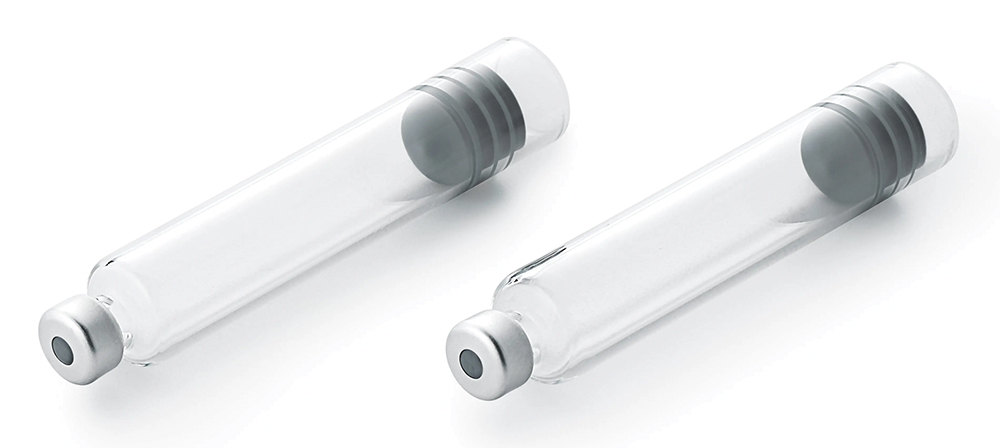
Figure 1: Standard single-chamber cartridges of the type used in the dual-cartridge architecture, filled on conventional aseptic fill-finish lines using formats and component systems already established at commercial scale.
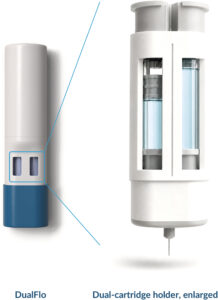
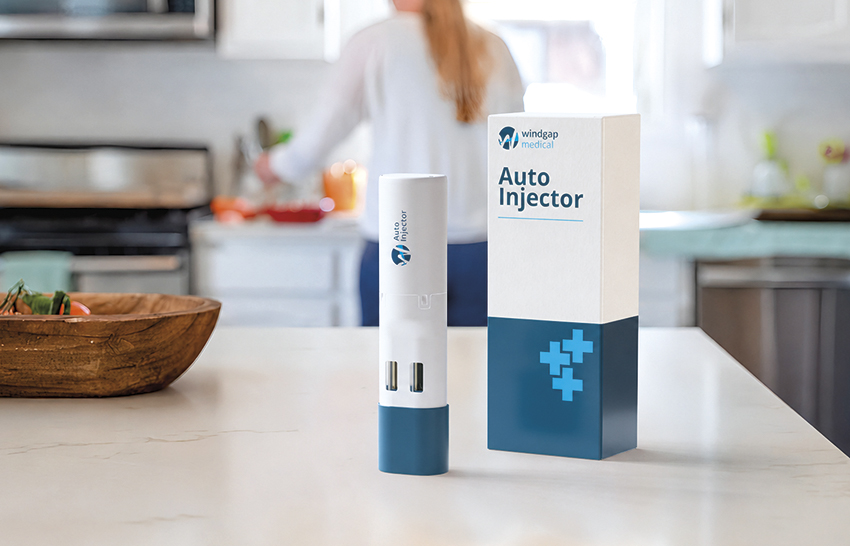
Figure 2: Windgap Medical’s dual-cartridge architecture. Left: the DualFlo handheld autoinjector. Right (enlarged): the dual-cartridge holder seen through the device
window, in which two standard single-chamber cartridges are integrated into a single automated handheld system, with the fluid path converging on one needle.
TWO CARTRIDGES, ONE HANDHELD EXPERIENCE
The arithmetic is straightforward. Two 3 mL cartridges provide 6 mL of capacity. Two 5 mL cartridges provide 10 mL. Two 1.5 mL cartridges enable validated reconstitution, even for difficult-to-mix formulations. The more important point, however, is not simply that two containers hold more drug than one – it is that the dual-cartridge architecture allows total delivered volume to become partially decoupled from individual primary-container volume.
This is a distinct concept from a dual-chamber container. The two containers described here are standard single-chamber cartridges, filled on standard aseptic fill-finish lines (Figure 2). A true dual-chamber container is a single bespoke two-compartment vessel requiring a non-standard fill sequence on dedicated equipment – centre stopper placement, fill, stopper, invert and refill. In a dual-cartridge architecture, this filling complexity is eliminated from the supply chain.
A different development path emerges. Rather than continually increasing the diameter or length of a single large-volume primary container, a dual-cartridge device is built on established cartridge formats, component systems and manufacturing infrastructure that pharmaceutical companies already understand. There is a meaningful risk reduction between qualifying an established primary-container platform for a molecule and having to create a new container and filling ecosystem around it. This is one aspect of the premise behind Windgap Medical’s dual-cartridge architecture. The second part is the energy source.
Once the physiological limit is no longer assumed to be 2–3 mL, the engineering problem becomes more demanding. The device must move the required combination of volume and viscosity through an acceptable needle, at the necessary pressure and within the relatively short time window that makes handheld administration practical. In this context, the power source becomes a first-order design variable.
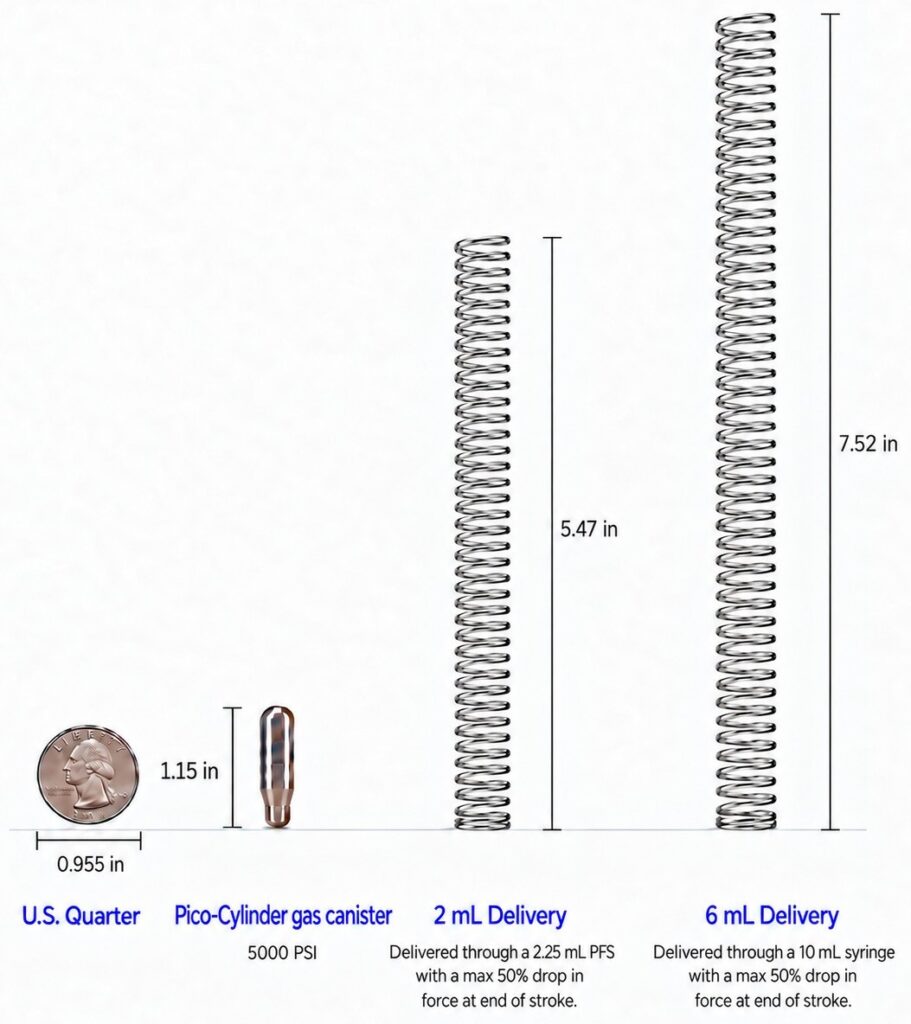
Figure 3: Energy source comparison: the compact gas Pico-Cylinder used in Windgap Medical’s platform alongside a mechanical spring of equivalent stored energy. Representative scaling for illustrative purposes.
Windgap Medical’s platform uses a compact gas-cylinder energy source to drive drug delivery from two primary containers through a single handheld system (Figure 3). The objective is not simply to generate more force. The energy source, containers, flow path, needle and formulation must operate as an integrated system, with the available pressure and delivery profile matched to the volume, viscosity and target administration time of the drug product.
For the 6–10 mL range in particular, the challenge is two-fold. The dual-cartridge architecture creates the required capacity without demanding that a single primary container continuously increase in size. The gas-powered drive system provides an energy source that can be engineered around the pressure and flow requirements necessary to move that volume within a time frame appropriate for handheld delivery.
Together, those elements create a different way of approaching the “missing middle”. The same dual-container architecture can also accommodate a range of drug presentations, including sequential liquid delivery or dry and suspension-based formulations that require mixing. However, the central opportunity discussed here is simpler: extending the practical volume range of handheld drug delivery.
THERE IS ALREADY PROOF
Recent clinical evidence suggests that this general design space is achievable. Kang et al reported a Phase I study of a third-party, prototype, spring-powered, high-volume, handheld autoinjector. This device had a different drive architecture from the gas-powered system described above, and was used to administer a 10 mL formulation containing recombinant human hyaluronidase. The mean delivery time was 27.9 seconds. Among the subjects receiving the handheld injection, 91% reported no or mild injection-site pain and 96% indicated that they would be willing to receive the injection again.7 The use of recombinant human hyaluronidase is a necessary qualifier – these results should not be extrapolated to every formulation or molecule. However, the study does provide proof that a 10 mL dose is not inherently incompatible with the handheld autoinjector experience.
This changes the discussion – the relevant question is no longer simply: “Is 10 mL too much for a handheld device?”, it becomes: “Can this particular combination of volume and viscosity be delivered through an appropriate needle, at the required pressure, within a patient-acceptable injection time?”. That is a substantially different engineering question, and one that opens up a larger design space than a simple volume threshold suggests.
NOT EVERY LARGE-VOLUME PRODUCT BELONGS IN A HANDHELD DEVICE
None of this should suggest that on-body systems are unnecessary. For very large doses, long administration times or formulations that benefit from slow, controlled delivery, an on-body system may clearly provide the better patient experience. In professionally administered settings, wearable systems also create workflow advantages, freeing healthcare providers from attending a long SC administration. The goal should not be to move every 3–10 mL product into a handheld device, it should be to avoid moving every 3–10 mL product out of one simply because it crossed an inherited volume threshold. This distinction matters.
A 6 mL formulation requiring twenty minutes of administration involves a very different device discussion from a 10 mL formulation that can potentially be delivered in 30 seconds. The lower-volume product may, in fact, be the less suitable handheld candidate. Volume alone cannot make that decision.
REDEFINING THE BOUNDARY
So, at what volume does a handheld autoinjector stop making sense? The evidence suggests that there is no single answer. The legacy 1–2 mL boundary emerged in an era when conventional autoinjectors and syringes were themselves limited to small-volume delivery.1 Clinical studies have since demonstrated that SC tissue can tolerate substantially larger volumes. Human-factors research suggests that injection duration, rather than volume alone, places an important constraint on handheld use. Pipeline analyses show a meaningful population of pharmaceutical products moving directly into this emerging gap. Finally, recent clinical work has demonstrated that, under appropriate formulation conditions, even 10 mL can be delivered through a handheld autoinjector in approximately 30 seconds.
The boundary should not be defined by an inherited number. Instead of asking, “At what volume must this product move to an on-body system?”, pharmaceutical developers might first consider a more precise series of questions:
- Can the required combination of volume and viscosity be delivered within a reasonable handheld injection time?
- Can established primary-container formats be used?
- Can the required pressure and flow be achieved through an acceptable needle?
- Does the available energy source provide the appropriate delivery profile?
- Can the resulting device preserve the patient experience that made auto-injection successful in the first place?
“THE ‘MISSING MIDDLE’ MAY NOT REPRESENT THE PHYSIOLOGICAL LIMIT OF SC DELIVERY. IT MAY REPRESENT THE NEXT ARCHITECTURAL BOUNDARY FOR THE HANDHELD AUTOINJECTOR TO CROSS.”
For many products, the answers may still lead to an on-body system. For others, particularly within the emerging 3–10 mL range, two established primary containers integrated into a single handheld architecture and coupled with an energy source designed around the required pressure, flow and injection time may offer another path. The “missing middle” may not represent the physiological limit of SC delivery. It may represent the next architectural boundary for the handheld autoinjector to cross.
REFERENCES
- Bittner B et al, “Challenging the Myths of Subcutaneous Delivery: An Industry Expert Perspective”. J Control Release, 2026, Vol 396, art 114902.
- Woodley WD et al, “Clinical Evaluation of Large Volume Subcutaneous Injection Tissue Effects, Pain, and Acceptability in Healthy Adults”. Clin Transl Sci, 2022, Vol 15(1), pp 92–104.
- Green P, Schneider A, Lange J, “Navigating Large-Volume Subcutaneous Injections of Biopharmaceuticals: A Systematic Review of Clinical Pipelines and Approved Products”. mAbs, 2024, Vol 16(1), art 2402713.
- Ghosh I et al, “Subcutaneous Drug Delivery of High Concentration Antibody Products – Part 2: Formulation, Device Options, and Clinical Bridging Strategies for Patient-Centric Commercial Presentations.” mAbs, 2026, Vol 18(1), art 2680773.
- Schneider A et al, “Hold the Device Against the Skin: The Impact of Injection Duration on User’s Force for Handheld Autoinjectors”. Expert Opin Drug Deliv, 2020, Vol 17(2), pp 225–236.
- Schneider A et al, “Understanding Patient Preferences for Handheld Autoinjectors Versus Wearable Large-Volume Injectors”. Expert Opin Drug Deliv, 2023, Vol 20(2), pp 273–283.
- Kang DW et al, “A Phase I Clinical Study to Evaluate Rapid, High-Volume, Subcutaneous Auto-Injector Tolerability with Recombinant Human Hyaluronidase.” Drug Deliv Transl Res, 2026, Vol 16(1), pp 95–107.