To Issue 190
Citation: Ravazzolo V, James T, “Leveraging Large-Volume Platforms for Liquid-Liquid Drug Delivery”, ONdrugDelivery, Issue 190 (Sep/Oct 2026), pp 60–64.
Valerio Ravazzolo and Thomas James examine liquid-liquid drug delivery using Stevanato Group’s EZ-fill® 3 mL internal-bypass cartridge platform and SHL Medical’s Magnitude 3.0 autoinjector platform, demonstrating how these technologies can be integrated into a standardised container-device ecosystem, helping to reduce the cost, risk and development timelines traditionally associated with customised solutions for combination products.
WHY LIQUID-LIQUID FIXED-DOSE DRUG COMBINATIONS REMAIN UNDERSERVED
Interest in liquid-liquid fixed-dose drug combinations (FDCs) is continuing to grow, particularly for monoclonal antibody combinations.1 However, for many biologics, co-formulation is not simple. Proteins often require different pH environments, excipient systems or ionic strengths to other co-formulants, meaning that they must remain physically separate throughout storage before being combined at the point of administration.
If incompatible formulations remain in prolonged contact, physical and chemical instability can occur, potentially leading to aggregation, viscosity changes or drug degradation. These interactions also complicate analytical characterisation, making it more difficult to attribute observed changes to an individual active substance rather than the co-formulation itself. As described by Mueller et al,2 these formulation and analytical considerations represent significant barriers to the development of liquid-liquid protein co-formulations.
To overcome these challenges, developers have looked to dual-chamber delivery systems that keep incompatible formulations physically separate until the point of administration. Dual-chamber primary containers have typically been customised for individual drug products, with cartridge dimensions, bypass geometries and plungers tailored to each application. Since the primary container and delivery device must function together as an integrated system, bespoke container designs require corresponding adjustments to the device, or entirely new devices, to accommodate the container geometry and operating characteristics. Customised primary container formats can also require modifications to fill-finish and final assembly processes.
Qualification adds a further layer of complexity. Performance must be assessed at the assembled product level, as modifications to the container or device can influence injection performance, manufacturability or process robustness. Any resulting design change may therefore require verification of the complete container-device system. These additional requirements can extend development timelines and increase costs and risks, while reducing supply-chain flexibility.
A CARTRIDGE-BASED ROUTE TO STANDARDISED DUAL-CHAMBER DELIVERY
Stevanato Group’s EZ-fill® 3 mL internal-bypass cartridge and SHL Medical’s Magnitude 3.0 autoinjector are advanced platform technologies. Through a collaborative compatibility assessment, the companies have demonstrated how these existing platforms can be combined to support liquid-liquid drug delivery. Together, they provide a standardised container-device ecosystem that reduces the integration complexity traditionally associated with liquid-liquid FDC products.
SHL Medical’s Cartridge-Based Autoinjector: Magnitude
An evolution of SHL Medical’s Maggie platform, Magnitude is an advanced cartridge-based autoinjector platform supporting 3 mL and 5 mL cartridge configurations. This standard interface enables integration with Stevanato Group’s EZ-fill internal-bypass cartridge platform without any modifications to the device. A conventional compression-spring-based powerpack reliably drives the dual-plunger system, while SHL Medical’s Needle Isolation Technology (NIT) separates the cannula from the primary container until use, enabling independent fluid-path configuration. Decoupling cannula selection from cartridge geometry supports targeted injection times across a range of viscosities, without requiring redesign of the primary container.
Stevanato Group’s Dual-Chamber RTU Cartridge
Designed using the external dimensions of standard ISO 3 mL cartridges, Stevanato Group’s dual-chamber EZ-fill cartridge uses an internal bypass and standard plunger stoppers to keep two formulations separate during storage before connecting them to the same fluid path during administration (Figure 1). In the configuration tested with Magnitude 3.0, Chamber One accommodates up to approximately 1.3 mL and Chamber Two up to approximately 1.4 mL, providing a total fill volume of around 2.7 mL.
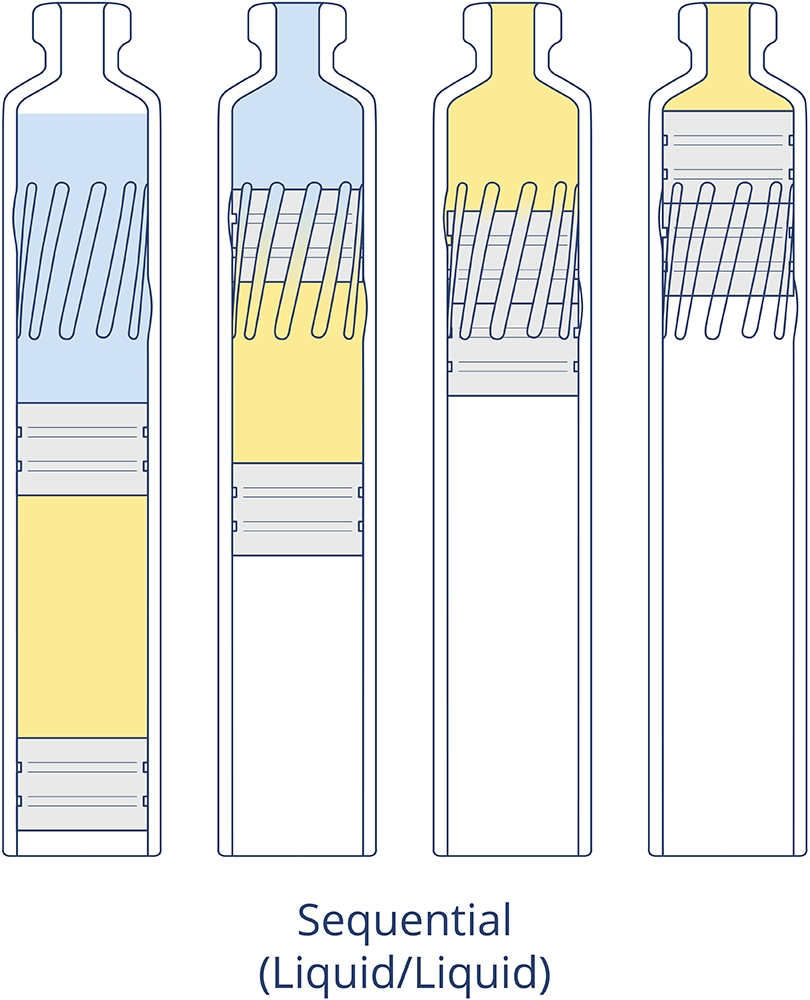
Figure 1: A dual-chamber cartridge employing an internal bypass and standard plunger stoppers.
These injection volumes can be tailored by adjusting the positions of the bypass and/or end plunger, providing additional flexibility to drug developers while maintaining the benefits of a well-known external form factor. If greater capacity is required, the concept could be scaled up using a dual-chamber EZ-fill 5 mL long cartridge in combination with Magnitude 5.0.
“BY BRINGING ESTABLISHED CARTRIDGE INTERNAL-BYPASS TECHNOLOGY INTO AN RTU FORMAT, STEVANATO GROUP ENABLES PHARMACEUTICAL COMPANIES TO BENEFIT FROM ITS PROVEN EZ-FILL PLATFORM WHILE REDUCING FILL-FINISH COMPLEXITY AND STREAMLINING TIME TO MARKET.”
Internal-bypass technology has been used in bulk cartridges for decades. Its availability in ready-to-use (RTU) containers enables this well-established technology to be filled using standard fill-finish processes on combi-lines. By bringing established cartridge internal-bypass technology into an RTU format, Stevanato Group enables pharmaceutical companies to benefit from its proven EZ-fill platform while reducing fill-finish complexity and streamlining time to market.
THE VALUE OF A STANDARDISED 3 mL INTERFACE
The standardised external dimensions of the ISO 3 mL cartridge provide a common interface between the cartridge and the autoinjector. The value of bringing the two platforms together is unlocked by this shared interface – the Magnitude 3.0 autoinjector can accommodate the EZ-fill cartridge without modification. These critical cartridge dimensions also support the use of standard elastomeric components and existing RTU cartridge filling and handling infrastructure, allowing manufacturing assessments to use established processing concepts.
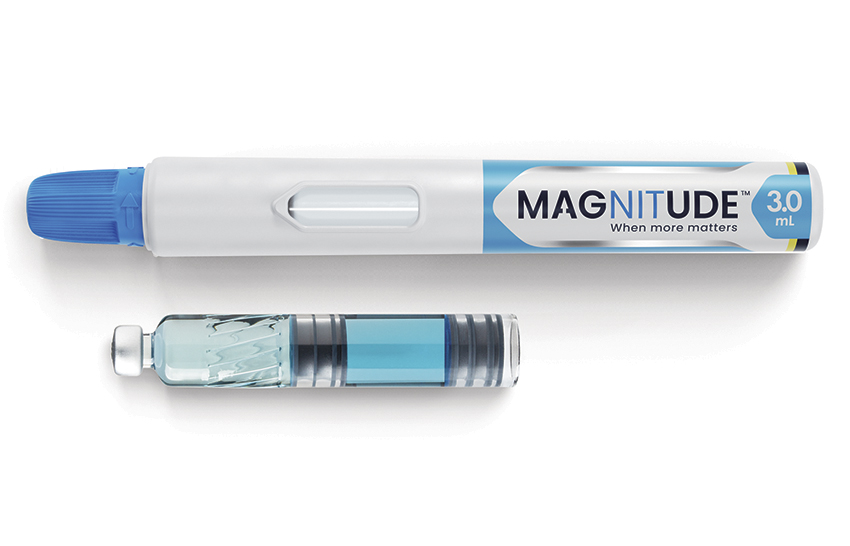
The resulting configuration provides a more standardised starting point for container-device integration, fill-finish and final assembly, while eliminating reliance on custom geometry across the delivery ecosystem (Figure 2).
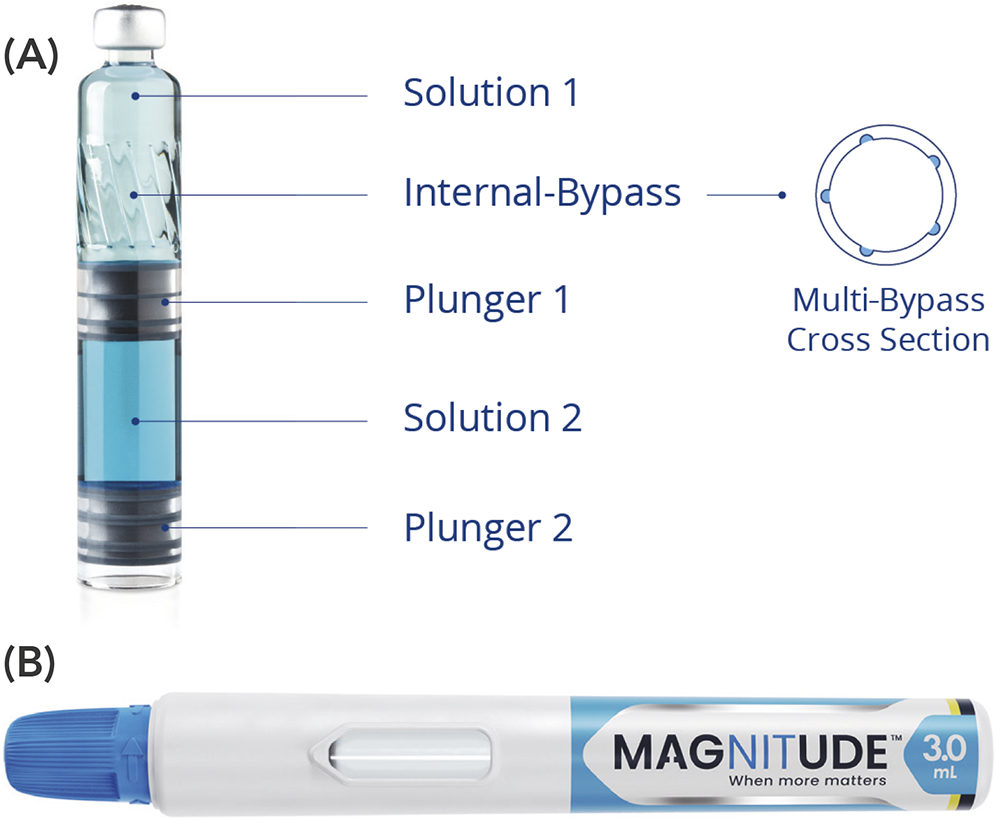
Figure 2: (A) The standardised ecosystem combining the EZ-fill 3 mL internal-bypass RTU cartridge with (B) the Magnitude 3.0 autoinjector.
DE-RISKING DEVELOPMENT THROUGH PRE-EVALUATED COMPATIBILITY
Before a drug-specific combination product enters formal verification, feasibility assessments can be implemented to reduce development risk by demonstrating that the integrated container-device system performs its critical functions as intended. For a dual-chamber system, this includes confirming that the drive system can overcome the break-loose forces generated by the two plungers and maintain controlled delivery as the first chamber empties and the second liquid traverses the bypass.
As shown in Figure 3, at the start of injection, the drive system overcomes the break-loose forces of both plungers. The plungers then move together as the first solution is delivered. When the first plunger reaches the internal bypass, its movement stops and the second solution passes through the bypass into the fluid path, driven by the rear plunger alone. Finally, once the rear plunger reaches the first, the remaining dose is co-administered as both plungers continue together towards the cartridge shoulder.
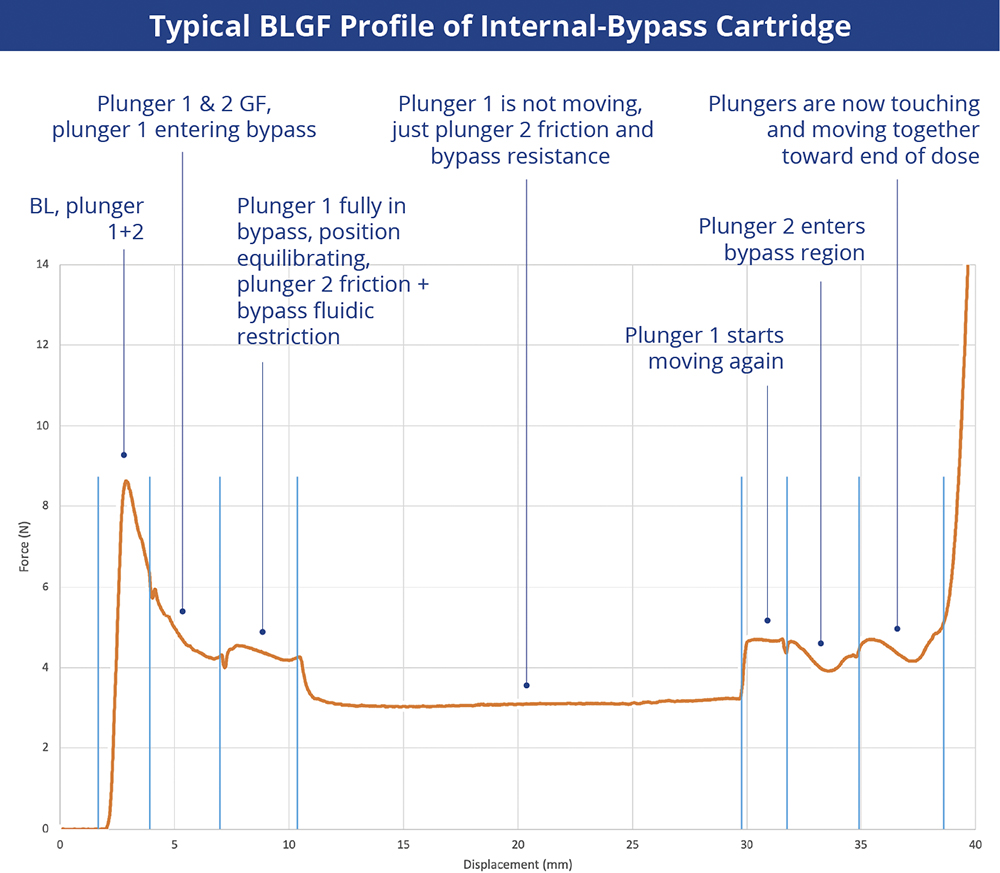
Figure 3: Force-displacement (break-loose and gliding force) profile illustrating the movement of both plungers during injection.
To assess the system’s compatibility, Stevanato Group and SHL Medical tested Magnitude 3.0 with the EZ-fill® internal-bypass cartridge under standard atmospheric conditions. The assessment included a 31-point dimensional compatibility evaluation and measurements of system characteristics such as injection time, delivered volume, activation force and needle extension.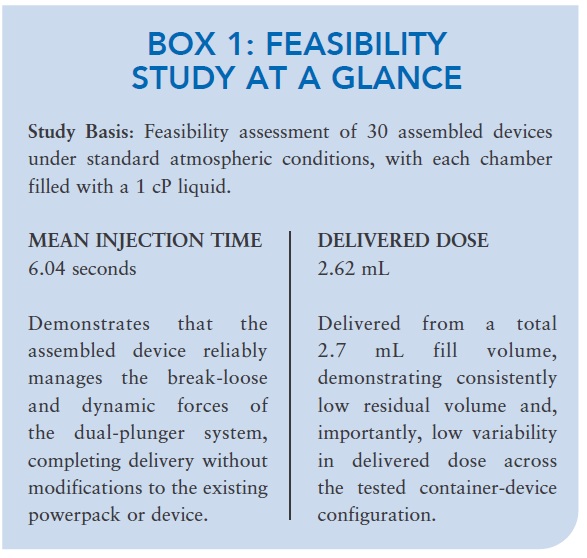
Injection time was assessed to confirm the powerpack’s ability to manage the dynamic force profile of the dual-plunger system reliably and to complete delivery through the bypass across the tested container-device assemblies. Delivered dose was evaluated to assess both the nominal achievable delivered volume and the consistency of dose delivery, pointing to any variability of residual volume across samples (Figure 4).
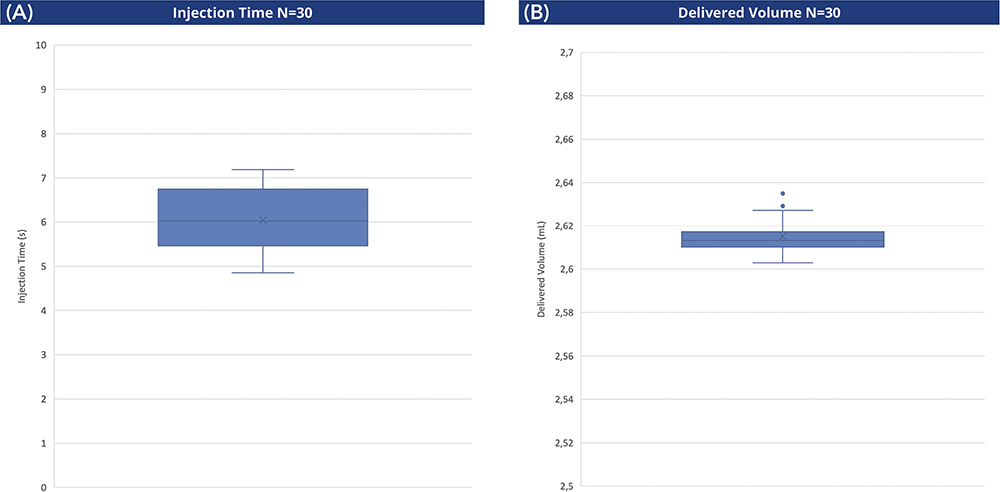
Figure 4: (A) Injection time and (B) delivered dose results for the tested container-device configuration.
The feasibility assessment revealed consistent injection time and delivered dose performance using 30 assembled devices filled with a 1 cP liquid in each chamber. Chamber One contained 1.3 mL and Chamber Two contained 1.4 mL, for a total fill volume of 2.7 mL.
The findings provided an initial feasibility baseline for the standardised container-device configuration before drug-specific development. The mean injection time of 6.04 seconds indicated that the system is capable of consistent, full-dose delivery while maintaining usability. The delivered dose results demonstrated highly repeatable performance, indicating consistent residual volumes across the tested samples.
BREAKING SILOS: A FULLY INTEGRATED ECOSYSTEM APPROACH
Successful drug delivery depends on aligning the primary container not only with the device but also the manufacturing process from the outset. Treating these as separate development challenges can allow interface requirements to emerge only after significant design decisions have already been made.
From the earliest stages of development, Stevanato Group and SHL Medical involved equipment manufacturers, elastomer suppliers and CMOs. Their input helped to assess how the dual-chamber format would move through fill-finish and final assembly under real manufacturing conditions.
The cartridge’s standard external format supported this integrated approach. Its ISO 3 mL cartridge dimensions and EZ-fill® presentation aligned with established RTU fill-finish combi-lines, allowing manufacturing to begin from familiar filling and handling concepts rather than a bespoke, bulk dual-chamber cartridge process.
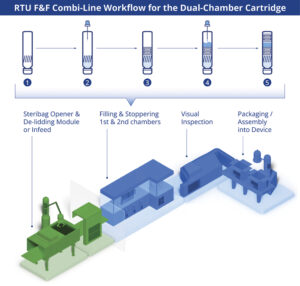
Figure 5: RTU fill-finish combi-line workflow for the dual-chamber cartridge. This shows the five filling stages followed by visual inspection and device assembly. (Implementation will still depend on the selected machine model. Some lines may require engineering adaptations for the second filling and plunger-insertion steps.)
The dual-chamber filling process follows five defined stages (Figure 5):
- Load the empty cartridge
- Fill the first chamber
- Insert the mid-plunger
- Fill the second chamber
- Insert the rear plunger.
After filling, the cartridge can proceed to visual inspection and device assembly. Its standard external dimensions support transfer between these stages because the handling systems do not require custom equipment installations. Lastly, final assembly of the cartridge into the Magnitude device leverages existing equipment which is also capable of final assembly of single-chamber ISO 3 mL cartridges with Magnitude.
ACCELERATING LIQUID-LIQUID FDC DEVELOPMENT
As demand for combination therapies grows, pharmaceutical companies need delivery systems that can maintain separation during storage without creating a bespoke development and manufacturing programme. Stevanato Group and SHL Medical are addressing this challenge by integrating two existing platform technologies into a combined configuration for liquid-liquid FDC delivery.
The standardised container-device configuration offers a practical route to self-administered liquid-liquid combination products using established RTU manufacturing concepts. Starting from a jointly assessed container-device configuration can simplify development, reduce integration risk and accelerate time to market by leveraging existing primary container, fill-finish, device and final assembly platforms.
“The standardised container-device configuration supports a more streamlined development pathway for liquid-liquid FDC self-administration.”
Each programme will still require formulation-specific testing with the intended drug product and final components. However, resolving key interface considerations earlier allows development teams to focus on therapy-specific optimisation rather than custom container and device integration.
By aligning primary-container design with device compatibility, fill-finish and assembly from the outset, the standardised container-device configuration supports a more streamlined development pathway for liquid-liquid FDC self-administration. For patients, this creates the potential for combination therapies that can be administered in a single injection through a familiar autoinjector, reducing the need for separate injections and supporting the shift towards home treatments.
REFERENCES
- Krieg D, Winter G, Svilenov HL, “It Is Never Too Late for a Cocktail: Development and Analytical Characterization of Fixed-Dose Antibody Combinations”. J Pharm Sci, 2022, Vol 111(8), pp 2149–2157.
- Mueller C, Altenburger U, Mohl S, “Challenges for the Pharmaceutical Technical Development of Protein Coformulations”. J Pharm Pharmacol, 2018, Vol 70(5), pp 666–674.