To Issue 191
Citation: Hieber D, “The Platform Adoption Gap: Why Device Selection is Only The Beginning of Combination Product Development”, ONdrugDelivery, Issue 191 (Oct 2026), pp 24–28.
Darren Hieber investigates the often overlooked gap between selecting an injection device platform for a drug development programme and having a finalised combination product ready for commercialisation, digging into the various activities required to bridge the gap.
As pharmaceutical pipelines have shifted over the past decades, naturally, so too have the systems that support them. Of particular importance to the drug delivery sector has been the rise of platform devices as a means of simplifying development pathways and accelerating time to market. The appeal of platform products speaks for itself – an autoinjector platform, for example, offers a proven technology with a pre-established supply chain and, in many cases, will also have many of the device-related elements of a regulatory submission ready to use.
Compared with developing a bespoke delivery device in-house, platform devices offer lower risk and shorter development timelines – two factors that can be major differentiators for drug developers aiming to be the first to market. These benefits have significant appeal across the full spectrum of pharma companies, but they are especially relevant to those that lack their own device expertise. For example, emerging biotech companies with novel, often challenging, biologic formulations can benefit enormously from buying in a proven platform pen injector, autoinjector or wearable device.
“THE PROLIFERATION OF PLATFORM PRODUCTS, WHILE A BOON TO THE INDUSTRY, HAS GIVEN RISE TO A COMMON MISCONCEPTION – THAT ‘PLATFORM’ EQUALS ‘PLUG-AND-PLAY’.”
However, the proliferation of platform products, while a boon to the industry, has given rise to a common misconception – that “platform” equals “plug-and-play”. In actual practice, while platform devices will accelerate and simplify the device development compared with designing a bespoke device from scratch, they do not obviate the need for development and device expertise entirely. A succinct way to describe this gap between misconception and reality is that while the device already exists, the combination product does not.
THE PLATFORM ADOPTION GAP
So, what does it take to turn a platform device into a market-ready combination product? Understanding how to bridge this gap and where responsibilities for the various aspects lie are critical to modern combination product development. While many device development companies and CDMOs can and do assist with turning a platform device into a marketed combination product, ultimate responsibility for design controls, risk management, verification, validation, regulatory submission and manufacturing readiness remains with the programme sponsor – it does not come packaged with the platform device.
In practice, what platform devices do for programme sponsors is change the process of device development, rather than eliminate it. Instead of extensive expertise necessary to design a drug delivery device from first principles, a platform device changes the process to one of demonstrating that a particular combination of drug, primary container, device architecture and user population all work together in concert to store and deliver the drug reliably and safely.
Ultimately, this process is guided by risk management. The initial hazard analysis and associated risk assessments define much of the development pathway, determining the evidence, testing and validation activities required for a specific combination product. This is a key reason why every platform device project remains unique, even when the underlying device is unchanged.
“ANOTHER ASPECT OF COMBINATION PRODUCT DEVELOPMENT THAT PROGRAMME SPONSORS TEND TO UNDERESTIMATE IS THE AMOUNT OF PREPARATION REQUIRED TO REACH THE CLINIC.”
This work is anything but trivial. While platform devices undoubtedly offer a faster and lower-risk development pathway, it is easy to underestimate the amount of work and expertise required to bridge the gap between platform and combination product – especially for organisations embarking on a device development journey for the first time, or where the requirement is for low- to medium-batch volumes. For teams without their own device experts, working with outside expertise, such as a CDMO, can make the difference between a troubled and arduous development and bridging the gap to successful product launch and commercial scale-up in a smooth, controlled manner.
COMPATIBILITY IS NOT ASSUMED: VERIFYING THE DRUG-DEVICE SYSTEM
When carrying out initial research for a platform device, suppliers will typically offer prospective customers a defined operating range and compatibilities for their products. However, selecting the right platform device is not as simple as comparing the specifications given for a platform device with the anticipated requirements for the drug. Pharmaceutical development is rarely so simple. Every combination product represents a unique interaction between:
- The drug product
- The primary container
- The delivery device
- The intended use environment.
Every one of these factors has the potential to affect the suitability of a given platform device for a given drug programme. Consider just the drug product itself: the unique formulation characteristics of a drug all impact the requirements for the device. A key example of this is the viscosity, where device developers are currently competing to offer platform devices capable of delivering ever-higher viscosities to cater to the demands of increasingly challenging biologic formulations. Understanding the approach each of these competitors is taking and how it relates to the needs of both the drug formulation and the intended use environment is fundamental to choosing the right platform for the programme.
Some of the verification work that is typically required for a platform device includes (Figure 1):
- Lab-based performance testing
- Dose accuracy
- Injection time
- Container closure integrity
- Stability and efficacy studies
- In-use assessments.
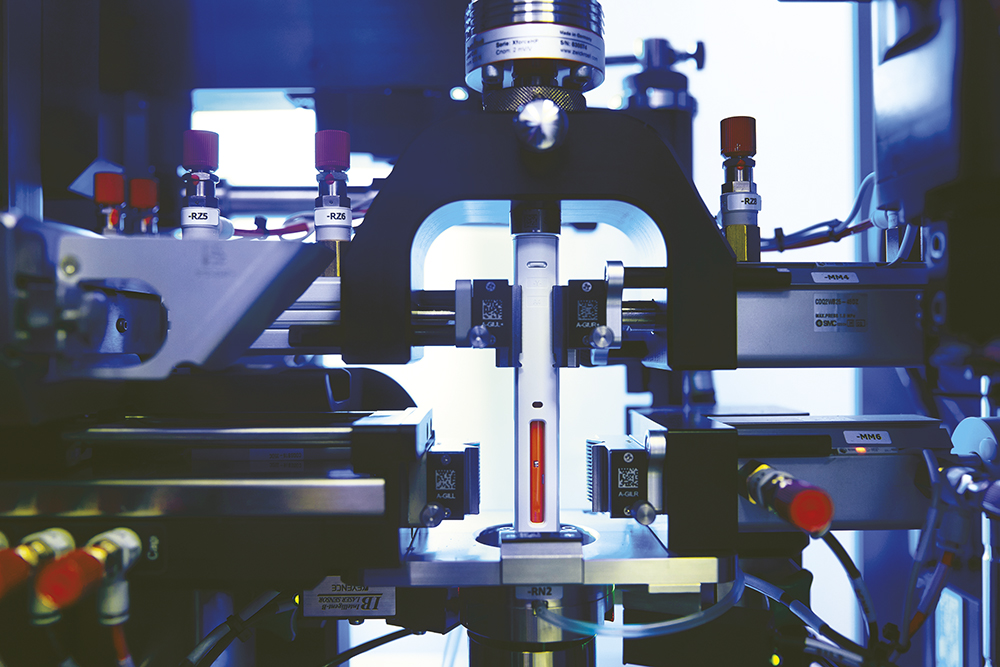
Figure 1: A platform autoinjector, undergoing functional testing on a ZwickRoell testing machine.
For a company expecting a platform device to be “plug and play” with their drug product, the amount of work required can be a rude awakening. Adopting a platform device does not obviate the need to demonstrate and validate the performance of the final drug-device combination product.
HUMAN FACTORS: PAST SUCCESS DOES NOT GUARANTEE FUTURE SUCCESS
Many platform device developers invest in applying human factors to develop and demonstrate this to some degree in their documentation to showcase that their devices are proven with patients. However, while it may be tempting to assume that the device developer’s human factors testing is universally transferrable to any combination product programme, this is not the case – usability depends heavily on factors that can vary significantly from programme to programme.
The most important factor here is the intended user population – a device that performs well for one patient demographic may prove unsuitable in the hands of another. Different patient populations will have variations in expected dexterity, strength, cognitive ability, disease burden and therapy use environments, all of which can have a major impact on device suitability.
Is the therapy intended for use by a healthcare professional in a clinical environment? Is it meant for chronic at-home use by primarily elderly patients? Is it an emergency-use therapy that will need to be delivered in high-stress situations by a lay-person? The intended user population and use environment will determine what is required of not only the device but its packaging, labelling and instructions for use.
As such, even with mature platform devices, it is important for programme sponsors to conduct their own human factors testing with a prospective device. The device developer’s testing will most likely have been with their own labelling and packaging, which can be noticeably different from the pharma company’s own – and have an equally noticeable effect on usability.
Platform devices, by their nature, are intentionally standardised, so limitations revealed by a sponsor’s own human factors testing can be difficult to modify. Therefore, it is important to be thorough at this stage, and for each development project to have its own usability engineering plan, to avoid unwelcome surprises further down the line. These activities should be integrated into the broader risk management process, ensuring that use-related risks identified throughout development are appropriately evaluated and mitigated.
THE HIDDEN WORK OF CLINICAL READINESS
Work does not stop with validation and human-factors readiness, however. Another aspect of combination product development that programme sponsors tend to underestimate is the amount of preparation required to reach the clinic. Before even clinical-scale manufacturing can begin, the following activities must be completed:
- Tooling procurement
- Tooling qualification
- Manufacturing documentation
- Process development
- Training
- Equipment configuration.
All of these activities require expertise separate to that needed to validate the combination product. For example, platform device-based combination products still typically require their own process settings and assembly parameters based on the specific interactions between the drug formulation, primary container and device.
Clinical supply is a key milestone for any drug development programme and should not be overlooked when planning ahead – it can be a critical mistake to assume that clinical supply will simply happen along the way to full commercial-scale manufacturing. The timespan between validating and selecting the right platform device for a drug is usually longer than programme sponsors expect, and those that properly account for it will find themselves with a significantly smoother and less stressful development journey.
MANUFACTURING: WHERE MINOR CHANGES CAN CREATE MAJOR CONSEQUENCES
Customisability is a fundamental feature of platform devices – not only must a device be adjusted to suit the needs of the drug it is intended to deliver, pharma sponsors will often want to ensure that the final combination product is suitably aesthetically differentiated from the rest of the market, with variations in colour, label design, window size and shape, product dimensions and more. Such differentiation is not merely a branding exercise; it can help pharmacists and patients tell different injectable products apart from one another.
However, this customisability can lead to finished combination products having unique production requirements – even seemingly minor changes to the platform device’s architecture can have implications for its assembly (Figure 2). Requirements arising from changes to the core platform device can include:
- Tooling updates
- Assembly machine parameter changes
- Software changes
- Force profile adjustments
- Additional validation activities.
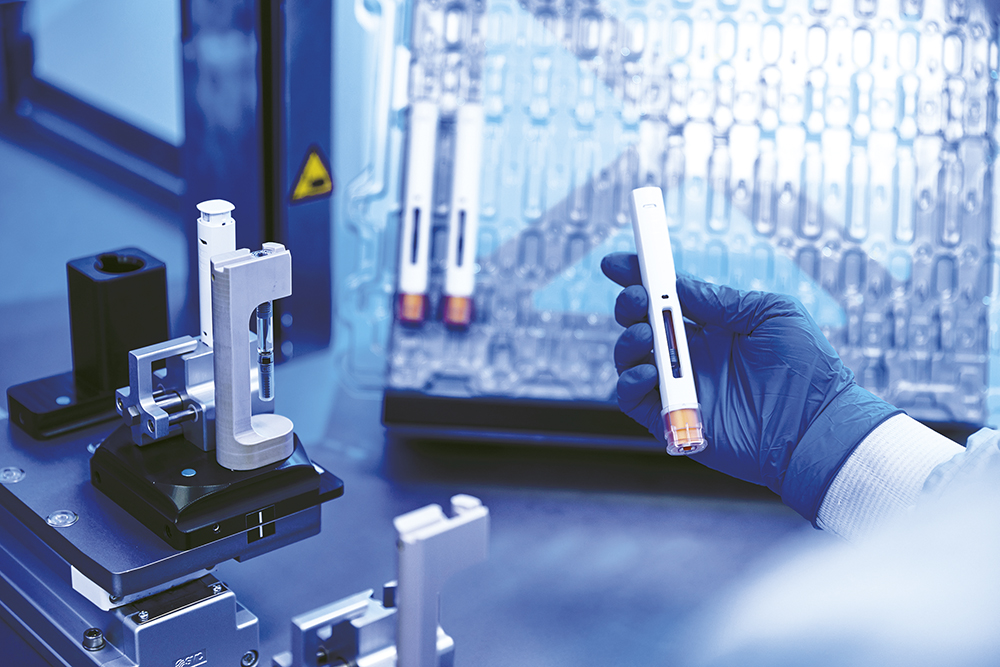
Figure 2: A platform autoinjector, following semi-automatic assembly on a Mikron (Neuchâtel, Switzerland) MAIA assembly machine.
The process is all interconnected – a decision made for usability or aesthetic reasons can lead to challenges arising during manufacturing; a packaging requirement can have knock-on effects for automation; a change to the device can affect the equipment needed for labelling. Much like validation, adopting a platform device does not make the engineering work required to turn that device into a combination product disappear. Instead, platforms move the effort away from device design towards implementation and integration of the platform device with the drug programme, and successful programmes will take this into account at an early stage and make appropriate preparations, rather than treat them as late-stage activities.
PACKAGING AND LABELLING: OFTEN OVERLOOKED, FREQUENTLY CRITICAL
Packaging and labelling are an indispensable aspect of a combination product yet are often treated as an afterthought to the device and the drug itself. It is a mistake to treat packaging and labelling as a final box to tick prior to commercialisation – they should be considered as a major aspect of combination product development and given appropriate time and care (Figure 3). Packaging and labelling can be broken down into two broad workstreams: functional and commercial/regulatory.
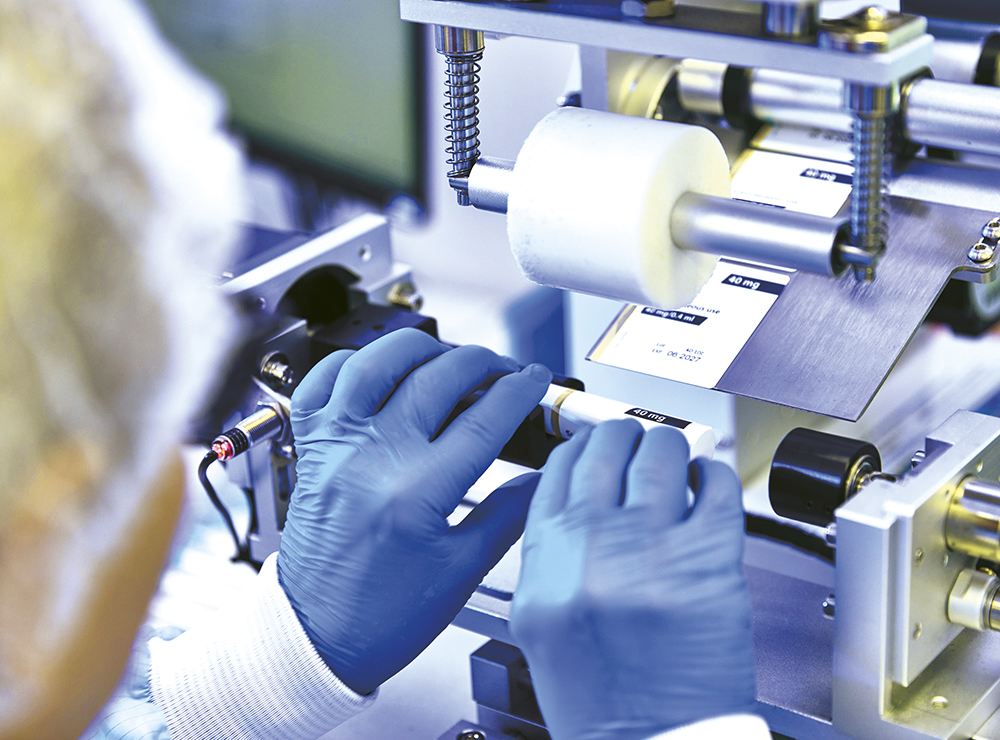
Figure 3: A platform autoinjector, being labelled on a semi-automatic labelling machine.
When talking about the functional side of packaging and labelling, the focus should be on how these aspects of the combination product affect its practical use and storage. Does the labelling influence how a user interfaces with the device? How does the label placement relate to the device’s viewing window? Does the secondary packaging ensure that the device is held securely during transport and storage? These are only a few of the considerations that will need to be made to ensure that the packaging is functional – all of which require careful engineering and validation.
On the other hand, the commercial and regulatory side of packaging and labelling considers aspects such as multilingual labelling, country-specific artwork, change controls, translation management and stock-keeping unit (SKU) management. Different regulatory authorities will each have their own requirements and expectations for what is included in a device’s labelling and packaging, and manufacturers must ensure that the correct SKUs are sent to the correct market. Some authorities and markets will also have expectations regarding sustainability, such as recyclability of packaging and material-use reduction.
Regulatory strategy should remain an active workstream throughout development, with ongoing engagement with relevant health authorities helping to align expectations, address emerging questions and reduce programme risk before critical milestones are reached.
Packaging and labelling are about much more than the aesthetic presentation of a combination product. They influence the usability, manufacturability and integrity of the final product, and are subject to regulatory requirements and scrutiny. Understanding what is required of packaging and labelling, how that varies across regulatory authorities and how they interact with the platform device itself are all crucial for success.
CLOSING THE PLATFORM GAP
Drug delivery device development is an extraordinarily challenging process. Platform devices have gone a long way to mitigating the effort and risk required to pair a drug candidate with a suitable delivery device, making them one of the most effective routes to market for injectable therapies – especially for smaller pharma and biotech companies without their own in-house device expertise – but have not obviated that effort and risk entirely. For an injectable drug development programme to reach the market successfully, the gap between platform device and combination product must be closed. Achieving this requires a thorough understanding of the development activities that platform devices still require. As discussed, these activities include:
- Compatibility and verification
- Human factors studies
- Clinical readiness
- Manufacturing implementation
- Packaging and labelling
- Regulatory strategy and planning.
These activities are all interconnected, with decisions made in one area frequently creating requirements in another. The key to successfully navigating this complexity is a cross-functional team executing a well-controlled, phase-gated design process underpinned by risk management and robust design controls. When supported by the appropriate expertise and an ISO 13485-compliant development framework, platform adoption becomes a far more predictable and controlled pathway to market. This is where Ensera can help, combining expertise across device development, human factors, regulatory, manufacturing and packaging disciplines within a single integrated development model.
Ensera is a full-service partner that can help pharma companies smoothly navigate the turbulent waters of product and process development and minimise the risk of costly mistakes and delays. From the initial stages of platform selection through to commercial readiness, Ensera can supply the expertise to ensure that development programmes proceed according to plan and are not defined by unwelcome surprises (Box 1).
BOX 1: ENSERA’S CAPABILITIES
Ensera helps pharmaceutical companies accelerate injectable combination product programmes by bringing device development, human factors, manufacturing and packaging expertise together within a single global organisation. The company’s capabilities include:
Design and product development support for platform and proprietary drug delivery devices
- Human factors engineering, usability studies and risk-based development
- Combination product verification, validation and regulatory support
- Final assembly of injectable combination products for clinical and commercial supply
- Secondary packaging, labelling, kitting and market-specific packaging solutions
- Integrated development-to-manufacturing programmes that reduce technology transfer risk
- Specialist support for low- to medium-volume products, including orphan and rare disease therapies
- Global manufacturing footprint across North America, Europe and Asia
- Dedicated project teams focused on responsiveness, collaboration and customer service.
Furthermore, Ensera has established alliances and approved assembly partner status with many of the leading platform device developers, including SHL Medical, Ypsomed and Stevanato Group, in addition to fill-finish partners such as Argonaut (Carlsbad, CA, US) and American Injectables (Brooksville, FL, US). By pairing together strong relationships across the industry and a wealth of device development expertise, Ensera is ideally positioned to help its pharma partners successfully bridge the gap from platform device to approved and marketed combination product at speed.