To Issue 192
Citation: Grace S, Fong A, “Bioplastics in Drug Delivery: Sustainable Solution or Substitution Trap?”, ONdrugDelivery, Issue 192 (Oct/Nov 2026), pp 44–47.
Serena Grace and Alex Fong examine the environmental and supply-chain limits of bio-based plastics in drug delivery, arguing that material substitution alone cannot address the sector’s deep dependence on virgin plastics. They consider how reducing raw material dependence can contribute not only to lowering carbon footprints but also to increasing supply-chain resilience, and highlight the importance of assessing, not assuming, impact.
A PROMISING ALTERNATIVE
As the pharmaceutical industry increases its focus on the environmental impact of drug delivery devices, bio-based plastics have emerged as one of the most visible responses to the sector’s well-documented dependence on fossil-derived raw materials. Replacing fossil-based polymers with materials made from renewable biological feedstocks offers an attractive proposition: reduced reliance on finite resources and, potentially, lower greenhouse gas emissions.
It is also a relatively straightforward intervention to communicate both internally and externally and, in some cases, to implement. “Drop-in” bioplastics can retain the same chemical structure as their fossil-based counterparts, allowing established manufacturing processes and recognised device architectures to be maintained.1
Some bioplastics are already used in the medical device industry, to differing degrees. Polylactic acid (PLA) is a bioabsorbable polymer commonly used in orthopaedic implants, providing comparable fixation to traditional implants while eliminating complications associated with retaining non-biodegradable materials.2 Polyhydroxyalkanoates (PHAs) are also used in medical implants, with further applications, such as wound dressings, currently being explored.3 Cellulose, the most abundant natural biopolymer on Earth, has garnered particular interest due to its biodegradable, biocompatible, non-cytotoxic and non-genotoxic properties, making it a leading candidate for a range of medical and pharmaceutical applications.4 The range of potential biomaterials will continue to expand as research unveils new biological feedstocks and manufacturing routes.
“BIOPLASTICS ARE CLEARLY A PROMISING ALTERNATIVE TO FOSSIL-DERIVED POLYMERS, BUT MANUFACTURERS CANNOT AUTOMATICALLY CONSIDER THEM THE MOST MEANINGFUL – OR WORSE, THE ONLY – SUSTAINABILITY INTERVENTION.”
For drug delivery, however, material substitution is rarely straightforward. Devices must deliver a therapy accurately and reliably over time, while maintaining mechanical performance, dimensional stability, drug compatibility, usability, shelf life and patient safety over long commercial lifecycles. Any material change must therefore satisfy demanding engineering and quality requirements as well as the regulatory expectations of a highly controlled industry. Bioplastics are clearly a promising alternative to fossil- derived polymers, but manufacturers cannot automatically consider them the most meaningful – or worse, the only – sustainability intervention.
THE LIMITS OF FEEDSTOCK SUBSTITUTION
Overestimated Impact
The fundamental point is simple – “bio-based” describes what a polymer is made from, not the overall environmental impact of the material. Replacing fossil-derived feedstocks with biological sources may reduce dependence on petroleum, but this is only one element of the wider sustainability question. Depending on the feedstock and the production pathway, bioplastics may not have as low an environmental impact as is often assumed. Land use, water consumption and impact on biodiversity must all be taken into account to avoid overestimating the total product-level benefit. There are also concerns that crop-derived feedstocks may compete with food and fuel production for limited resources, including land and water.5
This is driving interest in second-generation feedstocks, which use non-food biomass and waste-derived streams such as agricultural residues and industrial biowaste. These could reduce some of the pressures associated with dedicated agricultural production, while creating value from materials that might otherwise be discarded. However, second-generation materials must be submitted to the same scrutiny as any other material, and they may not solve the wider problem if their use creates a new point of dependency and competition with other sectors.
Scalability
European Bioplastics (Berlin, Germany) estimates that the global bioplastics production capacity will roughly double to approximately 4.69 million tonnes by 2030.5 Yet this remains a fraction of the total plastics demand, raising practical questions about the reliability of long-term supply, particularly if multiple sectors turn to bioplastics as their preferred route for decarbonisation. Smaller production volumes can also contribute to higher material costs when compared with established fossil-based polymers, although increasing production capacity, technological development and incentives could narrow the gap over time.6
For drug delivery device manufacturers, this is particularly relevant, given the long commercial lifecycles of many products. Devices can remain on the market for many years, making consistent material availability, quality and validated supply important considerations. Introducing a material that is readily available today but dependent on a relatively immature supply chain could create a different form of vulnerability.
Waste Management
Bioplastics is a broad term that can be applied to polymers that are bio-based, biodegradable or both. Indeed, approximately half of current bioplastics are not biodegradable,7 and even those that are biodegradable or compostable can pose end-of-life issues, including microplastic formation and the need for specific industrial conditions that are not available through conventional waste management systems.
As RecycleLab (Chipping Norton, UK) founder, Danielle Stephens, explains, “What we see is that the material itself rarely makes the difference. It comes down to how the item is disposed of. Whether a part is bio-based or fossil-based, if it goes in the clinical waste bin, it ends up in the same place, and any saving which was intended to be made will be neutralised. If we want to realise the benefit that we set out to get, we must change where the plastic goes at the end, not just what it’s made of.” RecycleLab specialises in recycling laboratory consumables made of single-use plastics.
To fully realise the potential environmental impact of bioplastics, existing recycling strategies and waste management systems must be reconsidered to ensure that the intended end-of-life benefit is not lost to incineration or landfill.8 The implication here is not that bio-based plastics have no value. It is that changing the feedstock does not, by itself, guarantee the most sustainable or resilient route forwards.
“FOCUSING ON THIS ‘QUICK AND EASY’ INTERVENTION RISKS OBSCURING THE DEEPER ISSUE: DEPENDENCE ON VIRGIN PLASTIC.”
BEYOND THE SWAP
Given the highly regulated nature of the medical device industry, a drop-in material can appear significantly less disruptive than changing the architecture or lifecycle of a device. However, focusing on this “quick and easy” intervention risks obscuring the deeper issue: dependence on virgin plastic. Whether the feedstock is fossil-based or biological, a device manufactured from virgin polymers leaves the manufacturer exposed – this exposure is both environmental, as producing a new polymer requires resources and energy, and commercial, as the manufacturer remains dependent on the availability, quality and price of a newly produced polymer.
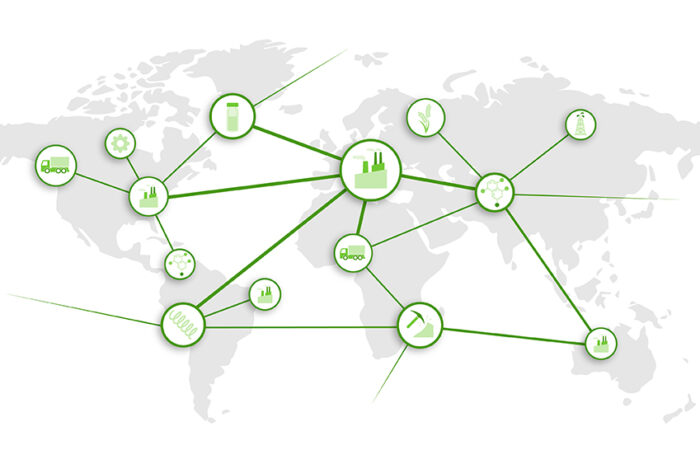
Polymer supply chains are complex and international, regardless of feedstock. The OECD (Paris, France) notes that international trade plays a significant role at multiple stages of the plastics value chain,9 creating exposure to fluctuations in raw material availability and energy costs. Trade restrictions, geopolitical tensions and competing demands from other sectors can also increase vulnerability. Recent supply chain disruptions have demonstrated how quickly these factors can affect the availability and price of industrial materials.10–12
For drug delivery, the consequences can be particularly significant. Devices are often designed and validated around specific polymers, grades and processing characteristics, and may remain commercially available for many years. As a result, a material cannot simply be substituted whenever market conditions change – changes to material type, formulation, processing or source may require additional assessment and validation to prove that the device continues to meet its safety and performance requirements, adding both cost and complexity.
Reducing the quantity of virgin material required in the first place therefore offers a different kind of resilience; rather than simply seeking alternative sources of virgin polymer when supply becomes constrained, manufacturers can reduce their exposure altogether. This changes the question from “Can we swap this material?” to “How can this device be as sustainable and resilient as possible across its lifecycle?”.
DESIGNING FOR CIRCULARITY
Systems that require fewer materials and remain in use longer offer a more structural approach to reducing resource dependence. Material efficiency should be an early design consideration, examining how to reduce parts, lighten components and simplify architectures without compromising performance, usability or safety. Other possibilities include modular or platform-based systems, appropriate reuse, reprocessing and remanufacturing, and designing elements for disassembly and recovery.
While sterility, contamination risk, product stability and patient safety are legitimate concerns with regard to reuse and reprocessing, they should not prevent consideration of circularity during development. Designing for material efficiency or future recovery does not necessarily mean creating a reusable product if this is not appropriate. It can simply mean avoiding unnecessary complexity, reducing material demand or making valuable materials easier to recover at end of life.
The potential benefits are not only environmental. By using fewer virgin materials, manufacturers can reduce their exposure to volatile supply chains, constrained feedstocks, rising material costs and future regulatory or procurement pressures. More efficient use of resources can therefore contribute to resilience as well as sustainability.
“THE IMPACT MAY BE FAR GREATER IF MATERIAL SUBSTITUTION IS REFRAMED AS ONE POTENTIAL
INTERVENTION WITHIN A BROADER STRATEGY, RATHER THAN THE SOLE STRATEGY ITSELF.”
Circularity does not render bio-based plastics irrelevant. Where virgin materials remain necessary, a lower impact feedstock can still be valuable. However, the impact may be far greater if material substitution is reframed as one potential intervention within a broader strategy, rather than the sole strategy itself.
ASSESSING NOT ASSUMING
The challenge for device developers is therefore not simply to identify a material with a better sustainability profile; it is to determine which interventions can truly and measurably deliver the greatest benefits. As sustainability claims are now coming under the same scrutiny as safety and performance claims, this must be demonstrated, not presumed.
Lifecycle assessments (LCAs) provide a framework to compare the environmental performance of different material and design choices across a product or portfolio’s lifecycle, looking not only at fossil-based emissions but also land use, land use changes, water use, resource depletion and other environmental indicators.
This is particularly important for bio-based materials, as a reduction in one impact can result in an increase elsewhere, an effect known as “burden shifting”. For example, a material may reduce fossil resource consumption or greenhouse gas emissions while creating greater land use impacts. Conversely, a material with a different feedstock may enable lighter components, generating a number of benefits across the product lifecycle, including reduced transport weight, which would be missed if the polymer was considered in isolation.
For instance, a validated, independently reviewed ISO LCA commissioned by Owen Mumford showed that swapping certain fossil-based components of a new reusable autoinjector for PLA-based parts offered only a marginal reduction in the overall product environmental footprint. This highlights the importance of using a consistent and transparent methodology when comparing potential interventions.
For drug delivery, the value of an LCA is not just in establishing whether a bio-based plastic is “better” than a conventional one. It provides a common basis for assessing material substitution, material reduction, modular design, reuse, reprocessing and recovery against the same objective: delivering the required clinical function with the lowest overall environmental burden, while maintaining technical and regulatory feasibility and supply-chain resilience. This also helps to prevent burden shifting, by allowing developers to identify impacts elsewhere in the product lifecycle.
CONCLUSION
Bioplastics have a legitimate role to play in making drug delivery devices more sustainable. In appropriate applications, particularly where drop-in materials can reduce environmental impact without compromising device performance or regulatory requirements, they offer a simple and credible route to improvement.
“RETHINKING DEVICE DESIGN CAN SUPPORT BOTH ENVIRONMENTAL GOALS AND SUPPLY-CHAIN RESILIENCE BY REDUCING THE QUANTITY OF NEW MATERIAL THAT THE SECTOR NEEDS TO SOURCE, MANUFACTURE
However, material substitution should not obscure the greater opportunity to reduce the amount of virgin material a device requires throughout its lifecycle. Rethinking device design can support both environmental goals and supply-chain resilience by reducing the quantity of new material that the sector needs to source, manufacture and ultimately dispose of. This is why the industry should move beyond asking whether a plastic is bio-based and instead ask whether a device is more sustainable and resilient as a result of its use.
Embecta is a trademark of Embecta Corp. Owen Mumford and the Owen Mumford logo are trademarks of Owen Mumford Limited. All other trademarks are the property of their respective owners. All rights reserved.
REFERENCES
- Jothiprakash G et al, “Toward net-zero plastics: Synthesis, applications, and global trends of bioplastics”. J Environ Chem Eng, 2026, Vol 14(3), art 123097.
- Jee E et al, “Polylactic acid bioabsorbable implants of the hand: A review”. J Hand Microsurg, 2024, Vol 16(3), art 100053.
- Moshkbid E et al, “Biodegradable Alternatives to Plastic in Medical Equipment: Current State, Challenges, and the Future”. J Compos Sci, 2024, Vol 8(9), art 342.
- Chandel N et al, “The versatile world of cellulose-based materials in healthcare: From production to applications”. Ind Crops Prod, 2023, Vol 201, art 116929.
- Rosenboom JG, Langer R, Traverso G, “Bioplastics for a circular economy”. Nat Rev Mat, 2022, Vol 7, pp 117–137.
- “Global bio-based plastics production capacity”. Web Page, European Environment Agency, accessed Sep 2026.
- Rahman MH, Bhoi PR, “An overview of non-biodegradable bioplastics”. J Clean Prod, 2021, Vol 294, art 126218.
- ten Boer N et al, “Biodegradable bioplastics in healthcare: opportunities, challenges and sustainable recycling”. RSC Sustainability, 2026, Vol 4(2), pp 628–649.
- Moïsé E, Tresa E, “Trade policies to promote the circular economy: A case study of the plastics value chain”. OECD Trade Policy Papers, 2023, No 279.
- “Fuel Rationing, No AC, 4-Day Work Week: How Countries Are Dealing With The Iran War Oil Crisis”. Web Page, Forbes, Mar 2026.
- “OECD Supply Chain Resilience Review”. Web Page, OECD, Jun 2025.
- Qazi A, “Systemically important supply chains in crisis: Mapping disruptions and global ripple effects”. Nat Hazards Res, 2026, Vol 6(2), pp 373–384.
Previous article
FOR THE RECORD: HOW PAST EXPERIENCE ENABLES FUTURE SUCCESSNext article
Company Showcase: Grand River Aseptic Manufacturing