To Issue 192
Citation: Garoufas A, Armenio L, “Why the Greenest Polymers Never Reached Scale”, ONdrugDelivery, Issue 192 (Oct/Nov 2026), pp 54–57.
Athanasios Garoufas and Laura Armenio discuss how the sustainability profile of a material is baked-in at its production, examining how traditional methods for producing polymers fail to unify both environmentally favourable feedstock and industrial-scale production capacity, and consider the advantages that next-generation methods that bring these two key aspects together could bring to not only drug delivery but the wider industry.
Sustainability in drug delivery is usually discussed at the end of product development, when considering aspects such as packaging, the device and its disposal. The decisions that guide production, however, are made much earlier. The contribution to the carbon footprint from material selection is fixed by the way the material is manufactured. In a fibre-based product, the polymers that can be used are largely decided by the process used to turn them into a fibre.
“THESE ARE MANUFACTURING QUESTIONS, AND THEY SET THE CEILING ON EVERYTHING A SUSTAINABILITY CLAIM CAN HONESTLY SAY AFTERWARDS.”
WHAT IS A SUSTAINABLE POLYMER?
From a pragmatic point of view, it can be argued that the question is not about whether a given polymer is bio-based or biodegradable – many polymers are one or both. The real question is whether or not a polymer can be turned into a fibre at all, and whether it can be done at a scale needed for a commercial product. These are manufacturing questions, and they set the ceiling on everything that can be honestly said in a sustainability claim afterwards.
It is worth being precise about what such a claim even means, because the industry is full of single-attribute statements that do not survive a lifecycle-scale view. “Bio-based” describes where the feedstock came from. “Biodegradable” describes what happens to the polymer at its end of life. Neither aspect on its own provides information about the carbon footprint per functional unit across the product’s lifecycle, and neither is the same as being sustainable.
A bio-based polymer spun from an aggressive solvent, or a biodegradable one that only breaks down under industrial composting the product will never see, are no better than the incumbent polymers they might replace. The useful frame is not a label – it is the full accounting of feedstock, solvent and process; energy per unit of usable material; how much material and API are actually needed; and what happens at end of life. It makes sense to start with the manufacturing process, because this introduces a real constraint.
“THE POLYMERS WITH THE BEST SUSTAINABILITY PROFILES, THE ONES DERIVED FROM BIOLOGICAL SOURCES, ARE EXACTLY THE ONES THAT ARE UNSUITABLE FOR MELT-BASED PROCESSES.”
CURRENT MANUFACTURING PROCESSES
Broadly speaking, there are currently two primary ways to turn a polymer into fibre at industrial scale. Melt-based processing includes melt-blowing, a process already operated at very high throughputs for nonwovens, up to 150 kg per hour per metre of line width.1 Melt-blowing is efficient and uses no solvent at all, which is a real advantage. At the same time, however, this can only be a process for polymers that have a stable melt phase, which, in practice, means mostly petroleum-derived thermoplastics. The polymers with the best sustainability profiles, the ones derived from biological sources, are exactly the ones that are unsuitable for melt-based processes.
The reason why melt-based processing cannot be used with biologically derived polymers is a mechanistic one – or, more precisely, a thermal one. Proteins such as collagen, gelatin and silk, as well as polysaccharides such as chitosan, pullulan, carboxymethyl cellulose and alginate, simply do not have a true melt phase. They denature, degrade or char long before they get there. You cannot melt-blow gelatin, and so the scalable melt route is closed off for the whole class of natural polymers.
One thing to be mindful of, of course, is that biodegradability and biological origin are not the same property. There are synthetic biodegradable polyesters, polylactic acid (PLA) and polycaprolactone (PCL) among them, that melt and are melt-processed all the time, but they are chemically synthesised rather than extracted from a biological source, and, of the two, only PLA is even bio-based, with PCL being derived from petroleum. So the polymers that cannot be melted are the ones that genuinely come from biological sources, which happen to be the same ones with the strongest feedstock and end-of-life sustainability profiles.
What remains practical at scale for these polymers is solution spinning, in which the manufacturer dissolves the polymer, forms the fibre and then removes the solvent. There are other non-melt routes – protein self-assembly and bacterial biosynthesis among them – but they are niche or hard to scale into an engineered membrane. Solution spinning is entirely capable of handling natural polymers, and can do so using benign solvents. Gelatin, for one, can be spun from water alone, and newer solution-spinning methods can be particularly well suited to aqueous systems of this kind. And this is the critical point – the primary flaw of solution spinning in sustainability terms is the solvent, and that flaw is at its weakest right where the bio-based benefit is at its strongest.
Among the solution-spinning methods available, the most established one – electrospinning – has been around for the best part of a century, and it does not really scale. A single spinneret produces polymer at a rate of 0.01–0.1 grams per hour and, although multi-needle and needleless configurations can do better than that, throughput has remained the recognised bottleneck for industrial use.2,3 Even a purpose-built high-throughput laboratory system tops out at a few grams per hour.4
“ELECTROSPINNING PROVED DECADES AGO THAT BIO-BASED NANOFIBRE CAN BE MADE. WHAT IT NEVER PROVED IS THAT THESE MATERIALS CAN BE MADE AT THE VOLUME AND COST THAT A COMMODITY PRODUCT NEEDS.”
Electrospinning proved decades ago that bio-based nanofibre can be made. What it never proved is that these materials can be made at the volume and cost that a commodity product needs. So, until recently, the situation was a choice between two incomplete options – melt-based methods that scale but exclude the sustainable polymers, whereas conventional solution-spinning methods include those polymers but do not scale. Neither delivered both, and that, more than any question of chemistry, is why bio-based nanofibre mainly stayed in the laboratory.
NEXT-GENERATION SOLUTION SPINNING: SOLVING SCALE
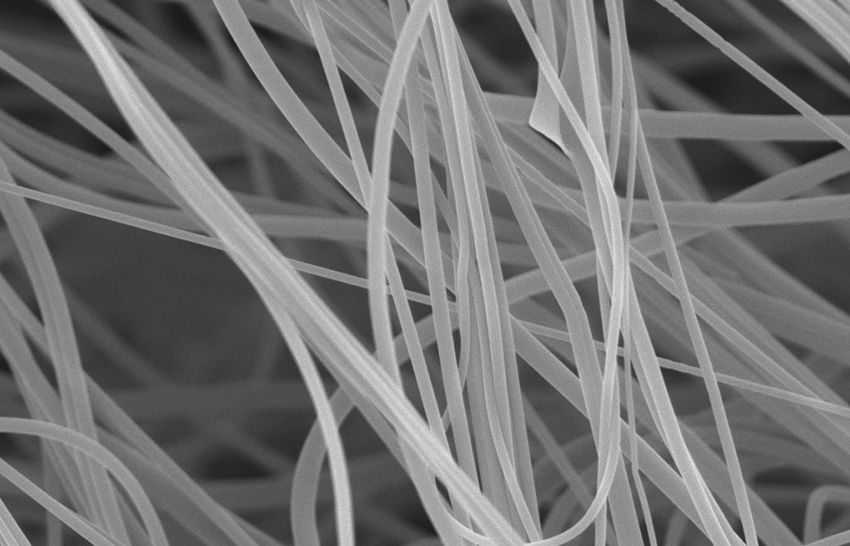
This status quo is changing. Modern methods using advanced solution-spinning techniques are able to keep what makes a solution-based route appealing in the first place – access to the natural polymers and to the benign solvents that melt methods cannot touch, while working comfortably at production throughputs of kilograms per hour, territory that, like for like, conventional electrospinning struggles to enter. The difference is not only one of scale, though. Modern solution spinning can create finer fibres and more open, interconnected mats, rather than the dense layer produced by electrospinning. Put the two together – the scale and the morphology – and a bio-based nanofibre becomes something that pharmaceutical companies can actually build a product around.
Strictly speaking, this is not an all-green process, and it should not be presented as one. Some medical formats use polyesters that still need organic solvents, and the solvent chemistry is largely shared among solution methods, so there is no solvent advantage to claim over electrospinning as such in these cases. The differentiation is narrower than that, and more honest for it. In essence, it comes down to access to the sustainable polymers that cannot be produced using melt-based methods, combined with a scale that conventional solution methods cannot reach.
Scale also changes the energy picture because, in fibre production, energy consumption is dominated by throughput; energy per kilogram of usable material falls as output rises. In lifecycle accounting, this is one of the larger levers for improving sustainability, although it only moves once the process itself can run efficiently at volume.
There is a second consequence of solving the scale problem, and it reaches well beyond drug delivery. The same polymer family can be produced at different grades – technical, cosmetic, food, pharmaceutical – and it is the grade, not the platform, that decides which sector the material can serve. So, once a bio-based nanofibre can be made at scale, one process can address applications sitting in completely different regulatory worlds, at which point the sustainability argument ceases to be about a single product – it becomes about reach.
THE BIGGER PICTURE
In drug delivery itself, biopolymers and protein nanofibre are already well-studied and comparatively sustainable materials.5 A nanofibre membrane does its job with a very low mass of material, and release can be tuned through polymer choice and layering, which increases the amount of API actually used, rather than lost as overage, and since the API is the largest single contributor to both cost and carbon footprint, that efficiency matters. Sustained local release from drug-eluting mats produced using next-generation solution-spinning methods has been tracked in vivo and modelled6 – not just inferred from a dissolution bath – which is the level of evidence to which such a claim should be held.
The larger sustainability prize, though, may well be in the commodity sectors, where scale has always been the barrier. Take hygiene as an example. The superabsorbent material in a modern nappy is sodium polyacrylate – a petroleum-derived, non-biodegradable material used in very large volumes. Bio-based absorbents based on cellulose, nanocellulose and carboxymethyl cellulose are currently being investigated,7–9 and a nanofibrous form is attractive for two distinct reasons. The high surface-to-volume ratio provides strong absorbency, and the fibre network distributes and wicks liquid better than a bed of particles, which is a significant functional gain in the acquisition and distribution layer, as well as offering improved sustainability.
What has been missing is not the chemistry but the ability to make bio-based nanofibre at hygiene-industry volumes, and the arithmetic there is simple. At that scale, even a partial substitution, a few percent, is a large absolute reduction in fossil-derived, non-degradable materials. Therefore, the realistic target is not to replace the incumbent outright – it is to make partial replacement viable at scale, which conventional methods could not do.
Filtration follows the same logic. Nanofibre-based media give high filtration efficiency at low pressure drop,10 which also means less energy is required to push air or fluid through the filter, and a biopolymer version would be biodegradable where petroleum-based polymers are not. This is another commodity sector, and another one gated by scale rather than by the science.
Food technology is the less obvious one, and it connects to the same platform directly. Edible nanofibre scaffolds are being developed for cultivated meat, where the scaffold has to be edible and animal-free and, for anything resembling a whole cut, has to guide cell differentiation and texture rather than just support proliferation. Nanofibre and related scaffolds mimic the extracellular matrix and can support that differentiation, with fibre diameter and porosity tunable to the same end.11,12
“WHAT HAS BEEN MISSING UNTIL NOW WAS THE ABILITY TO PRODUCE SUSTAINABLE POLYMERS AT AN INDUSTRIAL SCALE.”
CONCLUSION
In all cases, the key point is that the sustainability of a fibre-based material is set upstream by which polymers can be used and at what scale. What has been missing until now was the ability to produce sustainable polymers at an industrial scale. In drug delivery, this manifests as a more material-efficient format, in hygiene and filtration as a bio-based substitution that finally has a route to volume, and in food technology as an edible scaffold that can be made at more than laboratory quantity. Different sectors, but the same underlying principle.
It should be highlighted that there are still limits. A solution route still uses solvent, resorbable is not the same as compostable and a sustainability claim is only worth as much as the lifecycle accounting behind it. But the framing is the useful part – for most of the history of nanofibre materials, the sustainable polymers and the scalable process were mutually exclusive, and the field got used to treating bio-based nanofibre as a laboratory curiosity. That constraint is no longer fixed. Once the greenest polymers can be spun at scale, sustainability in these products stops being a story told at the disposal end and becomes a decision made at material selection, which is where it belonged in the first place.
REFERENCES
- Kara Y, Molnár K, “A review of processing strategies to generate melt-blown nano/microfiber mats for high-efficiency filtration applications”. J Ind Text, 2022, Vol 51(1 Suppl), pp 137S–180S.
- Persano L et al, “Industrial Upscaling of Electrospinning and Applications of Polymer Nanofibers: A Review”. Macromol Mater Eng, 2013, Vol 298(5), pp 504–520.
- Mikaeili F, Abe OO, Gouma PI, “High-Throughput Electrospinning of Biomaterials” in “Additive Manufacturing in Biomedical Applications” (Narayan RJ ed). ASM International, 2022.
- Gilmore TS, Gouma PI, “Scalable electrospinning using a desktop, high throughput, self-contained system”. Sci Rep, 2024, Vol 14(1), art 25844.
- Stie MB et al, “Protein materials as sustainable non- and minimally invasive strategies for biomedical applications”. J Control Release, 2022, Vol 344, pp 12–25.
- Polyak P et al, “In Vivo Quantitative Monitoring of Drug Release from Halo-Spun Rubbery Mats by Fluorescent Organism Bioimaging (FOBI)”. Polymers, 2025, Vol 17(22), art 2972.
- Chavan VD et al, “A critical review on technological development of cellulosic material as a sustainable alternative for superabsorbent polymers and its recent applications”. Chem Eng J, 2024, Vol 499, art 156487.
- Zhang Z et al, “Cellulose/nanocellulose superabsorbent hydrogels as a sustainable platform for materials applications: A mini-review and perspective”. Carbohydr Polym, 2023, Vol 299, art 120140.
- Patiño-Masó J et al, “TEMPO-Oxidized Cellulose Nanofibers: A Potential Bio-Based Superabsorbent for Diaper Production”. Nanomaterials, 2019, Vol 9(9), art 1271.
- Espinoza-Montero PJ et al, “Nude and Modified Electrospun Nanofibers, Application to Air Purification”. Nanomaterials (Basel), 2023, Vol 13(3), art 593.
- Lu H et al, “Bioprocessing by Decellularized Scaffold Biomaterials in Cultured Meat: A Review”. Bioengineering, 2022, Vol 9(12), art 787.
- Dos Santos AEA et al, “Bioactive cellulose acetate nanofiber loaded with annatto support skeletal muscle cell attachment and proliferation”. Front Bioeng Biotechnol, 2023, Vol 11, art 1116917.