To Issue 193
Citation: Vernall C, “Tuning the AdheResp Breath-Actuated Mesh Nebuliser for Challenging Delivery to the Lungs”, ONdrugDelivery, Issue 193 (Nov 2026), pp 50–54.
Chris Vernall presents an overview of the AdheResp® breath-actuated mesh nebuliser platform, alongside several studies conducted to optimise mesh nebuliser features to achieve ideal aerosol generation, particle size and delivery time.
“PROTEINS, ANTIBODIES AND NUCLEIC ACIDS OFFER NEW THERAPEUTIC POSSIBILITIES, BUT THEIR FORMULATIONS CAN INTRODUCE CHALLENGES THAT REQUIRE CLOSER INTEGRATION BETWEEN DRUG AND DEVICE DEVELOPMENT.”
The development of inhaled medicines is creating exciting opportunities to treat respiratory diseases with increasingly complex molecules. Proteins, antibodies and nucleic acids offer new therapeutic possibilities, but their formulations can introduce challenges that require closer integration between drug and device development.
For pharmaceutical developers, generating an aerosol is only part of the requirement – the delivery system must preserve the formulation’s critical attributes, generate an appropriate aerosol size distribution and deliver the intended dose within an acceptable treatment time (TT). Achieving this balance requires an understanding of how the formulation interacts with the device and the flexibility to adjust that interaction.
HCmed’s AdheResp® breath-actuated mesh nebuliser provides a highly customisable platform for this approach. Studies with viscous model solutions and fragile lipid nanoparticle (LNP) formulations illustrate how different challenges can be addressed through formulation-specific device selection.
A PLATFORM DESIGNED FOR CUSTOMISATION
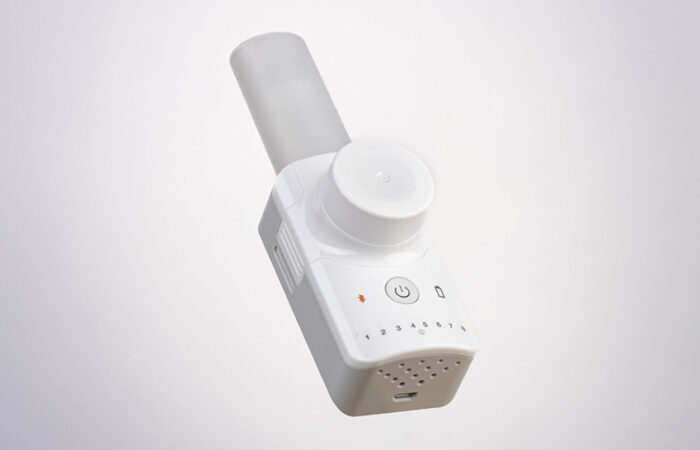
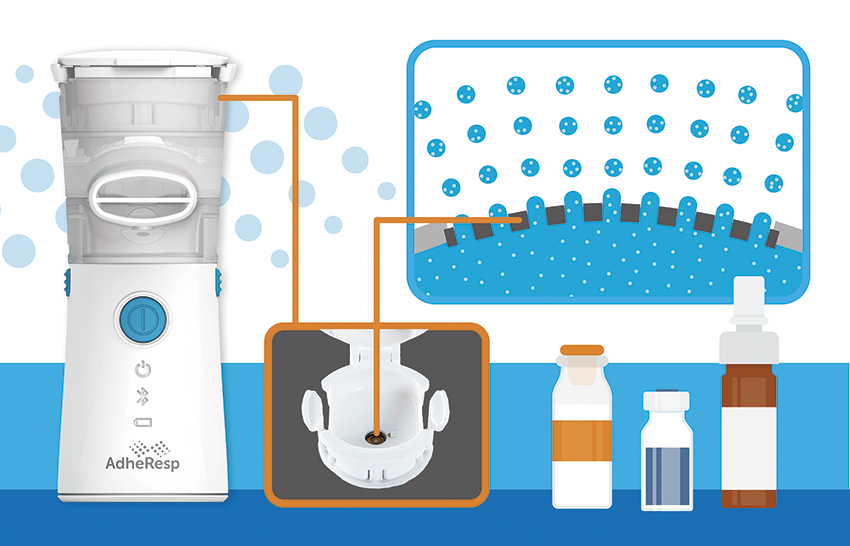
AdheResp received US FDA 510(k) clearance in June 2025 across several different configurations.1 The platform combines aerosol generated by a vibrating mesh with breath actuation, synchronising aerosol delivery with inspiration to reduce drug loss during exhalation. Bluetooth connectivity supports transmission of treatment data, while a lock-and-key activation system enables pairing with a specific medication.2
For combination product development, AdheResp’s flexibility encompasses hardware and firmware configurations, mesh pore size and driving power. These provide developers with options for balancing aerosol characteristics, output and delivery efficiency.

Figure 1: A lipid nanoparticle.
This flexibility is particularly relevant when two formulations require different approaches to aerosolisation. A viscous solution may require greater driving energy to initiate and sustain output, whereas a fragile LNP formulation may benefit from conditions that minimise the stress experienced during delivery (Figure 1).
DIFFERENT FORMULATIONS, DIFFERENT PRIORITIES
Elevated viscosity, including values above approximately 2.5 cP, can substantially restrict a liquid’s movement through a vibrating mesh. This is a practical development challenge rather than a universal threshold – performance also depends on surface tension, composition and mesh design. Reduced output can extend TT and, in some cases, prevent effective aerosol generation.
Higher driving power can help to overcome viscous resistance, while larger pores can facilitate liquid passage. However, these adjustments must also respect the integrity of the API. For sensitive biologics, improved output is valuable only if post-nebulisation quality and activity remain acceptable.
LNP-encapsulated messenger RNA (mRNA) presents a different challenge. Mechanical and interfacial stresses during aerosolisation can disrupt nanoparticle structure or alter cargo retention. Lower-energy delivery conditions may help to preserve sensitive formulations, but electrical power alone does not alleviate the stresses placed on LNPs.3 Mesh design, formulation composition and exposure duration also matter. The objective is therefore to identify operating conditions that preserve formulation quality while providing useful aerosol performance.
BALANCING AEROSOL SIZE, OUTPUT AND TREATMENT TIME
Alongside formulation integrity, developers often aim for a specific mass median aerodynamic diameter (MMAD) or aerodynamic particle size distribution to support delivery to the intended lung region (Figure 2). Mesh pore size and device power can influence both aerosol size and output rate (OR). Increasing OR can reduce TT, but larger pores may also generate larger droplets.
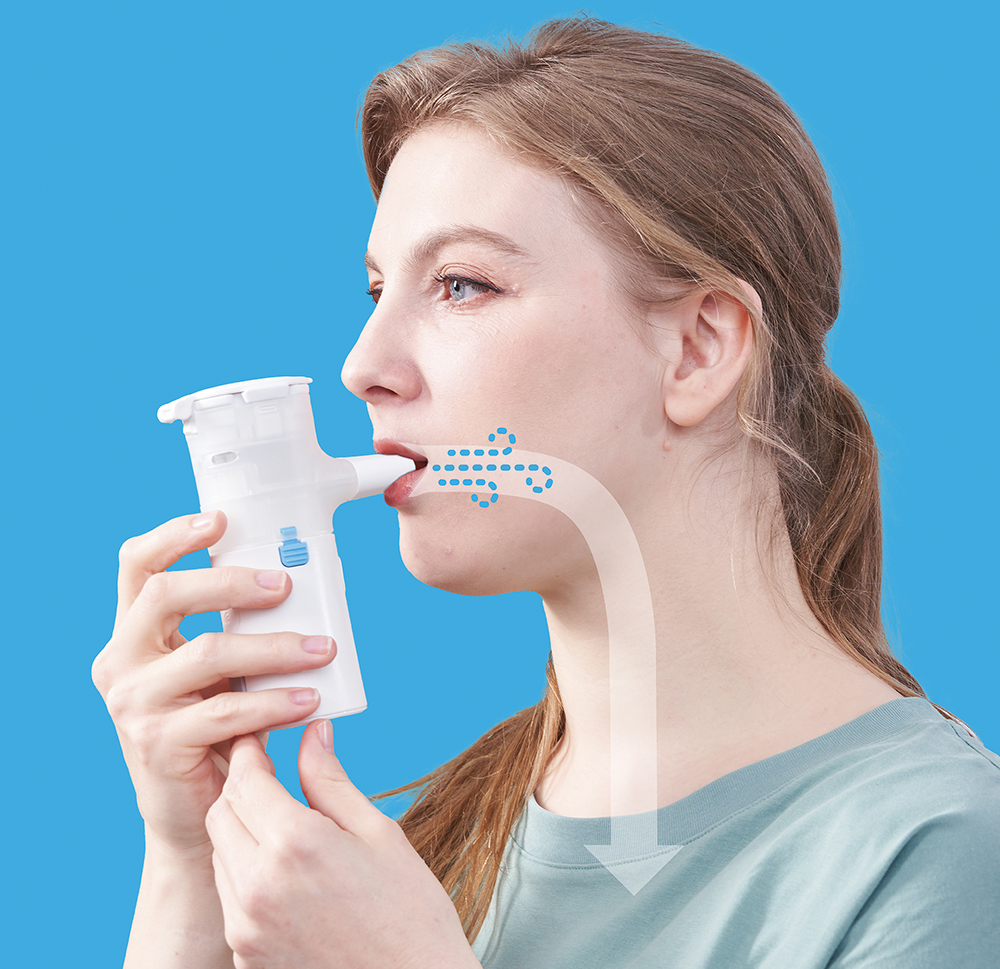
Figure 2: Delivery to the optimal lung region.
For breath-actuated operation, elapsed TT also depends on the breathing cycle. Consequently, continuous-mode OR should not be used directly to predict breath-actuated TT. Device screening should assess these parameters together, with laser diffraction characterising droplet size and cascade impaction establishing aerodynamic performance where required.
CASE STUDY 1: ADAPTING DELIVERY FOR ELEVATED VISCOSITY
An HCmed study evaluated three investigational AdheResp configurations operating at high power (HP) with a standard mesh, S03, and two larger-pore meshes, C01 and C02.4 Model formulations contained 0.1% albuterol sulphate and 10%, 20% or 30% sucrose in normal saline, providing viscosities spanning 1.26–2.86 cP. Tables 1 and 2 describe the resulting variations in treatment time and delivered dose.
| Sucrose (% w/w) |
Mesh | Power | TT (min) |
Delivered dose (mg) |
Delivered rate (mg/min) |
|---|---|---|---|---|---|
| 10 | S03 | HP | 04:55 ± 00:23 | 1.21 ± 0.04 | 0.25 ± 0.01 |
| 10 | C01 | HP | 02:50 ± 00:13 | 0.95 ± 0.04 | 0.34 ± 0.01 |
| 10 | C02 | HP | 02:13 ± 00:05 | 0.81 ± 0.07 | 0.37 ± 0.02 |
| 20 | S03 | HP | 05:59 ± 00:00 | 1.30 ± 0.02 | 0.22 ± 0.00 |
| 20 | C01 | HP | 03:35 ± 00:30 | 1.07 ± 0.09 | 0.30 ± 0.02 |
| 20 | C02 | HP | 03:11 ± 00:04 | 1.00 ± 0.04 | 0.32 ± 0.02 |
| 30 | S03 | HP | 18:53 ± 02:35 | 1.35 ± 0.02 | 0.07 ± 0.01 |
| 30 | C01 | HP | 06:06 ± 01:32 | 1.26 ± 0.04 | 0.21 ± 0.04 |
| 30 | C02 | HP | 05:57 ± 00:11 | 1.24 ± 0.04 | 0.21 ± 0.00 |
| 30 | C02 | UHP | 04:57 | 1.06 | 0.21 |
Table 1: Mesh and power selection: treatment time and delivered dose.
| Sucrose (% w/w) |
Mesh | Power | Dv50 (µm) |
Volume fraction <5 µm (%) |
Geometric standard deviation |
|---|---|---|---|---|---|
| 10 | S03 | HP | 4.03 ± 0.08 | 64.01 ± 1.58 | 1.73 ± 0.01 |
| 10 | C01 | HP | 5.73 ± 0.28 | 41.68 ± 2.93 | 1.80 ± 0.02 |
| 10 | C02 | HP | 6.52 ± 0.70 | 34.39 ± 6.37 | 1.80 ± 0.02 |
| 20 | S03 | HP | 3.66 ± 0.20 | 71.21 ± 4.27 | 1.59 ± 0.08 |
| 20 | C01 | HP | 4.70 ± 0.24 | 54.04 ± 3.33 | 1.72 ± 0.02 |
| 20 | C02 | HP | 5.09 ± 0.39 | 48.98 ± 5.02 | 1.72 ± 0.02 |
| 30 | S03 | HP | 2.97 ± 0.07 | 89.20 ± 4.29 | 1.48 ± 0.07 |
| 30 | C01 | HP | 3.97 ± 0.43 | 67.76 ± 8.49 | 1.59 ± 0.04 |
| 30 | C02 | HP | 4.31 ± 0.60 | 61.98 ± 11.36 | 1.59 ± 0.05 |
| 30 | C02 | UHP | 4.86 | 52.05 | 1.68 |
Table 2: Mesh and power selection: droplet size distribution.
Droplet size was measured by laser diffraction. Treatment time and delivered dose were assessed using a 1.5 mL fill and a standard adult breathing pattern (500 mL tidal volume, 15 breaths per minute and equal inspiratory and expiratory durations). Testing was performed in triplicate.
With the lowest-viscosity formulation, S03 produced a volume median droplet diameter (Dv50) of 4.03 µm, with a TT of 4 minutes 55 seconds and approximately 80% of the nominal loaded dose collected on the inhalation filter. At the highest viscosity, however, TT with S03 increased to 18 minutes 53 seconds.
Pairing the 2.86 cP formulation with the C02 mesh reduced TT to 5 minutes 57 seconds, while retaining approximately 83% delivered dose. The Dv50 was 4.31 µm, with approximately 62% of aerosol volume below 5 µm. These laser diffraction results describe droplet size, rather than MMAD or an aerodynamic fine particle fraction (FPF).
The results also demonstrate why the largest pore is not automatically the best option. With the lowest-viscosity formulation, C02 shortened TT to 2 minutes 13 seconds, but increased Dv50 to 6.52 µm and reduced the delivered dose to approximately 54%. Therefore, the appropriate configuration depends on the formulation and the required balance between speed, aerosol size and dose.
An additional exploratory run used an ultra-high-power (UHP) unit with C02 and a 30% sucrose formulation. Here, TT decreased from 5 minutes 57 seconds to 4 minutes 57 seconds, approximately 17% shorter than the original HP/C02 configuration.
However, the Dv50 increased from 4.31 µm to 4.86 µm, while the aerosol volume below 5 µm decreased from approximately 62% to 52%. Compared with the original data, this illustrates a potential trade-off between shorter treatment time, delivered dose and droplet size. More work is required before drawing firm conclusions about the benefits of increasing power.
Sucrose solutions provide useful models of elevated viscosity, but do not establish the stability of a complex biologic under equivalent conditions. Molecule-specific integrity and activity testing remain essential. Since completing this study, HCmed has also investigated biologic formulations with viscosities exceeding 3.2 cP, achieving good results with the HP base unit.
CASE STUDY 2: PRESERVING LNP CHARACTERISTICS DURING AEROSOLISATION
A study conducted by InhaTarget Therapeutics (Gosselies, Belgium), in collaboration with HCmed, examined AdheResp with empty LNPs, followed by an mRNA-loaded LNP formulation. These experiments used the standard-power (SP) unit in continuous operation, providing an initial assessment of mesh compatibility before subsequent breath-actuated evaluation. Tables 3 and 4 display these results.
| Mesh | OR (mL/min) |
Volume fraction <5 µm (%) | ||
|---|---|---|---|---|
| 1.30 mg/mL lipid concentration | 3.25 mg/mL lipid concentration | 6.50 mg/mL lipid concentration | ||
| Small | 0.30 | 68 | 65 | 65 |
| Medium | 0.41 | 60 | 59 | 59 |
| Large | 0.52 | 54 | 52 | 55 |
Table 3: Empty-LNP mesh screening with SP base unit and different LNP volumes.
| Assessment | Parameter | Reported result |
|---|---|---|
| LNP quality after 1 min | Encapsulation efficiency | Before: 99.5%; reservoir: 99.5%; collected aerosol: 99.4% |
| LNP quality after 1 min | Hydrodynamic diameter (Z-average) | Before: 213.5 nm; reservoir: 195.6 nm; collected aerosol: 192.7 nm |
| LNP quality after 1 min | Derived scattering count rate | Approximately 15% reduction reported; not a direct particle count |
| Laser diffraction | Dv50/volume below 5 µm | 4.1 µm/66% |
| NGI: 30 s | MMAD/FPF below 5 µm | 3.8 µm/65.5% |
| NGI: 60 s | MMAD/FPF below 5 µm | 3.8 µm/64.3% |
Table 4: mRNA-LNP quality and aerosol performance with SP base unit.
For empty LNPs at 1.30 mg/mL total lipid concentration, gravimetric OR increased from 0.30 to 0.41 and 0.52 mL/min across the small to medium and large meshes. Larger meshes also shifted the droplet size distribution towards larger diameters, as expected. Across three lipid concentrations, the volume fraction below 5 µm was approximately 65–68% with the small mesh and 52–55% with the large mesh.
Measurements of LNP size, dispersity and surface charge supported progression with the small mesh and SP base unit. The subsequent mRNA-LNP formulation contained 230 µg/mL mRNA and 5.29 mg/mL total lipid. It generated a Dv50 of 4.1 µm, with 66% of the aerosol volume below 5 µm.
After one minute of nebulisation, encapsulation efficiency was 99.4% in the collected aerosol, compared with 99.5% before nebulisation. The mean hydrodynamic diameter decreased from 213.5 nm to 192.7 nm. These observations support retention of encapsulation under the tested conditions, while highlighting the need to further investigate material recovery and compositional changes.
Aerodynamic testing used a cooled next-generation impactor (NGI) at 15 L/min, with a phospholipid tracer quantified by liquid chromatography–electrospray ionisation–mass spectrometry. Across three runs, MMAD was 3.8–3.9 µm and the reported FPF below 5 µm was 63.3–65.5%. These findings support the need for further development, including direct assessment of mRNA recovery, functional activity and performance during breath-actuated delivery.
HCmed has developed a low-power base unit, which is being studied with InhaTarget on different LNP compositions, with data to be shared next year.
“TOGETHER, THESE STUDIES ILLUSTRATE THE VALUE OF TREATING DEVICE CONFIGURATIONS AS AN ACTIVE DEVELOPMENT VARIABLE. FOR VISCOUS FORMULATIONS, MESH SELECTION AND SUFFICIENT DRIVING POWER CAN MAKE A SUBSTANTIAL DIFFERENCE TO AEROSOLISATION EFFECTIVENESS AND TREATMENT TIME.”
BUILDING THE FORMULATION-DEVICE PAIRING EARLY
Together, these studies illustrate the value of treating device configurations as an active development variable. For viscous formulations, mesh selection and sufficient driving power can make a substantial difference to aerosolisation effectiveness and treatment time. For LNP formulations, useful aerosol characteristics must be achieved alongside acceptable nanoparticle and cargo quality.
A practical development programme should screen mesh and power combinations against predefined targets for aerosol size, delivered dose, treatment time and post-nebulisation integrity. Promising configurations can then progress to testing under representative breathing conditions.
AdheResp’s customisable platform offers a means of exploring this balance early. As inhaled therapies become more complex, close collaboration between formulation and device teams will be central to translating promising molecules into practical treatments for patients.
REFERENCES
- “AdheResp Smart Breath-actuated Mesh Nebulizer, K250583”. US FDA, Clearance Letter, Jun 2025.
- “AdheResp”. Company Web Page, HCmed Innovations, accessed Oct 2026.
- van Rijn CJM et al, “Low energy nebulization preserves integrity of SARS-CoV-2 mRNA vaccines for respiratory delivery”. Sci Rep, 2023, Vol 13, art 8851.
- Cuevas Brun E et al, “Enhancing Delivery Performance of Viscous Solutions with a Customizable Breath-actuated Mesh Nebuliser Delivery Platform”. DDL Conf Proc, 2025, Vol 36, pp 253–256.