To Issue 193
Citation: Gandhi R, “What It Takes to Deliver Two Sprays: Lessons from Commercial BiDose™ Product Development”, ONdrugDelivery, Issue 193 (Nov 2026), pp 68–74.
Reenal Gandhi discusses Aptar Pharma’s dual-dose intranasal delivery device, BiDose™, explains how an integrated development approach is particularly relevant to dual-dose nasal delivery and presents two case studies showcasing how BiDose can be applied for different therapeutic applications.
Systemic nasal drug delivery is entering a new phase. Over the past decade, the intranasal route has expanded beyond its traditional role in local nasal therapies and emergency-use applications. Pharmaceutical companies are now evaluating intranasal drug delivery across central nervous system (CNS) disorders, psychiatric conditions, cardiovascular indications and an increasingly diverse range of acute and episodic treatment settings.
As these opportunities have expanded, so too have the demands placed on delivery systems. For many development programmes, the question is no longer simply whether a drug can be delivered via the nose – it is whether the resulting combination product can progress successfully through development, manufacturing and commercialisation.
At first glance, dual-dose nasal delivery can appear relatively straightforward: a delivery system provides two sprays rather than one. In practice, however, those two actuations introduce interconnected formulation, performance, usability, regulatory and manufacturing requirements.1
The delivery system must provide consistent performance across both actuations. The formulation must remain protected during storage and transportation. Users must understand the intended administration sequence. Regulatory submissions must include appropriate evidence for the finished combination product. Manufacturing processes must maintain the required performance as production scales up.
“SUCCESSFUL DUAL-DOSE INTRANASAL DELIVERY PRODUCTS SHOULD THEREFORE BE DEVELOPED AS COMPLETE COMBINATION PRODUCTS RATHER THAN AS FORMULATIONS PAIRED WITH DELIVERY SYSTEMS LATER ON IN THE PROGRAMME.”
Successful dual-dose intranasal delivery products should therefore be developed as complete combination products rather than as formulations paired with delivery systems later on in the programme. Formulation compatibility, analytical performance, product protection, administration clarity, manufacturing readiness and commercial considerations can all influence how a programme progresses.
Aptar Pharma’s BiDose™ System (BDS) was developed within this broader context. The established platform combines ready-to-use, primeless operation with two successive metered sprays, one-handed actuation and position-independent operation.2
Today, the platform continues to evolve. The latest BDS variant incorporates dose-status feedback and ergonomic refinements while building on the established foundation of the platform. This evolution reflects an important principle in drug delivery – experience should not simply validate a platform, it should inform its continued improvement.
The value of BiDose therefore extends beyond the physical delivery of two sprays. It draws on the technical knowledge, product-development insights and industrial experience accumulated through work on commercial programmes (Figure 1).
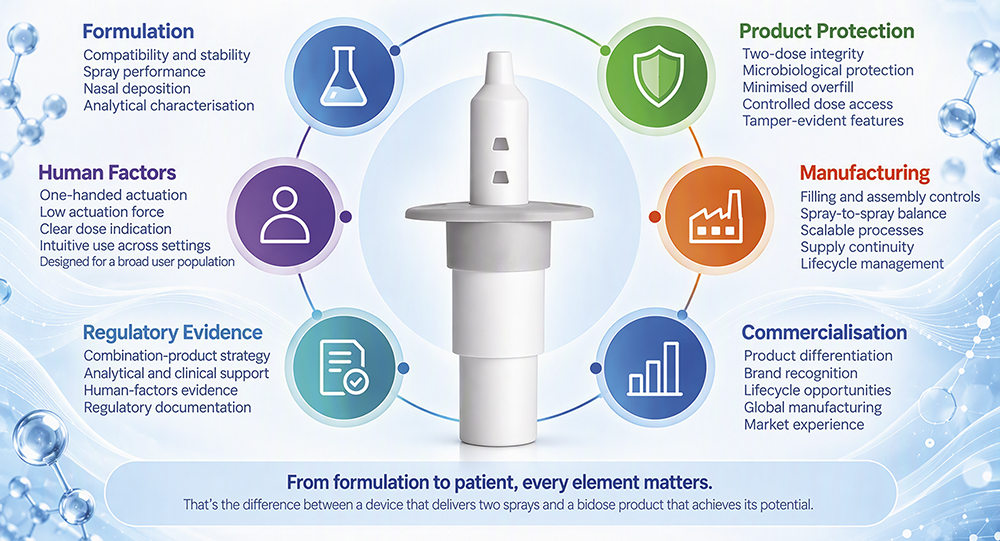
Figure 1: Delivering two sprays is only one part of dual-dose intranasal product development. Formulation, product protection, human factors, manufacturing, regulatory evidence and commercialisation must be considered as connected elements of the finished combination product.
DEVELOPING THE FORMULATION AND DELIVERY SYSTEM AS ONE PRODUCT
Combination product success rarely depends on the delivery system alone. A formulation may demonstrate promising characteristics during development yet behave differently once integrated with the selected delivery device. Delivered dose, spray pattern, plume geometry, droplet-size distribution, formulation stability and material compatibility can all influence the performance of the final drug product.
For this reason, Aptar Pharma approaches development from the perspective of the complete combination product, rather than considering the formulation and delivery system as independent workstreams. The company’s development capabilities include delivered-dose assessment, spray-characterisation studies, droplet-size analysis, nasal-cast investigations, compatibility assessments and development-scale filling.
These activities are not only intended to generate performance data but also to help identify the factors driving the observed results. When differences emerge during development, the objective is to understand the relationships between the formulation, delivery system and manufacturing process.
This integrated approach is particularly relevant to dual-dose nasal delivery. Two consecutive actuations create specific expectations around consistency and reproducibility across the intended administration sequence. Development programmes may therefore benefit from examining how formulation–system interactions could influence finished product performance before regulatory submission and commercialisation.
For programmes evaluating BiDose, this means considering the formulation, platform and associated processes together from an early stage. This can help teams to develop a more complete understanding of the finished combination product as the programme advances.
Some formulation challenges originate outside the delivery mechanism itself. Moisture sensitivity, oxygen exposure and long-term stability can influence product performance well before administration. Through its Active Material Science division, Aptar Pharma can help development teams investigate potential sources of product instability and evaluate appropriate product-protection strategies, including technologies such as Activ-Vial™, which is designed to help protect sensitive formulations from moisture and oxygen during storage. This creates a broader framework in which the formulation, protection technologies and delivery system can be considered together.
“AS PHARMACEUTICAL PIPELINES INCREASINGLY INCLUDE PEPTIDES, BIOLOGICS, OLIGONUCLEOTIDES AND OTHER HIGH-VALUE COMPOUNDS, THE CONVERSATION AROUND INTRANASAL DELIVERY IS EXPANDING BEYOND DOSE ADMINISTRATION ALONE.”
PROTECTING THE FORMULATION, DOSE BY DOSE
As pharmaceutical pipelines increasingly include peptides, biologics, oligonucleotides and other high-value compounds, the conversation around intranasal delivery is expanding beyond dose administration alone. Development teams are therefore paying closer attention to how efficiently valuable formulation is used during development, clinical manufacture and commercial supply.
One frequently overlooked consideration is overfill. Formulation retained within a delivery system beyond the intended administered dose must still be manufactured, filled, tested and supplied. As API value increases, the significance of this additional volume may also grow.
BiDose was designed with this consideration in mind. The system delivers two metered 100 µL actuations while limiting the amount of formulation that remains undelivered.2 For high-value or difficult-to-manufacture APIs, minimising non-delivered formulation can help to reduce unnecessary API consumption across development, clinical manufacture and commercial supply.
Where APIs are valuable or complex to produce, reducing the quantity committed to non-delivered volume may become an important consideration within the broader product strategy. In such cases, both the delivered dose and the volume that remains within the system warrant careful attention.
Product protection extends beyond API conservation. BiDose is designed to support formulation protection during storage and preserve the integrity of both doses until the point of use, an approach Aptar Pharma describes as two-dose integrity.
Another aspect of product protection concerns access to the formulation itself. Unlike multidose products that may contain larger volumes, BiDose was designed for applications in which one or two therapies are required for treatment. By limiting the quantity available within the delivery system to the intended treatment paradigm, the platform restricts access to excess drug product. By limiting the quantity of formulation available and helping to restrict direct access to the contained drug product, the BiDose design may be relevant to treatment strategies in which controlled access is an important consideration.
Aptar Pharma also highlights the relevance of this approach for compounds with abuse potential or products characterised by a narrow therapeutic index. By limiting the quantity of formulation available within the delivery system, the BiDose design may be appropriate for treatment strategies for which controlling access is essential. Its relevance is necessarily therapy-specific, but it reflects a broader principle: product protection involves both preserving formulation quality and aligning access to the drug product with the intended treatment strategy.
PLATFORM EXPERIENCE DRIVES CONTINUED EVOLUTION
The most significant aspect of the latest variant of the BDS is not any single feature but what the refinements collectively represent. The platform now incorporates an integrated status-indication system, which has been designed to provide clearer visibility of system status during use and can help healthcare professionals to understand the actuation status of the system.
Two visual windows provide dose-by-dose status feedback during administration. After each actuation, the corresponding indicator changes colour, helping the user recognise that an actuation has occurred and see whether the second spray remains available.
This focus on administration clarity reflects the environments in which many nasal products may be used – patients may manage symptoms outside the clinic, caregivers may need to administer treatment to another person and healthcare professionals may have limited time for instruction. In these situations, clear information about the status of the delivery system can become an important part of the product experience.
Following the first actuation, the button automatically releases, leaving the system ready for the second spray. Both actuations follow a similar administration sequence, with no initial or intermediate priming required. The actuation force for both sprays is intended to support use across a broad user population. Additional refinements include an enlarged finger flange, a narrower nasal tip and a coloured container-holder element supporting the status-indication system. These changes were introduced while maintaining targeted specifications for shot weight, spray pattern, droplet-size distribution and trigger force consistent with previous platform generations (Figure 2).

Figure 2: BiDose design refinements support administration clarity and product interaction, including actuation-status feedback and ergonomic features intended to support handling.
Together, these user-interface, ergonomic, design and process refinements build on the established BiDose platform rather than introducing a new two-spray concept. They are intended to support administration clarity, a consistent user interaction and reliable operation across the two-actuation sequence, illustrating how an established platform can evolve as development, manufacturing and commercial knowledge accumulates.
MANUFACTURING INSIGHT BUILT THROUGH COMMERCIAL EXPERIENCE
BiDose has supported marketed intranasal delivery devices across distinct therapeutic settings. This commercial presence provides practical insight into the requirements that emerge as a dual-dose intranasal device progresses from development through scale-up and commercial manufacture.
Experience across commercial programmes has shown that delivering two sprays with the intended performance profile is only one part of the challenge. Manufacturing readiness also requires reproducibility, appropriate filling and assembly controls, supply continuity and lifecycle planning. These considerations must be addressed alongside formulation and delivery system performance as part of the finished combination product.
A two-spray delivery platform must be integrated into production processes designed to maintain the required performance across manufacturing campaigns and throughout the commercial life of the product. As production scales, filling parameters, component assembly and process controls can all influence the performance of the finished product.
Aptar Pharma’s experience in supporting commercial nasal drug delivery devices has shown that performance across two sprays depends not only on delivery-system architecture but also formulation filling, component assembly and manufacturing process controls. Although BiDose is designed to support consistency between actuations, variability can create challenges during development and performance evaluation. By evaluating the formulation, delivery system and filling process together, development teams can better understand potential sources of variability and establish a more informed control strategy for filling and assembly.
This helps to explain why Aptar Pharma’s contribution can extend beyond supplying the delivery system. Development-scale filling, spray-performance testing, compatibility investigations and root-cause analysis can help teams to examine the interactions between formulation, process and device performance.
Through internal expertise and collaboration with service providers, including CDMOs and CMOs, Aptar Pharma can support programmes from early development and clinical manufacture through to commercial production. This framework gives developers access to BiDose alongside broader development and manufacturing support as their development programmes advance.
APTAR PHARMA’S BDS PLATFORM IN PRACTICE
The following examples illustrate two distinct applications: a customised BiDose configuration for a CNS therapy and the integration of the BDS platform into a broader product solution for cardiovascular care. Together, they demonstrate how the same underlying platform can be configured and supported around different product profiles, although each programme requires its own development and supporting evidence.
From a Two-Dose Requirement to Commercial Reality
The development of a marketed esketamine nasal spray provides a practical example of how a specific set of dosing and use requirements was addressed through a customised BiDose configuration. The programme called for two accurate, sequential doses, with one administered into each nostril and no initial or intermediate priming. The product also needed to support self-administration with minimal training.3 In the US, the marketed product is self-administered under the supervision of a healthcare professional.
Meeting these requirements involved more than selecting a two-spray delivery system. Dose accuracy, plume projection and droplet size were evaluated and optimised as part of the development programme, which combined the customised BiDose liquid configuration, the formulation and the requirements of the finished combination product.3
Aptar Pharma’s contribution extended across several areas documented in the published case study, including product development, pharmacokinetic studies, regulatory support, operational excellence, continuous improvement, lifecycle management and risk management. The programme also drew on Aptar Pharma’s analytical laboratories, research facilities and manufacturing capabilities.3
Manufacturing considerations were incorporated from the outset. One programme objective was to develop a configuration optimised for high-volume production, bringing manufacturing requirements into the customised BiDose configuration alongside dose delivery, spray performance and intended-use requirements.3
The programme provides a practical example of how two-dose administration, drug-product performance, supervised self-administration and high-volume production requirements can be addressed around a customised BiDose configuration.
Experience from one programme does not replace the product-specific evidence required for another. It can, however, provide a more informed basis for identifying the formulation, performance, use and manufacturing questions that need to be addressed.
Extending BiDose into Cardiovascular Care
More recently, BDS has supported a product in a distinctly different therapeutic setting: cardiovascular care. Milestone Pharmaceuticals’ (Montreal, Canada) CARDAMYST™ (etripamil) uses Aptar Pharma’s BDS platform. The product received US FDA approval for the conversion of acute symptomatic episodes of paroxysmal supraventricular tachycardia to sinus rhythm in adults. This commercial milestone extended Aptar Pharma’s BiDose experience into cardiovascular care.4
The clinical development programme evaluated self-administered intranasal etripamil using a symptom-prompted repeat-dose regimen for atrioventricular-nodal-dependent paroxysmal supraventricular tachycardia.5 Separate clinical pharmacology studies characterised the pharmacokinetic and pharmacodynamic profile of intranasally administered etripamil and reported rapid absorption under the study conditions.6
Aptar Pharma’s Active Material Science division collaborated with Milestone Pharmaceuticals to develop the customised polypropylene dual-container closure system used for CARDAMYST. The solution incorporates Activ‑Vial technology to help protect the product from moisture and oxygen during storage. The protective presentation securely houses two BiDose units and includes an integrated cap, with features intended to help prevent accidental activation or the devices from falling out of the container while supporting reliable access when treatment is required.4
The CARDAMYST programme therefore illustrates how BiDose, Activ‑Vial technology and a customised protective presentation can be brought together within a wider product solution, with delivery, product protection and the intended-use environment considered as connected elements.
FROM FEASIBILITY TO COMMERCIAL REQUIREMENTS
Experience across these programmes shows how the questions change as development advances. During feasibility, the central question may be whether two doses can be delivered with the required spray characteristics. As a programme progresses, the focus broadens. Teams must consider:
- How formulation and delivery-system performance will be maintained
- Which filling and assembly controls may be required
- How the administration sequence will be communicated
- How the system will be protected within the finished product presentation
- What analytical, human factors and regulatory evidence will be needed
- How production and scale-up requirements will be addressed.
These are not secondary considerations. They are part of the work required to progress a two-dose intranasal concept towards a commercial combination product.
The esketamine and CARDAMYST programmes illustrate different dimensions of this journey. One demonstrates the depth of development behind a customised two-dose CNS product intended for high-volume manufacture, while the other shows BiDose entering a cardiovascular setting as part of a broader protective product solution.
Together, they provide important evidence for the continued evolution of BDS. New variants are not intended to redefine dual-dose nasal delivery – they represent the evolution of an established Aptar Pharma platform, incorporating refinements informed by product development, manufacturing and commercial programmes.
DIFFERENTIATION THROUGH THE COMPLETE PRODUCT EXPERIENCE
In competitive pharmaceutical markets, differentiation rarely comes from the drug product alone. It can also emerge from how the formulation, delivery system, packaging, usability and product presentation are brought together into a coherent experience.
For dual-dose intranasal delivery systems, this broader perspective is particularly relevant. Two-spray delivery creates opportunities to reconsider how a product is configured, presented and administered. Rather than treating the delivery system as a standalone component, developers can evaluate how it contributes to the overall product proposition.
“BIDOSE OFFERS OPPORTUNITIES FOR CUSTOMISED CONFIGURATIONS, ERGONOMIC ADAPTATION AND DIFFERENTIATED PRODUCT CONFIGURATIONS.”

Figure 3: The interaction between the user and the delivery system forms part of the overall product experience.
BiDose offers opportunities for customised configurations, ergonomic adaptation and differentiated product configurations. Recent platform enhancements continue this evolution through visible actuation-status feedback and ergonomic refinements intended to support the user experience.
Differentiation, however, extends beyond the appearance of the delivery system. Products sharing similar APIs, therapeutic targets or mechanisms of action may also be distinguished through their overall configuration and the way users interact with them. In this context, customisation may contribute to product recognition and a more distinctive experience for patients and healthcare professionals (Figure 3).
This approach may be particularly relevant to lifecycle-management programmes, repurposed molecules and when seeking a differentiated product position. Reformulation, changes to the route of administration and delivery platform selection can all contribute to a new product proposition.
Aptar Pharma supports these efforts through drug-repositioning and lifecycle-management expertise intended to help developers explore additional opportunities for existing assets. Innovation is not limited to discovering a new molecule – it can also involve reconsidering how an established molecule is formulated, delivered and experienced.
The use of a proprietary delivery platform may also contribute to the intellectual property strategy surrounding the finished drug product. The implications are necessarily programme-specific, but platform differentiation and intellectual property considerations may introduce an additional dimension when evaluating long-term commercial strategy.
Differentiation should therefore not be regarded solely as an aesthetic exercise. The value of a dual-dose intranasal delivery platform should be considered in the context of the complete product experience and the wider development and commercial strategy.
COMMERCIALLY ESTABLISHED, CONTINUING TO EVOLVE
Intranasal drug delivery continues to expand across therapeutic areas, molecule classes and treatment paradigms. As these opportunities develop, expectations of dual-dose intranasal delivery platforms are also evolving.
Aptar Pharma’s BDS platform has progressed through experience spanning marketed products, combination product development and commercial manufacture. Its latest variant represents the next stage in that progression, incorporating actuation-status feedback and ergonomic refinements while building on the established platform foundation.
Discussions around dual-spray delivery often begin with the actuations themselves. Commercial combination products, however, are shaped by everything surrounding them, including formulation compatibility, product protection, usability, manufacturing processes, evidence generation and commercial execution.
Ultimately, the future of dual-dose intranasal delivery will not be shaped by delivery systems alone. It will depend on how effectively developers bring together formulation, delivery-system performance, patient and user needs, manufacturing strategy, regulatory planning and commercial objectives.
For programmes where two-spray delivery aligns with the intended product profile, Aptar Pharma’s BDS brings together an established platform, commercial experience and integrated development capabilities. While delivering two sprays is only the starting point, the real value lies in the knowledge required to help translate a dual-dose strategy into a finished combination product.
REFERENCES
- Gandhi R, “Why Aptar Pharma’s BiDose™? Expanding Opportunities in Systemic Nasal Drug Delivery.” Web Page, Aptar Pharma, 2026.
- “BiDose™ Liquid Nasal Spray System product information”. Web Page, Aptar Pharma, accessed Oct 2026.
- “Case Study: Bidose Nasal Spray Pump for Depression”. Web Page, Aptar Pharma, accessed Oct 2026.
- “Aptar’s Bidose Nasal System Delivers CARDAMYST™ (etripamil), the First and Only Self-Administered FDA-Approved Nasal Spray for Paroxysmal Supraventricular Tachycardia (PSVT)”. Press Release, Aptar Pharma, Dec 2025.
- Stambler BS et al, “Self-administered intranasal etripamil using a symptom-prompted, repeat-dose regimen for atrioventricular-nodal-dependent supraventricular tachycardia: the RAPID trial”. Lancet, 2023, Vol 402(10396), pp 118–128.
- Ip JE et al, “Pharmacokinetics and pharmacodynamics of etripamil, an intranasally administered, fast-acting, nondihydropyridine calcium channel blocker”. Clin Pharmacol Drug Dev, 2024, Vol 13(4), pp 367–379.