To Issue 190
Citation: Rufer S, Mishra P, “High-Concentration, High-Viscosity Delivery with Core-Annular Flow”, ONdrugDelivery, Issue 190 (Sep/Oct 2026), pp 54–58.
Dr Simon Rufer and Pratik Mishra introduce CoFlo Medical’s core-annular flow platform, which promises to eliminate the long-standing viscosity bottleneck for needle-based delivery. The company’s platform enables high-concentration, high-viscosity delivery for existing formulations without the need for reformulation or new compounds in a patient-friendly form.
Viscosity has historically constrained drug delivery and, consequently, upstream drug development. High-concentration therapies designed to fit within the limited subcutaneous volume highly viscous. Above 50 cP, the force required to push the viscous product through standard needles becomes excessive, and drug developers must turn to alternative approaches, each with their own trade-offs.1–3
Reformulation with viscosity-reducing excipients or as a non-aqueous microparticle suspension typically adds development, manufacturing and regulatory complexity, which can extend programme timelines and cost. Increasing the acceptable dosing volume with the use of recombinant human hyaluronidase or on-body injectors can affect the patient experience, as large volumes are often associated with longer delivery times, additional user steps and greater injection site discomfort. High-power gas or electromechanical drive mechanisms capable of overcoming high viscosity tend to increase device complexity and can expose the drug product to elevated shear during delivery.
In an attempt to avoid these viscosity-driven delivery challenges entirely, modern drug developers often implement selection criteria during drug discovery and development to screen out potential high-viscosity candidates. Unfortunately, this could force as many as 20% of early drug candidates to be abandoned,4,5 sacrificing potentially efficacious high-viscosity compounds.
“CoFlo HAS DEMONSTRATED A 100-FOLD REDUCTION IN INJECTION FORCE COMPARED WITH CONVENTIONAL DEVICES, ENABLING FORMULATIONS UP TO 400 mg/mL AND 1,000 cP.”
BREAKING THE INJECTABILITY BARRIER WITH CORE-ANNULAR FLOW
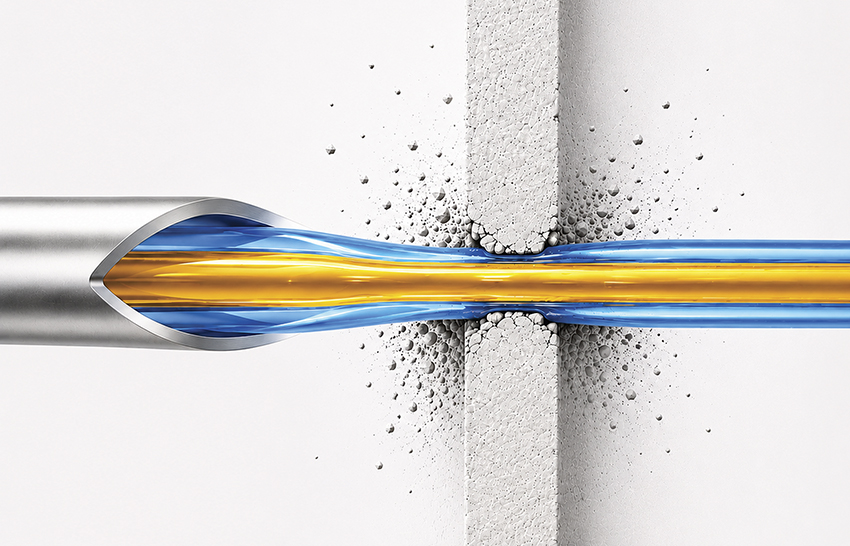
In injectable drug delivery, the narrow needle presents the highest fluidic resistance, making it the physical bottleneck that prevents high-viscosity drug delivery. CoFlo’s technology alleviates the needle’s resistance by creating a core-annular flow (CAF) within the needle. As shown in Figure 1, the viscous drug travels as the core and is shielded from the needle wall by a sheath of lower-viscosity fluid. Because the viscous drug never comes into contact with the needle wall, the injection pressure is dramatically lower than what the Hagen-Poiseuille equation would predict for the drug alone. In fact, the injection pressure with CAF depends only on the viscosity of the sheath fluid and is agnostic to the drug’s viscosity.6
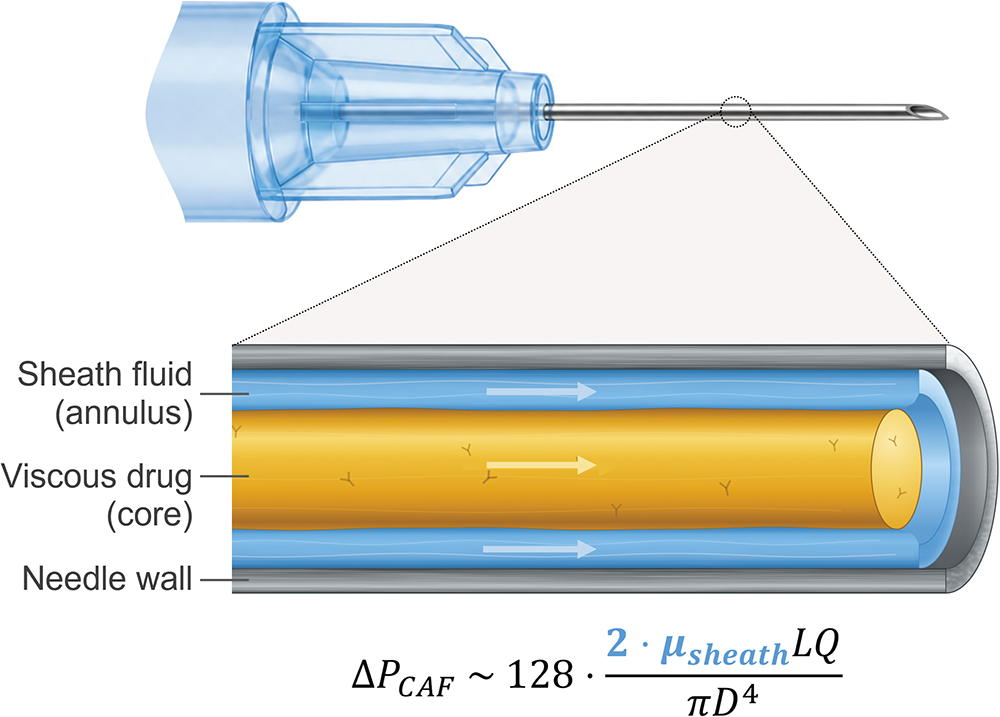
Figure 1: In CAF, the sheath fluid shields the viscous drug from the needle wall, so the injection pressure is a function of the sheath fluid’s viscosity instead of the drug’s viscosity. L is the needle length, Q is the flow rate and D is the needle diameter.
As a result, CAF makes extremely viscous formulations injectable at a very low force, as shown in Figure 2. CoFlo has demonstrated delivery of a 2 mL, 800 cP mimic solution in 20 seconds through a 27G TW needle with less than 20 N of force – a 100-fold reduction in injection force when compared with a conventional device (Figures 2 & 3). Since flow rate scales directly with applied force, CAF’s force reduction leaves substantial headroom for even faster injections with only a modest increase in user-applied force. This approach opens the door to high-concentration formulations that would have otherwise been impossible to deliver. CoFlo has demonstrated a 100-fold reduction in injection force compared with conventional devices, enabling the injection of monoclonal antibody (mAb) formulations up to 400 mg/mL and 350 cP, and suspensions of up to 500 mg/mL and greater than 1,000 cP.
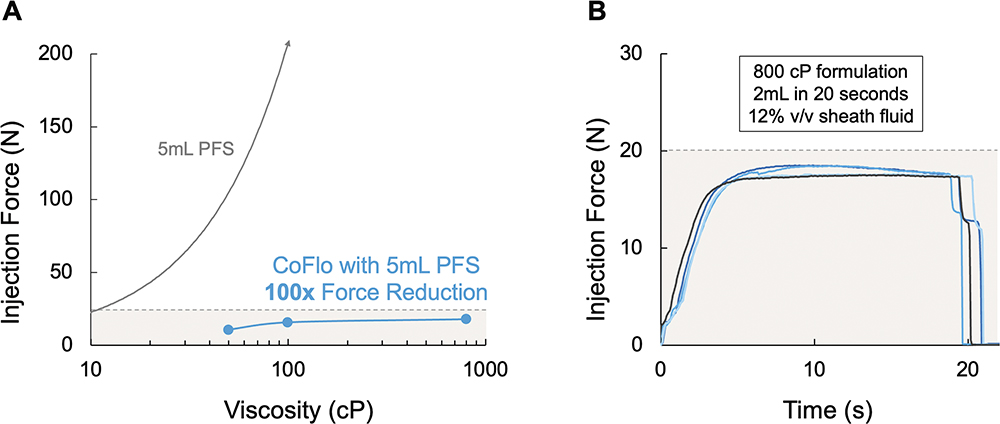
Figure 2: Injectability data for a 2 mL delivery in 20 seconds through a 27G thin-wall ½” needle. A) CoFlo’s CAF reduces injection force 100-fold compared with conventional syringes, unlocking high-viscosity delivery. B) Injection force profiles at <20 N collected with a CoFlo device.
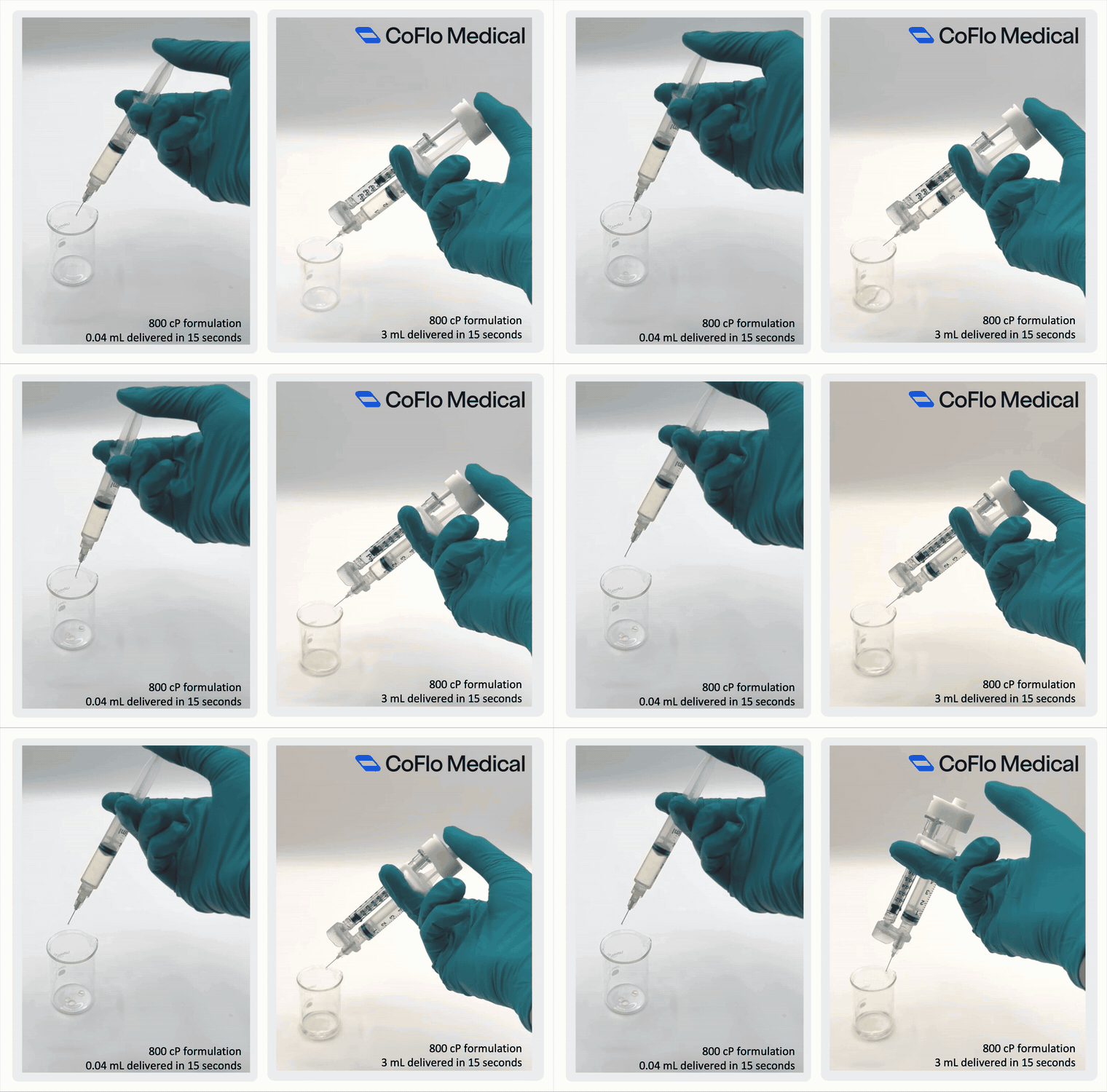
Figure 3: An 800 cP formulation is nearly impossible to inject via a standard 27G thin-wall needle. With 12% v/v saline sheathing fluid, CAF unlocks rapid injectability for the same formulation and needle. Here, the CO-AXL hub adapts disposable syringes for a vial presentation.
Formulation Flexibility: No Reformulation or New Compounds
CoFlo’s CAF platform is engineered to provide maximum flexibility for the sheath fluid. The sheath fluid can be a wide range of low-viscosity fluids that are at least transiently compatible with the drug. Commonly used fluids include the drug’s own buffer solution, saline, a second API or even an enzyme-active formulation such as hyaluronidase. The sheath fluid can be limited to as little as 10% of the total injected volume while still delivering the force-reduction benefit of CAF. As a result, no new chemical or biological entity needs to be introduced to achieve CAF’s benefits – the sheath fluid can simply be a component already present in the formulation.
“THE DRUG PRODUCT ITSELF DOES NOT NEED TO BE REFORMULATED FOR THE CAF APPROACH, KEEPING HIGH-DOSE FORMULATION COMPLEXITY DELIVERY TO A MINIMUM.”
The drug product itself does not need to be reformulated for the CAF approach, keeping high-dose formulation complexity to a minimum. In fact, removal of the viscosity constraint from the formulation development phase may even open the excipient design space, promoting faster development of more stable formulations. The introduction of the sheath fluid can also protect the drug product from shear-induced damage, as the sheath separates the drug from the needle wall, where shear stress is highest.
CoFlo’s UNIVERSAL CO-AXL HUB
CoFlo has developed a universal CO-AXL needle hub that adapts two syringes to create the CAF in the needle, as shown in Figure 3. One syringe is filled with the viscous drug product, and the other syringe is filled with the sheath fluid. The CO-AXL hub’s design preserves primary container flexibility with ISO 80369-compliant Luer ports that are compatible with any Luer-lock prefilled syringe (PFS) or disposable syringe. Several technical innovations have led to this universal hub design that can accommodate a wide range of drug viscosities, volumes, formulations and primary containers (Table 1).
| Parameter | Platform Capability |
| Drug viscosity | 1 to >1,000 cP |
| Drug volume | 0.05–10 mL |
| Sheath fluid fraction | As low as 10% of total injected volume |
| Injection force | Target <20 N |
| Primary container | Any Luer-lock syringe – glass, cyclo-olefin polymer or co-polymer, or disposable plastic |
| Needle | 29G extra-thin-wall and larger |
| Injection route | Subcutaneous, intravitreal or intramuscular |
| Drug formulation | Biologics (antibodies, proteins, etc) |
| Suspensions and gels (particles, cells, lipid nanoparticles) | |
| Small molecules | |
| Shear-sensitive compounds | |
| Sheath fluid formulation | Drug’s own buffer solution |
| Saline for injection | |
| Second API | |
| Enzyme-active formulation (e.g. hyaluronidase) |
Table 1: CoFlo double-barrel device platform scope.
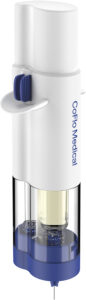
Figure 4: Prefilled double-barrel delivery system for patient self-administration at home. The user steps mirror a conventional prefilled syringe.
CoFlo’s CO-AXL hub can enable quick-to-clinic timelines for drug products in a vial presentation using disposable plastic syringes that are connected to the universal hub, as shown in Figure 3. This opens the opportunity for quick-to-clinic timelines and physician-administered use. In an early exploratory usability evaluation, 12 first-time lay users with no prior self-injection experience or training successfully completed the full syringe filling, connection and delivery sequence on their first attempt using only the instructions for use.
CoFlo has integrated the CO-AXL hub into a user-friendly double-barrel CAF device that accommodates prefilled syringes (Figure 4). It is optimised for patient self-administration and its use steps mirror those of a single conventional prefilled syringe.
Demonstrated Performance De-Risks Combination Product Co-Development
Through partnerships with global pharmaceutical companies, CoFlo has demonstrated high-viscosity injectability of clinical and marketed drug formulations spanning monoclonal antibodies, small molecules and suspensions. These studies have verified injection force performance, dose accuracy, the absence of shear-induced damage or aggregation and controlled subvisible and visible particulate levels. Ex vivo feasibility data have also shown that CAF remains functional and stable when delivered into human subcutaneous tissue, not just in a bench fixture.
CoFlo has established a platform framework for the requirements, risks and testing needed to demonstrate device and combination product safety and efficacy. The CO-AXL hub is produced via injection moulding with standard materials and is a low-part-count component, supporting rapid manufacturing scale-up. Together, this technical and regulatory foundation de-risks the co-development pathway required to bring a combination product with the CO-AXL hub to clinical use.
“CoFlo GIVES DRUG DEVELOPERS BACK THE FREEDOM TO OPTIMISE THERAPIES AROUND THE PATIENT AND THE MOLECULE, RATHER THAN THE LIMITS OF THE NEEDLE.”
SUMMARY: OPPORTUNITIES WITHOUT THE VISCOSITY CONSTRAINT
With injection force decoupled from drug viscosity, CoFlo’s CAF platform opens up the potential for a new regime of streamlined injectability for formulations up to 400 mg/mL and >1,000 cP. Key opportunities for clinical and marketed drug programmes include:
- Dual-drug delivery
- Intravenous-to-subcutaneous transition for high-dose drugs (>300 mg)
- Less frequent dosing and faster delivery for existing subcutaneous and intravitreal therapies
- Next-generation drug candidates developed without viscosity restrictions.
CoFlo gives drug developers back the freedom to optimise therapies around the patient, rather than the limits of the needle.
REFERENCES
- Robinson TE et al, “Filling the Gap: A Correlation between Objective and Subjective Measures of Injectability”. Adv Healthc Mater, 2020, Vol 9(5), art e1901521.
- Barichello E, Sutton C N, “Proving the Design Space: Advancing the Development of Syringe-Device Combinations”. ONdrugDelivery, Issue 178 (Oct 2025), pp 10–15.
- Fontanellaz T, Jost R, Schneider S, “Subcutaneous Drug Delivery: Adapting to High-Viscosity, Large-Volume Demands”. ONdrugDelivery, Issue 166 (Oct 2024), pp 8–12.
- Kingsbury JS et al, “A single molecular descriptor to predict solution behavior of therapeutic antibodies”. Sci Adv, 2020, Vol 6(32), art eabb0372.
- Wei Y et al, “Improved Diffusion Interaction Parameter Measurement to Predict the Viscosity of Concentrated mAb Solutions”. Mol Pharm, 2023, Vol 20(12), pp 6420–6428.
- Jayaprakash V et al, “Enhancing the Injectability of High Concentration Drug Formulations Using Core Annular Flows”. Adv Healthc Mater, 2020, Vol 9(18), art e2001022.